If you have ever opened a +EV betting tool, seen dozens of bets scrolling down the page, and had no idea which ones to actually fire, this walkthrough is for you. Portfolio EV is built to answer exactly that question. Instead of guessing which markets, books, and sports are worth your money, you build a "portfolio" from OddsShopper's tracked betting results and let the tool feed you only the bets that fit it.
I will go through the whole setup the same way I run it for myself: build a portfolio, trim it to the markets that have actually held an edge, turn on alerts, place a bet straight from the tool, and then read the one number that tells you whether you are really winning.
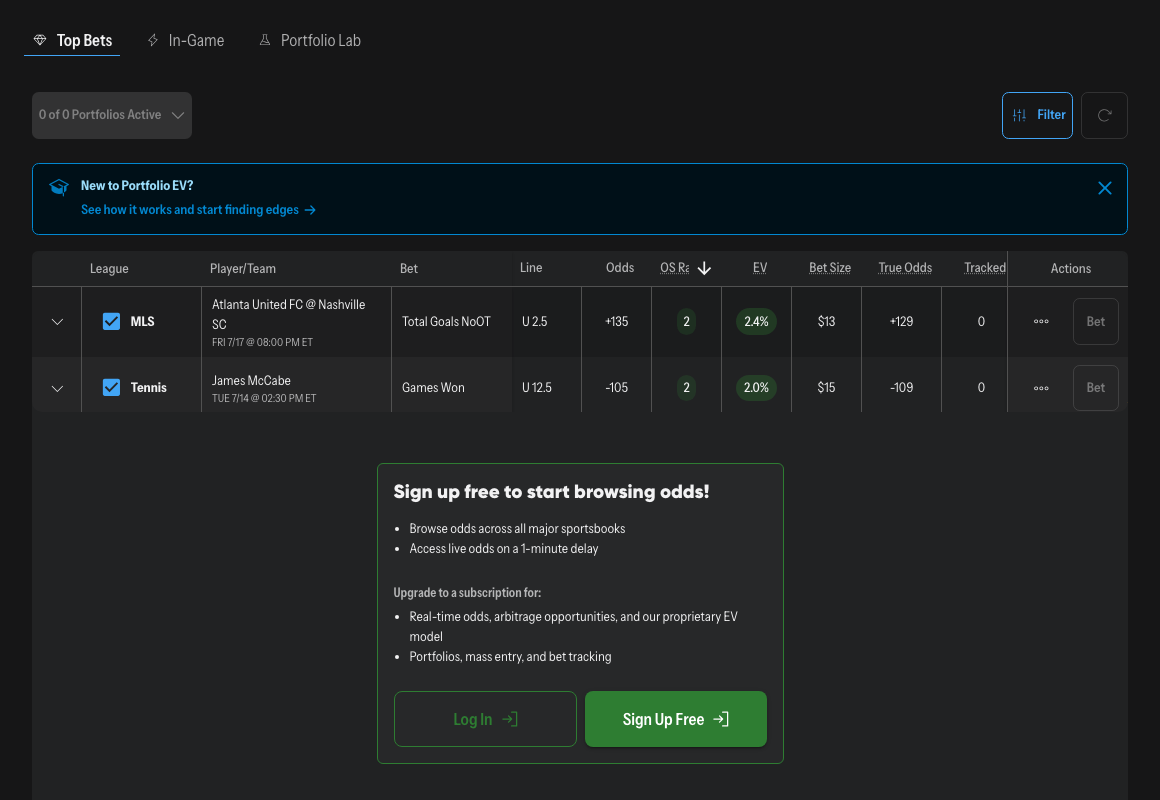
The OddsShopper +EV Screen.
In Summary
- Portfolio EV Turns Thousands Of Tracked +EV Bets Into A Filtered Feed You Can Trust. You decide the sports, books, and markets; the tool surfaces only the bets that match.
- The "Lab" Shows OddsShopper's Real Tracked Results — Good, Bad, And Ugly. That transparency is the whole point: you build around the markets that have beaten the closing line, not the ones you hope will.
- Start With A Min OS Rating Of 2 And The Current-Season Timeframe. Recent samples matter because books re-price markets month to month.
- Prune The Markets You Are Not Beating. In the worked example below, dropping a few weak markets moved a DraftKings NBA portfolio from a 2.33% to a 5.27% tracked ROI.
- Turn On App Notifications And Track Every Bet. Alerts get you the best available number; the CLV readout tells you if your process is +EV.
Watch: How To Use OddsShopper Portfolio EV
Here is the full walkthrough on video if you would rather follow along click by click. Watch on YouTube.
What Portfolio EV Actually Does
Quick context before the clicks. A positive expected value (+EV) bet is one priced in your favor versus the true, no-vig market price, so over a large sample it should make money even though any single bet can lose. Portfolio EV takes that idea and scales it: rather than chasing one bet at a time, you spread your bankroll across many small +EV bets so variance shrinks and your results track the edge. For the full concept, read our companion guide on what Portfolio EV is and why it works; this article is the hands-on version of operating the tool.
The key thing that separates this from a generic bet finder is the data underneath it. Every bet the tool has recommended is tracked across sportsbooks and markets, and those results are shown to you openly. That is what lets you build around what has worked instead of a hunch.
The split of labor is what makes it usable. You set the boundaries; the tool does the scanning, the sizing, and the bookkeeping:
| You Decide | Portfolio EV handles |
|---|---|
| Which Sportsbooks To Bet | Scanning every book for +EV prices |
| Which Sports And Markets To Include | Surfacing only the bets that fit your portfolio |
| Min OS Rating And Timeframe | Recommended bet sizing for your bankroll |
| When To Place A Bet | Loading the bet slip, alerting you, tracking CLV |
Step 1: Build Your First Portfolio
When you land on the Portfolio EV homepage, the first thing you see is a prompt to create your first portfolio. Start there. Press Create a new portfolio and the tool loads OddsShopper's tracked betting results across every sportsbook and every market. It takes a few seconds to populate.
This view is the foundation for everything else. You are not picking bets yet; you are deciding the universe of bets you want the tool to watch for you.
Step 2: Filter To The Books, Sports, And Markets You Actually Beat
Now you narrow it down. In the example I will use a DraftKings 🎁 NBA portfolio, since NBA is in season and gives you a steady supply of bets.
- Open Sportsbooks, unselect everything, and select just DraftKings.
- Open Leagues and select NBA.
- You now see every market OddsShopper has tracked on DraftKings NBA, with the option to sort by ROI or by profit.
The profit column assumes you were betting the tool's recommended bet sizes for your bankroll across those markets, so it reflects how each market has actually performed rather than a guess.
The honest part is what happens when you scroll to the bottom of the ROI sort. Some markets have not been beaten. In the walkthrough, rebounds was a loser, so it comes out. Removing it alone moved the portfolio from a 2.33% to a 3.78% tracked ROI. Drop the other markets that have not held an edge (rebounds-and-assists and points-and-assists in this case) and the rest of the board has been profitable on the season.
Here is how that pruning looked, step by step:
| Portfolio State | Tracked bets | Tracked ROI |
|---|---|---|
| All DraftKings NBA Markets (Current Season) | ~3,100 | 2.33% |
| After Removing Rebounds | — | 3.78% |
| After Removing Weak Assist Markets | ~2,200 | 5.27% |
You are not deleting data or hiding losses; you are choosing to concentrate your action in the markets where the tracked edge has actually shown up. Past tracked ROI is not a promise of future results, but building around proven markets is a far better starting point than spreading your bankroll evenly across everything.
New to OddsShopper?It scans 100+ sportsbooks and flags the bets priced in your favor, then lets you build a portfolio around the exact markets that have held an edge. You can try it free for 7 days, and code EV20 takes 20% off OS Pro or OS Core if you subscribe. Start your free trial
Step 3: Set The Min OS Rating And Timeframe
Two settings shape the quality and relevance of what you build on.
Min OS rating. Start at a minimum OS rating of 2. That is the recommended baseline; it keeps the portfolio focused on bets with a meaningful edge rather than razor-thin ones.
Timeframe. A couple of weeks into a season there is usually enough data to select current season rather than leaning on prior years. This matters because sportsbooks adjust their pricing month over month and year over year, so recent samples describe the books you are actually betting into today. Just keep an eye on sample size. You do not want to make decisions off ten tracked bets; the DraftKings NBA example above had a couple thousand, which is a sturdier base.
Step 4: Save The Portfolio And Turn On Bet Notifications
Once the portfolio looks right, save it and give it a clear name like "NBA DK." Labeling matters once you run several portfolios across different books and sports.
Then turn on notifications. With the OddsShopper app installed, an alert hits your phone the moment a bet appears inside your portfolio's EV parameters. This does two things. It helps you actually place the bets your portfolio surfaces over a busy day, and it gets you in at the best available number, since lines move and a +EV price can shrink as the day goes on. Speed is part of the edge.
It also helps to press Save defaults so the tool opens with your chosen portfolios already selected every time you log in on desktop or in the app.
Step 5: Place And Track Your Bets
Back on the top bets page, select your portfolio and you will see the bets it is recommending right now. On a busy 10-to-12-game NBA slate that can be 50 to 100 bets; on a one-game night it might be a single play.
To place one, press Bet. The tool loads that wager straight into a bet slip on your selected sportsbook, so you can confirm it in a couple of taps from your phone or desktop. After you place it, press Track and hide. That tucks the bet away so you know it is done and stops future alerts for the same play from cluttering your feed.
Everything you have placed lives under My Bets, with the line you got recorded next to each one.
Step 6: Read Your CLV, The Real Scoreboard
This is the step most bettors skip, and it is the one that tells you whether your process is +EV.
Closing line value (CLV) measures whether you beat the price the market settled on at game time. The closing line is the sharpest number the book will post, especially in deep, liquid markets, so consistently getting a better price than the close is the strongest sign you are taking real value rather than getting lucky. In My Bets, the tool shows an expected CLV % for each wager based on how the line moved after you bet it, plus a running count of how many of your bets are beating CLV.
Win or lose on the night, that readout is your honest feedback loop. Beat CLV across a large sample and the results tend to follow.
The mindset shiftjudge a single night by your CLV, not your win-loss. You can lose four of five bets and still have done everything right if you beat the closing line on all five. The money follows the process over a long run, not over a Tuesday.
Why This Beats Betting On Vibes
The reason to run a portfolio rather than eyeball a bet feed comes down to three things this tool does that guesswork cannot:
- It Is Built On Tracked, Transparent Results. You can see which markets have actually beaten the number and which have not, instead of trusting a gut read.
- It Sizes And Spreads Your Action. Many small +EV bets across non-correlated outcomes is how you let the math play out while keeping any single result from sinking your day.
- It Scores You On CLV, Not Vibes. Beating the closing line is a leading indicator; profit on a given night is noisy. The tool puts the leading indicator in front of you.
That combination is the difference between hoping you are a winning bettor and having the data to know whether you are.
FAQ
What is OddsShopper Portfolio EV? It is a positive expected value betting tool that scans 100+ sportsbooks, flags bets priced in your favor, and lets you build a saved "portfolio" of the exact sports, books, and markets you want it to surface bets from.
What is a good min OS rating to start with? A minimum OS rating of 2 is the recommended baseline. It keeps the portfolio on bets with a meaningful edge rather than the thinnest +EV plays.
Should I use current season or all-time data? Once a season has a decent sample, current season is usually the better filter, because sportsbooks re-price markets over time and recent data reflects the books you are betting into now. Just make sure the sample is large enough to mean something.
Why does removing a market raise my portfolio's ROI? Because you are dropping markets the tracked data shows have not been beaten. Concentrating on the markets that have held an edge raises the blended ROI of what is left, as in the DraftKings NBA example above.
What is CLV and why does it matter? CLV, or closing line value, is whether you beat the line the market closed at. The closing line is the sharpest price available, so consistently beating it is the best evidence your bets are truly +EV.
Is there a free way to try it? Yes. New users get a free 7-day trial, so you can build a portfolio and watch the bets it surfaces before paying anything.
Start Building Your Own Portfolio
OddsShopper is a +EV tool that scans 100+ sportsbooks and shows you, in real time, which bets are priced in your favor, then lets you build a portfolio around the markets that have actually beaten the number. It does automatically what this whole tutorial taught you to do by hand. Try it free for 7 days, and if you subscribe, code EV20 takes 20% off your first payment of OS Pro or OS Core. Start your free trial
Bet responsibly. Odds and tracked results vary by sportsbook and over time, and no profit is promised. Anyone who needs help with a gambling problem can call 1-800-GAMBLER.
More on this: OddsShopper Winner: 850 Losses, a Five-Figure July · OddsShopper Winner: 31 Green Days, Not One Jackpot · How To Use The OddsShopper +EV Tool: A Beginner Guide · How To Use The OddsShopper Odds Screen To Find Value · How To Use OddsShopper Pro: Your First 10 Minutes