Every few months someone drops a thread claiming their AI model is crushing the sportsbooks, and my inbox fills up with the same question: should I just let a computer pick my bets? The honest version is not the one the hype sells you. A model that predicts winners is the easy part. Beating the price the book sets is the whole game, and that is where almost every "AI beats Vegas" story quietly falls apart.
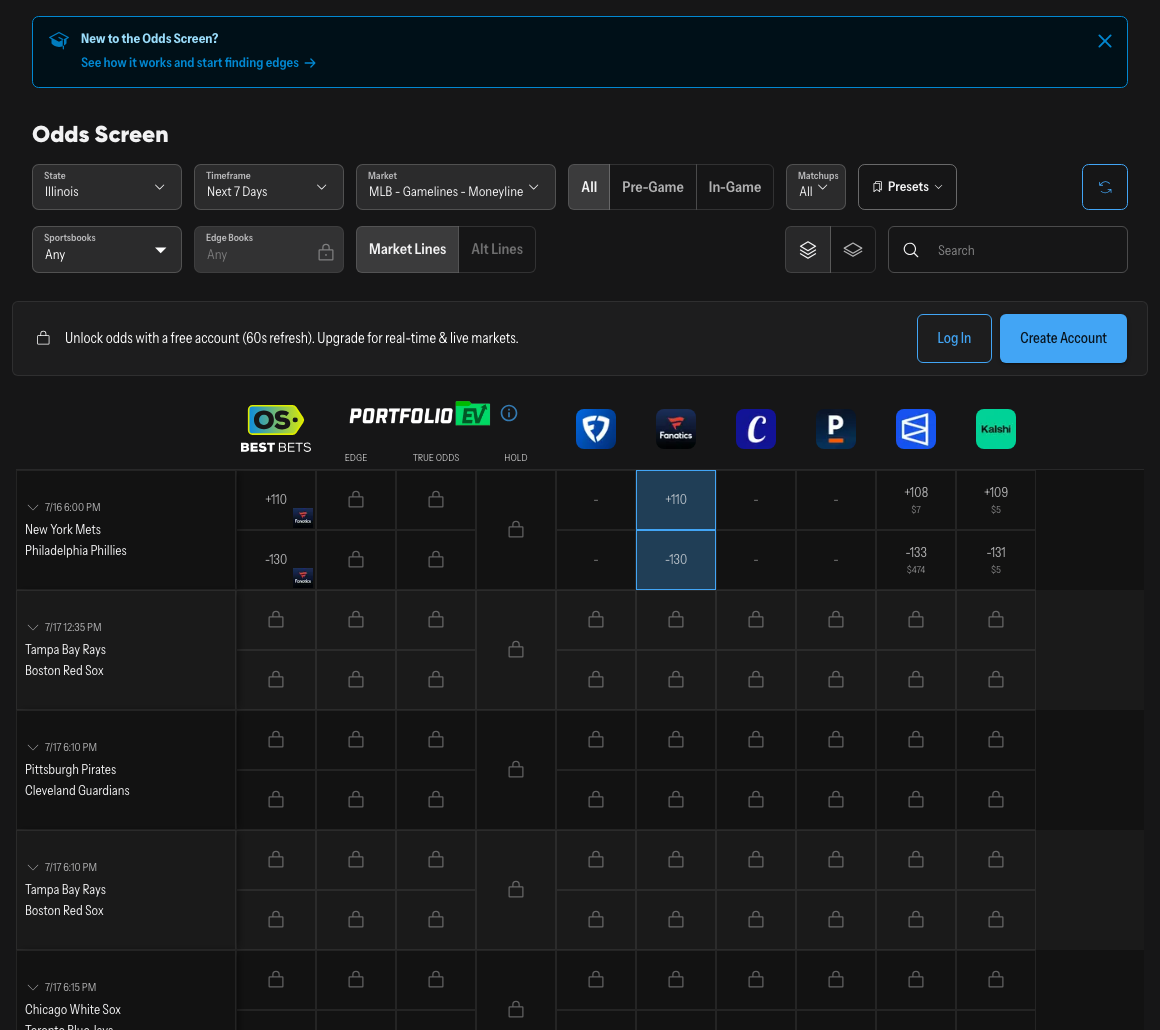 The OddsShopper live odds screen — every book's price on one board, refreshed in real time. Open the live board.
TL;DR: What This Comes Down To
- A Prediction Model Alone Does Not Beat Sports Betting. The books already price games with sharp, efficient lines, so "I think the Lakers win" is worth nothing unless you got a better number than the market.
- The Vig Is The Wall. At a standard -110, you need to win about 52.4% of your bets just to break even. A model that is "right" 52% of the time still loses money.
- The Edge Lives In The Price, Not The Pick. Two books can post the same side at +360 and +425. Same opinion, very different result. Line shopping captures that gap; a model that ignores it does not.
- Closing Line Value (CLV) Is The Real Scoreboard. Beating the closing number consistently is the clearest sign you have an edge, and it has nothing to do with how fancy your model is.
- The Version That Actually Works: use tools to compare prices across books and to see where sharp money is moving, then bet the best number. That is what OddsShopper is built to do.
What People Actually Mean By "AI Sports Betting"
When someone asks whether AI can beat the sportsbooks, they almost always mean one specific thing: a model that ingests stats, spits out a probability, and tells them who to bet. Feed it the data, trust the output, print money.
That framing skips the only question that matters. Betting is not a prediction contest against the game. It is a pricing contest against the market. The book is not your opponent because it disagrees with your forecast. The book is your opponent because it sets a price, takes a cut, and moves that price the second smart money shows up. An AI that is great at the first job and blind to the second is bringing a calculator to a poker game.
Why A Prediction Model Alone Doesn't Beat The Books
Start with the math nobody puts in the AI thread. A standard line is -110 on both sides. The implied probability of a -110 bet is 52.4%, so both sides together add up to about 104.8%. That extra cut, a bit under 5%, is the book's built-in margin, also called the hold or the vig.
What that means in practice: to break even at -110 you have to win 52.4% of your bets. Not 50%. So your shiny model can be flat-out good, correctly picking the winning side 52% of the time, and you will still slowly lose money. The book did not need to out-predict you. It just charged a toll on every play, and your model never accounted for the toll.
Now layer on the harder truth. The closing line on a major market is one of the most accurate forecasts in all of sports, because thousands of bettors and the sharpest syndicates in the world have hammered it into shape by kickoff. And the books are not standing still either. FanDuel 🎁, DraftKings 🎁, and the data shops that price for them run their own models on the same public stats your AI can see, then sharpen the number with the live flow of real money. Train a model on the same box scores and you are not out-thinking their pricing, you are re-deriving it a step behind. Asking it to consistently out-forecast the closing number is like asking it to consistently out-price the stock market. It happens at the margins, in slow corners of the board, but "I built an AI that beats the closing line across the board" is a claim that almost never survives contact with a real bankroll.
The trapa model that is right is not the same as a bet that is good. Being right 52% of the time at -110 is a losing strategy. The number you got matters more than the side you picked.
The Closing Line Is The Real Scoreboard
If you only track one thing, track closing line value (CLV). CLV is simple: did you bet a better number than the one the market closed at? If you took the Dodgers at -140 and they closed -160, you beat the close. Over a large sample, consistently beating the closing line is one of the strongest signals that you are finding real value, because it means you are routinely getting a price the market later agreed was too good.
Notice what CLV does not care about: whether a human or an algorithm made the pick. It only cares about the price. One caveat that keeps CLV honest: the signal means something only in deep, liquid markets where the closing number is razor-sharp. Beat the close on a thin, lightly-bet market and that close may be too soft to prove anything. If you want the full method for tracking it, our closing line value guide shows how to grade every bet against the no-vig close.
Track one numberdid you beat the closing line? Over a large sample, consistently getting a better price than the market's close is one of the clearest signs your process has a real edge, no matter who or what made the pick.
That leads to the part most AI fans skip entirely. When your number is not better than the market's, the correct play is no bet. Most of the board is priced too efficiently to touch, and forcing action on every game is how a model with a small edge bleeds out. Selectivity is the discipline; passing is a winning move. A computer that helps you grab the best number on the few spots worth betting is useful. A computer that hands you a prediction on all of them and ignores the price is not. If you want the full breakdown of value versus the posted price, our positive expected value guide walks through the EV math step by step.
The Edge Lives In The Number You Get
Let me show you the gap with one bet. Say you and your model love an underdog. Three books are open. Here is the same exact opinion priced three different ways:
| Sportsbook | Price (American) | Your profit on a $100 win | Implied probability |
|---|---|---|---|
| Book A | +360 | $360 | 21.7% |
| Book B | +400 | $400 | 20.0% |
| Book C | +425 | $425 | 19.0% |
Same team, same bet, same conviction. Take it at +360 when +425 was sitting one tab over and you just handed the book $65 of profit on a winning ticket, for free. The model did nothing wrong. You did, by not shopping the number.
Stretch that across a full season of bets and the difference between always taking the best available price and grabbing whatever your one app shows is, for most bettors, the entire difference between green and red. This is the part the AI pitch buries. The pick is a commodity. Everyone has opinions, and the books have the sharpest one of all. The price is where money is actually won and lost, and you capture it by comparing every book at once, not by trusting a single number from a single model.
This is the job OddsShopper does automatically: it lines up the same bet across every major sportsbook and flags where the best number lives, and its de-vig fair-odds and Portfolio EV tools strip out the hold so you can see what a bet is truly worth versus what each book is charging.
New to OddsShopper?It scans every major sportsbook in real time, shows you the best available price on every bet, and uses de-vig fair odds to flag the ones priced in your favor. That is the edge a prediction model can't give you on its own. Try OS Pro free for 7 days, and code AIEDGE20 takes 20% off your first payment if you stay.
Follow The Sharp Money, Not The Model
What actually moves a line is not your model. It is the sharps. The bettors and syndicates who price games for a living often get their money down first at sharper books, on betting exchanges, or on prediction markets like Kalshi and Polymarket, before the soft books fully adjust. When they pound a side, the number moves. Get on the right side of that move before it happens and you bought at a discount the rest of the market is about to chase.
The real, repeatable version of "beating the books" has nothing to do with predicting the final score. It is about reading the flow of money. The honest framing the pros use: most bettors lose over the long haul, so the goal is to get on the same side as the sharper, higher-volume money instead of betting blind against the market.
This is what OddsShopper's Sharp Action tool inside OS Pro is built to surface. Instead of a model's guess about who wins, it reads where sharp money is moving on betting exchanges like Novig and ProphetX and prediction markets like Kalshi and Polymarket, and shows you which way that money is pushing a number. In a normal daily workflow it sits next to the odds-comparison screen: you scan the board, see which sides the exchange money is backing, then weigh that against the current price across every major sportsbook and grab the number before the soft books catch up. We break down how to read and tail that flow in our follow the sharp money guide, and what separates a sharp from a square in the sharp betting guide.
None of this is a promise that you win. Lines move, books limit winners, and any single bet can lose. But following the money to a better price can be a real edge over time, and it is one a standalone prediction model structurally can't reach, because it is not even looking at the market.
How To Turn Sharp Action Into A Better Number: A Worked Example
Let me make this concrete with a hypothetical, because the theory only matters if you can run it on a Tuesday night. Say you are eyeing an underdog you already like. You open the board and one slow book still has it at +150 while most of the field has already settled around +135. A pure prediction model does not care about that spread. It likes the dog, so it fires at the first price it sees.
Here is the part the model never sees. The Sharp Action tool lights up: exchange and prediction-market money is piling onto that same underdog. Money on a side shortens its price, so the sharp books are already trimming the dog from +135 down toward +125. That flow is the tell, because it means the sharpest money in the market agrees with your side. The slow book still showing +150 has not caught up yet, so you grab that stale number before it drops, and you are done.
Play it forward to the close. The rest of the market finishes catching up and the dog closes at +125. You bet +150; the market closed +125. You just booked textbook closing line value, the exact scoreboard we set up earlier, captured without predicting a single outcome. Same pick, better number, measurable edge. The model picked the side; the price and the sharp-action read are what created it.
The movethe model's job ends at picking a side. Grabbing the stale +150 while the field trims to +125, then beating that close, is where the money is actually made. It is a price-and-flow job, not a prediction job, and it is the swing an AI oracle structurally can't hand you.
Multiply that one number across a season of bets and it stops being a rounding error. The bettor who habitually grabs +150 while the field settles at +135 and beats the close is the one still standing in the fall. The bettor who lets a model fire at the first available price gives up the only measurable advantage in that example: the gap between the stale +150 and a market already sliding toward +125.
SO How Should A Bettor Actually Use AI?
AI is a fine assistant and a terrible oracle. Used well, it speeds up the grunt work: scanning a huge board fast, organizing splits, surfacing spots worth a closer look. Used badly, it becomes a confident voice telling you to fire blind at whatever number your one app happens to show.
The bettors who hold up over a long sample are not the ones with the cleverest model. They are disciplined about three boring things:
- Shop for the best price every single time. The same pick at +425 instead of +360 can be the difference between a winning year and a losing one.
- Size bets to a real bankroll. Bet a fraction of your roll, smaller on higher-variance plays, and never bigger to chase a loss.
- Track your closing line value. CLV tells you whether you actually have an edge or just had a hot month.
A model can support all three. It cannot replace any of them. Unglamorous as it sounds, that is the honest answer to "can AI beat sports betting," and it is the one that keeps a bankroll alive.
Frequently Asked Questions
Can AI actually beat sports betting? Not on prediction alone. The books price games efficiently and bake in a margin, so a model that only forecasts winners runs into the vig and the closing line. The repeatable edge comes from getting a better price than the market: line shopping, de-vig fair odds, and following sharp money. AI can help you do those faster, but it does not replace them.
Why isn't a winning prediction model enough? Because at -110 you need to win about 52.4% of your bets just to break even, and the closing line is already an extremely sharp forecast. A model can be accurate and still lose to the hold and to bettors who simply got a better number on the same side.
What is closing line value and why does it matter? CLV measures whether you bet a better price than the market closed at. Consistently beating the close over a large sample is the clearest sign you are finding real value, regardless of whether a person or an algorithm made the pick. It is the metric sharp bettors live by.
What tools actually give a bettor an edge? Real-time odds comparison across many books so you always take the best price, de-vig and EV tools that show a bet's true value versus the posted price, and a sharp-action feed that shows where exchange and prediction-market money is moving. OddsShopper bundles all of these in OS Pro.
Is sports betting legal where I am? Sports betting is legal in regulated U.S. markets where it is offered, and the rules vary by state. Always bet within the law in your jurisdiction, only with money you can afford to lose, and treat it as entertainment, not income. You must be 21+ to bet in most regulated markets.
More on this: Louisiana Sports Betting: Rules, Promos & Apps 2026 · Arizona Sports Betting: Is It Legal? Apps & Rules · Illinois Sports Betting: Is It Legal? Apps & Rules · Massachusetts Sports Betting: Is It Legal? Apps & Rules · Beat The Sportsbooks With A Small Bankroll
The Bottom Line
Can AI beat the sportsbooks? Not by predicting winners, because the major markets are already priced too efficiently to beat on prediction alone, and the book charges the vig on top. The edge that holds up is older and simpler than any algorithm: shop every book for the best price, follow the sharp money to the right side before the line moves, and track your closing line value so you can measure whether your process is actually beating the market.
So before I fire on anything a model likes, I run three quick checks: is my number better than the rest of the screen, is the move backed by sharper money on the exchanges, and would I still respect the bet if it loses? If any one of those fails, the model is just a confident guess, and a confident guess at a bad price is how bankrolls die. Clear all three and you are playing the game the way the sharps actually play it.
Want the edge a model can't reach on its own? OddsShopper compares every bet across every major sportsbook, strips out the vig to show true odds, and surfaces where the sharp money is moving, so you take the best number instead of a guess. Start OS Pro free for 7 days, then code AIEDGE20 takes 20% off your first payment.