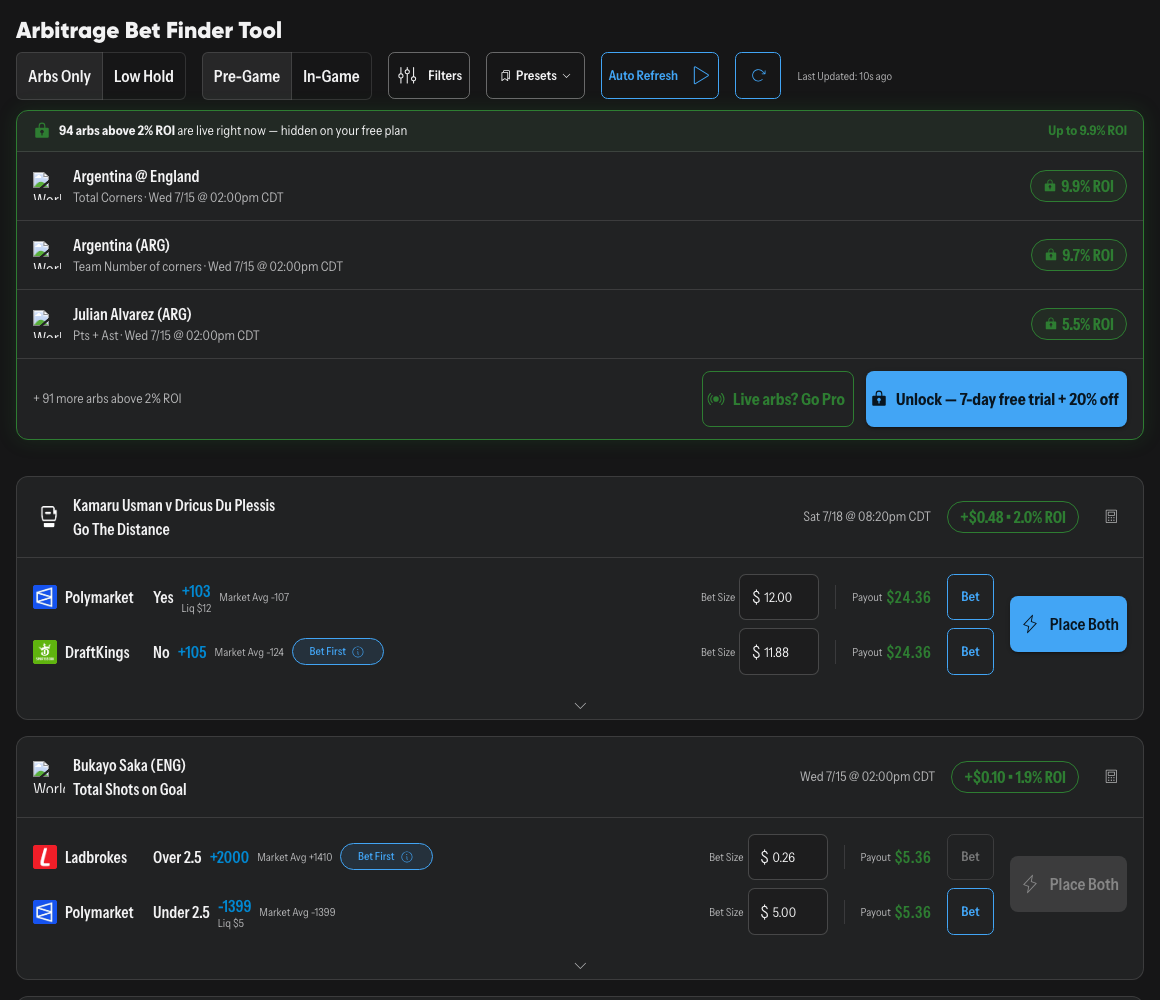
 The OddsShopper Arbitrage Finder — live two-book locks with stakes and payouts. Open the live tool.
In Summary
Arbitrage betting, or "arbing," means betting every outcome of a market across different sportsbooks at prices that let you come out ahead no matter which side wins. It works because books disagree on odds, and when one book's price is high enough on one side while another book is high enough on the other, the two prices no longer add up to 100% implied probability. When that gap opens, you can stake both sides in the right proportion and lock in a small return regardless of the result. The catch is that arbs are usually small (often 0.5–2%), they vanish fast, it's low-risk rather than risk-free (a line can move before you place your second bet), and books don't love bettors who only arb. OddsShopper's Arbitrage tool scans the market for these opportunities in real time so you don't have to find them by hand.
What Is Arbitrage Betting?
Every set of odds carries an implied probability: the book's estimate of how often that outcome hits, plus its built-in margin (the "vig"). On a normal two-way market, the two sides add up to more than 100%. That extra is the hold, and it's how the house makes money.
Arbitrage happens when that math breaks. Because every sportsbook prices independently, two books will sometimes post numbers that, combined, add up to less than 100% implied probability. When that happens, you can bet both sides, one at each book, and come out ahead regardless of the result, as long as both bets are placed at those prices.
For more on this, see Arbitrage Calculator: How to Size Your Arb Bets.
If you read our guide on positive expected value, you'll recognize this as the extreme case of a negative synthetic hold. Instead of an edge on one side, you've got an edge across the whole market.
How Arbitrage Betting Works: A Worked Example
Take a tennis match between Carlos Alcaraz and Jannik Sinner. You find these prices at two different books:
- Alcaraz at +110 on FanDuel
- Sinner at +110 on DraftKings
A price of +110 means a $100 bet returns $110 in profit. Because both books are pricing their player generously, the two prices don't add up to a full 100% market, and that gap is the arbitrage. Since the odds are the same on both sides, you simply bet $500 on each ($1,000 total):
- If Alcaraz wins: your $500 on Alcaraz returns $1,050 (your $500 back plus $550 profit). The Sinner bet loses. You're up $50.
- If Sinner wins: your $500 on Sinner returns $1,050. The Alcaraz bet loses. You're up $50.
Either way you walk away with $1,050, a $50 profit no matter who wins. You never had to predict the winner; you only had to spot that the two books disagreed enough to leave a gap. (This is a clean, simplified example. Real arbs are usually smaller, around 0.5–2%, but the mechanic is exactly the same.)
Arbs show up constantly: a +130 on one book and a -120 on the other for the same market is a textbook arbitrage. For anyone who just wants to grind those edges, it's a low-stress way to bet. You're not sweating an outcome, you're collecting a margin.
One practical caution: track which side of an arb you've already placed. Forget a leg you've filled, go to place "another" arb, and you can hit your max on one side while the other never lands, leaving you with a one-sided position. A half-filled arb isn't an arb.
You just watched a $50 arb fall out of two prices, now imagine catching them all day. OS Pro's Live Arbs feed scans every book in real time and hands you both sides plus the exact stakes before the gap closes. Try it yourself free for 7 days, no risk, then code ARB20 takes 20% off OS Pro or OS Core if you stay.
How to Calculate an Arbitrage Bet
The margin on any two-way arb is:
Arb margin = 1 − (1 / decimal odds A + 1 / decimal odds B)
Note the formula wants decimal odds, and US books quote American prices — our odds converter flips -110 or +150 into decimal (and shows the implied probability) in one step.
If that number is positive, you have an arbitrage. To size each side so both outcomes pay equally, stake each leg in proportion to the other side's implied probability:
- Stake on A = Total × (1 / odds A) ÷ (1 / odds A + 1 / odds B)
- Stake on B = Total × (1 / odds B) ÷ (1 / odds A + 1 / odds B)
You can run this by hand, but it's slow and error-prone when a line is about to move. An arbitrage calculator does it instantly. Enter the two prices and your total stake, and it returns the exact amount to put on each side plus your expected return. OddsShopper's Arbitrage tool has this built in, so the stakes are calculated for you the moment an opportunity appears.
How to Find Arbitrage Bets
The hard part isn't the math. It's finding the gaps before they close. That means continuously comparing the same market across dozens of sportsbooks, because an arb only exists when two specific books are out of line with each other. Doing that manually across every game and prop is impossible.
This is exactly what line shopping is for, and it's why the Arbitrage tool exists. The tool scans every sportsbook we track in real time and ranks live arbitrage opportunities by margin, including the small, short-lived gaps that are impossible to catch by hand. You see the two sides, the books offering them, and the exact stakes, then it's a race to place both legs before the price corrects. The free tool shows you the concept; OS Pro unlocks the full Live Arbs feed, the real-time stream and the higher-margin opportunities (including arbs above 2%) that free users don't see.
A few realities worth knowing before you start:
- It's low-risk, not no-risk. If a line moves before you get the second leg down, a book voids or limits a bet, or you mis-size a stake, the expected return can shrink or flip to a loss. Place both legs quickly and double-check your numbers.
- Arbs are small and short-lived. Most are 0.5–2% and can disappear in seconds when a book adjusts. Speed matters.
- You need accounts and balances at multiple books. You can't arb if your money is all in one place. Which books deserve those deposits is its own call: our guide to the best sportsbooks for arbitrage betting covers the traits that make a book arb-friendly.
- Sportsbooks limit known arbers. Books watch for bettors who only ever take both sides of a market, and may cut limits. Many sharp bettors mix arbitrage with +EV betting to stay under the radar. Tailing the market's sharp side is another blend-in play, and our Liquidity Tool guide shows how to spot where that money is landing.
- Don't waste free bets on arbs. Convert them first: our walkthrough on how to convert a free bet into cash shows the play, and the Free Bet Converter runs the numbers for the most cash with the least risk.
- Arb profits are taxable. In the U.S., sports-betting winnings are reportable income, so keep records of your bets and net results. (This isn't tax advice; check your situation.)
The same logic extends beyond the sportsbooks: when a book and a CFTC-regulated exchange price the same event differently, that gap can be playable too. See our guide to prediction market arbitrage.
Step-by-Step: Placing Your First Arbitrage Bet
If you've never arbed before, here's the whole loop start to finish:
- Fund accounts at several sportsbooks. You can only arb if you have balances in multiple places. An arb lives across two books, so one account isn't enough.
- Open the Arbitrage tool. It's already scanning every book we track and ranking live opportunities by margin.
- Pick an opportunity and check the margin. Start with something in the 1–2% range on a market you understand.
- Note the exact stakes. The tool calculates how much to put on each side so both outcomes pay the same, with no manual math.
- Place the larger/most-likely-to-move leg first. Lock the side that's most likely to shift, then place the other immediately.
- Confirm both bets landed at the expected prices. If one leg moved before you got it down, recalculate, and don't leave yourself one-sided.
- Record it. Track your stake, books, and result for your bankroll (and taxes).
The whole thing takes a couple of minutes once you've done it a few times. The skill is speed and discipline, not math. The tool handles the math.
Arbitrage Betting vs. +EV Betting
They're cousins, but not the same. Arbitrage aims to lock in a small return on a single market right now by covering every outcome. Positive EV betting doesn't lock in any single bet. It bets one side when the price is better than its true probability, and aims to profit over a large sample. Arbitrage is lower-risk and lower-return; +EV is higher-variance with a higher ceiling. Hedging is the third cousin: instead of staking both sides upfront, you hedge a bet by taking the other side after your original ticket has gained value, locking in a result. Most serious bettors use both arbitrage and +EV, and OddsShopper's tools cover each.
Frequently Asked Questions
Is arbitrage betting legal? Arbitrage betting is legal where sports betting is legal and regulated. It's simply taking advantage of price differences between sportsbooks. That said, sportsbooks are private businesses and can limit or restrict accounts they identify as pure arbers.
How much money can you make arbitrage betting? Most arbs return 0.5–2% per opportunity, so returns scale with how much you bet and how many opportunities you can act on. It's a grind of small, low-risk gains rather than big wins, which is exactly why a tool that surfaces opportunities in real time matters.
Do I need an arbitrage calculator? Practically, yes. The math is simple but slow by hand, and arbs close fast. A calculator (built into OddsShopper's Arbitrage tool) instantly returns the exact stake for each side and your expected return.
Why do arbitrage opportunities exist? Because every sportsbook sets its own odds. When two books disagree enough on a market, their combined prices can drop below 100% implied probability, and that gap is the arbitrage.
Will I get limited for arbitrage betting? You can. Books monitor for accounts that consistently bet both sides of a market. Since an arb is already +EV on at least one side, looking like a normal customer isn't about adding more +EV bets, it's about variety: many bettors mix in other bet types, like parlays and recreational props, to blend in.
Related reading: Will Sportsbooks Ban You for Arbitrage Betting?.
Ready to step up your arbing? Hunting arbs by hand is slow, and the obvious low-margin ones get your accounts limited fast. OS Pro unlocks the full Live Arbs feed: every book, in real time, including the higher-margin arbs free users never see, so you can move faster and spread action across more books to keep a lower profile. Upgrade to OS Pro with code ARB20 for 20% off your first payment and put the Live Arbs feed to work today.
More on this: Closing Line Value (CLV) Explained: Beat the Close · Parlay Betting Explained: The +EV Fix For Yours · Odds Boosts Strategy: Which Ones Are Actually +EV · Bankroll Management Sports Betting: Unit & Kelly Sizing · Free Bet Conversion: How to Turn a Free Bet Into Cash