Last updated: July 23, 2026
TL;DR
A betting odds converter takes one price and shows you the same bet in every format: American (the +150 / -110 you see at most U.S. books), decimal (2.50), fractional (3/2), and implied probability (the percent chance the price is built on). They all describe the identical payout, just written three different ways, plus the probability hiding underneath. The fastest way to convert is the table below, but the reason converting matters is the fourth column: implied probability is the book's price expressed as a percent, and once you can read that percent, you can tell whether a bet is actually priced in your favor. That fourth column is the number I check first on every bet, and it is the whole reason I wrote this guide the way I did. Below you get the conversion table, the formulas for doing it by hand, and a worked example of turning a price into a value decision.
The Odds Conversion Table
Here are the most common prices in all four formats. Decimal odds and implied probability are rounded to two places, the way a sportsbook or calculator would display them; fractional odds are shown in their conventional ratio form (10/11, 3/2, and so on). One note for the self-checkers: the implied-probability column is figured from the exact American price, so running 1 / decimal on a rounded decimal (1.91 for -110) can land a rounding hair off the printed number (52.36% versus 52.38%).
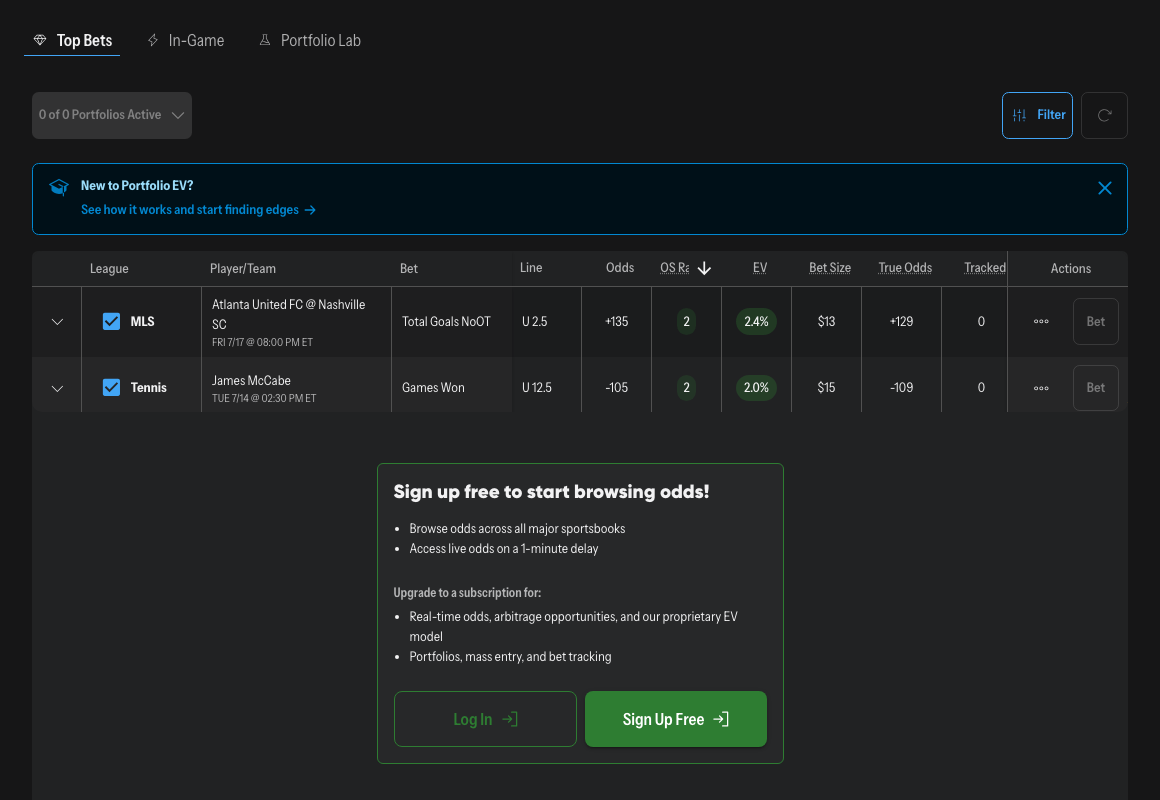
The OddsShopper +EV Screen.
| American | Decimal | Fractional | Implied Probability |
|---|---|---|---|
| -300 | 1.33 | 1/3 | 75.00% |
| -200 | 1.50 | 1/2 | 66.67% |
| -150 | 1.67 | 2/3 | 60.00% |
| -110 | 1.91 | 10/11 | 52.38% |
| +100 (Even) | 2.00 | 1/1 | 50.00% |
| +120 | 2.20 | 6/5 | 45.45% |
| +150 | 2.50 | 3/2 | 40.00% |
| +200 | 3.00 | 2/1 | 33.33% |
| +220 | 3.20 | 11/5 | 31.25% |
| +300 | 4.00 | 3/1 | 25.00% |
| +500 | 6.00 | 5/1 | 16.67% |
Notice the pattern in the last column. The bigger the underdog price, the smaller its implied probability, which means a longer-shot bet pays more for the same stake. Hold onto that, because it is the whole reason converting odds is worth your time.
How To Convert American Odds By Hand
American odds are built around a $100 bet. A positive number (+150) is how much profit a $100 stake returns; a negative number (-150) is how much you must stake to win $100.
For the negative-odds formulas below, drop the minus sign and use the number on its own (so -150 goes in as 150).
American to decimal:
- Positive odds:
(odds / 100) + 1, which turns +150 into(150 / 100) + 1 = 2.50. - Negative odds:
(100 / odds) + 1, so -150 works out to(100 / 150) + 1 = 1.67.
American to implied probability:
- Positive odds:
100 / (odds + 100). Run +150 through it and you get100 / 250 = 40.0%. - Negative odds:
odds / (odds + 100), and -150 lands at150 / 250 = 60.0%.
American to fractional: convert to decimal first, subtract 1, then write the result as a fraction. +150 is decimal 2.50, minus 1 is 1.5, which is 3/2.
How To Convert Decimal Odds By Hand
Decimal odds show your total return per $1 staked, the profit and your original stake together. Decimal 2.50 means a $1 bet returns $2.50 total: $1.50 profit plus your $1 back.
- Decimal To Implied Probability:
1 / decimal— run 2.50 through it and you get1 / 2.50 = 40.0%. This is the cleanest conversion in betting, which is one reason sharp bettors and most of the rest of the world prefer decimal — it turns any decimal price into an implied probability calculator with a single division. - Decimal To American: if the decimal is 2.00 or higher,
(decimal - 1) × 100, which reads 2.50 as1.5 × 100 = +150. Below 2.00, use-100 / (decimal - 1), so 1.50 resolves to-100 / 0.5 = -200. - Decimal To Fractional: subtract 1 and express as a fraction. 2.50 becomes 1.5, or 3/2.
How To Convert Fractional Odds By Hand
Fractional odds, common in the UK and in horse racing, show profit relative to stake. 3/2 means you win 3 units for every 2 you risk. When your book only ever shows American prices, treating this section as a fractional odds converter is enough — read the ratio, then run it through the two formulas below.
- Fractional To Decimal: divide the fraction and add 1. 3/2 is 1.5, plus 1 is 2.50.
- Fractional To Implied Probability:
denominator / (numerator + denominator), so 3/2 gives2 / 5 = 40.0%. - Fractional To American: convert to decimal, then use the decimal-to-American rule above.
Why Implied Probability Is The Column That Matters
The first three formats are just different ways to write the same payout. American, decimal, and fractional describe the exact same return, so converting between them is pure translation. The fourth column is different. When you convert odds to probability, you restate the price as "how often this has to win for the book to break even," and that is the number you can actually have an opinion about.
Here is the move that separates bettors who win from bettors who don't. You convert the price to implied probability, then you compare it to your own estimate of how likely the outcome is. If you think a team wins more often than the price implies, the bet is priced in your favor. That gap is positive expected value, and it is the only durable edge in betting. Our guide on how to find +EV bets walks through it in full.
The shortcutconvert any price to a percentage, then ask one question. "Do I think this happens more often than that percent?" If yes — and especially once you have removed the vig and your estimate is grounded — it is a bet worth a closer look. If no, pass, no matter how much you like the team.
One Catch: The Vig Inflates Every Implied Probability
Add up both sides of a typical sportsbook market at one book and you will usually get more than 100%. A game priced -110 on each side converts to 52.38% and 52.38%, which sums to 104.76%. That extra 4.76% is the vig, the book's built-in margin, and it means the raw implied probability slightly overstates the book's true estimate. To get the book's actual no-vig probability you strip that margin out, which we cover in how to remove the vig. For a quick gut check the raw number is fine; for a real value decision, de-vig first.
A Worked Example: Turning A Price Into A Decision
Say you are looking at a baseball moneyline and your read is that the home team wins about 55% of the time. You check the price and the best number you can find is -110.
Convert -110 to implied probability: 110 / (110 + 100) = 110 / 210 = 52.4%.
Your estimate (55%) is higher than the price's implied probability (52.4%). The book is paying you as if this team wins 52.4% of the time, but you believe it wins 55% of the time. That roughly 2.6 percentage point gap is what creates positive expected value, as long as your 55% read is accurate. Betting grounded edges like this over a large sample is how you tilt the long-run math in your favor, though results still swing hard in the short term.
Flip it and the bet diesat -150 the same team converts to 60.0% implied, which is above your 55% read. Same team, same game, but now the number is against you, so the right move is to pass.
That is the entire job of an odds converter. It is not about memorizing that 2.50 equals +150. It is about getting to the percent so you can compare it to what you actually believe.
Why The Best Number Matters
You already saw the payoff in the table: $150 profit at +150 versus $220 at +220 on the same $100, because the longer number carries a lower implied probability. You will not usually find the identical bet swinging that far between two books, but the principle holds at every scale — the higher the number you get on a bet you like, the more the same stake pays and the more implied value you capture. A few cents of better price, taken every time, is real money over a year.
This is why line shopping, comparing the same bet across sportsbooks and taking the best price, is one of the simplest ways to improve your expected price before you get into any handicapping. Say you like a team's moneyline and DraftKings has it at +150, FanDuel posts +160, and BetMGM has +170. Same bet, three prices — and once you convert each one, the difference is obvious:
| Sportsbook | American | Decimal | Implied Probability | $100 profit |
|---|---|---|---|---|
| DraftKings | +150 | 2.50 | 40.00% | $150 |
| FanDuel | +160 | 2.60 | 38.46% | $160 |
| BetMGM | +170 | 2.70 | 37.04% | $170 |
The one I keep coming back to is that bottom row: BetMGM's +170 is the same wager as DraftKings' +150, but it pays $20 more on the same $100 and prices the team as a bigger underdog (37.04% versus 40.00%), so it hands you more implied value for free. On longshots or fast-moving markets the gap can be wider still. Taking the higher number on every bet like this adds up over a season. (If you are new to reading prices, our how to read betting odds guide covers the basics first.)
That is the exact problem OddsShopper was built to solve. It scans every book we track in real time and shows you, side by side, who has the best number on the bet you want, so you are never the bettor stuck on +150 when +170 was available one app over. You can compare live prices yourself on the OddsShopper odds screen.
New to OddsShopper?It scans every major sportsbook at once and highlights the bets priced in your favor, the same convert-and-compare math this guide just walked through, run automatically for you. Code ODDS20 takes 20% off OS Pro: Start with OddsShopper.
How OddsShopper Converts Odds For You
Doing the math by hand is good to understand, but you will not run these formulas before every bet. OddsShopper's tools convert every price for you and take the next step automatically:
- The odds screen shows the same bet across every book on the board, so you can grab the best number (the DraftKings-versus-BetMGM gap from earlier) without converting each one yourself.
- The +EV screen converts each price to a True Odds probability, de-vigs it, and grades every bet with an EV number, an OS Rating, and a suggested bet size, as the screenshot above shows. The tool surfaces only the bets priced in your favor, so the convert-and-compare loop runs in the background.
You learn the mechanics here; the tools do the repetition. Take the -110 example from earlier: the +EV screen converts that price to 52.4%, strips the vig to the market's true number, and surfaces the bet automatically when your projected win rate clears that line, so you are not re-running 110 / 210 before every play. Knowing why a number is good and having something that finds it across the board in seconds is what keeps me from taking a worse price than I had to.
Frequently Asked Questions
What does an odds converter do? It restates a single bet in every odds format: American (+150), decimal (2.50), fractional (3/2), and implied probability (40%). The first three are the same payout written differently; the implied probability is the percent chance the price is built on, which is the number you use to judge value.
How do you convert odds to implied probability?
From decimal, divide 1 by the decimal odds (1 / 2.50 = 40%). From positive American odds, use 100 / (odds + 100). From negative American odds, drop the minus sign first, then use odds / (odds + 100) (so -150 becomes 150 / 250 = 60%). The result is the percent of the time the bet must win for the book to break even on it.
Why do the two sides of a game add up to more than 100%? That extra is the vig, the sportsbook's margin. Because each side's implied probability is slightly inflated by the hold, you remove the vig to get the book's true probability before judging a bet. See how to remove the vig.
Which odds format is best to use? Decimal is the easiest for the value math, since implied probability is just 1 divided by the decimal — that is why the worked example above jumps straight to the percentage. American is the U.S. standard you will see at most books, and fractional is common in the UK and horse racing. They all describe the same bet, so read in whichever you are fastest with and convert to the percentage when you need to judge value.
Does converting odds actually help me win? Not on its own. Converting to implied probability is what lets you compare a price to your own estimate (like the 55% read in the example above) and compare the same bet across books to take the best number. It sharpens your price decisions and it is the first step toward finding value, but it does not guarantee winning bets; your estimate and your discipline still do the heavy lifting.
The Bottom Line
Here is the whole discipline in one line: convert the number to a percentage, remove the vig before you trust it, and shop the same market across books. If your edge survives all three steps, the price is doing enough work to back the bet. If it disappears, pass, no matter how much you like the play. That sequence, not memorizing a table of equivalents, is what getting to the best number actually buys you.
New to OddsShopper? It runs that convert, de-vig, and compare sequence across every major sportsbook automatically. Code ODDS20 takes 20% off OS Pro: Start with OddsShopper.
More on this: Best +EV Bet Tracker: What To Look For (And What Most Skip) · Closing Line Value Vs. Variance: Your P&L Is Lying To You · Devig Calculator: Find Fair No-Vig Odds From -110 Prices · How To Bet On Horses: 6 Horse Racing Bet Types Explained · Polymarket Fees Explained: What Trading Actually Costs