No Vig Odds: How to Remove the Vig and Find the True Price
In Summary
No vig odds are what a market's price should be once you strip out the sportsbook's built-in margin: the vig, also called the juice, the hold, or the overround. Here's the part most bettors never internalize. A standard two-way market priced -110 / -110 doesn't add up to 100% probability. It adds up to about 104.8%. That extra ~4.8% is the vig, and it's the reason blindly betting either side is a slow bleed. To find the true odds, you remove the vig. Convert each side to implied probability, add them up, then divide each side by that total to renormalize back to 100%. That renormalized number is the fair, no-juice price. This isn't a parlor trick; it's the single calculation underneath every +EV decision. Once you know the true odds, a bet is positive expected value (the foundation of our whole approach to +EV) any time a book pays you better than that no-vig price. This guide walks the devig math with real numbers, two-way and three-way, explains when the simple method breaks (heavy favorites), and shows how to skip the hand-math entirely with OddsShopper's Betting Odds Calculator and EV Calculator. If you need a refresher on reading the odds themselves first, start with how to read betting odds.
Go deeper: Implied Probability: Convert Betting Odds To A Win %.
What the Vig (Juice) Actually Is
The vig (vigorish, juice, hold, margin, overround; same thing under different names) is the commission a sportsbook bakes into its prices. It's how the house turns a profit regardless of which side wins. You never see it itemized like a fee. Instead, it's hidden inside the odds themselves, which is exactly why it's so easy to ignore.
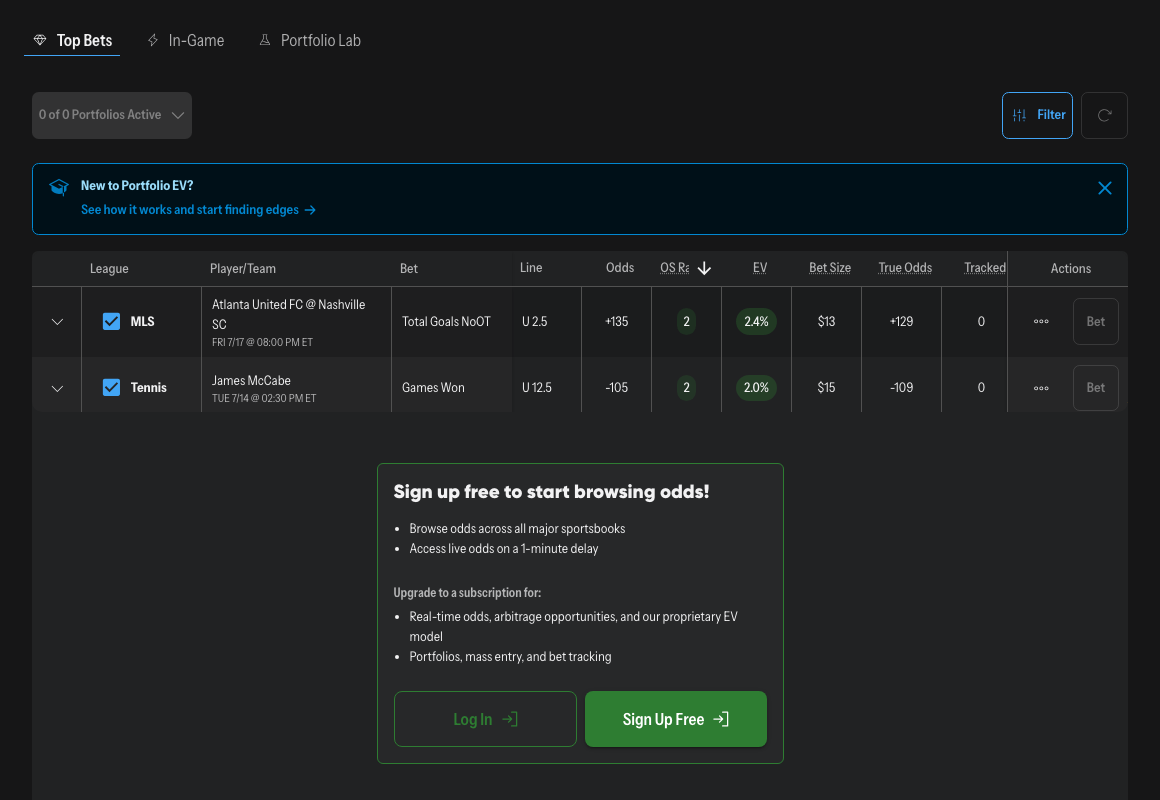
The OddsShopper +EV Screen.
The cleanest way to see it is the classic spread or total: -110 on each side. Convert -110 to implied probability and you get 52.4%. Both sides at -110 means:
52.4% + 52.4% = 104.8%
A fair, two-outcome market should sum to exactly 100%. Those are the only two things that can happen, so their true probabilities have to add up to one. This one sums to 104.8%. That extra 4.8% is the vig: the book is charging you to take 100% worth of outcome at a 104.8% price. The sum over 100% is called the overround or the hold, and it's the number you have to remove to find no juice odds.
This is why "I just bet the side I like at -110" is a losing formula even if you're right slightly more than half the time. At -110 you need to win 52.4% of the time just to break even, not 50%. The vig moved the goalposts. Removing it puts them back.
Why a -110 / -110 Market Implies More Than 100%
It helps to think of the book as selling two lottery tickets that together cover every outcome. If the tickets were priced fairly, they'd cost exactly $1.00 combined to cover a $1.00 payout: break-even, no edge for anyone, since one of the two tickets has to win. Instead the book sells the pair for about $1.048. That $0.048 premium is the vig, and the book collects it no matter which ticket wins.
The percentages behave the same way. Each -110 side "costs" 52.4% of probability. Two of them cost 104.8%, so you're being asked to pay for 104.8% of certainty when only 100% exists. The market is padded. Removing the vig is just deflating that padded market back down to the 100% it should sum to, proportionally, so you can see each outcome's real chance.
A few reference points for how heavy the juice gets, so you know what "normal" looks like:
- -110 / -110 (standard spread/total): ~4.8% hold.
- -105 / -105 (reduced-juice book): ~2.4% hold, half the tax.
- A typical two-way moneyline at a major book: often 4–6% hold.
- Player props and three-way markets (soccer 1X2): frequently 6–8%+. The juice you pay is highest exactly where most casual bettors play.
That last point matters. The thinner and harder-to-price the market, the more vig the book charges, which is also where, after you devig, the biggest mispricings tend to hide.
How to Remove the Vig: The Two-Way Method
Here is the entire procedure, step by step. It's three steps and it works for any two-outcome market (spread, total, two-way moneyline, over/under prop). Beginners can run it on a calculator in under a minute:
- Convert each side to implied probability.
- Negative odds: implied % = (−odds) / (−odds + 100)
- Positive odds: implied % = 100 / (odds + 100)
- Add the two implied probabilities together. The sum will be over 100%, and that excess is the vig.
- Divide each side's implied probability by that total (renormalize). Now they sum to exactly 100%. Those are your no-vig, true probabilities. Convert back to odds and you have the fair price.
This is the multiplicative method — it assumes the vig is spread proportionally across both outcomes. It's the standard, and for two roughly even sides it's the right tool. (We'll cover where it breaks in a minute.)
A Real Worked Example: Devigging Eagles −150 / Cowboys +130
Let's do it with real numbers. Say you're looking at a Week 1 Eagles–Cowboys moneyline, and the best available prices are Eagles -150 at one book and Cowboys +130 at another.
Step 1, implied probabilities:
- Eagles -150 → 150 / (150 + 100) = 60.0%
- Cowboys +130 → 100 / (130 + 100) = 43.5%
Step 2, add them:
60.0% + 43.5% = 103.5%
So this market carries a 3.5% hold, but here's a subtlety worth being precise about, because most guides get it wrong: I built that number from the best price on each side across two different books. That's a convenient illustration, but it is not the rigorous way to derive true odds. Taking the best of each side across books understates the real hold and slightly inflates both sides' fair value. The cleaner method is to devig a single sharp two-sided market (a Pinnacle or Circa price), or a proper multi-book consensus, and then, as a separate step, line-shop for the soft book that pays better than that fair price. Deriving the fair line and shopping for the bet are two different jobs; don't conflate them (more on the consensus method below). I'm using the two-book shortcut here only to keep the arithmetic clean.
Step 3, renormalize to 100%:
- Eagles true probability = 60.0 / 103.5 = 57.97% → fair price ≈ -138
- Cowboys true probability = 43.5 / 103.5 = 42.03% → fair price ≈ +138
Now you have a no-vig estimate of the true odds (keep that word estimate; the market's fair price is the best proxy we have, not gospel, and in thin or stale markets it can be off, which is exactly where the real edges live): the Eagles are really about a -138 favorite, not -150, and the Cowboys are really about +138, not +130. That's the no-vig line. And here's where it pays off. If any book is offering the Cowboys at +145 or better, you're getting paid more than their true +138 price, and that's a positive-EV bet. If the best Cowboys price anywhere is +120, every book is shading you below fair and there's no bet to make. Same game, and the only thing that decides whether there's value is the gap between the price you can get and the no-vig true price you just calculated.
That comparison, offered price vs. de-vigged true price, is the entire mechanic of finding value. We see this in the data constantly: the same side can grade clearly +EV on one book and negative on another. When the true odds devig to -119 (about a 54.3% chance), a -110 price grades out around +3.7% EV (you're getting paid better than fair), while a -130 price on a second book grades out around -3.9% ROI, worse than the -119 true number. One price beats the true odds, the other doesn't. The devig is what tells you which is which.
Don't run this math one game at a time.OddsShopper's EV Calculator devigs the market and grades your price against the true line in seconds, and Portfolio EV does it across every book at once. Curious what it flags as +EV on today's board? See for yourself free for 7 days, with code NOVIG20 for 20% off OS Pro or OS Core after.
How to Remove the Vig in a Three-Way Market (Multiway Devig)
Two-way markets are the easy case. Plenty of markets have three or more outcomes: soccer 1X2 (home / draw / away), three-way moneylines, or any market where you pick one of several results. The method generalizes cleanly:
- Convert every outcome to implied probability.
- Add all of them together (the sum will again be over 100%).
- Divide each outcome by that total to renormalize the whole set back to 100%.
A Real Worked Example: Devigging a Soccer 1X2 Market
Take an EPL match, Arsenal vs. Manchester City, priced three ways:
- Arsenal (home) +180 → 100 / (180 + 100) = 35.71%
- Draw +240 → 100 / (240 + 100) = 29.41%
- Man City (away) +160 → 100 / (160 + 100) = 38.46%
Add them:
35.71% + 29.41% + 38.46% = 103.58%
A 3.58% overround across three outcomes. Renormalize by dividing each by 103.58%:
- Arsenal true probability = 35.71 / 103.58 = 34.48% → fair ≈ +190
- Draw true probability = 29.41 / 103.58 = 28.39% → fair ≈ +252
- Man City true probability = 38.46 / 103.58 = 37.13% → fair ≈ +169
Now you can price every side honestly. If a book offers Arsenal at +200, that beats their true +190 and it's a value bet; Arsenal at +180 is below fair and isn't. The math doesn't care how many outcomes there are. You always strip the total back to 100% and compare.
When the Simple Method Breaks: Favorites, Longshots, and Multiple Books
Two honest caveats, because the simple multiplicative devig isn't perfect and pretending it is would be bad advice.
1. Heavy favorite / big longshot. The multiplicative method assumes the vig is spread proportionally across outcomes. That's a fine assumption when both sides are close to even (an NFL spread). It's a worse assumption when you've got a -2000 favorite and a +900 longshot, because real markets load more vig onto the longshot than the favorite (the "favorite-longshot bias"). For those lopsided markets, sharper shops use the power method or the Shin method, which redistribute the vig unevenly to account for that bias. You don't need to hand-calculate those, but you should know that on extreme prices, a plain proportional devig slightly overstates the longshot's true chance. For most everyday spreads, totals, and roughly balanced moneylines, multiplicative is the right and standard tool.
2. One book isn't the truth; the consensus is. De-vigging a single book gives you that book's opinion of fair, vig included. The sharper move is to devig a consensus of several books (or a known-sharp book like Pinnacle or Circa), because one book can simply be wrong or stale. This is exactly how the pros do it: devig off a sharp anchor like Pinnacle or Circa against a handful of books. And the failure mode is real. If a single source gets double-counted in the set, the resulting live odds get thrown off, so each book should count exactly once. The cleaner your set of independent sources, the closer your no-vig number is to the real true odds. OddsShopper's pricing reflects this directly: sourcing a line to a multi-book consensus instead of a single book produces a meaningfully sharper fair line, and a sharper fair line surfaces more genuine edges, than devigging off any one book on its own.
Neither caveat changes the core habit. It just means: use the right devig method for the shape of the market, and devig off the sharpest, broadest set of prices you can.
Why True Odds Are the Foundation of +EV
Everything above exists to produce one number: the true, no-vig price. That number is the floor under every betting decision worth making.
Think of it as a benchmark. The market gives you a padded price; you strip the pad off to get the fair price; then you go shopping for a book that's out of line, paying you better than fair. That gap is your edge, and it's the only thing that is. Knowing the fair line is what makes this possible: once you know it, betting the Yankees (or any side) is value as long as you can get a price better than that fair number. You don't need to predict winners. You need the true odds and a book that beats them.
This is also why beating one book "doesn't matter unless you're also beating the true odds." You can find the best price on the board and still be making a -EV bet if that best price is still worse than fair. The no-vig number is the referee. (For the full theory of expected value and how the edge compounds, the positive expected value pillar is the place to go deep; for the day-to-day workflow of hunting these spots, see how to find +EV bets.)
One compliance note worth stating plainly: a +EV bet, even off a perfect devig, is not a winner on any single night. It's a price-driven edge that plays out over a large sample. You will lose plenty of +EV bets. Judge the process (are you consistently getting prices better than true odds?), not last night's result.
Do It Faster: The Betting Odds Calculator and EV Calculator
You can devig a single market by hand in under a minute, and you should do it a few times until the logic is muscle memory. What you can't do by hand is devig every market on every book for every game and prop, re-check them as lines move, and act before the edge closes.
That's the work the tools carry:
- Betting Odds Calculator: convert any price between American, decimal, and fractional, and read the implied probability instantly. It's the betting odds converter step (Step 1 above) done for you, in any format.
- EV Calculator: feed it the no-vig true odds and the price you can actually get, and it returns the expected value of the bet. This is the price-vs-fair comparison, automated, the moment that decides whether there's a bet at all.
- Portfolio EV (OS Pro): the full version. It scans every book we track in real time, devigs each market against a sharp multi-book consensus, and surfaces the live +EV plays ranked by edge, with the book, price, and EV% already calculated. And the results are published transparently (wins and losses, not cherry-picked screenshots), which is the part I'd want to see before trusting any EV product.
The hand-math in this article is the understanding. The tools are the execution, and at the speed real markets move, execution is most of the game.
Frequently Asked Questions
What does "no vig odds" mean? No vig odds (also called vig-free, no-juice, or fair odds) are a market's prices after the sportsbook's built-in margin, the vig, has been removed. They reflect each outcome's true implied probability, summing to exactly 100%, instead of the padded 100%+ a book actually posts. They're the benchmark you compare real prices against to find value.
How do I remove the vig from betting odds? Three steps: (1) convert each side to implied probability, (2) add the sides together (the sum will be over 100%, and the excess is the vig), (3) divide each side by that total to renormalize back to 100%. The results are the no-vig true probabilities; convert them back to odds for the fair price. The Betting Odds Calculator handles the conversions.
Why does a -110 / -110 market add up to more than 100%? Because -110 implies a 52.4% chance, and two sides at 52.4% sum to 104.8%. A fair two-outcome market should sum to exactly 100%; the extra ~4.8% is the vig, the sportsbook's margin baked into the price. Removing the vig deflates that 104.8% back to 100% proportionally.
What is the vig (or juice) in betting? The vig (also called juice, hold, margin, or overround) is the commission a sportsbook charges, hidden inside its odds. It's why the house profits long-term regardless of which side wins. A standard -110/-110 market carries about a 4.8% hold; props and three-way markets often run 6–8%+.
What's the difference between no-vig odds and the true odds? For practical purposes they're the same thing: no-vig odds are your estimate of the true odds, derived by stripping the book's margin out of the posted price. The more (and sharper) the books you devig across, the closer your no-vig number gets to the real true probability.
Does removing the vig promise a winning bet? No. It is not risk-free, and never treat it as a sure thing. Devigging tells you the fair price, and betting only when you beat that price gives you a long-run edge (+EV), but any single bet can still lose. It's an edge over a large sample, not a promise on one wager. Always bet within a bankroll you can withstand a losing stretch with.
Which devig method should I use? For roughly balanced markets (most spreads, totals, two-way moneylines), the simple multiplicative method shown here is the standard. For markets with a heavy favorite and a big longshot, the power or Shin methods distribute the vig more realistically. Either way, devig across a consensus of books rather than a single one.
Want to skip the hand-math? Devigging one market at a time is the right way to learn it, but the edges close before you can clear every book by hand. OS Pro runs the no-vig math for you: the EV Calculator compares any price to its true odds, and Portfolio EV scans every book we track in real time, devigs each market against a sharp consensus, and ranks the live +EV plays by edge. Upgrade to OS Pro with code NOVIG20 for 20% off your first payment and let the true-odds engine do the work. 21+ and legal where regulated; bet responsibly.
More on this: Odds Boosts Strategy: Which Ones Are Actually +EV · Bankroll Management Sports Betting: Unit & Kelly Sizing · Closing Line Value (CLV) Explained: Beat the Close · Free Bet Conversion: How to Turn a Free Bet Into Cash · How to Find +EV Bets: A Practical Workflow