In Summary
Every betting line is a probability wearing a costume. Implied probability is the win percentage a price quietly assumes, and learning to read it is the difference between betting blind and betting like you know what the number means. The math is short. For American odds, a negative price (a favorite) converts with (−odds) / (−odds + 100), and a positive price (an underdog) converts with 100 / (odds + 100). For decimal odds, it is simply 1 / decimal. That is why -110 implies about 52.4%, +150 implies exactly 40%, and +200 implies 33.3%. Two things follow once you can do this in your head. First, on a standard sportsbook market the two sides almost always sum to more than 100%, and that overage is the sportsbook's margin, the vig. Second, the moment you can turn any price into a percentage, you can compare it to your own estimate of how likely the outcome is, and that gap is where value betting starts. If you think a team wins 50% of the time and the price implies 45%, you are getting paid more than the outcome is worth, which is the definition of a positive-EV bet. This guide walks the formulas with real numbers, gives you a quick-reference table of common odds, explains why the percentages overshoot 100%, and shows how to skip the hand-math with OddsShopper's Betting Odds Calculator. Still shaky on the odds formats themselves? Start with how to read betting odds and come back.
What Implied Probability Actually Is
When a sportsbook posts a price, it is making a statement about how likely it thinks an outcome is. Implied probability is that statement translated back into plain English: the percentage chance the price is built around.
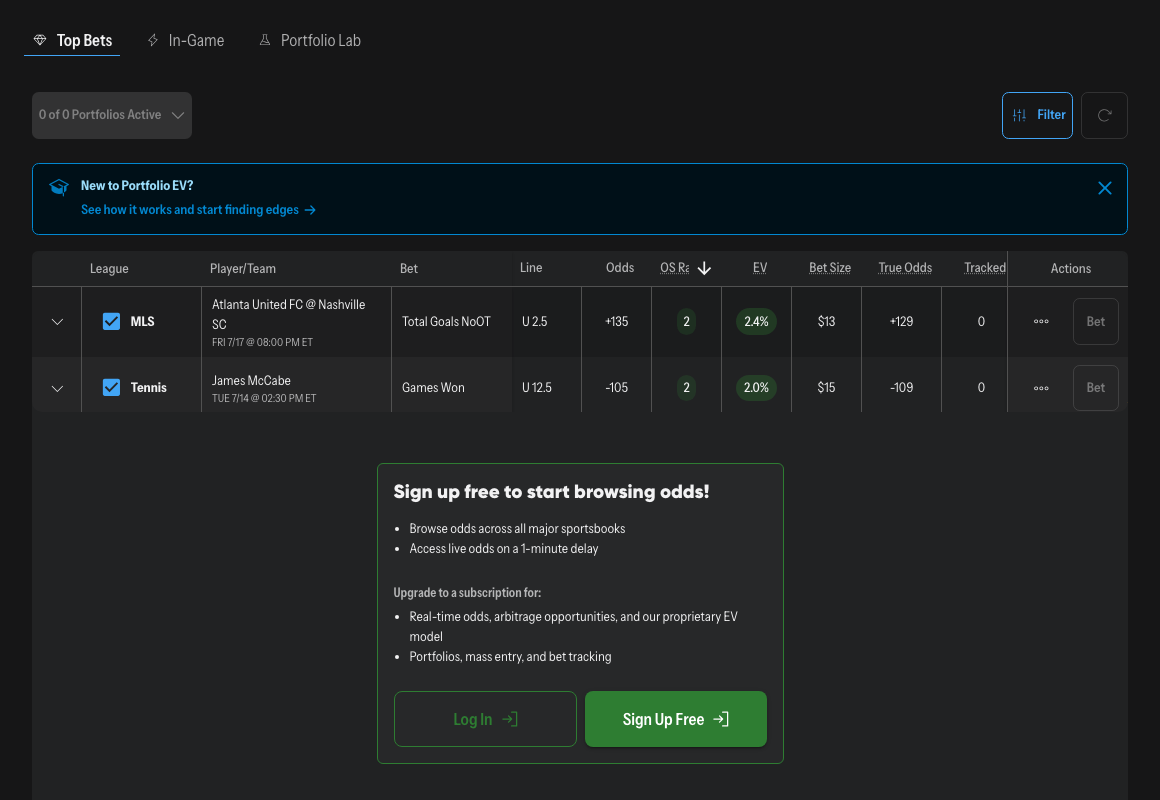
The OddsShopper +EV Screen.
Think of it as the break-even line. If a bet is priced at -110, the book is telling you that you need to win this wager about 52.4% of the time just to come out even over the long run. Not 50%. The price has already moved the bar. Anything below 52.4% and you lose money betting it repeatedly; anything above, you make money. The implied probability is that bar.
This is the single most useful number in betting because it converts every price, in every format, onto one common scale. A casual bettor sees "-110" and "+150" as two unrelated symbols. Once you convert them to 52.4% and 40%, you can line them up against each other, against a third book's number, and against your own read on the game. Everything downstream (finding value, removing the vig, line shopping) depends on first being able to ask the simple question: what win rate is this price actually charging me for?
How To Convert American Odds To A Win Percentage
American odds come in two flavors, and each has its own formula. They are both quick enough to run on a phone calculator.
Negative odds (favorites, e.g. -150). The minus sign means you risk that amount to win $100. The implied probability formula:
implied % = (−odds) / (−odds + 100)
Take -150: 150 / (150 + 100) = 150 / 250 = 60.0%. A -150 favorite is priced as a 60% proposition.
Positive odds (underdogs, e.g. +150). The plus sign means a $100 stake wins that amount. The formula flips:
implied % = 100 / (odds + 100)
Now flip to +150: 100 / (150 + 100) = 100 / 250 = 40.0%. The +150 underdog is priced at 40%.
Notice those two add to exactly 100% in this clean illustration, because I used mirror-image numbers. Real markets rarely line up that politely, and the reason why is the whole point of a section further down.
A couple more worked examples, because reps are how this becomes automatic:
- +200:
100 / (200 + 100)=100 / 300= 33.3%. A nice rule of thumb: +200 is roughly a one-in-three shot. - -200:
200 / (200 + 100)=200 / 300= 66.7%. The favorite side of that same line. - -110:
110 / (110 + 100)=110 / 210= 52.4%. The standard "juiced" price you see on almost every spread and total.
How To Convert Decimal And Fractional Odds
If you bet international markets, soccer, or use an exchange, you will run into decimal and fractional odds. The good news: decimal is the easiest conversion in all of betting.
Decimal odds. The implied probability is just the reciprocal:
implied % = 1 / decimal
A 2.50 price gives 1 / 2.50 = 40.0% (the same as +150, because they are the same price in different clothing). A 1.91 gives 1 / 1.91 = 52.4%, which is -110 in decimal form. And an even-money 2.00 gives 1 / 2.00 = 50.0%. One division and you are done. Decimal is the one conversion I still do in my head on the fly, because an exchange screen gives you no other choice and a single division is faster than reaching for an app.
Fractional odds. Common in the UK and horse racing, written like 3/1 or 1/2. The formula:
implied % = denominator / (numerator + denominator)
Here 3/1 gives 1 / (3 + 1) = 25.0%, and 1/2 gives 2 / (1 + 2) = 66.7%. Same answer you would get converting the equivalent American or decimal price, which is the reassuring part: implied probability is format-agnostic. A price is a price, and it always implies one win percentage no matter how it is written.
A Quick-Reference Table: Common Odds To Win %
You do not need to memorize the formulas if you internalize the shape of the curve. Here are the prices you will see most often, with their decimal equivalents and implied win percentages. Bookmark it.
| American Odds | Decimal Odds | Implied Win % |
|---|---|---|
| -400 | 1.25 | 80.0% |
| -300 | 1.33 | 75.0% |
| -200 | 1.50 | 66.7% |
| -150 | 1.67 | 60.0% |
| -110 | 1.91 | 52.4% |
| +100 (Even) | 2.00 | 50.0% |
| +120 | 2.20 | 45.5% |
| +150 | 2.50 | 40.0% |
| +200 | 3.00 | 33.3% |
| +250 | 3.50 | 28.6% |
| +300 | 4.00 | 25.0% |
| +500 | 6.00 | 16.7% |
Decimal odds are rounded to two places; each implied win % is computed from the exact American price, so a -110 line reads as 52.4%.
The takeaway you should feel in your gut after staring at this: bigger underdog prices imply small win percentages, and you only need them to hit occasionally to profit. A +500 dog (16.7%) that you believe is really a 25% chance is a strong value if your estimate is sound, even though it should still lose about three out of four times over a large sample. The price, not the win-loss record, is what makes it good or bad.
New to OddsShopper?It scans 100+ sportsbooks and converts every price to an implied win % for you, then flags the bets where the price is paying more than the outcome is worth. You can try it free for 7 days, and code IMPLIED20 takes 20% off your first payment of OS Pro or OS Core if you subscribe.
On a CFTC-regulated prediction market the conversion is even simpler: a contract's price in cents is its implied probability. Here is how Kalshi odds convert to American odds.
Why The Two Sides Add Up To More Than 100%
Here is the part that trips up almost every new bettor. Take that standard spread priced -110 on both sides. Convert each side:
52.4% plus 52.4% = 104.8%
A fair two-outcome market with no push, like a standard two-way moneyline, should sum to exactly 100%, because one of the two things has to happen. This one sums to 104.8%. That extra 4.8 percentage points is not a math error. It is the sportsbook's margin, known as the vig (also called the juice, the hold, or the overround), and it is baked invisibly into the prices.
The book is effectively selling you 104.8% worth of "certainty" when only 100% exists. That padding is how the book builds its long-run margin, and it is why blindly betting either side of a -110 market is a slow leak even if you are right slightly more than half the time. At -110 you need to win about 52.4% of your graded (non-push) bets to break even, not 50%. The vig moved the goalposts.
So the implied probabilities a book posts are always a little inflated. To recover the true probability, you strip that margin back out, a process called removing the vig. The short version, using the simplest approach (the proportional method): convert each side to implied probability, add them up, then divide each side by that total to renormalize back to 100%. For the -110 / -110 case, 52.4 / 104.8 = exactly 50% on each side, the fair number. Seeing it side by side makes the move obvious:
| Side | Raw Implied % | Fair (No-Vig) % |
|---|---|---|
| Side A (-110) | 52.4% | 50.0% |
| Side B (-110) | 52.4% | 50.0% |
| Total | 104.8% | 100.0% |
We walk the full devig math, including lopsided favorites and three-way soccer markets, in no vig odds: how to remove the vig. For this guide, the thing to hold onto is simpler: the raw implied probability includes the book's tax, and the fair probability is what is left after you remove it.
How Implied Probability Helps You Find Value
This is where the math stops being trivia and starts being money. Once you can turn any price into a percentage, you can compare it to your own estimate of how likely the outcome is. That comparison is the entire engine of profitable betting.
The rule is short:
If your estimated probability is higher than the price's implied probability, the bet has value. If it is lower, pass.
Say you have done your homework on an MLB game and you think the underdog wins 48% of the time. You check the board and the best price is +120, which implies 45.5%. The market is pricing the team at 45.5% when you believe it wins 48% of the time, so you are getting paid more than the outcome is worth. You have found a positive expected value bet, the foundation of our entire approach to +EV. Flip it: if your estimate was only 42% and the price still implied 45.5%, there is no bet. The book is asking you to pay for more certainty than you believe exists. One more step sharpens the read: that 45.5% still has the book's margin baked in, so the market's true opinion of the underdog is a shade lower. Devig the full market and the gap your 48% estimate identified gets a touch wider, not narrower.
Two honest caveats keep this from being a fantasy. First, your estimate has to be good, and a single book's price is itself a strong estimate, so beating it consistently is hard work, not a hunch. The sharper benchmark is the no-vig price devigged across several books, not one book's padded number. Second, this is an edge over a large sample, not a promise on any one night. A +EV bet still loses plenty of individual wagers. You are betting the price, and the price plays out over hundreds of bets, not one.
For more on this, see What Is A Futures Bet? Payouts, Vig, And When To Bet.
There is one more lever that compounds all of this: line shopping. The implied probability of a bet changes with the price, so getting +145 instead of +130 on the same team lowers the win rate you need to profit and turns marginal bets into clear ones. Always take the best available number across books; the OddsShopper odds screen puts every book's price on one row so that habit runs itself. A better price is a lower break-even percentage, free of charge.
Do It Instantly: The Betting Odds Calculator And Portfolio EV
You can convert any single price by hand in a few seconds, and you should do it enough times that the common ones (52.4%, 40%, 33.3%) live in your head. What you cannot do by hand is convert every price on every book for every game, devig each market, and compare it to a fair estimate before the line moves. Here is the work the tools carry:
- Betting Odds Calculator: paste any American, decimal, or fractional price and it returns the implied win % instantly, in every format at once. It is Step 1 of this whole article, automated.
- EV Calculator: feed it the fair no-vig probability and the price you can actually get, and it returns the bet's expected value, the exact comparison this article is built around.
- Portfolio EV (OS Pro): the full version. The tool scans every book we track in real time, converts and devigs each market against a sharp multi-book consensus, and surfaces the live bets where the price implies a lower win % than its fair-probability estimate, ranked by edge. A transparent record of wins and losses, not cherry-picked screenshots, is the part I would want to see before trusting any EV product.
The hand-math in this article is the understanding. The tools are the execution, and at the speed real markets move, execution is most of the game.
More on this: Prediction Market Prices: Kalshi's Probability In Shoes · Best +EV Bet Tracker: What To Look For (And What Most Skip) · Closing Line Value Vs. Variance: Your P&L Is Lying To You · Devig Calculator: Find Fair No-Vig Odds From -110 Prices · How To Bet On Horses: 6 Horse Racing Bet Types Explained
Frequently Asked Questions
What is implied probability in betting? Implied probability is the win percentage a betting price assumes. It is the break-even rate: the share of the time you would need to win that bet to profit long-term at that price. Converting every price to a percentage puts all formats on one scale so you can compare them to each other and to your own read on the game.
How do you convert betting odds to a probability? Use the formula that matches the format:
- American, Negative (Favorite):
(−odds) / (−odds + 100) - American, Positive (Underdog):
100 / (odds + 100) - Decimal:
1 / decimal - Fractional:
denominator / (numerator + denominator)
The Betting Odds Calculator runs all four for you in any format.
What does -110 imply as a percentage?
A -110 price implies about a 52.4% win probability: 110 / (110 + 100) = 110 / 210 = 52.4%. It is the break-even rate on the standard juiced price you see on most spreads and totals, which is why you need to win more than 52.4% of your -110 bets to come out ahead.
Why do both sides of a market add up to more than 100%? Because the sportsbook builds its margin (the vig or juice) into both prices. A -110 / -110 market implies 52.4% plus 52.4% = 104.8%, and that extra 4.8 percentage points is the book's built-in margin. A fair two-outcome market should sum to exactly 100%, so you remove the vig to recover the true probability. See how to remove the vig.
How do I use implied probability to find a value bet? Convert the price to its implied probability, then compare it to your own estimate of the outcome's chance. If you believe the outcome is more likely than the price implies, the bet has positive expected value. If your estimate is lower, pass. The bigger and more reliable that gap, the better the bet. The full theory is in our guide to finding +EV bets.
Is the implied probability the same as the true probability? No. The raw implied probability includes the sportsbook's margin, so it is slightly inflated. The true (fair) probability is what remains after you remove the vig, ideally across a consensus of several sharp books rather than one. The implied number is your starting point; the no-vig number is the benchmark you actually bet against.
Want to skip the hand-math? Converting one price at a time is the right way to learn implied probability, but you cannot clear every book by hand before the edges close. OS Pro does it for you: the Betting Odds Calculator converts any price to a win % in every format, and Portfolio EV scans 100+ sportsbooks in real time, devigs each market, and ranks the live bets whose price implies a lower win rate than its fair estimate of the outcome. Try it free for 7 days, and use code IMPLIED20 for 20% off your first payment of OS Pro or OS Core. 21+ and legal where regulated. If you or someone you know has a gambling problem, call 1-800-GAMBLER. Bet responsibly.