The first thing I tell anyone new to futures is the part nobody mentions up front: a futures bet ties up your money for months, and the sportsbook holds a much bigger edge on it than on a normal game. Both are fixable once you understand the math, so here is everything I wish I had known before locking up that first stake.
The Quick Answer
A futures bet is a wager on a long-run outcome — a champion, a division winner, an MVP or other award, or a team's season win total — that settles weeks or months after you place it, with the payout locked at the odds you took ($100 at +1000 returns $1,100). The catch is twofold: your stake is tied up until the market grades, and the sportsbook's built-in margin on a futures board is several times steeper than on a game line, which makes shopping for the best available price the single biggest edge you have. The full payout table, the vig math the books hope you never run, and the honest case for (and against) hedging are all below.
What Is A Futures Bet?
A futures bet is a wager on an outcome that gets decided in the future rather than tonight: who wins the championship, who takes a division or conference, who wins MVP or another award, or whether a team finishes over or under its projected season win total. You place it now, the result lands weeks or months later, and the ticket pays only when that long-term outcome is settled.
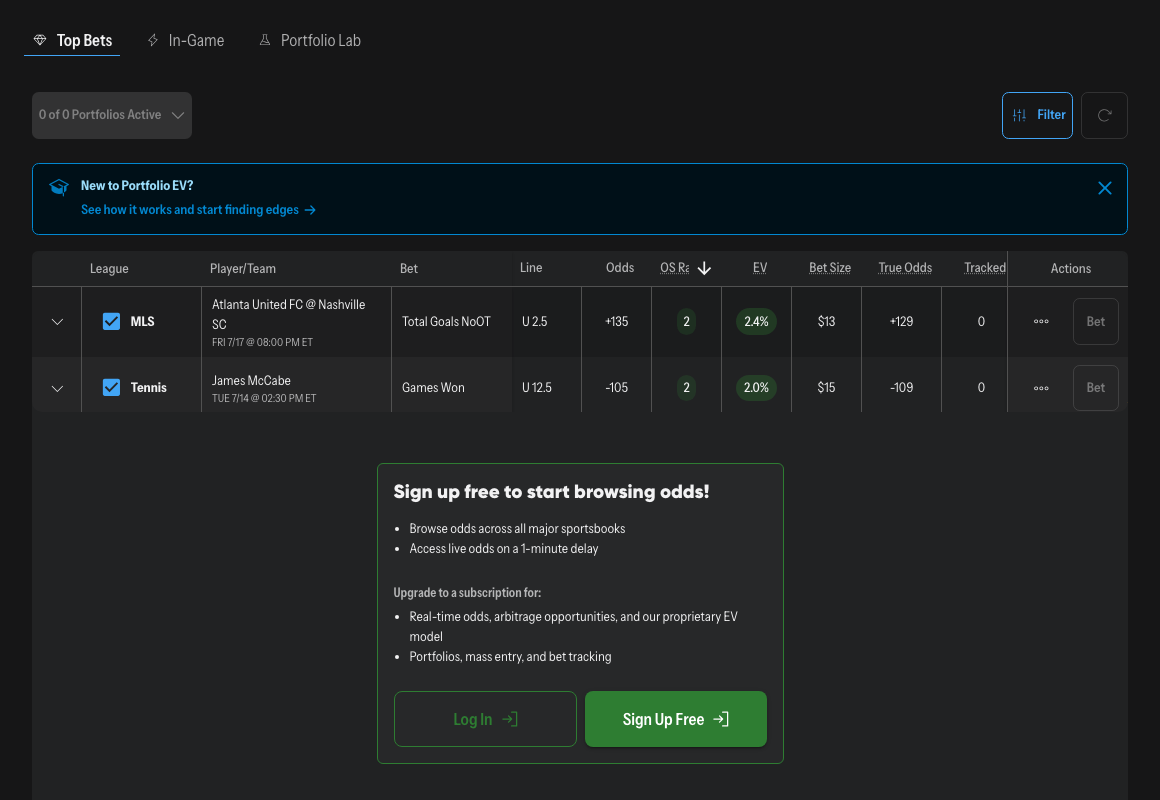
The OddsShopper +EV Screen.
These markets exist across every sport, and they fall into a few common types:
- Championship Futures — who wins the whole thing: the Super Bowl, the World Series, the NBA title, the Stanley Cup, a World Cup.
- Division, Conference, And Qualification Futures — who wins a division, who reaches the final, who makes the playoffs.
- Award Futures — MVP, Rookie of the Year, Cy Young, top scorer, Coach of the Year.
- Season Win Totals — an over/under on a team's regular-season wins (an NFL team set at 9.5, an MLB team at 86.5). Our NFL win totals and college football win totals guides break down how to handicap this market specifically.
The same shape shows up in baseball, football, basketball, hockey, golf, and soccer alike. Football offers the deepest futures menu most bettors will ever see: Super Bowl, conference, division, win totals, and awards all trade year-round. Our NFL futures betting guide walks that board sport-specifically once you have the fundamentals from this page. If the question is "who wins the whole thing" or "how does the full season turn out," you are looking at a futures market.
The mechanics differ from a single game in three ways that drive everything else in this guide: the payout is usually much bigger, your money is committed for a long time, and the book's margin is wider. Understand those three and you understand futures betting.
How Futures Odds And Payouts Work
Futures prices are quoted in the same American odds you see on any bet line, so reading them is no different from reading a game line. If you want the full refresher, our guide on how to read betting odds walks through plus and minus prices step by step. The short version: a plus number tells you the profit on a $100 stake, and the size of that number tracks how unlikely the book thinks the outcome is.
Worked Example: What A $100 Futures Ticket Pays
Here is how a $100 stake pays out across a range of typical futures prices, with the implied probability each one carries:
| Odds (American) | $100 stake returns | Profit | Implied probability |
|---|---|---|---|
| +150 | $250 | $150 | 40.0% |
| +500 | $600 | $500 | 16.7% |
| +1000 | $1,100 | $1,000 | 9.1% |
| +2500 | $2,600 | $2,500 | 3.8% |
| +10000 | $10,100 | $10,000 | 1.0% |
(Implied probability for a plus price is 100 ÷ (odds + 100), rounded here to one decimal.)
Two things to take from that table. First, the payout climbs fast as the price lengthens, which is the appeal: a small stake on a +2500 champion returns 26 times your money if it hits. Second, that long price is long for a reason. The implied probability is the share of the time the book is pricing it to win, and at +10000 the book is saying this happens about 1 time in 100. The big number is exciting, but it is attached to a small real chance, and that is the trade you are making.
One reason I love futures as a teaching tool: because the prices are so spread out, the difference between a good number and a bad number is enormous in dollar terms. Backing a team at +1200 instead of +1000 is not a rounding error. Win that ticket and the better number puts an extra $200 in your pocket for the exact same bet. That is why the price you get is the whole game, a point I will come back to.
Why Your Money Is Tied Up Until It Settles
The part beginners underrate most: when you place a futures bet, that stake is gone from your bankroll until the market settles, and a season-long market can take months. A World Series future placed in spring does not resolve until the fall. A win-total bet is not graded until the team plays its final regular-season game.
It is an opportunity cost, not just a waiting game. The same $100 sitting on a six-month future could have been turned over dozens of times on shorter bets in that window, each one a fresh chance to find a good price. Sharp bettors think about this constantly, because money that is locked up is money that is not working. It does not make futures bad; it just means you should size them with sound bankroll management in mind and not commit a stake you would rather have churning week to week.
The hidden cost of a futures ticketa stake parked on a six-month future is money that cannot chase the next good price all season. Size your futures for that long hold, and never lock up cash you would rather have working week to week.
Many major sportsbooks now offer a "cash out" on futures before they settle, which lets you take an early amount that is usually shaded below the ticket's fair value — we cover the mechanics in cash out betting explained. Treat that with suspicion. The book only offers it because it is profitable for the book, and the price it gives you back is in its favor, not yours. I will cover the one situation where stepping out early actually makes sense in the hedging section below.
Why The Vig Is Higher On A Futures Board
This is the most important and least understood part of futures betting, so it is worth slowing down. Every sportsbook bakes a margin into its prices, called the vig or juice. On a standard two-way game line, that margin is small. Add up the implied probabilities of both sides of a typical line and you get roughly 105%, meaning about a 5% overround in the book's favor.
A futures board is a different animal. There might be 30 teams listed to win a title, and when you add up the implied probability of every single one, the total does not come to 100%. It often comes to 130%, 140%, or more. That extra 30% to 50% on top of a fair 100% is the book's edge, and it is baked into every price on the board. The longer the list of options, the more places the book hides its margin.
What that means in practice: futures prices are, on average, worse relative to the true odds than the prices on a single game. You are paying a bigger tax for the privilege of the big payout. The defense is the same skill that beats any market, removing the vig to see the fair price underneath the offered one. Our walkthrough on how to remove the vig shows the arithmetic; the OddsShopper de-vig and Portfolio EV tools do it for you across a full board in seconds. Until you strip the juice out, you cannot actually tell whether +1000 is a gift or a trap.
The one-line versionon a game line the book's margin is about 5%; on a 30-team futures board it can be 40% or more. That is why finding the best available number matters far more on futures than on anything else you bet.
Buying Low Early Vs. Hedging Late
Timing is where futures betting turns from a guess into a strategy, and it has two sides.
Buying low early means taking a price before the rest of the market catches up to it. Futures odds drift all season as teams win, lose, get hurt, and make moves. A contender priced at +1500 in spring might be +600 by midsummer if it starts hot. If you saw the value first and bought at +1500, you are holding a number nobody can get anymore, and your ticket is worth more than what you paid for it on paper. The earlier you are right, the longer and better the price you lock.
Hedging late is the other side. Say that +1500 ticket is now one round from a championship and the team is a short favorite to finish it. You can place a second bet on the other outcome to take some money off the table regardless of which side wins. Hedging does not maximize your long-term expected value; in fact it gives a little of your edge back, because you are paying the book's vig a second time to buy certainty. That is the honest trade-off, and it is why hedging is not a routine move.
The early-vs-late arc in one lineearly in the season you are hunting the longest fair price on the board; late in the season, if you are still alive, you are deciding whether certainty is worth handing a slice of that edge back. Both decisions are about price, not prediction.
So when is hedging worth it? When the locked amount is large relative to your bankroll and the certainty is worth more to you than the last sliver of value. Turning a live +1500 longshot into a smaller-but-certain return can be the right call when that money would change your month, not just your ledger. If it is a modest stake you can comfortably let ride, hedging usually just hands the book extra juice. If you do decide to hedge, our how to hedge a bet guide shows how to size the second leg so the outcome is even on both sides, and the hedge bet calculator does that arithmetic for you.
Futures Bets Vs. Straight Bets And Props
It helps to see them side by side, because the differences are what make futures their own discipline rather than just a bigger version of a game bet.
| Straight bet (single game) | Futures bet | |
|---|---|---|
| What You Wager On | One game's result tonight | A season or tournament outcome later |
| When It Settles | Hours | Weeks to months |
| Typical Payout | Modest | Large, with longshots paying 10x or more |
| Book's Vig | About 5% on a two-way line | Often 30% to 50% across a full board |
| Money Tied Up | Brief | The whole season |
| Where The Skill Is | Beating one number | Timing the price and shopping a wide board |
Neither is better. They are different jobs. A straight bet is a fast, low-margin turn of your bankroll (the same logic behind why straight bets beat parlays for most bettors). A futures bet is a slow, high-margin, high-upside hold where being early and getting the best number do most of the work. I run plenty of both, and I size my futures smaller precisely because the money is committed longer and the vig is steeper.
A prop is the third tool people lump in here, and it is worth separating cleanly. A prop bets a specific occurrence rather than an outcome: a player to throw over 1.5 touchdowns, a team to score first, a pitcher's strikeout total. Most props settle inside a single game, so they behave like straight bets on the timeline; your money frees up in hours. The one overlap is the season-long prop, like a player to hit 40 home runs over the full year, which settles months out like a future. The simple tell: if you are betting how the whole season or tournament ends (a champion, an MVP, a win total), it is a future; if you are betting a particular event (a stat line, a first score), it is a prop, even when it takes a season to grade.
Where Line Shopping Matters Most
If you take one habit from this whole guide, make it this one: shop every futures price across multiple books before you bet. Line shopping is simply taking the best available number for the exact bet you want, and it is free expected value because the bet is identical no matter where you place it.
It matters everywhere, but it matters most on futures. With a single game line, the best price might be a handful of points better than the worst. On a futures board, because the prices are so long and the books disagree so much, the same team to win a title can sit at +1000 at DraftKings while FanDuel hangs +1400, with BetMGM and Caesars parked somewhere in between. Betting the +1400 instead of the +1000 is the same wager for $400 more profit on a winning $100 ticket. Nobody should ever leave that on the table, yet most casual bettors place the first price they see at the one app on their phone.
That is exactly the gap the OddsShopper odds screen is built to close. It lines up the same market across 100+ sportsbooks — the tool surfaces the best available number on the board and how much vig each book has baked in — so the right price is in front of you instead of buried in a dozen apps you would have to check by hand. For a concrete worked example of a real futures board in action, our World Cup futures guide walks through how the prices move and where the value tends to hide.
New to OddsShopper?It scans 100+ sportsbooks at once and shows you the best available price across the board, plus how much vig is baked in so you can see the fair number underneath. That +1000 vs. +1400 gap from a minute ago — the $400 swing on one winning $100 ticket — is precisely the kind of spread it exists to catch. You can try it free for 7 days, and code SMARTBET20 takes 20% off if you subscribe.
How I Actually Approach A Futures Market
When I sit down to bet a future, the process is the same every time:
- Find the value. Pick the team or player I think the market is underrating.
- Shop every book. Check the price everywhere instead of accepting the first one I see.
- Remove the vig. Run the board through a de-vig so I know the fair number behind the offered price.
- Only fire if it beats fair. If the best available price beats that fair number, I have a positive expected value (+EV) bet. If it does not, I pass, because the big payout is not worth chasing once the book's margin has swallowed the edge.
Then I size it for the long hold. Because the money is committed for months and the vig is steep, my futures stakes are smaller than my game-line bets, and I never commit cash I would rather have turning over week to week. That discipline, more than any single pick, is what keeps futures betting fun instead of a stake I resent watching sit there all season.
Frequently Asked Questions
What is a futures bet in simple terms? It is a bet on something that gets decided later in the season or tournament rather than in tonight's game, like who wins the championship, who wins MVP, or whether a team beats its projected win total.
How do futures bets pay out? They pay at the American odds you locked when you placed the bet. A $100 stake at +1000 returns $1,100, your original $100 plus $1,000 in profit. The longer the price, the bigger the payout and the smaller the implied chance.
When do futures bets pay out? When the long-term outcome is settled, which can be weeks or months after you place the bet. A season-long market like a champion or a win total is not graded until that season or tournament ends.
Why is the vig higher on futures? Because a futures board lists many outcomes, and the implied probabilities of all of them added together can reach 130% to 150% instead of the roughly 105% on a two-way game line. That extra margin is the book's edge, hidden across every price.
Should I hedge a futures bet? Only when the locked amount is large relative to your bankroll and certainty is worth more to you than the last bit of value. Hedging gives a little expected value back to the book, so it is a deliberate choice, not a default move.
Can I bet futures early or should I wait? Buying early lets you grab a long price before the market corrects, which is where a lot of futures value lives. Waiting can make sense if you expect a team's price to lengthen, but if you already see the value, taking the better number early is usually the stronger play.
More on this: Kalshi Perpetual Futures: Leverage, Funding And What Can Liquidate You · Event Contracts Vs Futures And Options: Same Question, Two Payoff Shapes · Kalshi NFL Futures Vs Sportsbooks: Where The Edge Is · NFL Futures Betting: Odds, Holds, Bankroll & Timing · World Cup Futures Picks: Ivory Coast, Colombia, Japan
The Bottom Line
A futures bet trades a long wait and a steeper house margin for a much bigger potential payout. Win the timing by buying value before the field catches up, win the math by removing the vig and only betting prices that beat the fair number, and claim the easiest edge by always shopping for the best line, because nowhere does the best price matter more than on a futures board.
That last part is the easiest edge to claim and the one most bettors skip: remember, taking +1400 over +1000 was worth an extra $400 on a single $100 ticket. OddsShopper scans 100+ books so that best futures number is handed to you instead of hunted for. Try it free for 7 days, then code SMARTBET20 takes 20% off if you stick around.
Betting involves risk and is intended for those 21+ in regulated markets where legal. Bet within your means.