Every offseason, months before a single National Football League game kicks off, sportsbooks post a season-win number for all 32 teams and let you bet the over or the under. Those NFL win totals are one of the more approachable corners of the futures board, because unlike a Sunday point spread that the whole sharp market hammers into shape by kickoff, a win total is a slow, months-long market that the books post early and defend with small limits. This guide walks through how NFL win totals and futures actually work, when the numbers post and move, and the repeatable ways to find an edge before the market catches up.
TL;DR: How To Bet NFL Win Totals
- What They Are: a season-long over/under on a team's regular-season wins across all 17 games, posted as a half-win line like 8.5 so there is no push. Playoffs never count toward NFL season win totals.
- Why They're Beatable: books post them months early, before rosters are fully settled through free agency, the draft, and camp, and they defend those soft numbers with low limits.
- Where The Edge Lives: lead your read with the quarterback, then roster and coaching changes, then the schedule, then regression off last year's one-score-game luck.
- How To Find The Best Over And Under Bets: build your own win number game by game, then bet only the gap between your number and the posted line — and shop that number across books, because half a win is a different bet entirely.
- When To Bet: earlier is usually better; the softest numbers get bet and moved as camp news lands over the summer.
I walk through each of these below, then run a full worked example so you can build a number yourself.
What An NFL Win Total Is
A win total is a futures bet: the book posts a number for a team's regular-season wins, almost always as a half-win line so there is no push, and you bet whether the real total finishes over or under it. Set a team at 8.5 and the over needs nine wins or more, while the under needs eight or fewer. On the rare whole-number total, a team landing exactly on the number pushes and your stake comes back. The number covers the 17-game regular season only, so playoff results never count toward it. One tell I read on any total is the limit: when a book will only take a small max bet on a number, it is telling me the number is soft and it wants to see the money before it commits.
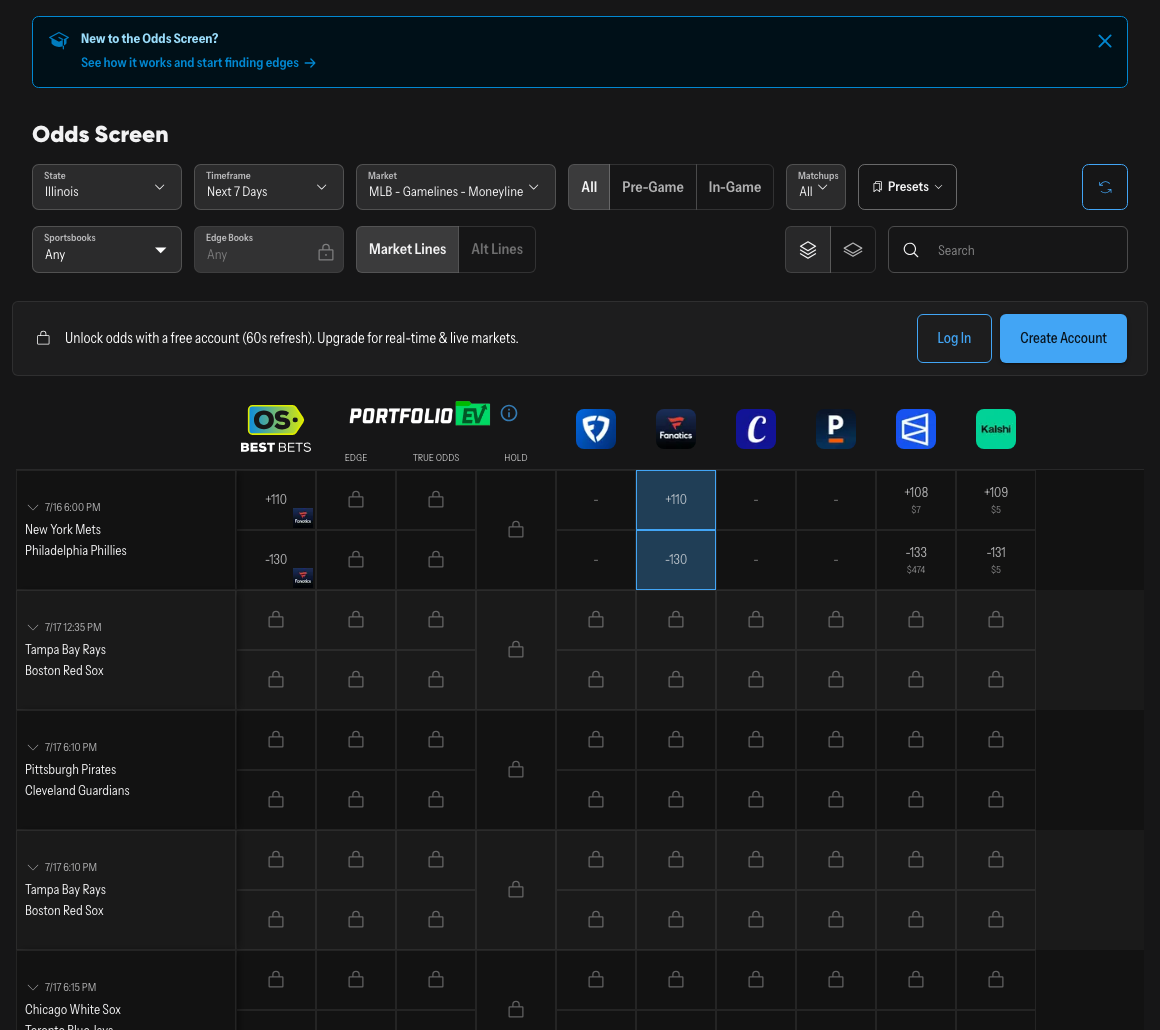
The OddsShopper Odds Screen.
On the board it looks like this"Regular Season Wins O/U 8.5, over -120 / under +100." You are simply betting whether the team clears 8.5 wins across its 17 games, and the price on each side tells you how the book leans.
Two things separate a win total from a normal game line. First, it carries vig like any market, and that vig often sits heavier on the over, because the public loves backing a team it expects to have a big year. Second, your money is tied up for months. A win total does not settle until the regular season ends in early January, so you are trusting the operator to hold that ticket from spring all the way to Week 18. That long settlement window is a real cost. A futures ticket also ties your bankroll up with the operator for months, so the book's reliability and the opportunity cost of that locked-up money are part of the bet, not a footnote.
Why NFL Win Totals Are Softer Than The Sunday Line
The main NFL market is about as efficient as betting gets. A Sunday spread is priced, bet, and re-priced by sharp money all week, so finding a real edge on a headline side or total is brutally hard. Season win totals are a different animal. They get posted in the spring, before free agency, the draft, and training camp have settled what a roster and a schedule actually look like, and the book cannot sharpen a full-season projection the way it sharpens one three-hour game.
Because the books know these early numbers are soft, they defend them with low limits. A small maximum bet is a tell: it means the number has not been battle-tested, and the shop wants to see where the money goes before it moves the line. The markets an operator is least comfortable booking, such as early win totals, preseason lines, and draft props, are exactly where diligent research can get ahead of the number, which is why they carry the tiniest limits on the board.
| NFL Sunday game line | NFL win total | |
|---|---|---|
| When It Is Priced | Sharpened all week to kickoff | Posted in spring, months early |
| Market Efficiency | Very tight, tough to beat | Softer until the market corrects |
| Typical Limits | Higher | Low, a soft-market tell |
| Where The Edge Lives | Rare | Roster, schedule, and regression the number lags |
One caution before you get excited: soft does not mean "just fade the public." Blind contrarian betting is a dead edge in modern markets. The number is beatable because the market is less efficient and posted early, not because the popular side is automatically wrong. Your job is to find the specific gap between the posted number and a realistic season, then bet only that gap.
When Books Post And Move NFL Win Totals
Timing is half the edge on this market. The first NFL win totals usually surface from late winter into spring, priced off last season's results before the roster, the draft, and the schedule are fully baked in. From there the number moves in waves: free agency reshapes a depth chart, the draft adds a rookie quarterback or a difference-making defender, the May schedule release sets the game order, travel, and rest spots, and training-camp and preseason news, especially an injury to a starter, can swing a number a full win late in the summer.
The practical lesson is to attack a soft number early. Early money on these low-limit markets is often the sharper money, and a win total you like in February frequently gets bet toward your side as the market corrects over the summer. If your number is still the good side when the line closes in Week 1, that is closing line value, one of the strongest signals that your read beat the market rather than just caught a lucky bounce. Wait until August and you are frequently betting a number that has already been sharpened by everyone who moved first.
New to OddsShopper?The tool scans every major US sportsbook and shows the no-vig fair price next to the best available number, so the line-shopping this guide teaches happens automatically. You bring the projection; it does the price comparison. You can try it free for 7 days, and code NFLWINS20 takes 20% off OS Pro or OS Core if you subscribe.
Roster And Coaching Changes Are The Biggest Movers
Start where the number moves most. More than any other sport, the NFL is a quarterback league, and quarterback is where win totals swing hardest. Upgrading from a replacement-level starter to a franchise passer can be worth multiple wins on its own, and the number does not always move fast enough when a team lands one in the draft or a trade. The reverse is just as sharp: a team losing its starter to a departure or a summer injury, with only an unproven backup behind him, tends to be priced above where the new depth chart deserves.
Lead your read with the quarterback.Before you weigh anything else on a win total, ask what changed at passer. A quarterback upgrade or downgrade is usually the single biggest swing on the number, and the market is often slow to fully price it.
Coaching and scheme changes reset a team, and the market often prices that reset with a lag, still reflecting last year's staff and system. Continuity along the offensive and defensive lines matters too, since trench play travels year to year better than headline skill talent. The first question I ask on every number I bet is what changed at quarterback, and only once that roster baseline is set do I let anything else into the projection.
Read The Schedule And Strength Of Schedule
With that roster baseline in hand, the next step is to translate it through the 17-game schedule, because the same team banks a very different number of wins behind an easy draw than a brutal one. Many games fall cleanly into the clear-win or clear-loss bucket and barely move the number. The season turns on the handful of near-coin-flip games, and projecting those is the whole exercise.
Work through the full schedule and sort every game into three buckets: the clear wins, the clear losses, and the toss-ups. Two soft home matchups and a date with a rebuilding division rival project as clear favorites; a road trip to a reigning conference champion projects as a probable loss. Those barely move your total. The whole exercise lives in the context that swings the toss-ups:
- Divisional Games are played twice and stay tighter than the talent gap suggests, so a team in a strong division banks fewer easy wins than its roster implies.
- Scheduling Traps quietly cost wins: a brutal three-game road stretch, a short-week Thursday game after a physical Sunday, and poor bye-week placement all bleed a win or two off an otherwise fine roster.
- Soft Draws Pad Totals: a friendly opening stretch and a late-season run of home games can lift a mediocre team over a number its talent alone would not clear.
A roster can return every starter and still miss its over behind a gauntlet schedule, which is why even a strong-roster read has to be priced against the real schedule. Price the game-by-game path on the NFL odds screen rather than trusting last year's win total.
Regression: Last Year's Record Lies
Win totals over-anchor to last season's record and the offseason narrative, and that is a recurring, mechanical source of value. The single most useful correction is to strip out one-score-game luck.
- A Team That Overachieved Gets An Inflated Total. Records in one-score games regress toward the mean year to year. An 11-win team that went 8-1 in games decided by a touchdown or less is priced like an 11-win team, but its underlying play looked closer to an eight-win team that caught the bounces. The market sells you last year's luck at a premium.
- A Collapsed Team Gets A Suppressed Total. The same regression runs the other way. A roster that lost a stack of close games, or turned over its coaching staff, is often still priced like the wreckage that got the old regime fired, even after it reloaded.
- Brand And Hype Inflate Overs. A marquee franchise draws public money onto its over regardless of the roster, and that money, stacked on the natural over-vig, pushes the number past fair.
Point differential is a better guide to a team's true level than its record, so a club whose win-loss mark badly outran how it actually played on the field is a prime regression candidate. The discipline is to quantify the gap rather than bet the story. An overreaction is only an edge if your own projection of the schedule lands a full win or more off the posted number.
Build Your Own Number: A Worked Example
Everything above rolls into one repeatable process, and it is the one our team runs on every win total we bet: build your own number, then bet only when the market disagrees with it. Go through the 17-game schedule one game at a time, assign each a simple lean of clear win, clear loss, or toss-up, and give the toss-ups a rough win probability. Add it up. That expected-wins figure is your number, and the bet lives in the gap between it and the posted total.
Here is what that looks like for a generic playoff-hopeful team with a manageable draw:
| Bucket | Games | Expected wins |
|---|---|---|
| Clear Wins (Soft Matchups And Weak Division Games) | 8 | ~6.6 |
| Toss-Ups (Near Coin-Flip Games) | 5 | ~2.5 |
| Clear Losses (Playoff-Caliber Opponents On The Road) | 4 | ~0.9 |
| Your Projected Total | ~10.0 |
If your process lands at 10 wins and the book hangs the total at 8.5, the over has value. If you project seven and the number is 9.5, the under does. Building a number keeps you honest. It turns "I think they'll be good" into a defined edge you can size and shop, and it stops you from backing a team you like at a price that already bakes in the good season. Size that bet to the edge and your bankroll, never to how much you like the team, and if you are new to staking, our bankroll guide covers how to set unit sizes.
Shop The Number And Respect The Juice
In my experience, few markets vary book to book like season win totals, where even half a win or a few cents of juice can change the bet. One book might hang a team's over at 8.5 while another posts it at 9.5, a full win of cushion apart, and even at the same total the price can swing from -110 at one shop to +105 at the next. Those are different bets entirely, and the bettor who does not compare is leaving real edge on the table. The check I run before I bet is to de-vig the two-way price: strip the vig out of the over and under to get the market's implied probability on each side, then compare that to the odds my own projection gives the team to clear the number. The side is only worth backing when my projection is more confident than the no-vig price by more than the juice, so de-vigging tells me the market's honest line, not by itself which side to take. Run that comparison across DraftKings 🎁, FanDuel 🎁, BetMGM 🎁, and Caesars before you bet, because the fair price can flip which side has value from one book to the next. The over also often carries the heavier juice, so it needs a bigger projected gap than an under to clear the price.
One shopping note: the widest price gaps show up right when a number is posted, before the books converge on each other, so the earlier you compare a total you like, the better your odds of catching an outlier number one shop hung a step off the field.
The bottom line on pricethe same team's win total is a bet at one number and a pass at another, so shop it every time. Compare the futures number and the juice across every book you can bet, use the de-vigged fair price to judge which side has value, and lean on OddsShopper's NFL odds screen to price the game-by-game path behind your projection.
Win Totals Are Just One NFL Futures Market
Of the whole futures board, the win total is the most approachable market because you can rebuild the number yourself. A win total only asks you to project 17 games and add them up. A Super Bowl or division-winner price asks for far more: a full playoff bracket, how teams correlate against a shared schedule, injury tails across a four-month season, and the tie-breakers that decide a division on the last Sunday. That extra machinery is exactly where a casual model breaks down, which is why books can hang a longshot or a heavy favorite at a two-way price where both sides are bad at once, all of it protecting their hold and tying up your bankroll for months on the same counterparty. The win total hides none of that. Its inputs are the same schedule and roster you already read for a side, so a patient NFL futures bettor gets the cleanest shot at value here, on the one futures market whose fair number you can reconstruct from scratch. The rule I follow: cut your futures teeth on win totals, and only step up to division and Super Bowl markets once you can build a team's win number cold.
NFL Win Totals FAQ
What is an NFL win total? An NFL win total is a season-long over/under on how many regular-season games a team wins. The book posts a half-win number, such as 8.5, and you bet whether the team finishes over or under it. It is a futures bet, so your money stays tied up until the regular season ends, and only the 17-game regular season counts.
Are NFL win totals a good bet? They can be, because the market is softer than the NFL's Sunday game lines. Season totals get posted months early, before the roster and schedule settle, and the books defend them with low limits. Value comes from projecting the schedule and roster more carefully than the posted number does, then betting only when your projection disagrees.
When should you bet NFL win totals? Usually earlier rather than later. Limits are low, so the numbers you like tend to get bet and move as the offseason unfolds through free agency, the draft, and training camp. If your projection is a clear win or more off the posted total and the price is fair, that is the spot, and shopping for the best number matters more the longer you wait.
Do NFL win totals include the playoffs? No. Books grade win totals on the 17-game regular season only, so playoff games never count. Always confirm the grading rules at your book before you bet.
How do you find value in NFL win totals? Build your own number game by game, weigh the quarterback situation and roster changes above everything else, and look for teams whose total is over-anchored to last year's record or a hype narrative. Bet only when your projection disagrees with the posted number by a meaningful margin, and take the best price across books.
The Bottom Line
NFL win totals are softer than the Sunday line for a simple reason: the books post them months early, before rosters are settled and before the market has priced the schedule's order, travel, and rest spots, and they defend those unsharpened numbers with low limits. The edge is not a secret angle. It is a process. Read the schedule, lead with the quarterback and roster changes, respect that last year's record and the offseason hype distort the number, build your own total, and then shop for the best price on the side your projection likes. Do that and you are betting the gap between the number and reality instead of the storyline.
Ready to stop guessing at the number? OddsShopper compares NFL futures across every major US sportsbook and de-vigs each line, so you can see the fair price and the best available number side by side before you lock in a season-long ticket. Start a free 7-day trial, and code NFLWINS20 takes 20% off OS Pro or OS Core.
Betting involves risk. Bet responsibly, only what you can afford to lose, and know that no edge wins every ticket. 21+ where legal.
More on this: NFL Training Camp Betting: What August News Moves Lines · NFL Win Totals 2026: Kalshi Vs DraftKings Vs FanDuel Split · NFL Win Totals 2026 On Kalshi: Week Two Widened The Gap · Don't Bet NFL Preseason Totals Before Reading This · NBA Win Totals 2026-27: Thunder and Spurs Near 60 on Kalshi