Every winning sports bettor is really doing one thing: paying less for an outcome than it is truly worth. An expected value calculator is how you check whether a given price on a game does that, before you ever put money on it. Get comfortable with it and you stop betting on gut feel and start betting on math, the same way the sharp shops do.
This guide walks through what expected value means, the exact formula an EV calculator runs, and a full worked example with real sportsbook-style prices. By the end you will be able to take any moneyline, spread, or total, drop it into an expected value calculator, and know in seconds whether it is a positive expected value (+EV) bet or a losing one over the long run.
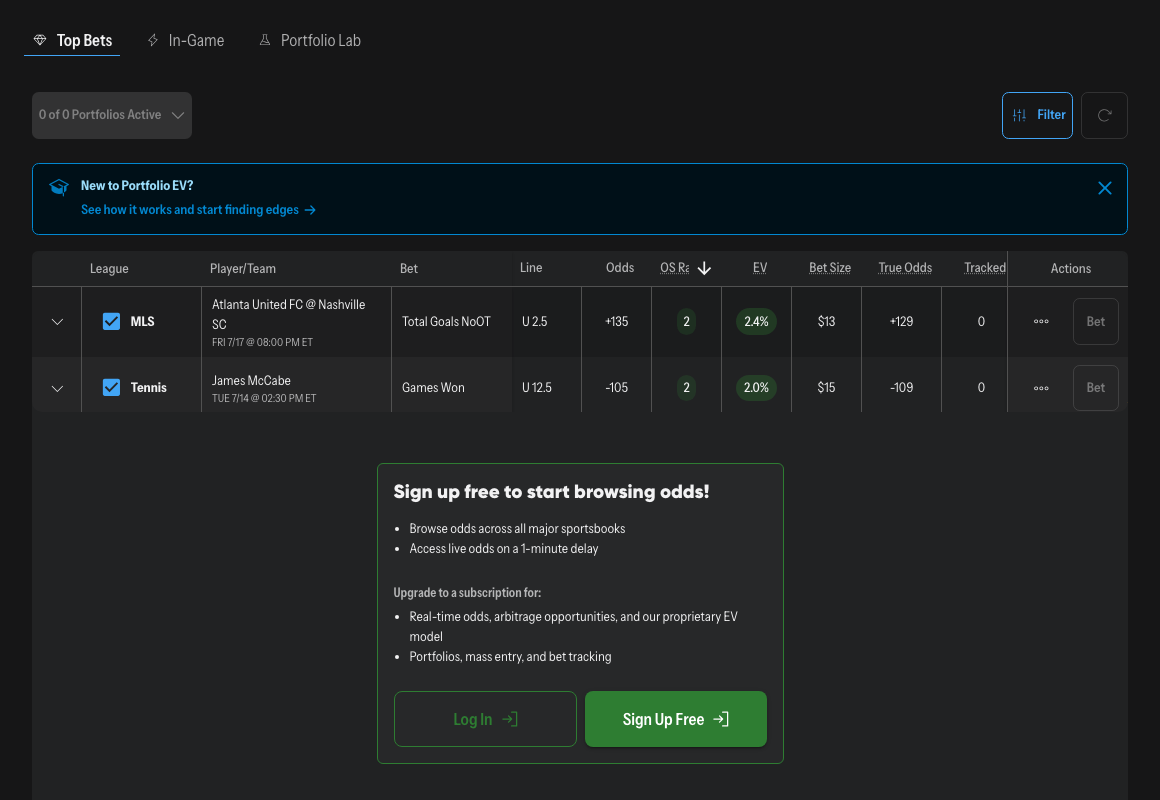
The OddsShopper +EV Screen.
What Is Expected Value In Sports Betting?
Expected value is the average amount a bet would win or lose if you could place it thousands of times. That single number tells you whether a wager is smart, independent of whether this particular bet happens to win or lose.
A bet has positive expected value (+EV) when the odds you are getting pay more than the true probability of the outcome justifies. A bet has negative expected value (-EV) when the price is worse than the real odds, which is the case on the vast majority of bets a sportsbook offers, because the book bakes in its margin.
The mechanic behind every +EV bet is simple: your estimate of the true win probability is higher than the probability implied by the price. If FanDuel 🎁 is paying a number that says a team wins 53% of the time, but the fair market says that team really wins 56%, you are getting paid for those extra three points. Do that repeatedly and the math grinds in your favor, even though any single bet can still lose.
That gap between the true odds and the posted odds is the entire game. An EV calculator just measures the gap for you and turns it into a dollar figure.
The Expected Value Formula
An expected value calculator runs one core equation. For a straight bet, the formula is:
EV = (Win Probability × Profit if You Win) − (Loss Probability × Amount You Risk)
You feed it three inputs:
- Your True Win Probability for the outcome (expressed as a decimal, so 56% is 0.56).
- The Odds you can bet at (American, decimal, or fractional; the calculator converts them to a profit figure).
- Your Stake, the amount you are risking.
The output is the average profit or loss per bet. A positive number means the wager is +EV and worth making at that price. A negative number means the price is too short and the bet grinds against you over time.
Two inputs come straight off the sportsbook: the odds and your stake. The hard one is the true win probability, because the book will never hand it to you cleanly. That is where de-vigging comes in, covered below.
How To Use An EV Calculator: A Worked Example
Say DraftKings 🎁 is showing the New York Yankees at -115 on a given night, and you think the Yankees are a stronger favorite than that price suggests. Here is how an expected value calculator turns that read into a number.
Step 1: Convert the odds to a profit figure. At -115, a $100 bet returns $86.96 in profit if it wins (you risk $115 to win $100, so per $100 staked the profit is 100 × 100/115 = $86.96).
Step 2: Enter your true win probability. Assume your fair estimate is that the Yankees win 56.2% of the time (the next section shows exactly how to get this from the market instead of guessing). That makes the loss probability 43.8%.
Step 3: Run the formula.
EV = (0.562 × $86.96) − (0.438 × $100) EV = $48.87 − $43.80 = +$5.07 per $100 bet
That is a +5.1% return on investment. The calculator is telling you that at -115, this Yankees bet is priced in your favor: repeated over a large sample, it nets about five dollars for every hundred risked. That is a genuine +EV bet.
Now flip it. If your true estimate were only 52%, the same math reads (0.52 × $86.96) − (0.48 × $100) = $45.22 − $48.00 = -$2.78 per $100, a -2.8% bet you should pass on even though the team is still favored to win. Same game, same team, opposite decision, because EV depends on the price, not on who you think will win.
The takeawaya good team at a bad number is a bad bet, and an underdog at a great number can be a great bet. The expected value calculator is what separates the two, and it does it before you risk a cent.
New to OddsShopper? It scans 100+ sportsbooks in real time and runs this exact EV math on every live line for you, then flags the bets that come back positive. You can try it free for 7 days, and code EV20 takes 20% off OS Pro or OS Core if you subscribe.
How To Find Your True Win Probability (De-Vig The Odds)
The whole calculation lives or dies on that win-probability input, and this is where most bettors go wrong. You cannot just convert the price you are betting into a probability and call it fair, because that price already includes the sportsbook's cut, known as the vig or juice.
The reliable way to estimate true probability is to take a sharp, efficient market and remove the vig from it. Here is the process on a real two-way market.
Suppose FanDuel prices a game at Yankees -140, Red Sox +120. First convert both sides to implied probability:
- Yankees -140 implies 140 / (140 + 100) = 58.3%
- Red Sox +120 implies 100 / (120 + 100) = 45.5%
Add those together and you get 103.8%, not 100%. That extra 3.8% is the vig, the book's built-in margin. To get the fair, no-vig probabilities, divide each side by that total:
- Fair Yankees probability = 58.3% / 103.8% = 56.2%
- Fair Red Sox probability = 45.5% / 103.8% = 43.8%
If you would rather not run the conversion each time, this quick reference covers the prices you will see most:
| American Odds | Implied probability |
|---|---|
| -200 | 66.7% |
| -140 | 58.3% |
| -115 | 53.5% |
| +100 | 50.0% |
| +120 | 45.5% |
| +150 | 40.0% |
| +200 | 33.3% |
That 56.2% is the number we dropped into the EV calculator above. Once you have the fair probability from a sharp market, you can shop that same team at every other book and instantly see which prices beat it. A full breakdown of the math lives in our guides on implied probability and how to remove the vig. If you just need a single price turned into payout, profit, and implied probability, our odds calculator does that conversion in one step.
This is also why line shopping matters so much: the fair probability stays roughly the same across books, but the price does not. When one book is slow to move, its stale number can sit well above fair value, and that is exactly the +EV bet an EV calculator surfaces.
One aside: on CFTC-regulated event contracts there is no vig to strip. The price is the crowd's probability and the exchange charges a visible fee instead, a difference Kalshi vs a sportsbook breaks down.
Positive Vs. Negative EV: What Counts As A Good EV?
Not every +EV bet is worth the same. A common question is what counts as a good expected value, and the honest answer is that any positive number is theoretically worth betting, but the size of the edge tells you how confident to be.
| EV / ROI On The Bet | What it means | How to treat it |
|---|---|---|
| Below 0% | Negative EV | Pass. The price is worse than fair value. |
| 0% To 2% | Thin edge | Real but small; sensitive to your probability estimate being slightly off. |
| 2% To 5% | Solid +EV | The core of most winning portfolios. |
| 5%+ | Strong edge | Often a slow line or a soft book; bet it before it moves. |
The catch: those percentages are only as good as your probability input. A calculator that says +8% is meaningless if your win probability is a guess. This is why grounding the estimate in a de-vigged sharp market, rather than your own hunch, is the difference between real EV and imaginary EV.
EV Vs. ROI: What Is The Difference?
These two get used interchangeably, but they answer different questions. Expected value is the dollar figure a bet is worth on average (the +$5.07 above). ROI, or return on investment, is that same edge expressed as a percentage of what you risked (+5.1%). EV tells you the raw profit per bet; ROI lets you compare bets of different sizes on equal footing. An EV calculator usually shows both, and for building a betting strategy the ROI figure is the more useful one, because it lets you rank a $50 bet and a $500 bet by how efficient each one is.
How EV And Bet Sizing Work Together
Finding a +EV bet answers whether to bet. It does not answer how much. Two bettors can both find the same 5% edge and end up with very different results based on staking.
The disciplined approach is to keep bet sizes proportional to your edge and your bankroll rather than betting the same amount on everything. Bettors who want to be precise about it use the Kelly Criterion, a formula that scales your stake to the size of your edge, and most serious players use a fractional version (half-Kelly) to smooth out the swings. You do not need to master Kelly to profit from +EV betting, but you do need a consistent unit size and bankroll plan and the discipline to bet more when the edge is bigger and less when it is thin. For a deeper look at putting edges into practice on live markets, see our guide to live EV betting.
When To Use An EV Calculator (And When Not To)
An EV calculator is most powerful on markets where a sharp reference price exists to de-vig against: moneylines, spreads, and totals on major sports, where books like Pinnacle and Circa set efficient lines the rest of the market follows. On those, the fair probability is trustworthy and the edges are real.
It is weaker on markets with no clean sharp reference, such as obscure props or novelty bets, where you have nothing reliable to de-vig against and your probability input becomes a guess. Garbage in, garbage out. It is also the wrong tool for parlays unless you calculate the combined true probability of every leg, because the vig compounds across legs and a calculator fed single-leg prices will overstate your edge.
Used on the right markets with a market-based probability, though, an EV calculator is the closest thing there is to an objective read on whether a bet is worth making.
Let OddsShopper Run The Math On Every Line
Doing this by hand is fine for one bet. The problem is that real +EV opportunities are scattered across hundreds of games and dozens of books, and the good ones vanish in minutes as lines move. Checking each one manually is not realistic.
That is the job OddsShopper's tools do automatically. The odds screen compares every sportsbook's price on a market side by side, so the best number is always in front of you. Portfolio EV takes it a step further: it de-vigs the sharp market to a fair probability, runs the expected value formula on every live line, and surfaces the bets that come back positive, ranked by edge, with the fair odds, EV%, and win probability shown for each. It is the worked example from this article, executed across the entire board in real time instead of one game at a time.
If arbitrage is more your speed, the same fair-odds engine powers our arbitrage calculator, and the broader concept guide lives at positive expected value explained and how to find +EV bets. And when you are ready to work the board itself, our OddsShopper +EV tool walkthrough shows the screen-by-screen routine.
Ready to stop doing this by hand?OddsShopper scans 100+ sportsbooks and runs the EV math on every line for you, then shows you the bets priced in your favor with the exact edge on each. Try it free for 7 days, and code EV20 takes 20% off OS Pro or OS Core if you subscribe.
Frequently Asked Questions
What is an expected value calculator? An expected value calculator takes the odds on a bet, your estimated true win probability, and your stake, then calculates the average profit or loss you would make on that bet over a large sample. A positive result means the bet is priced in your favor (+EV); a negative result means the price is too short to be worth it.
How do I calculate expected value on a bet? Multiply your win probability by the profit you would win, then subtract your loss probability multiplied by the amount you risk. For a $100 bet at +120 that you think wins 50% of the time: (0.50 × $120) − (0.50 × $100) = +$10, a +EV bet.
What is a good EV in betting? Any positive EV is theoretically worth betting. In practice, a 2% to 5% edge is the sweet spot most winning bettors build around, and anything above 5% is a strong edge often caused by a slow or soft line. Edges under 2% are real but fragile if your probability estimate is even slightly off.
How do I find my true win probability? Take a sharp, efficient market (like Pinnacle), convert both sides to implied probability, add them up, and divide each side by that total to remove the vig. The result is the fair no-vig probability. Never use the raw price of the bet you are making, because it includes the book's margin.
What is the difference between EV and ROI? EV is the average dollar profit a bet is worth; ROI is that edge as a percentage of your stake. A bet worth +$5 on $100 risked has +$5 EV and a +5% ROI. ROI is more useful for comparing bets of different sizes.
Can I use an EV calculator for parlays? Only if you calculate the combined true probability of all the legs multiplied together, then compare it to the parlay price. Feeding a calculator single-leg numbers overstates your edge because the vig compounds across every leg of the parlay.
Is positive EV betting profitable? Over a large enough sample, consistently betting +EV prices is how sharp bettors profit, because the math works in their favor even though individual bets still lose. It requires accurate probabilities, disciplined bet sizing, and volume; it is not a way to win any single bet with certainty.
Do I need to calculate EV by hand every time? No. Tools like OddsShopper's Portfolio EV de-vig the market and run the expected value formula on every live line automatically, then rank the +EV bets by edge, so you get the answer without the manual math.
More on this: Devig Calculator: Find Fair No-Vig Odds From -110 Prices · Sportsbook Hold Calculator: Beat The Vig When You Bet · Free Bet Calculator: Turn Bonus Bets Into Cash · Hedge Bet Calculator: Lock In A Return On A Live Ticket · Odds Calculator: Payout, Profit & Probability
In Summary
Expected value is the number that tells you whether a bet is worth making, before it wins or loses. An EV calculator runs one formula: win probability times profit, minus loss probability times stake. The only hard input is the true win probability, and the reliable way to get it is to de-vig a sharp market rather than guess. Anything from 2% to 5% ROI is a solid edge; the price, not the team, is what makes a bet +EV. Doing it by hand works for one game, but OddsShopper's odds screen and Portfolio EV run the math across every live line so you can find the bets priced in your favor in seconds instead of one at a time.
Odds and examples are illustrative of the method and move constantly; always confirm the current price at the book before betting. Must be 21+ and in a jurisdiction where sports betting is legal. Please bet responsibly.