How to Find +EV Bets: The Practical Workflow I Actually Use
In Summary
If you already know how to find +EV bets in theory (that expected value betting means a bet is "positive expected value" when the price you get is better than the true odds of the thing happening), this is the practical companion to that idea. The short version: a +EV bet exists every time a sportsbook's price is better than the real (no-vig) chance of the outcome. Your whole job is to (1) figure out the true, vig-free price, (2) find books offering you better than that, and (3) actually get the bet down before the line corrects. Value bets hide in the same few places, namely live in-game lines, player props, and the seconds right after breaking news, because that's where books are slowest and recreational money is most careless. Doing this by hand across dozens of books is impossible, so I lean on OddsShopper's Portfolio EV tool, which scans every book we track in real time, compares each price to its de-vigged true odds, and ranks the live +EV plays for me. This guide is the workflow; if you want the full theory first, start with our positive expected value explainer.
Related reading: Best Sports Betting Software For 2026 and How To Win Sports Bets: A +EV Betting Strategy Guide.
First, Anchor to the True (No-Vig) Price
Every "+EV" decision comes down to one comparison: the price you can get vs. the true price. Not the price one book shows, but the consensus, vig-stripped fair price. Everything else in this guide is just faster ways to make that comparison.
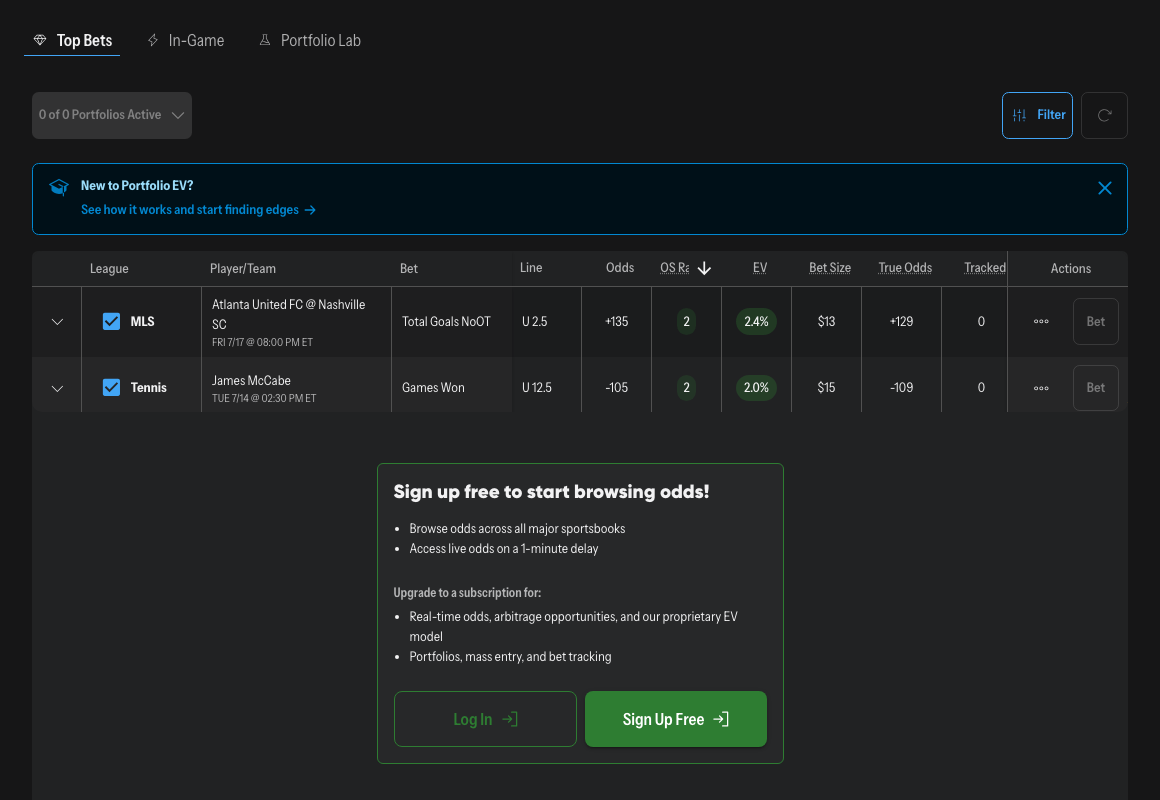
The OddsShopper +EV Screen.
Here's the mechanic. A two-way market's two sides should add up to 100% implied probability. Sportsbooks pad them past 100%. That extra is the vig (the hold), and it's why blindly betting either side is usually a slow bleed. To find value, you strip the vig back out to get the true odds, then look for a book paying you more than those true odds imply.
We see this play out on real lines every day. Take a Euro basketball game where Dubai -3.5 devigs to a true price of about -119 (54.3%). DraftKings 🎁 posts -112: you're paid as if the chance were 52.8% when it's really 54.3%, about a +3% EV bet. FanDuel 🎁 has the same side at -116: still a small edge (+1%) but a thinner one. Same game, same side, two prices, and both beat true odds here, but by different amounts, and a worse number eats the edge fast. That gap, price vs. true odds, is the +EV. There's no other secret.
So rule one of finding value bets: never judge a price in isolation. -112 is a good number or a terrible number depending entirely on what the de-vigged fair line is. That's the comparison the Sharp Sportsbook Algorithm and Portfolio EV run for you on every market, every second.
The 6-Step Workflow for Finding +EV Bets
This is the loop I actually run, start to finish:
- Pull the fair line. Get the de-vigged, multi-book consensus price for the market. Pricing off many books instead of one matters: sourcing a line to a sharp multi-book consensus rather than a single book can flip marginal markets from negative to positive EV. One book is an opinion; a sharp consensus is closer to the truth.
- Shop every book for a better number. A value bet only exists where some book is offering you better than fair. This is line shopping, and it's the entire game.
- Check the edge in real terms. A fixed-cent edge is a bigger ROI swing on an underdog than on a heavy favorite, so read the EV %, not just "it's a few cents better."
- Sanity-check the signal. If a play shows an absurd edge (say, 20% EV), be suspicious. That's usually a stale projection, not free value (more on this below).
- Size to the edge. A 1% edge is not a 5% edge, so stake proportional to the edge (fractional Kelly; OS tools recommend a stake off your bankroll) and size higher-variance plays (long dogs, props) smaller. Never flat-stake everything, and never chase a loss. Edge-finding without sizing discipline is the fastest way for a bettor with an edge to still go to zero.
- Place it fast, at the best price. Edges close in seconds. And don't leave a cent on the table; even +EV bets "leak value" if you habitually take a worse number than the floor price.
That's it. That loop is the entire EV betting strategy, and everything else is just learning how to find value bets faster. The hard part isn't steps 1 and 3 (the math). It's doing steps 1, 2, and 6 across every game and prop, fast enough to matter, while still sizing each bet to its edge. That's the part a tool has to carry.
Where +EV Actually Hides: Live, Props, and News
Theory says value can be anywhere. In practice it clusters in three spots, because those are where books are slowest and casual money is least price-sensitive.
Live / In-Game Betting
This is the big one. Market-based, the biggest edge to be had is in live betting, and it's not just that the edge is bigger, it's that books don't limit live action the same way they limit pregame. In-game lines move too fast for books to keep efficient, and rec bettors chase the scoreboard: they see a team go up 6-0 in the first quarter and pile on with no consideration for what the actual fair odds are. The softest windows are stoppages: halftime, NHL intermissions, timeouts, between innings. If you want to go deeper here, read our live betting strategy guide. It's the single most defensible place to hunt value bets.
Player Props
Props are thinner and less efficient than sides and totals, so the same de-vig comparison turns up more value bets, especially in markets books struggle to price tightly. The catch is data quality: a prop's edge is only real if your true-odds estimate is real, which is why I cross-check the Prop Tool output against the price on every book before firing.
The Seconds After News
The most teachable retail edge there is: beat the books to information. One of the easiest ways to beat rec books is to beat them to the news. When you get a notification that LeBron is ruled out, you go bet against the Lakers, and there's still roughly a 30-second gap to place those bets before the lines come down. An injury ruling moves the fair price instantly; the book's posted price takes a beat to catch up. That lag is your +EV.
A Real Worked Example: De-Vigging a Live Lakers Number
Let me make "beat the true price" concrete with real names and real math.
Say the Lakers are hosting the Nuggets, and at halftime you're looking at the Lakers' live moneyline. Pull the two-sided consensus market: Lakers -120 and the other side, Nuggets +110. To find the true odds, convert both to implied probability and strip the vig:
- Lakers -120 → implied probability = 120 / (120 + 100) = 54.5%
- Nuggets +110 → implied probability = 100 / (110 + 100) = 47.6%
- Combined = 54.5% + 47.6% = 102.2%
That 2.2% over 100% is the vig, the book's built-in hold. De-vig by normalizing each side by the total (102.2%): the Lakers' true probability is 54.5 / 102.2 = 53.4%, which converts to a fair price of about -114.
Now the comparison that defines value: the fair Lakers price is -114, and you go shopping for a book beating it. DraftKings is letting you take the Lakers at -108, a better number than fair. You're paid as if the Lakers were a 51.9% shot (-108) when their true chance is closer to 53.4%, which works out to roughly a +3% edge on that bet. It's not a huge edge, and a single one won't change your week. But firing dozens of those a day is exactly how a disciplined bettor grinds out a profit: a small per-bet edge, compounded over thousands of tracked bets across a full season, is how the profit shows up. Any single stretch is variance, not a durable rate.
The point of the example isn't the specific number. It's the habit. Every value bet you ever place is this same loop: de-vig to the true price, find a book beating it, take it fast.
How Portfolio EV Finds Value Bets For You
You can de-vig a single line by hand in 30 seconds. You cannot de-vig every line on every book for every game and prop, re-check them every few seconds, and act before they move. That's the job, and it's why the tool exists.
OddsShopper's Portfolio EV tool scans every book we track in real time, runs that de-vig-and-compare on each market against a sharp multi-book consensus, and surfaces the live +EV plays ranked by edge, with the book, the price, and the EV % already calculated. The underlying approach is built on de-vigging to that sharp multi-book consensus and comparing every offered price to the fair line in real time, so what you act on is a measured edge against the true number, not a hunch or a hot streak.
Two honest cautions the tool also taught me:
- Don't blindly fire every alert. If a play shows a wild edge, it's usually a stale projection (often an unprocessed injury), not real value. We've seen exactly this: when a ruled-out Kawhi Leonard was still live in the projections, the model surfaced a string of "90%, 80% EV" plays that were actually negative-EV bets. Implausible EV is a red flag, not a jackpot.
- +EV is a long-run process, not a per-bet promise. You can bet +EV, beat the closing line, and still lose for a stretch. That's variance, not a broken strategy. Judge yourself on closing line value over a large sample in liquid, efficiently-priced markets, not on last night (in thin prop or niche markets, a line can move for reasons that aren't real value).
If you want a free way to start, the odds calculator and odds-comparison tools let you line-shop and check a price by hand. To get the full real-time +EV feed (every book, every market, ranked by edge), that's OS Pro.
Stop de-vigging every line by hand.Portfolio EV runs that true-price comparison across every book in real time and ranks the live +EV plays by edge, so you act before the number moves. Try it yourself free for 7 days, no risk, then code FINDEV20 takes 20% off OS Pro or OS Core if you stay.
A Few Realities Before You Start
- Most markets have no bet, and that's the point. A huge share of lines are priced efficiently enough that both sides are -EV; there's no value there, and forcing a side anyway is how you bleed. Your structural edge over a sportsbook is that they must post a price on every game while you can sit out everything but the few spots that clear +EV. The tool's job isn't to hand you action on every game; it's to surface the rare market that's out of line so you can pass on almost all of them.
- +EV is not a free lunch. It's an edge over a large sample, not a win on any single bet. Bet within a bankroll you can absorb a losing week with.
- Speed and discipline beat math. The calculation is easy; getting the bet down at a good price before it moves is the skill.
- Books limit winners. Bettors who only ever scoop the obvious +EV plays get cut quickly. Mixing live bets, props, and the occasional sharp side keeps a lower profile.
- Convert free bets first. Don't burn a promo on a thin +EV play. Our Free Bet Converter shows how to turn a bonus into the most cash with the least risk.
- It's 21+ and legal-where-regulated. Bet responsibly, in markets where it's legal and available, and never chase losses.
Frequently Asked Questions
How do I find +EV bets as a beginner? Start with one market you understand, de-vig the two sides to a true price (or let a tool do it), and look for a book paying better than that true price. Line shopping across multiple books is non-negotiable, because a value bet only exists where one book is out of line with the consensus. The Portfolio EV tool automates the whole comparison so you're not de-vigging by hand.
Where are the best EV bets today? There's no fixed list of the best EV bets today. The best value bets cluster in live in-game lines, player props, and the moments right after breaking injury or lineup news, because those are where books are slowest and recreational money is least price-sensitive. There's no fixed "best bet"; the best one is whatever currently offers the biggest gap between the price you can get and the true odds.
Is +EV betting actually profitable? It can be, over a large sample. It's an edge, not a sure outcome. Per-bet edges are usually small (often low single-digit percent), so profit comes from volume and discipline, and you'll still hit losing stretches from variance. Track your closing line value in liquid markets to know whether your process is +EV; in thin markets a line move can be noise rather than real value.
What's the difference between +EV betting and value betting? They're the same idea. "Value bet" is the casual term and "+EV" (positive expected value) is the math behind it: both mean you got a price better than the outcome's true probability. For the full theory, see our positive expected value explainer.
Why do +EV opportunities disappear so fast? Because other bettors and the books are watching the same markets. The moment enough money hits a soft line, or the book updates for news, the price corrects and the edge is gone. That's why a real-time scanner matters: by the time you've de-vigged a line by hand, it may already have moved.
Ready to stop de-vigging lines by hand? Finding value bets one market at a time is slow, and the edges close before you can place them. OS Pro unlocks the full Portfolio EV feed: every book we track, scanned in real time, with each market de-vigged to its true odds and ranked by edge, so the +EV bets come to you. Upgrade to OS Pro with code FINDEV20 for 20% off your first payment and put Portfolio EV to work today.
More on this: Odds Boosts Strategy: Which Ones Are Actually +EV · Bankroll Management Sports Betting: Unit & Kelly Sizing · Closing Line Value (CLV) Explained: Beat the Close · Free Bet Conversion: How to Turn a Free Bet Into Cash · How to Hedge a Bet: When to Hedge & How Much