How to Read Betting Odds: American, Decimal & Fractional Odds Explained
In Summary
Learning how to read betting odds is the very first skill in betting, because every number on a sportsbook screen is just a price, and every price tells you two things at once: how much a winning bet pays, and how likely the book thinks that outcome is. There are three formats you'll run into: American odds (the +150 / -200 style used in the U.S.), decimal odds (2.50, common in Europe and on exchanges), and fractional odds (5/2, the old British/horse-racing style). They all describe the exact same bet; they're just three languages for the same thing. Once you can convert any price into its implied probability (the percentage chance baked into the odds), you can do the one thing that actually wins money over time: compare the book's number to what you think the true number should be. When the price implies a lower probability than the real chance, you've found value. That gap is the entire game, and it's what OddsShopper's odds calculator and Portfolio EV are built to surface.
The Three Betting Odds Formats Explained
Before you can find value, you have to be fluent in all three ways books quote a price. Here's how each one works, in plain terms.
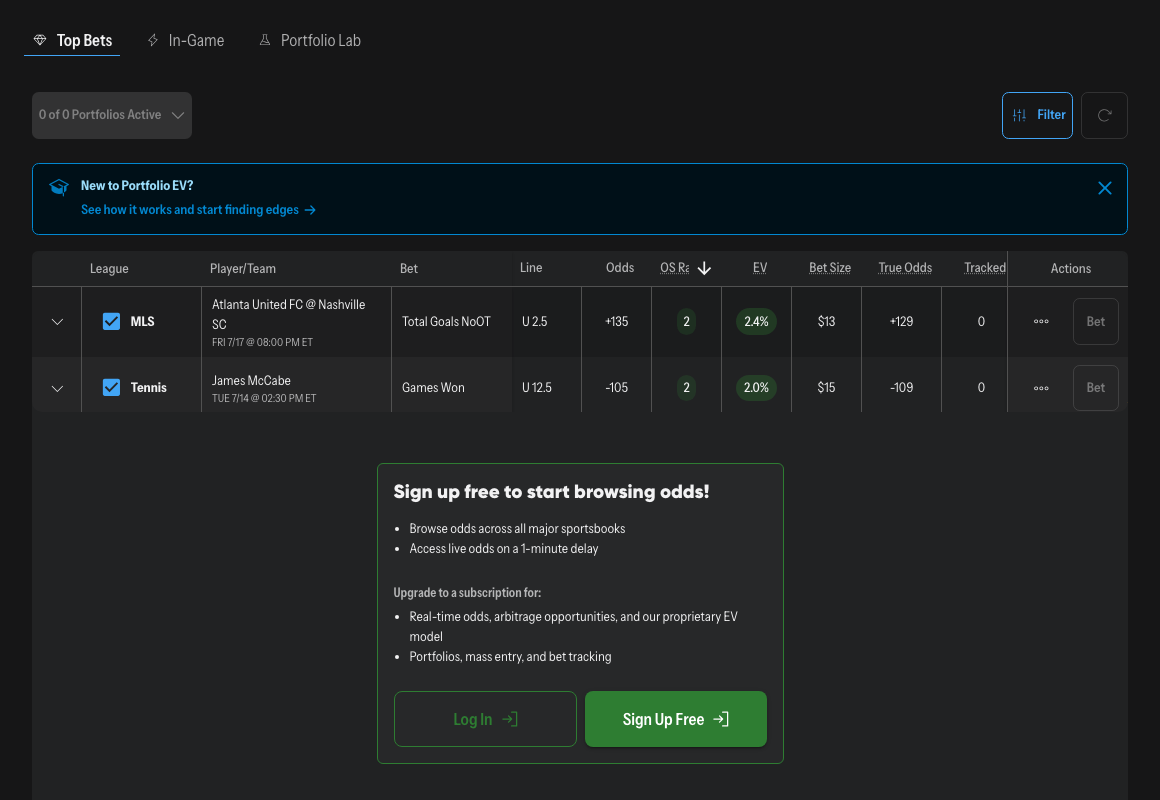
The OddsShopper +EV Screen.
American Odds (Moneyline / "+150, -200")
American odds are built around a $100 baseline and use a plus or minus sign:
- Positive odds (+150) = the underdog. The number is the profit on a $100 stake. A +150 bet wins $150 profit on $100 risked (you get $250 back total).
- Negative odds (-200) = the favorite. The number is how much you must stake to win $100. A -200 bet means you risk $200 to win $100 ($300 back total).
The bigger the negative number, the heavier the favorite. The bigger the positive number, the longer the shot. This is the default format on every U.S. sportsbook, so it's the one you'll read most.
Related reading: Sports Betting Strategy: How to Bet Smarter.
Decimal Odds (2.50, 1.50)
Decimal odds tell you your total return per $1 staked, including your stake back. So:
- 2.50 means a $1 bet returns $2.50 total ($1.50 profit + your $1).
- 1.50 means a $1 bet returns $1.50 total ($0.50 profit + your $1).
Decimal is the cleanest format for math. It's why most betting exchanges, calculators, and +EV models work in decimal under the hood. To get profit, just subtract 1 from the decimal number.
Fractional Odds (5/2, 1/2)
Fractional odds are the old-school British and horse-racing style. The fraction is profit / stake:
- 5/2 ("five to two") means you win $5 profit for every $2 staked.
- 1/2 ("one to two") means you win $1 profit for every $2 staked, a strong favorite.
You'll see fractional odds mostly on golf and horse racing. They're the least common in U.S. sportsbooks, but worth recognizing so a 9/4 price doesn't confuse you.
How to Convert Between Betting Odds Formats
Here's the part that makes you dangerous: all three formats are interchangeable. I keep the conversions in my head as a sanity check, but I run anything that matters through the OddsShopper odds calculator so I'm never doing arithmetic while a line is about to move.
American to decimal:
- Positive odds:
(American / 100) + 1→ +150 becomes(150/100) + 1 = 2.50 - Negative odds:
(100 / American) + 1→ -200 becomes(100/200) + 1 = 1.50
Decimal to American:
- If decimal ≥ 2.00:
(decimal − 1) × 100→ 2.50 becomes+150 - If decimal < 2.00:
−100 / (decimal − 1)→ 1.50 becomes-200
Fractional to decimal: (numerator / denominator) + 1 → 5/2 becomes (5/2) + 1 = 3.50
You do not need to memorize these to bet well, but you do need a tool that does it instantly. That's the whole point of an odds converter: paste a price in any format and read it in the one you think in.
Implied Probability: Turning Odds Into a Percentage
This is the single most important concept in this whole guide. Every price carries an implied probability, the chance the book is effectively assigning to that outcome. The formulas:
- From positive American odds:
100 / (American + 100)→ +150 =100 / 250= 40% - From negative American odds:
−American / (−American + 100)→ -200 =200 / 300= 66.7% - From decimal odds:
1 / decimal→ 2.50 =1 / 2.50= 40%
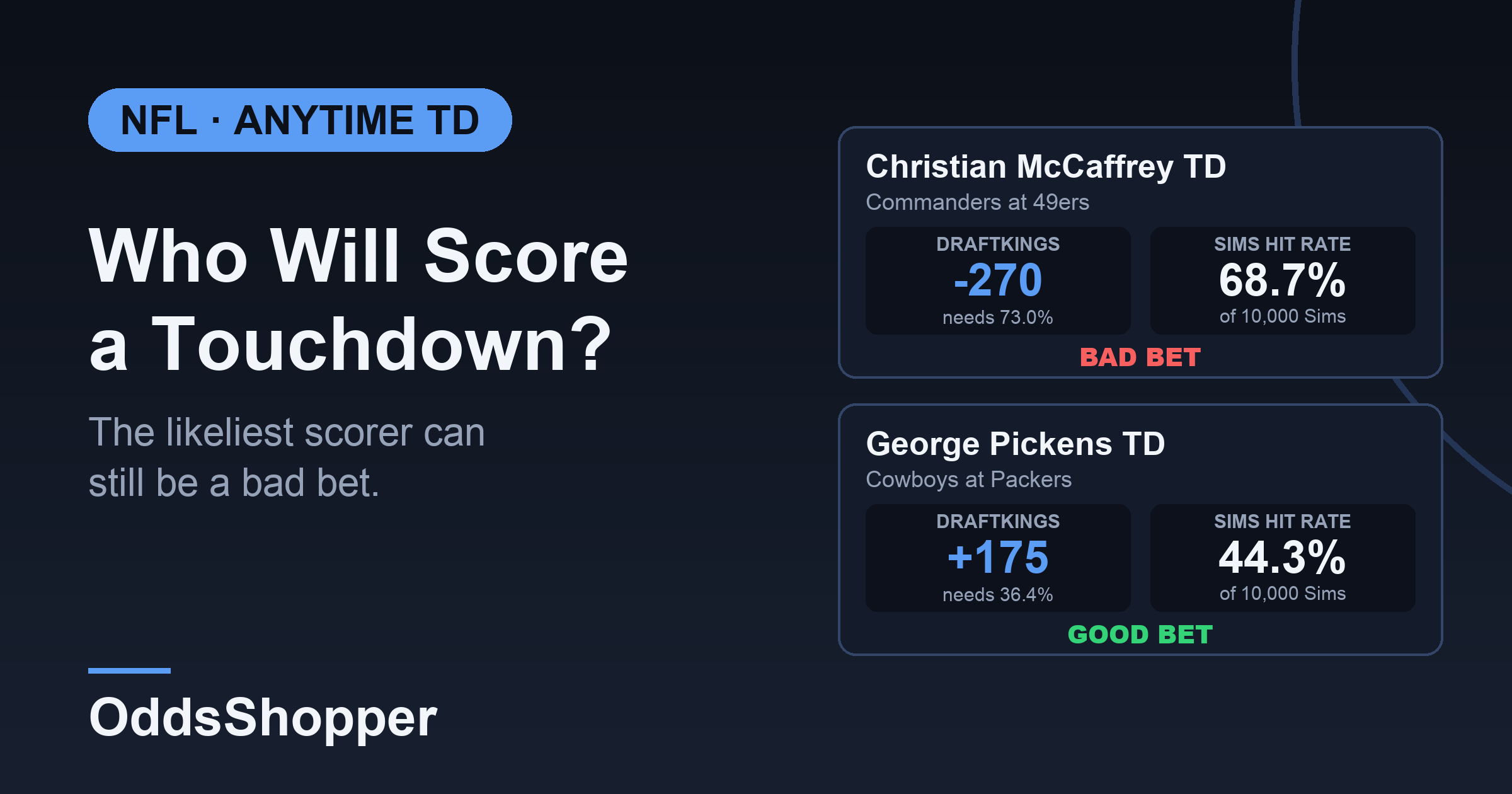
So +150, 2.50, and 3/2 all imply roughly the same thing: the book thinks this happens about 40% of the time. Read enough prices this way and the odds board stops looking like random numbers and starts looking like a list of probabilities you can argue with.
One catch: add up the implied probabilities on both sides of a market and you'll get more than 100%. That extra is the vig (the book's built-in margin, also called the hold). Stripping the vig back out to get the true, fair probability is called "de-vigging," and it's exactly what OddsShopper's Sharp Sportsbook Algorithm does across the whole market so you're comparing against a fair number, not a vigged one.
A Real Worked Example: Reading the Same Price Three Ways
Let me ground all of this in a real game. Take an NBA matchup between the Boston Celtics and the Oklahoma City Thunder. Say the Celtics moneyline opens at +150 on DraftKings. Here's that exact price in all three formats, plus its implied probability:
- American: +150 (risk $100 to win $150)
- Decimal: 2.50 (a $100 bet returns $250 total)
- Fractional: 3/2 (win $3 for every $2 staked)
- Implied probability:
100 / (150 + 100)= 40%
Now here's why reading odds matters. Suppose your own read, or a sharp projection, says the Celtics actually win this game about 45% of the time. The fair price for a true 45% chance is about +122 (decimal 2.22). The book is offering you +150, which only implies a 40% chance. You're getting paid as if Boston is a bigger underdog than they really are.
That 5-point probability gap (45% true vs. 40% implied) is positive expected value, and you can only see it because you converted the odds into a probability and compared it to a fair number. If you'd just stared at "+150" you'd have learned nothing. This is the bridge from "reading odds" to "beating odds," and it's covered in depth in our positive expected value guide.
Our job is simply to tell you what the fair line is. From there, betting any side is value as long as you can get a price better than that fair number. That's the whole idea in one sentence: value isn't about picking winners, it's about getting a price better than the true odds. Reading odds is just the literacy that lets you see it.
Don't crunch that 45% vs. 40% gap by hand on every game.OddsShopper's Portfolio EV converts and de-vigs prices across every book in real time, so the spots where the offered odds beat the true odds surface for you. Stop leaving the better number on the table: it's free for 7 days, then 20% off OS Pro or OS Core with code READODDS20.
Why This Is the First Step to Finding Value
Here's the practitioner truth: the bettors who win long-term aren't psychic, they're price-sensitive. They've trained themselves to instantly translate any odds into a probability and ask, "Is this number too generous?" Once that's automatic, two doors open:
- Line shopping. The same Celtics bet might be +150 at one book and +135 at another. A +150 winner pays about 6% more than +135 (decimal 2.50 vs. 2.35), free value just for having the better number. OddsShopper's line shopping and odds-comparison feed exist for exactly this.
- Spotting +EV automatically. You don't want to de-vig every market by hand. The tool scans every book we track in real time, converts each price to its implied probability, strips the vig to a fair line, and flags the bets where the offered price beats true odds. That's what Portfolio EV inside OS Pro does: it's the same de-vigging math from this article, back-tested and run across thousands of markets at once instead of one game on a napkin.
Reading odds by hand is the foundation. The tools are how you do it at scale, fast enough to actually beat a line before it moves.
One guardrail before you start firing on value: reading odds finds the edge, but bankroll discipline is what keeps it. Size each bet proportional to its edge (the tools recommend a stake off your bankroll via fractional Kelly) and size higher-variance plays smaller. And +EV is an edge over a large sample, not a win on any single bet: you'll lose plenty in the short term, one result proves nothing, so only bet what you can absorb a cold stretch with, and never chase.
How Odds Connect to Parlays
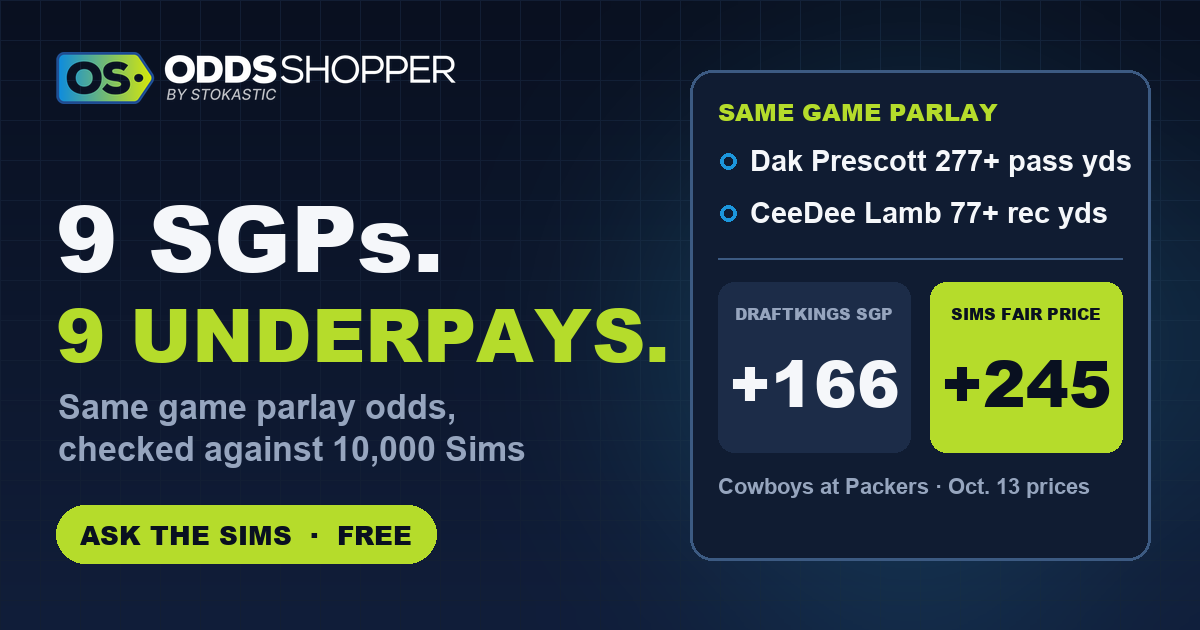
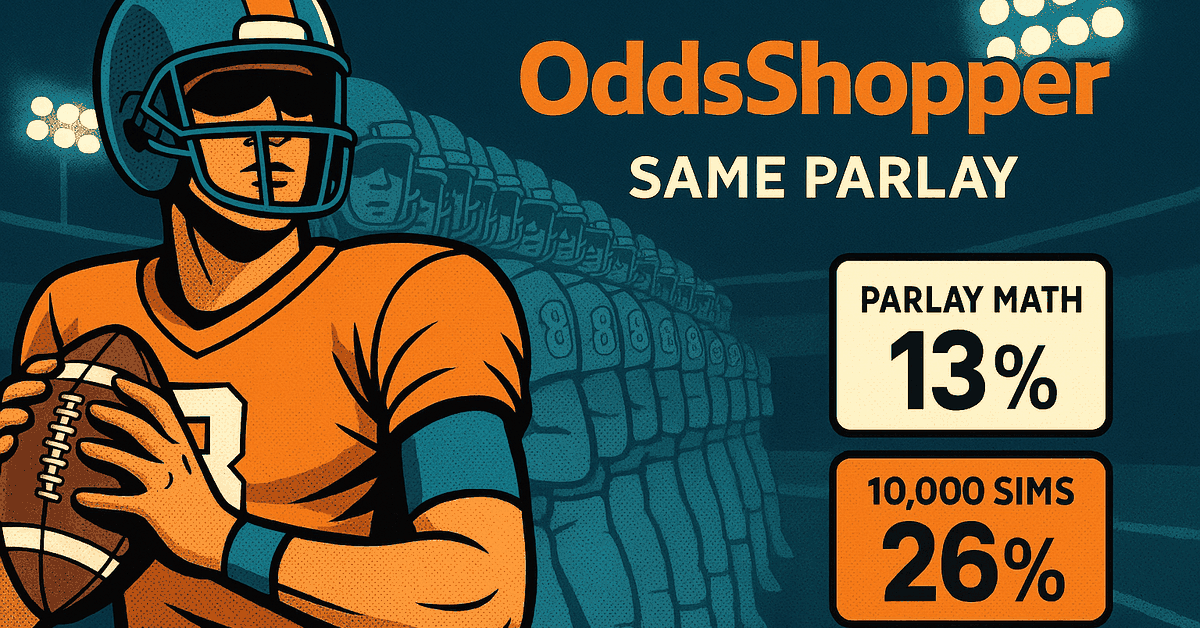
One more reason this literacy pays off: parlays. A parlay's price is just the individual leg odds multiplied together (in decimal). Two +150 legs (decimal 2.50 each) combine to 2.50 × 2.50 = 6.25, or about +525. Because EV multiplies across legs, a parlay built from +EV legs stays +EV, while one built from -EV legs compounds the house edge against you. If you can read each leg's implied probability, you can tell which kind of parlay you're actually holding. We break this down in the parlay betting guide.
Frequently Asked Questions
What do + and - mean in betting odds? In American odds, a minus sign (-200) marks the favorite and shows how much you must risk to win $100. A plus sign (+150) marks the underdog and shows how much profit you'd win on a $100 stake. The bigger the minus number, the heavier the favorite; the bigger the plus number, the longer the shot.
How do I convert American odds to decimal? For positive American odds, divide by 100 and add 1 (+150 → 2.50). For negative odds, divide 100 by the number and add 1 (-200 → 1.50). An odds calculator does it instantly in either direction.
What is implied probability in betting?
Implied probability is the percentage chance the odds suggest an outcome will happen. For +150 it's 100 / (150 + 100) = 40%. Comparing implied probability to the true probability is how you spot value: when the price implies a lower chance than the real chance, the bet is +EV.
Why don't the two sides of a market add up to 100%? Because of the vig, the sportsbook's built-in margin. The combined implied probabilities total more than 100%, and that overage is the book's edge. De-vigging removes it to reveal the fair probability, which is what OddsShopper's Sharp Sportsbook Algorithm does automatically.
Which odds format is best? They all describe the same bet, so it's preference. Decimal is the easiest for math and the cleanest for converting to implied probability, which is why most calculators and +EV models use it. American is the U.S. default. Pick the one you read fastest and use an odds converter for the rest.
Do I need to be good at math to read odds? No. You need to understand what the numbers mean, but you don't have to compute conversions by hand. A good odds calculator handles the arithmetic so you can focus on the only question that matters: is this price better than the true odds?
Once you can read any price as a probability, the next move is finding the prices where that probability beats the true odds, at scale, before the line moves. OS Pro runs Portfolio EV and the Sharp Sportsbook Algorithm across every book we track, converting and de-vigging thousands of prices in real time so the value bets surface for you. Upgrade to OS Pro with code READODDS20 for 20% off your first payment, and start betting against the number instead of guessing at it. Bet responsibly: 21+ where legal.
More on this: How To Bet Team USA: Where The Real World Cup Value Hides · World Cup Golden Boot Odds: Betting Guide & Value · World Cup Group Stage Betting: 3 Edges Books Missed · How To Bet World Cup Futures: Find The Softest Prices · Free PrizePicks Optimizer Guide