Search "how to make money sports betting" and the top result is some version of "$100 a day with a $1,000 bankroll, no BS." I've watched a lot of those. The math almost never survives contact with reality, and the people selling it know that. So let me give you the honest version instead: you can beat the sportsbooks with a small bankroll, but the edge comes from a few boring habits most bettors skip, and those habits matter more the less money you have. Stick with me and I'll show you what a $500 bankroll can realistically do, because the number is going to reset your expectations in a useful way.
Can You Actually Beat The Books With A Small Bankroll?
Yes, with an asterisk. A small bankroll doesn't change the math of beating the sportsbooks. It changes the stakes of getting it wrong. A bettor with a $50,000 roll can survive a lot of sloppy sizing and bad prices; a bettor with $500 cannot. Two $50 bets losing back to back is a rounding error on the big roll and a fifth of the small one, gone before the edge ever had a chance to show up. Every leak that a big roll absorbs, a small roll feels immediately.
On a small bankroll, discipline isn't a nice-to-have, it's the entire edge. The sharp with $500 and the square with $500 are separated almost entirely by whether they take the best available number, size to their edge, and refuse to chase. None of that requires capital. All of it requires patience, which is what the "$100 a day" crowd is betting you don't have.
So we're going to build the small-roll edge in the order it compounds: get the best price, size it correctly, set realistic expectations, pick the markets where a thin roll can actually win, and squeeze every free dollar the books hand you. Then let a tool do the parts you can't do by hand.
Bet The Best Number Every Time
Line shopping is the free half of a betting edge, and it's the single habit that separates bettors who slowly grow a small roll from ones who slowly bleed it.
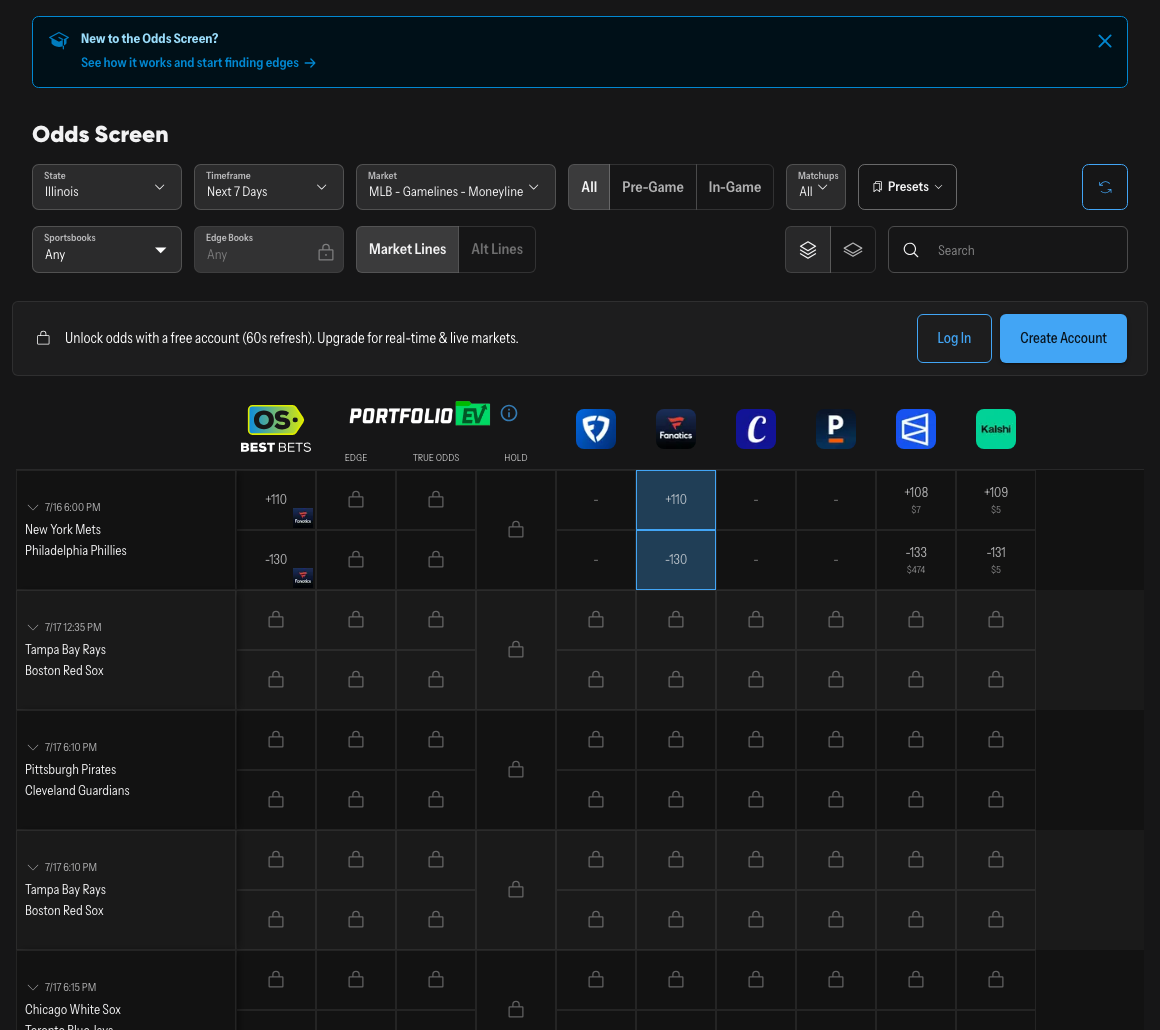
The OddsShopper Odds Screen.
Here's why it matters so much when money is tight. The same bet is priced differently at every book (if that's news to you, here's why sportsbooks post different odds on the same game), and those small gaps are, functionally, most of your margin. Take a mid-tier MLB moneyline on a night the books disagree. On the same game you might see:
| Sportsbook | Price on the same side | $10 bet returns (profit) |
|---|---|---|
| FanDuel | +112 | $11.20 |
| BetMGM | +115 | $11.50 |
| DraftKings | +120 | $12.00 |
Look at the top and bottom rows. Same team, same bet, same night, and DraftKings pays you 80 cents more per $10 than FanDuel does. That sounds trivial. It is not. That 80-cent gap works out to roughly 3 to 4 cents of expected value per dollar on that bet, which is about the size of the entire edge most winning bettors have in the first place. Most nights the payout gap between books is smaller than that, a cent or two per dollar rather than eight, but it never goes away, and a small-roll bettor who takes the best of it on every bet has closed a real share of the distance to profitability without handicapping a single game better than anyone else.
The catch is that no human checks every book on every bet. That's what the live odds screen is built to do: it lines up every book's price on a market side by side so you take the best one in a click instead of eyeballing three apps. In football, the same habit is the spine of our NFL betting strategy guide: key numbers and timing matter, but none of it works if you're paying -115 for a number someone else is selling at -105. On a thin bankroll, that free habit is worth more than any pick.
New to OddsShopper? It compares the price of your bet across 100+ sportsbooks and flags the ones priced in your favor. Start with the free odds screen to see the gaps yourself, and code EDGE20 takes 20% off your first payment of OS Pro or OS Core when you want the full board.
Size Every Bet To Your Edge, Not Your Gut
Getting the best number is half the job. The other half is not blowing up the roll before that edge can compound. This is where small bankrolls die, because a $500 roll and a "I really love this one" feeling are a dangerous combination.
The rule is simple to say and hard to follow: bet a small, fixed slice of your bankroll, and make the biggest bets your biggest edges. For most people that means 1 to 3 percent of the roll per play, never more than about 5 percent on any single bet. Here's what that looks like in actual dollars, because "2 percent" feels abstract until you see it next to a $500 balance:
| Bankroll | 1% unit | 2% unit | 3% unit | 5% hard cap |
|---|---|---|---|---|
| $500 | $5 | $10 | $15 | $25 |
| $1,000 | $10 | $20 | $30 | $50 |
| $2,000 | $20 | $40 | $60 | $100 |
Read the $500 row and notice what isn't there: a $50 bet. That's 10 percent of the roll, and it's the size most beginners fire when a game feels too good to pass up. Two of those losing back to back and a fifth of the bankroll is gone before the edge ever had a chance to show up. The grid is boring on purpose. A small bankroll betting strategy that survives is one where the biggest bet of the month is still small.
Sizing that scales with your edge is the Kelly criterion, and on a small roll you always bet a fraction of what full Kelly suggests (half-Kelly is the common ceiling), because full Kelly assumes your read is perfect and yours never is. The complete unit-and-Kelly breakdown, including a worked stake calculation, lives in our bankroll management guide.
Why does fractional sizing matter more on a small roll? Because the downswings are longer than your gut believes. Even a winning bettor hitting 55 percent will run into losing streaks of six or seven in a row, sometimes eight, over a normal season. A big roll shrugs those off. A small roll that over-sized into the streak is simply gone, and gone means you never make it to the part where the edge pays. Survival is the strategy.
One practical wrinkle the unit grid hides: the plan above needs money at more than one book. Units come off your total roll, but a $500 bankroll spread across three sportsbooks is roughly $165 at each, and you need enough sitting at every one of them to take the best price when it shows up and to fund the cash side of a free-bet hedge. Keep the unit math on the whole bankroll, and keep each book funded well enough that a $10 bet or an $82 hedge never has to wait for a deposit to clear.
What A Small Bankroll Can Realistically Do: A Worked Example
Now the number I promised you. Let's kill the "$100 a day" fantasy with arithmetic instead of attitude.
Your long-run profit is roughly your ROI (return on the money you put through) times your total amount wagered. That's it. So take a disciplined small-roll bettor: a $500 bankroll, $10 average bets (the 2 percent unit from the grid above), and a solid but not superhuman 2 percent ROI. Here's the shape of it:
| Bankroll | Avg bet | Bets placed | Total wagered | Profit at 2% ROI | Profit at 4% ROI |
|---|---|---|---|---|---|
| $500 | $10 | 500 | $5,000 | $100 | $200 |
Look at the 2 percent column. Five hundred bets is a serious, disciplined grind, easily a few months of real volume. And the profit at the end of it is about $100, the exact number those videos promise you'll clear every single day. What's realistically a quarter's worth of grinding for a sharp small-roll bettor gets sold to beginners as a daily wage. That's the whole con.
Put it per day and it's about a dollar. Scale the same discipline to a $5,000 roll ($100 bets, $50,000 through the books) and a 2 percent ROI is $1,000 over the same stretch, roughly $10 a day. Ten dollars a day, give or take, is the realistic ceiling even for a roll that size, and that is with everything done right.
And the caveats matter here, because this is arithmetic, not a promise. That table assumes you run at a 2 percent ROI, which most bettors never sustain; a lot of people run at zero or negative. Over only 500 bets, variance can swing your real result well above or below those figures. The 2 percent isn't promised to anyone, and a small sample can bury a real edge for months. The table is there for its shape: sports betting with a small bankroll compounds slowly, and anyone selling it as a paycheck is selling something else. Treat it that way and you'll still be betting when the edge finally shows up. Chase the paycheck and you'll be reloading by Friday.
The honest yardstickif someone promises you $100 a day on a $1,000 roll, they're claiming a 10 percent return on the whole bankroll every day. Nobody sustains that. Judge a small-roll plan by the ROI on what you wager, over hundreds of bets, or don't judge it at all. And don't raise your unit until you've tracked a few hundred bets and you're beating the closing line on them; if either is missing, keep the units flat.
Where A Small Roll Finds Its Edge: Softer Markets And Speed
So if the profit is small and slow, where does a thin bankroll go to make the ROI column as fat as possible? Two places, and neither one is "pick better games."
The first is market choice. Sportsbooks price their main markets, the moneylines, spreads, and totals on marquee games, with enormous care, because that's where the sharpest money and the biggest limits live. The smaller, derivative markets get less attention: player props, alternate lines, team totals, the second and third tiers of a busy night. Those are the markets where books disagree with each other more often, which means the line-shopping gap from the first section gets wider, and where a mispriced number may sit longer than a main-market number would, though the best prices still move quickly. A small roll can't move any market, so it might as well live where the mispricings are.
| Marquee moneylines, spreads, totals | Props, alt lines, team totals, lower-profile games | |
|---|---|---|
| How Carefully The Books Price It | Their sharpest attention, biggest limits | Less attention, smaller limits |
| How Often Books Disagree With Each Other | Rarely by much | Often, and by more |
| How Long A Soft Number Lasts | Minutes | Long enough to actually bet it |
The right-hand column is where a $500 bankroll belongs, and notice that nothing in it requires you to know more football or basketball than the book does.
"Softer markets" is not one bucket, either. In the DraftKings NBA walkthrough from our own Portfolio EV tutorial, a portfolio of every tracked DraftKings NBA market (about 3,100 tracked bets from that season's sample) ran at a 2.33 percent tracked ROI; dropping rebounds alone lifted it to 3.78 percent, and pruning the two weak combo markets (rebounds-and-assists and points-and-assists) left roughly 2,200 tracked bets at 5.27 percent. Past tracked ROI is not a promise, but a small roll that can only afford a few bets a night should be spending them where the record says the number has actually been beaten. This is the entire logic behind +EV betting: you take the numbers the books got wrong instead of trying to out-predict them.
The second is speed. A soft number doesn't stay soft. Once the market catches up, the +EV price shrinks or disappears, so the bettor who sees it first gets the edge and the bettor who checks the app after dinner gets the corrected line. The answer I keep coming back to when a small-roll bettor asks me why their "same bets" don't work as well as they hoped: they're placing the right bets ten minutes late. That's also why the real scoreboard for a small roll isn't Tuesday's win-loss but closing line value, whether you consistently beat the price the market settled on. Beat the close on a big sample and the profit tends to follow; get beaten by it and no amount of "good picks" will save the roll.
Both are problems a tool solves better than a human does, and the last section is where that gets handled.
Squeeze Every Promo And Free Bet
Here's an edge the big-roll content skips because they don't need it, and it's tailor-made for a small bankroll: the sportsbooks will hand you money, and most bettors leave a chunk of it on the table.
Deposit bonuses, bet-and-get free bets, odds boosts and no-sweat promos all count, and a small roll should treat them as a core part of the bankroll, not a garnish. A $200 sign-up bonus is 40 percent of a $500 roll on paper. It usually arrives as bonus bets rather than cash, released as you bet rather than all at once, and even converted at the 60 to 80 percent rate we get to below, that is $120 to $160 of real money, more than the worked example above earns in a quarter of grinding. The books at the best-price table above run these constantly: DraftKings 🎁, FanDuel 🎁, and BetMGM 🎁 typically run sign-up offers, with terms that vary by state and eligibility, worth checking before you place a single real-money wager.
The trick with a free bet specifically is that it isn't worth its face value. A $25 free bet doesn't return $25 if it wins, because you keep the profit, not the stake (the full breakdown of what a free bet is really worth is here). The way to pull the most real cash out of it is to convert it: place the free-bet token on one side and hedge it with a cash bet on the other side at a different book, so you keep most of the token's value whichever side wins, provided both bets get down at the prices you saw. How much you lock in depends on the odds you convert at, usually 60 to 80 percent of the token's face value, with anything over 70 counting as a strong conversion. Doing that pairing by hand is fiddly, which is why the Free Bet Converter exists: it shows you exactly which conversion squeezes the most cash out of each free-bet token, so a small roll turns every promo into real dollars instead of a coin-flip on a favorite. Our free bet conversion walkthrough runs one end to end at $100; scaled to a small-roll token, it looks like this: a $25 free bet on a +400 underdog at DraftKings, an $82 cash hedge on the -450 favorite at FanDuel, and about $18 kept whichever side wins, a 73 percent conversion. The hedge leg is your own cash at risk until the game settles, so size the play to money you have sitting at that book. For a bettor counting every $5, that is a meaningful slice of a month's profit.
Small-roll tipa promo dollar can be worth more to a $500 bankroll than a season of handicapping edge, so don't leave one unused. Read the terms first, claim the offers you can meet without over-depositing, and convert the bonus bets when the math is positive, before you start firing your own edge plays. Just remember the hedge leg is your cash, not the book's.
Let Portfolio EV Do The Heavy Lifting
Line shopping, edge-based sizing, promo math, hunting the softer markets, and getting there before the number moves are all doable by hand. Doing all five, on every bet, every day, is not. This is where a small-roll bettor either burns out or automates.
That's the job of Portfolio EV, the tool whose tutorial I cited a few sections up. The engine is de-vig-and-compare: the Sharp Sportsbook Algorithm strips the vig off each market to a multi-book true price, compares every book's number to that fair line, and surfaces the live bets priced in your favor, each with an OS Rating. Then it closes the loops that matter for a small roll, one by one:
- Sizing. You enter your bankroll, and every recommended bet comes back with a stake sized off your roll, so a $500 bettor isn't sized like a $50,000 one. Fill in the bankroll once and every bet on the board comes back with a recommended stake next to it, which is the sizing table from earlier done for you.
- Market Choice. A portfolio is a saved filter: the books you hold, the leagues you follow, and the markets you want scanned, built on top of OddsShopper's tracked results so you can see which markets have actually held an edge and prune the ones that haven't. The recommended starting floor is a minimum OS Rating of 2, which keeps the feed on bets with a meaningful edge instead of razor-thin ones. The click-by-click setup lives in that tutorial.
- Speed. Turn on notifications and the app pings your phone the moment a bet appears inside your portfolio's parameters, then the Bet button loads it straight into your sportsbook's slip. That's the "ten minutes late" problem from two sections ago, solved.
- The Scoreboard. Every bet you track lands in My Bets with the line you got, and the rebuilt Portfolios Review tab grades each one against closing line value, so you know whether the process is winning even on a week when the results aren't. The same rehaul added a daily swing range read off your own settings, which is the single most useful thing a nervous $500 bettor can look at before a losing night convinces them the system is broken.
Remember that 80-cent line-shopping gap from earlier? Portfolio EV is that habit run for you across every book and market at once, instead of one market you happened to check.
Grow a small roll without doing the math by hand.OddsShopper flags the bets priced in your favor across 100+ sportsbooks and sizes each one to your bankroll and your edge. Code EDGE20 takes 20% off your first payment of OS Pro or OS Core.
21+ and available only in regulated markets where betting is legal. Never bet more than you can afford to lose. Gambling problem? Call 1-800-GAMBLER.
Two cautions the tool can't save you from. Sizing protects an edge; it doesn't create one. If your bets aren't priced in your favor, perfect math just delays the loss, so get the +EV part right first. And profit is a long-run process: you can bet the best number, size perfectly, and still lose for a stretch. That is variance, and it is the exact reason a small roll has to be managed like it's the last $500 you've got.
The Small-Bankroll Reality Check
Beating the sportsbooks with a small bankroll is the same game as doing it with a big one, played with no margin for error, which is why the unglamorous stuff is the edge here. Take the best number every time, because that 80-cent DraftKings-versus-FanDuel gap is most of the edge you'll ever have. Size to a fraction of Kelly and never chase, because two $50 bets can take a fifth of a $500 roll in one night. Set your expectations to $100 over 500 bets, not $100 a day. Live in the softer markets and get there early. Convert every free bet instead of firing it on a favorite. That's the whole plan for how to grow a small betting bankroll, and none of it needs a bankroll you don't have.
If you want a wider view of who actually wins and how, our guide to the five types of bettors who beat the sportsbook maps where a disciplined small-roll grinder fits. And if you do this well enough for long enough, you'll eventually run into the sportsbooks' own reaction to winning players; what it means when a book limits your account is a problem worth understanding before it's yours. But the small-bankroll headline is simple: you don't beat the books by betting bigger. You beat them by refusing to give back the edges the person next to you throws away. It's 21+ and legal only in regulated markets where betting is available. Never stake money you can't afford to lose, and treat that $500 like it has to last.
More on this: Do Different Sportsbooks Have Different Odds On The Same Game? · Why Did My Sportsbook Limit My Account? What It Means · How Do Sportsbooks Make Money? The Vig And The Hold · How To Beat The Sportsbook: 5 Types Of Winning Bettors · Can AI Beat Sports Betting? Why Models Alone Lose
Frequently Asked Questions
Can you beat the sportsbooks with a small bankroll? Yes, but the small roll leaves no room for error. The math of beating the books (best price, edge-based sizing, no chasing) is the same at any bankroll size; a small roll just punishes leaks immediately. Discipline, not capital, is what separates a winning small-roll bettor from a losing one.
How much can you make sports betting with a $1,000 bankroll? Far less per day than the popular videos claim, and possibly nothing. Your profit is roughly your ROI times your total amount wagered, so even a strong 2 to 4 percent ROI on a few thousand dollars of turnover is tens to low hundreds of dollars over months, not per day. There's no promised number, and many bettors run at zero or negative.
How long does it take to grow a small betting bankroll? Think in months and seasons. At a realistic 2 percent ROI, a $500 roll turning over $10 bets nets roughly $100 across 500 wagers, which is a multi-month grind. Growth also compounds slowly: as the roll climbs, your percentage-based unit climbs with it, so a bigger bankroll bets bigger without you changing the risk. Patience is the mechanism.
Should you bet full Kelly with a small bankroll? No. Full Kelly assumes your win-probability estimate is exactly right, and it never is, so it over-bets and gets you busted through a normal losing streak. Use fractional Kelly (commonly a half or a quarter of full), especially on a small roll, where surviving the downswing is the priority.
Which markets are best for a small bankroll? The less efficient ones: player props, alternate lines, team totals, and the lower-profile games on a card, where sportsbooks disagree with each other more and a mispriced number lasts longer. A small roll can't move a market, so it should live where the line-shopping gaps are widest and act quickly before they close.
Is Portfolio EV worth it for a small bankroll? It's built for this exact problem: it finds the bets priced in your favor across every major sportsbook and recommends a stake for each one off your bankroll, so a small roll gets the best-number and sizing habits done automatically. It surfaces the +EV board, sends the bet to your phone the moment it appears, and grades every tracked bet against the closing line, and code EDGE20 takes 20% off your first payment of OS Pro or OS Core if you want the full feed.
Beating the books on a small roll is a grind, and the grind is a lot easier when the math is done for you. OS Pro unlocks the full Portfolio EV feed: enter your bankroll and every bet priced in your favor comes back with a recommended stake for your roll. Use code EDGE20 for 20% off your first payment of OS Pro or OS Core.
You can also browse today's free expert picks to see the process in action. 21+ and available only where betting is legal; never stake more than you can afford to lose. Gambling problem? Call 1-800-GAMBLER.