Your max bet was $2,000 last month. Today the same market will only take $28, or the slip just spat back a "stake exceeds limit" error on a bet you have made a hundred times. Nobody emailed you. Nothing in the app explains it. So you are left asking three questions: did I do something wrong, am I banned, and is this permanent? Short answers: probably not, no, and mostly yes. The longer answer is the interesting part, because a limit is not really a punishment. A limit is a grade, and by the end of this piece I will show you exactly what that grade says about your betting, plus what one price gap is worth once you can only get $50 down.
The Quick Answer
Your sportsbook limited your account because its risk model flagged your betting as consistently sharp: beating the closing line, hitting stale prices, harvesting promos, or firing into low-margin markets. Limiting is a stake ceiling, not a ban, and it is legal, disclosed in the terms you agreed to, and standard practice across the industry, DraftKings and FanDuel included. Below: the four account states bettors confuse, the six patterns that actually get you limited, and the one lever a capped bettor still controls.
First, Confirm You Are Actually Limited
Bettors lump four very different account states into "they limited me," and the fix for each is different. Thirty seconds of checking saves a pointless support ticket.
| What Happened | What it is | How you know | Is it about your winning? |
|---|---|---|---|
| Max Stake Shrank (Per Market Or Account-Wide) | A limit | Bets accept, just smaller; $500 markets now take $25 | Yes |
| Account Closed Or "Trading Suspended" | Closure | You cannot bet at all; usually an email citing terms | Sometimes |
| Bets Blocked In One Location | Geolocation block | Error mentions location or state; works when you travel home | No |
| Withdrawals Or Bets Frozen Pending Documents | Verification (KYC) hold | The book asks for ID, proof of address, or source of funds | No |
The row that matters for this article is the first one. A true limit is quiet: no email, no warning, your bets still accept, they are just capped at a fraction of the posted market maximum, sometimes per market (your NFL sides get cut while your NBA props stay open), sometimes across the board. If your situation looks like row three or four, fix your location settings or send the documents. If it looks like row one, keep reading, because the book just told you something about yourself that it never says out loud.
What Gets You Limited At A Sportsbook
Recreational books are not grading your morals. They run risk models over every account, and the models look for one thing: bettors whose action predicts where the line is going. These are the patterns that raise the flag:
- Consistently beating the closing line. The big one, explained properly below.
- Betting into stale prices. Firing the moment news breaks, before the book moves its number.
- Heavy promo and boost usage. An account that only shows up for boosts, odds specials, and bonus conversions is pure cost to the book.
- Arbitrage-shaped patterns. One-sided action at outlier prices that mirrors an arb on the other side at another book. We covered how books read that pattern in our guide to arbitrage limits.
- Volume on low-hold markets. Grinding derivatives and props where the book's margin is thin and its numbers are softest.
- Unusual stakes right after a line moves. Betting max into a number the rest of the market has already left behind.
Notice what is not on the list: winning a parlay, hitting a hot month, or cashing a big futures ticket. Books happily pay lucky winners, because luck regresses and those players keep depositing. What they will not pay indefinitely is predictive winning, and the way they measure that is the closing line.
The Closing Line Signal, Explained
The closing line is the last price before an event starts, and it is the sharpest number in the market because it has absorbed every bet and every piece of news. If you take a team at -105 and the market closes -125, you beat the close. Do that once and it is noise. Do it across hundreds of bets in liquid, mainstream markets, where the close is truly sharp, and it is the strongest evidence you can get that your bets have edge, stronger than your win-loss record over the same stretch, because results are noisy and prices are not. Books score every account on exactly this, which is why a bettor can get limited while losing: if your numbers keep beating the close, the model knows the results are coming. We break down the math in closing line value explained, but the one-sentence version is: you are not being graded on whether you won, you are being graded on whether you got good prices.
A Limit Is A Scoreboard
Here is the reframe that the forums and the complaint threads miss. Purely recreational bettors almost never get limited. The overwhelming majority of accounts never see a stake cut in their lives, because their action is exactly what the book wants. If a book cut you, its risk model, which watches more of your betting than you do, concluded either that your selections beat the number it closed at or that your account existed mostly to harvest promos. Either way, it priced you as unprofitable to keep at full stakes, and if you were doing the former, that is a compliment no book will ever put in writing.
A $28 cap is not an insult. A limit is the most honest performance review a bettor ever gets, delivered by the one party with a financial incentive to be right about you.
You are allowed to be annoyed and quietly proud at the same time. Most limited bettors are both.
To be fair to the books: this is risk management, not misconduct. Limiting is legal, it is disclosed in the terms of service you clicked through, and every major operator does it. An operator that never limited sharp action would be handing out edge until it stopped being a business. Getting angry at DraftKings or FanDuel for limiting you is getting angry at a casino for having a house edge. The productive response is not a grudge. It is a plan.
What To Do After A Sportsbook Limits You
The honest version first: you cannot un-ring this bell, and anyone who promises limit-proof betting is selling something. What you can do is keep the edge the limit just confirmed you have.
- Spread Your Action Across More Books. One capped account is a problem; one capped account out of eight is a rounding error. Every legal book in your state is a fresh set of limits and, more importantly, a fresh set of prices.
- Expect Different Books To Tolerate You Differently. Sharper, higher-limit operators are built to take winning action longer than recreational books, whose models trip early. Plan for a lifecycle, not a loophole.
- Take The Best Available Price On Every Single Bet. This is now the whole game, and the next section shows why with real numbers.
- Ease Off The Promos If Promos Were The Trigger. An account that occasionally converts a boost looks normal. An account that exists for them does not. When you do have bonus funds to convert, do the math with the free bet converter instead of forcing them into bad numbers.
That third bullet deserves its own section, because it is where a limited bettor either keeps an edge or slowly gives it back.
A Worked Example: One Bet, Two Prices, One $50 Cap
Once your stake is capped, price is the only lever left, so every cent of it has to work. The gap between books on the same market is the kind you will see any NFL Sunday: DraftKings hangs a side at -125 while BetMGM still has it at -105. Same bet, same result, different pay.
Read the bottom row twice, because it is the punchline of this whole article. At -125 your bet needs to win 55.56% of the time just to break even. At -105 it needs 51.22%. That is a 4.3-point head start on the exact same opinion, before anyone kicks a ball. If your edge is the two or three points that got you limited in the first place, the bad number erases it entirely and the good number keeps it. The bettor firing $500 could afford to be lazy about this. The bettor capped at $50 cannot. Want to sanity-check a price yourself? The free odds calculator converts any American price into its implied break-even rate in one step.
Doing that comparison by hand across a dozen apps for every bet is the tedious part, and it is the part OddsShopper automates. The Odds Screen lines up live prices across major sportsbooks on one page, and instead of grading them against a gut feel, it grades them against the no-vig fair price, the market's true probability with the book's margin stripped out (here is how that de-vig works). The +EV screen then sorts every market by expected return, so you see which posted numbers beat the fair benchmark right now. The benchmark is the true price, not someone's picks. Finding numbers that beat the close is how you beat the sportsbook in the long run, and it is the same skill whether your stake is $500 or $50. The same price engine powers the arbitrage finder, which surfaces the cross-book gaps where two prices disagree with each other outright, useful to understand even if you bet them carefully, since pattern number four above is how books spot heavy arb accounts.
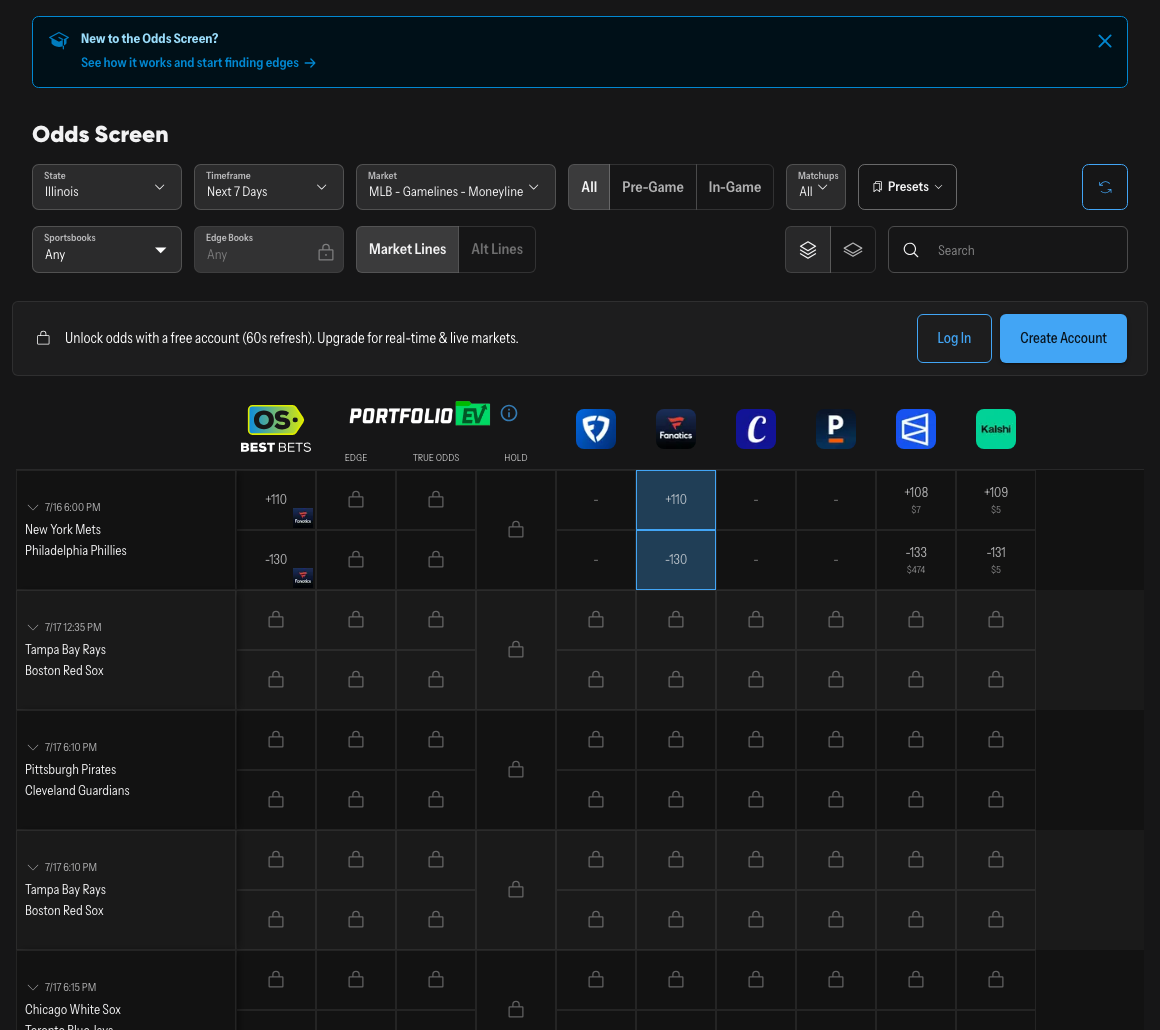
The OddsShopper Odds Screen.
Stop leaving the better number on the table. OddsShopper finds it for you across every book, free for 7 days, and code OS15 takes 15% off OS Pro after the trial.
What Not To Do After Getting Limited
This section is short because the rules are short, and every one of them protects the same thing this entire article is about: your legitimate access to the market and its prices.
- Do Not Open An Account In Someone Else's Name. Books call these "beard" or multi-accounting schemes, they violate the terms at every operator, and confirmed cases commonly end with the balance confiscated. In some states it crosses into fraud territory.
- Do Not Use A VPN To Bet From A State You Are Not In. Wagering across state lines is a legal problem, not just a terms problem.
- Do Not Let Someone Else Place Bets On Your Behalf For A Cut. Same failure mode: seized funds, closed accounts, and potentially worse.
Every scheme above risks the one thing a limited bettor still fully controls, which is legitimate access to the books that have not capped you yet. The edge that got you limited is worth protecting, and it is never worth trading for a confiscated bankroll. Bet where you legally stand, with stakes your bankroll supports, and let the price shopping do the work.
Sportsbook Limits FAQ
Is Being Limited Permanent?
Almost always, yes. Limits occasionally loosen after long periods of recreational-looking play, but no operator publishes a path back and you should not plan around one. Treat a limit as the account's new normal.
Can I Get My Limits Back By Contacting Support?
You can ask, and support will usually confirm the restriction without reversing it. Traders set limits from betting data, not from tickets, so a polite request rarely moves the number. Your realistic options are the ones above: more books, better prices.
Is It Legal For Sportsbooks To Limit My Account?
Yes. In regulated U.S. markets, operators can generally set stake limits at their discretion, and that discretion is written into the terms you accepted. Regulators have periodically pressed operators for more disclosure around limiting, but nothing broadly stops the practice today.
Do Sportsbooks Ban Winning Bettors Outright?
Rarely. Full closures are usually reserved for terms violations like multi-accounting or location fraud. Winning bettors get limited instead, because a capped sharp account is still useful to a book as a source of information about where its lines are wrong.
Is Betting Still Worth It After Being Limited?
If you were beating the close, yes. Your edge per dollar is unchanged; only the dollars moved. Smaller stakes mean slower profit and make price discipline non-negotiable, which is the entire argument of the worked example above. If you were not beating the close and got caught in a promo sweep instead, treat the limit as a nudge to bet lighter, not a badge.
Can I Still Withdraw My Money After Being Limited?
Generally, yes. A limit caps your stakes; it does not touch your balance, and winnings stay withdrawable under normal terms. Confiscations happen in terms-violation cases, things like multi-accounting or location fraud, not for winning too much.
Do Sportsbooks Share Information About Winning Bettors?
Sister brands running on the same platform often share risk data, so a limit at one can follow you to its siblings. Independent operators generally flag you on their own timelines, which is part of why spreading action across independently run books buys you time.
Which Sportsbooks Don't Limit Winners?
No mainstream U.S. book advertises a no-limit promise, and you should be skeptical of anyone claiming otherwise. The practical difference is tolerance: sharp-friendly, higher-limit operators let winning action run far longer than recreational-first books. The durable answer is diversification across every book you can legally access, not a hunt for the one book that never limits.
More on this: Why You're Not Winning At Sports Betting (Fix It Free) · Oklahoma At Michigan: Why 5.5 Is A Number To Lay · Do Different Sportsbooks Have Different Odds On The Same Game? · Why Did My Bet Get Voided? (And When A Book Can Do It) · Why Is My Bet Still Not Graded? Settlement, Explained
The Grade Is Real. Act Like It.
That $28 max bet stings less once you read it for what it is: the market's own risk models concluding that your numbers beat their closing prices. Most bettors never earn that. The ones who do face a fork: burn energy fighting a business practice that is legal, disclosed, and universal, or accept that the game has changed from stakes to price and get ruthless about the latter. A $50 bettor holding a 4-point break-even head start is in better shape than a $500 bettor giving it away at the wrong book. You already proved you can find good numbers. The only question left is whether you will keep getting paid the best available price for them.
OddsShopper exists for exactly that job: every book's price on one screen, graded against the no-vig fair number, so the edge that got you limited keeps working at whatever stake the books allow. Try it free for 7 days, and code OS15 takes 15% off OS Pro if you stay.
21+ only. Sports betting is legal only in regulated U.S. markets where available. Nothing here promises a financial outcome; bet within a bankroll you can afford, and if it stops being fun, call 1-800-GAMBLER.