Will Sportsbooks Ban You for Arbitrage Betting? What Happens to Your Accounts
Last updated: June 22, 2026
In Summary
Will sportsbooks ban you for arbitrage betting? The short answer is yes. Books limit and sometimes ban arbers, and most U.S. sportsbooks name arbitrage in their terms of service. The reason is plain: an arber only takes prices that beat the book, so the account stops being profitable for them. Books do not read your mind, though. They flag patterns, like stakes that only ever land on lines that move, calculator-exact bet sizes, instant action the second a number shifts, and a betting history with no recreational noise in it. I have arbed for years and been limited plenty, and what I have learned is that you cannot make an account immortal, but you can stretch its life a long way. This guide is the account-management side of arbing. If you still need the mechanics, start with arbitrage betting explained; here I assume you already arb and want to keep the books you arb from.
Go deeper: Arbitrage Calculator: How to Size Your Arb Bets.
Why Sportsbooks Limit Arbitrage Bettors
A sportsbook's business model runs on recreational bettors who play hunches and hold losing tickets. An arber does the opposite. When you arb, you stake every outcome of a market across different books so you come out ahead regardless of the result, which means you are only ever taking the prices that are wrong in your favor. Across thousands of bets, that account costs the book money on every wager it accepts from you.
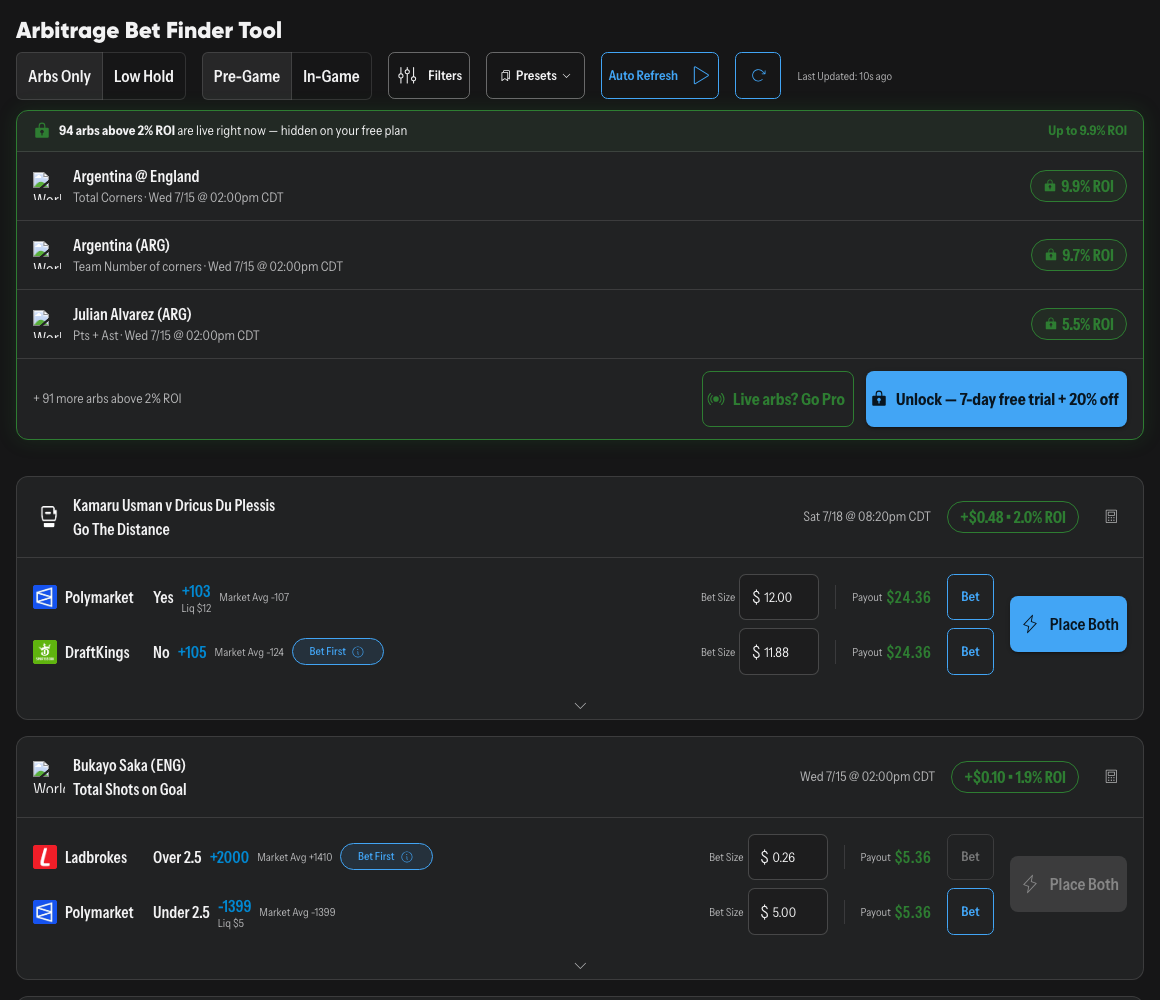
The OddsShopper Arbitrage Tool.
So books protect their margin. They run risk models that score how "sharp" an account looks, and when the score crosses a line, they act. The action usually escalates:
- Stake limiting. The most common outcome. You go to bet $500 and the book will only accept $14, or $2. The account still works, it is just throttled to a size where you cannot profit.
- Market restrictions. Limits applied only to certain sports, props, or live betting, where books know arbers feed.
- Bonus bans. You stop being offered promos, odds boosts, and free bets.
- Account closure. The book refunds your balance and shuts the door. Rarer, but it happens, and it is allowed under their terms.
None of this is a moral judgment. The strategy itself is legal where sports betting is legal and regulated. But a sportsbook is a private business, and it can decline or limit any customer it does not want, the same way a casino can show a card counter the door. Once you accept that sports betting limits are baked into the strategy, you stop trying to beat the risk model and start trying to outlast it.
The Signals That Flag Your Account
Books are not catching the idea of an arb. They are catching the fingerprints a careless arber leaves behind. After enough hands, these are the tells their models lean on most:
| The signal | What the book sees | Why it flags you |
|---|---|---|
| Calculator-exact stakes | $487.63, $213.41, $66.18 | Recreational bettors round. Raw stake-sizer outputs scream "tool." |
| Action only on sharp/moving lines | Every bet lands right before the number moves | Says you follow a model or a feed, not a hunch. |
| Instant bets on line moves | A wager fires seconds after a price shifts | Human bettors are slow. Feed-followers are fast. |
| Two-sided patterns across books | The same market, opposite side, two accounts | The literal shape of an arb. |
| Hammering obvious mispriced lines | You jump on a stale or error price | These get voided and tagged. It is the fastest path to getting banned for arbitrage betting. |
| Bonus-only behavior | You appear, clear a promo, vanish | Pure bonus extraction is a known sharp pattern. |
| Deposit/withdraw churn | Constant small deposits, a withdrawal after every win | Funding flow that mirrors a grinder, not a fan. |
Notice that none of these is "the book figured out you were arbing." Each one is a behavior that does not look like a normal customer. That is the whole game. Limits come from looking sharp, not from the math itself.
How Long Does an Arbing Account Last?
Be honest with yourself about the lifespan, because it varies wildly and nobody can promise you a number. I have torched a fresh account in a week by firing odd stakes on stale lines, and I have also kept a careful account alive the better part of a year by blending in. The sharper, newer, more promo-heavy books tend to limit fastest. Some of the bigger operators run looser for longer.
The realistic mental model is this: every arbing account is on a clock, and your habits decide whether that clock runs in weeks or in months. You are not trying to be invisible forever. You are trying to extract as much value as you can before the limit lands, and to have fresh books in reserve when it does. I treat account access as a finite resource I manage, not a permanent fixture I lean on.
How to Avoid Getting Limited
You cannot stop a book from limiting a winner eventually. You can avoid handing it the obvious reasons to do it early. These are the levers that actually move the needle on how to avoid getting limited, roughly in order of impact.
Round your stakes. This is the cheapest, highest-impact habit there is. A stake-sizer will tell you to bet $487.63 on one leg, but a real person bets $500. I round every stake to the nearest $5, $10, or $25. It costs a sliver of perfect balance on the arb and buys a stake that looks human. Round on the recreational-looking book especially.
A Quick Example: Rounded vs. Raw Stakes
Say an arb calculator hands you two legs to lock a small margin: $487.63 on the favorite at DraftKings 🎁 and $512.37 on the underdog at FanDuel 🎁. Fire those exact numbers and you have told both books a tool sized your bets. Round them to $485 / $515, or even $500 / $510, and the margin barely moves, but now the tickets read like someone betting round money. Across hundreds of bets, that one habit is the difference between blending in and lighting up a risk model.
Mix in "mug" bets. A mug bet is ordinary recreational action you place to look like a fan: a parlay on the weekend slate, a prop on a star player, a moneyline on your home team. They are not free, since most carry the vig you usually avoid, so I treat them as a marketing cost, not a profit center. A handful sprinkled through your history breaks up the wall-to-wall sharp pattern.
Spread action across more books. The fewer books you use, the faster each one sees your full pattern. The more books you hold balances at, the thinner your footprint is at any single one, and the more arbs you can reach in the first place. This is where a wide-coverage feed earns its keep, because you cannot spread action across books you are not watching. OddsShopper's Arbitrage tool scans 110+ sportsbooks, so you can rotate where you place rather than grinding two books into the ground.
Avoid the obvious stale and mispriced lines. The single fastest way to get caught is to pounce on a price that is clearly an error or badly lagged. Books void those bets, and they tag the account that took them. This is the part most "how not to get banned" pages skip, and it is where a fair-odds view helps directly. Because the tool scans every book and strips the vig to show each one's true price, you can tell a genuine 0.5–2% margin arb from a too-good stale number that is going to get voided and flagged. Skip the bait. The same line-shopping discipline that finds you the best number also tells you when a number is too far off to trust.
Watch your deposit and withdrawal cadence. Constant tiny deposits and a withdrawal after every win paint a grinder's funding flow. Fund an account once with a balance you will work through, withdraw sporadically rather than on every hit, and you give the book less to read.
Here is the same advice as a quick do/avoid checklist:
| Do this | Avoid this |
|---|---|
| Round stakes to $5/$10/$25 | Betting calculator-exact dollar amounts |
| Mix in occasional parlays and props | A history of nothing but sharp two-sided action |
| Hold balances at many books | Grinding the same two books all day |
| Take genuine small-margin arbs | Pouncing on obvious stale or error prices |
| Fund once, withdraw sporadically | Deposit-and-withdraw after every single win |
The fastest accounts to get limited are the ones taking obvious bad numbers all day. OddsShopper scans 110+ sportsbooks in real time, strips the vig, and shows each book's fair price, so you can find genuine arbs across many books and skip the stale lines that flag you first. Try OS Pro free for 7 days, then code ARBSAFE20 takes 20% off OS Pro or OS Core if you stay.
The Trade-Offs, Straight
Every tactic above has a cost, and the people who last are the ones who accept that instead of pretending it is free money.
Rounding stakes leaves a little balance on the table. Mug bets bleed vig. Spreading across more books means more accounts, more balances, and more admin. And the honest bottom line, the one the thin guides bury, is that a consistent winner gets limited eventually no matter how careful they are. Camouflage buys you time and volume, it does not make you invisible to a book that is paying attention.
That is why I do not treat arbing as my whole strategy, and most serious bettors do not either. Arbing is a low-variance grind of small margins with a built-in expiration date on every account. Positive EV betting carries more variance but a higher ceiling and the same need to manage account access. Running both, and managing your books like the finite resource they are, is far more durable than squeezing one account until it caps. You can shop and compare live numbers for either approach straight off the OddsShopper odds screen.
More on this: PrizePicks Limits: How I Still Win MLB Entries At A Card · Arbitrage Betting Mistakes: Why Your Arb Doesn't Fill · Is Arbitrage Betting Legal? US Rules Explained · Arbitrage Vs EV Betting: Which Fits Your Bankroll? · How Much Money Can You Make Arbitrage Betting?
Frequently Asked Questions
Will sportsbooks ban you for arbitrage betting? They can, and many name arbitrage in their terms of service. In practice the more common outcome is stake limiting, where your max bet drops to a few dollars, rather than a full ban. But account closure does happen, and the books are allowed to do it.
Is arbitrage betting illegal? No. It is legal in regulated U.S. markets where sports betting is legal, since you are just taking advantage of price differences between books. The risk is not legal, it is that a sportsbook, as a private business, can limit or close an account it does not want.
How do sportsbooks know you are arbitrage betting? They do not read your intent. Their risk models flag behavior: calculator-exact stakes, action only on lines that are about to move, instant bets after a price shift, and a history with no recreational bets in it. The pattern is the tell, not the math.
How do I avoid getting limited for arbitrage betting? Round your stakes, mix in ordinary recreational bets, spread your action across more books, avoid obviously stale or mispriced lines, and keep your deposit and withdrawal cadence calm. None of it makes you immune, it slows down how fast a book flags you.
How long does an arbitrage betting account last? It varies from days to many months depending on your habits and the book. Careless arbing on odd stakes and stale lines gets limited fast, while careful camouflage can stretch an account for months. No one can promise a specific lifespan.
Do "mug" bets really help? They help break up an all-sharp betting history, which is what risk models look for. They are not free, since most carry the vig you normally avoid, so treat the occasional parlay or prop as a small cost of staying under the radar, not a profit play.
Can OddsShopper stop my accounts from getting limited? No tool can promise that, and you should be skeptical of any that claims to. What a wide, de-vigged feed does is help you find arbs across many books, so you can spread action, and tell a real edge from a stale line that will get voided and flagged. It makes you a more efficient, lower-profile arber, not an invisible one.
*Arbing accounts run on a clock, and the obvious low-margin plays get them limited fastest. OS Pro scans 110+ sportsbooks in real time, strips the vig, and shows each book's fair price, so you can find genuine arbs across more books and skip the stale numbers that flag you first. Try it free for 7 days, then use code ARBSAFE20 for 20% off your first payment of OS Pro or OS Core.