Parlay Betting Explained: Why Most Parlays Lose
In Summary
A parlay combines two or more bets into one ticket. Every leg has to win for the parlay to cash, and in exchange the payout is much bigger than the individual bets would pay. Here's the part most sites get wrong: a parlay simply compounds the edge of its legs. Stack bad, vig-inflated bets and the house edge compounds against you, which is exactly why parlays have a sucker-bet reputation. But parlay +EV legs and your edge compounds in your favor. With a tool that surfaces +EV bets, a parlay becomes a higher-variance way to amplify real value, not a lottery ticket. This guide covers how parlay odds work, whether parlays are worth it (it depends entirely on your legs), and the strategy sharp bettors actually use.
What Is a Parlay Bet?
A parlay is a single bet made up of multiple "legs." You might combine an NFL spread, an NBA moneyline, and an MLB total into one parlay. The catch is simple: all of the legs must win. If even one loses, the entire parlay loses. In return for that added difficulty, the sportsbook pays out far more than you'd get betting each leg separately, because the odds of each leg multiply together. Fantasy pick'em slips run on the same all-legs-must-hit multiplication, which is why our PrizePicks Power Play vs. Flex Play guide reads a lot like parlay math.
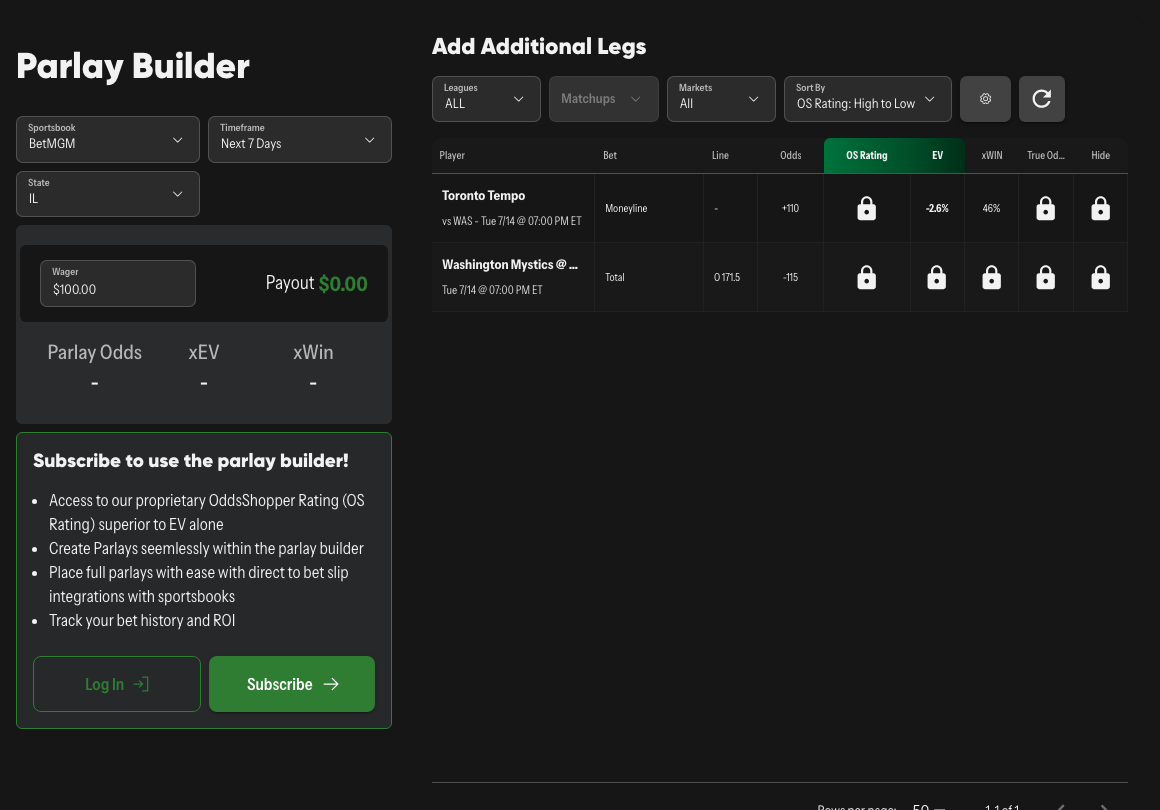
The OddsShopper Parlay Builder.
How Parlay Odds Work: A Simple Example
The math is just multiplication. Here's a simple, beginner-friendly example:
Say you bet $100 on a two-team parlay where each leg is priced at -110 (a standard line, risk $110 to win $100; if that notation is new, start with how to read betting odds):
- Bet each leg on its own and a $100 winner pays about $91 profit.
- Parlay the two together and if both win, you collect about $265 profit on the same $100.
That's the appeal: roughly triple the payout. But you only win if both legs hit. Miss one and the whole $100 is gone. Add a third leg and the payout jumps again (toward +600), and so does the difficulty. You can check any combination instantly with our parlay calculator, and the parlay calculator guide walks through the payout math behind it.
Bigger payouts only pay off when the legs are priced in your favor. OS Pro surfaces the +EV bets worth parlaying and lets the Parlay Builder stack them for you. Curious what it flags as +EV on today's board? See for yourself free for 7 days, with code PARLAYEDGE20 for 20% off OS Pro or OS Core after.
Are Parlays Worth It? It Depends Entirely on Your Legs
This is the part almost every parlay guide gets wrong. A parlay's expected value is the product of its legs' expected values, so a parlay compounds whatever edge your legs carry, in whichever direction they point.
- Stack -EV legs (random bets at vig-inflated prices, what most casual bettors do) and that negative edge compounds. A five-leg parlay of bad bets hands the book a brutal effective edge. This is why parlays have a sucker-bet reputation, and why a big share of sportsbook profit comes from losing parlays.
- Stack +EV legs (bets priced better than their true probability) and the math runs the other way: your edge compounds, and the parlay is +EV, often more so than any single leg. The catch is variance: a +EV parlay still hits less often than a straight bet, so it swings harder.
So are parlays worth it? They can be +EV, if your legs are +EV. That's the whole game, and it's exactly what OddsShopper is built for: use Portfolio EV to find legs that are actually priced in your favor, then parlay those. The difference between a sucker's parlay and a sharp's parlay isn't the parlay. It's whether the legs have an edge.
For more on this, see Same Game Parlay Strategy: One SGP, +369 or +580?.
The best parlays you can build are the ones made of good, positive-EV bets combined together, and that's the entire difference-maker. Because parlays are higher-variance, size them smaller than your straight bets and treat them as a way to amplify real value, not as your whole bankroll strategy. If you come from DFS, that framing should feel familiar: a parlay plays like a tournament entry while a straight bet plays like a cash game, a crossover our sports betting vs. DFS guide maps in detail.
Smart Parlay Strategy
If you're going to bet parlays, these principles tilt the odds back toward you:
- Make every leg +EV. That's the whole game. It's not the number of legs that makes a parlay good or bad; it's whether each leg is priced in your favor. A four-leg parlay where all four legs are +EV is a better bet than a two-leg parlay with a coin-flip leg, because more +EV legs compound more edge. The old "stick to two or three legs" advice exists because casual bettors pad parlays with -EV longshots to chase a payout. With +EV legs, adding legs adds edge.
- Mind the variance, not the leg count. The real trade-off with more legs isn't house edge; it's variance: more legs means a lower hit rate and bigger swings, even when every leg is +EV. So size longer parlays smaller and make sure each added leg is +EV (and ideally independent or deliberately correlated), not a marginal filler bet just to lengthen the ticket.
- Split a long ticket into a round robin. A round robin plays every smaller parlay combination of your legs as its own ticket, so one miss no longer zeroes the whole position: same legs, smoother variance.
- Use correlated, same-game parlays where they're mispriced. Correlation is an edge only when the book gets it wrong (more on this below).
- Shop the parlay price. Different books price the same parlay differently — the exact same three legs can pay noticeably more at DraftKings than at FanDuel or BetMGM. Line shopping across 100+ books, the core of what OddsShopper does, can meaningfully raise your payout on identical legs.
Same-Game Parlays and Correlation
The smartest parlay play is correlation: combining legs whose outcomes are linked, so when one hits, the other is more likely to hit too. Classic example: parlay a heavy favorite's moneyline with the game going over the total. If the favorite blows the game open, the over is more likely to cash as well. Because the legs move together, a correlated parlay can carry a real edge, but only when the sportsbook misprices that correlation. Books already shade same-game-parlay odds to account for correlated legs, so the edge exists when their model is off, not automatically.
Our Parlay Builder assembles tickets from legs that are +EV — each one de-vigged to its true no-vig price by our Sharp Sportsbook Algorithm and ranked by our back-tested Portfolio EV model — so you're building correlation on top of real value instead of stacking longshots. The same leg-by-leg discipline carries straight to pick'em apps, where every entry is a parlay of player projections — our free PrizePicks optimizer guide applies it to PrizePicks boards.
Should You Hedge a Parlay?
When a parlay comes down to its last leg, sportsbooks will happily let you hedge (bet the other side to lock in a result) or take a cash out. Here's the sharp view: if your parlay was +EV to begin with, hedging gives back the edge you earned. Over the long run, hedging your +EV tickets (and cashing out, which bakes in the book's margin) is a losing move; you're paying for certainty you don't need. The one time it's defensible is pure risk management: when the payout on the line is life-changing relative to your bankroll, locking in a chunk can be worth more to you than the EV you give up. That's rare. For a disciplined +EV bettor, the default is to let your +EV bets run.
Frequently Asked Questions
How do parlay payouts work? The odds of each leg multiply together, so the payout grows fast with each added leg: a two-leg parlay at -110 each pays roughly +265, a three-leg around +600. But every leg must win, so the bigger the parlay, the lower your chance of cashing.
Are parlays a good way to make money? They can be, but only if your legs are +EV. A parlay compounds the edge of its legs: stack vig-inflated random bets and you compound the house edge (which is why most parlay bettors lose), but parlay +EV bets and you compound your own edge. The legs are everything; the parlay just multiplies whatever edge they carry.
What is a correlated parlay? A parlay where the legs are linked so one winning makes the other more likely (e.g., a big favorite's moneyline plus the game's over). Correlation can give a parlay an edge, but only when the book misprices it, since sportsbooks already shade same-game-parlay odds for correlation.
How many legs should a parlay have? There's no magic number. What matters is that every leg is +EV, not how many legs there are. A four-leg parlay of +EV legs has more compounded edge than a two-leg one; it just carries more variance (a lower hit rate), so size it smaller. The mistake isn't adding legs; it's adding -EV legs to chase a bigger payout.
Should I hedge my parlay? Usually no. If your parlay was +EV, hedging (or cashing out) gives back the edge you earned and is a losing move over the long run. The exception is risk management: when the remaining payout is life-changing relative to your bankroll, locking in some of it can be worth the EV you surrender. For most +EV bets, let them run.
Stop stacking longshots. The OddsShopper Parlay Builder builds parlays from legs that are actually +EV, so you're compounding real edge, not donating to the book. Price any combination with our parlay calculator, then upgrade to OS Pro with code PARLAYEDGE20 for 20% off your first payment and build +EV parlays in seconds.
More on this: Closing Line Value (CLV) Explained: Beat the Close · Arbitrage Betting Explained: A $50-Profit Example · Odds Boosts Strategy: Which Ones Are Actually +EV · Bankroll Management Sports Betting: The 1% Rule · Cash Out Betting Explained: The Margin You Pay for Certainty