Last updated: July 22, 2026
A parlay calculator does one job: it takes the odds of every leg on your ticket and tells you what the whole bet pays. The math behind it is simple once you see it, so before you lean on a tool, it is worth learning how the number is built. That way you can spot the one thing every calculator quietly ignores: whether the price you got on each leg was any good.
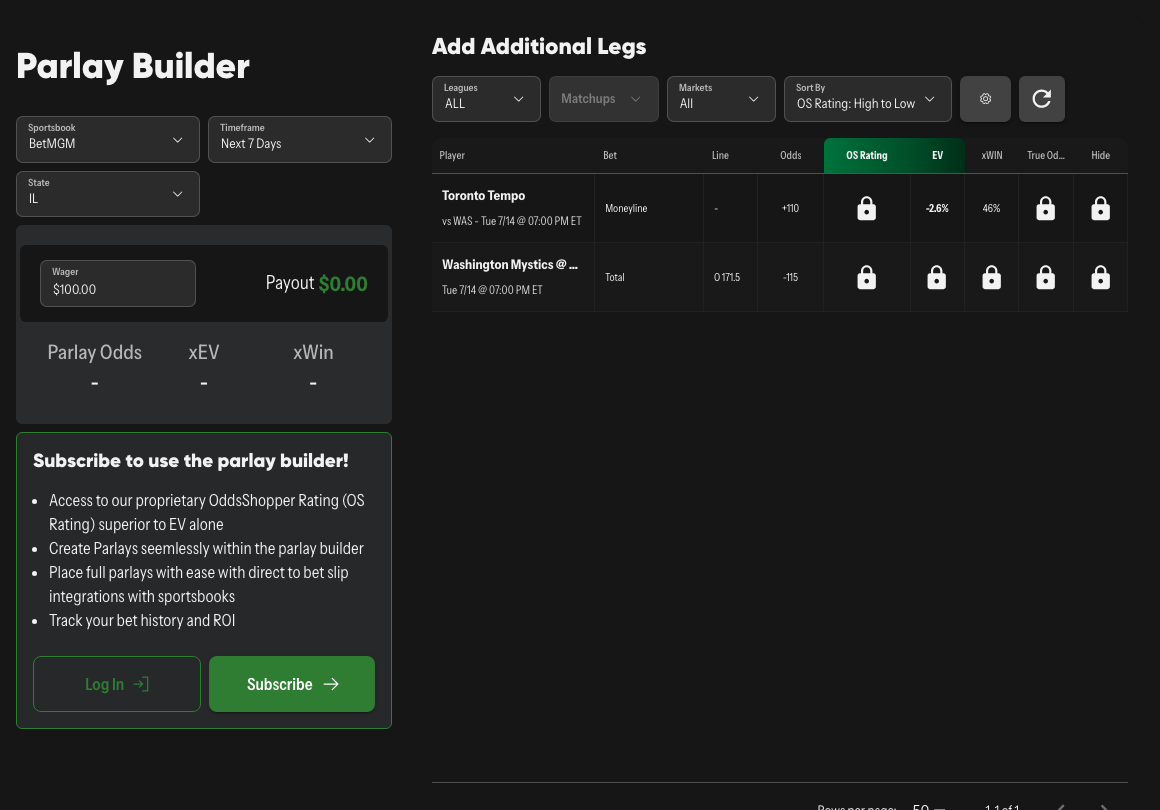
The OddsShopper Parlay Builder.
In Summary
- A parlay stacks two or more bets into one ticket. Every leg has to win, and the payout is the legs' decimal odds multiplied together.
- To price one by hand: convert each leg to decimal odds, multiply them, then multiply by your stake. A parlay calculator runs those same steps instantly.
- What a calculator cannot tell you is whether you got the best price on each leg. Because a parlay multiplies the legs, a small edge per leg compounds, so shopping the price matters far more here than on a single bet.
- The takeaway: get the best number on every leg first, then let the calculator multiply.
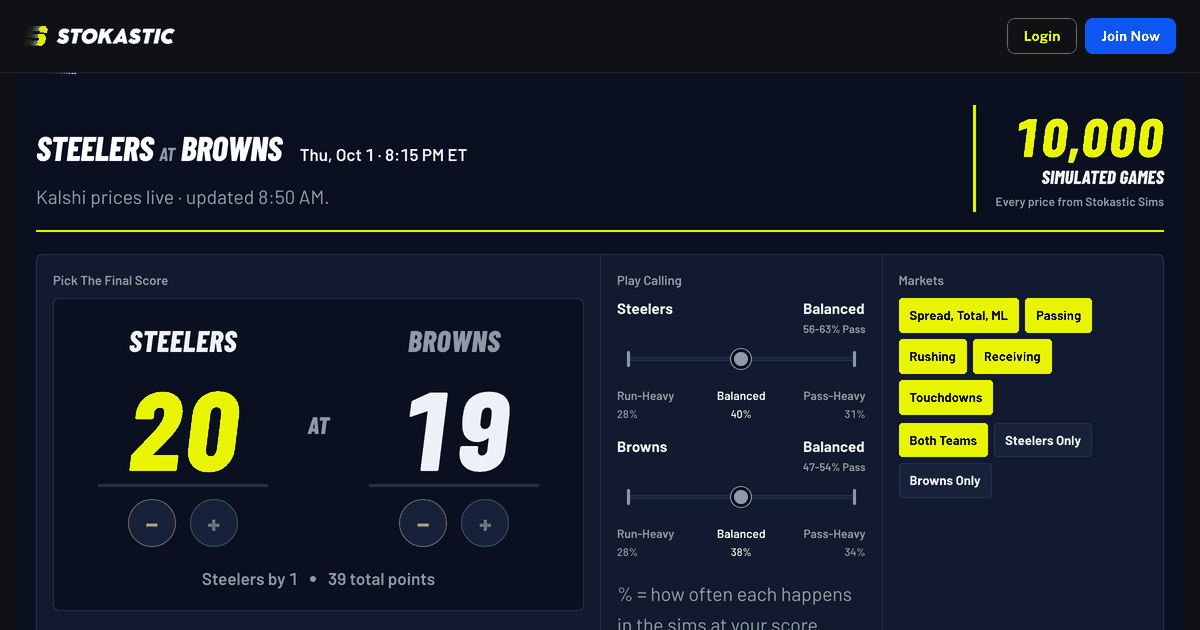 Price the combo before you buy it: the Kalshi Parlay Simulator runs 10,000 simulated games of this week's game and prints the fair price of any combo next to the price on Kalshi.
What A Parlay Calculator Does
A parlay combines two or more bets into a single ticket where every leg has to win for the bet to cash. Because the legs stack, the payout is much bigger than betting each one on its own, and the number behind that payout is just multiplication.
A parlay calculator automates three steps: it converts each leg's odds into a common format, multiplies them together, and applies your stake to spit out the total return and profit. You can run any combination in seconds with our parlay calculator. But knowing what the tool does under the hood pays off, because once you can price a parlay by hand you can also tell a good parlay from a bad one before you place it.
If you are brand new to this and want the full picture first (what parlays are, when they are worth it), start with parlay betting explained and come back here for the math.
How To Calculate Parlay Odds By Hand
The cleanest way to compute a parlay is to convert every leg to decimal odds first, because decimals multiply cleanly. If the American plus/minus format still trips you up, how to read betting odds covers it in full. Here is the four-step process.
- Convert each American line to decimal.
- For a plus line:
(odds / 100) + 1. So +150 becomes(150 / 100) + 1 = 2.50. - For a minus line:
(100 / the absolute value of the odds) + 1. So -110 becomes(100 / 110) + 1 = 1.909.
- For a plus line:
- Multiply all the decimal odds together. That product is the parlay's combined decimal odds.
- Multiply the combined decimal by your stake. The result is your total return (stake plus profit). Subtract the stake to see profit on its own.
- Convert back to American if you want the parlay quoted as a price. If the combined decimal is 2.0 or higher, use
(decimal - 1) x 100. If it is below 2.0, use-100 / (decimal - 1).
That is the whole engine. Every parlay calculator, including the one baked into your sportsbook app, is running those same four steps.
A Worked Example: A Three-Leg Parlay
Say I am building a three-leg MLB parlay and I want to know what a $50 bet returns before I place it. I like the Dodgers on the moneyline at -150, the Yankees at +120, and the over in the Braves game at -110. Those are the kind of prices you would pull off the live odds screen on any given night, used here as an illustration.
Convert each to decimal:
- -150 becomes
(100 / 150) + 1 = 1.667 - +120 becomes
(120 / 100) + 1 = 2.20 - -110 becomes
(100 / 110) + 1 = 1.909
Multiply them: 1.667 x 2.20 x 1.909 = 7.00. That 7.00 is the parlay's combined decimal odds, which converts to +600 in American terms.
Now apply the stake: $50 x 7.00 = $350.00 total return, which is $300 profit on top of your $50 back. Three modest legs, none of them a longshot, combine into a 6-to-1 payout. There is the appeal of a parlay, and the catch sits right beside it: all three have to land.
Parlay Payout Chart
Start with the most common reference point: a parlay where every leg is priced at the standard -110 (decimal 1.909), showing the profit on a $100 stake (rounded to the nearest dollar) and the chance all legs hit if each wins at exactly the rate that price implies (52.4%).
| Legs (Each -110) | Parlay price | Profit on $100 | Implied chance all hit |
|---|---|---|---|
| 2 | +264 | $264 | 27.4% |
| 3 | +596 | $596 | 14.4% |
| 4 | +1,228 | $1,228 | 7.5% |
| 5 | +2,436 | $2,436 | 3.9% |
| 6 | +4,741 | $4,741 | 2.1% |
Two things jump out. The payout climbs fast, and the chance of cashing falls just as fast. A six-leg parlay paying about 47-to-1 sounds great until you notice it hits about one time in 50 at these prices. The chart is the honest version of the dream: bigger numbers, longer odds.
Quick tipa parlay's combined decimal odds are just the product of the legs. If you can multiply, you can price any parlay. The hard part is not the math; it is getting a good price on each leg before you multiply.
Why The Same Parlay Pays More At A Better Price
That gap is the piece a plain calculator hides. It prices the parlay at whatever odds you fed it and never asks whether those were the best odds available.
Take the three-leg, all -110 parlay from the chart: it pays +596, or $596 profit on $100. Now suppose DraftKings 🎁 had all three legs at -110, but you checked FanDuel 🎁 and BetMGM 🎁 and found -105 on the same three. On one bet, that barely moves the needle. Watch what it does to the parlay.
- -105 in decimal is
(100 / 105) + 1 = 1.952 - Three of those multiplied:
1.952 x 1.952 x 1.952 = 7.44, which is about +644
Same three teams, same bet, but now $100 returns $644 profit instead of $596. You picked up about $48 for the work of clicking the better number. Because a parlay multiplies the legs, a small edge on each one compounds, so shopping the price pays off far more on a parlay than it ever does on a single bet. The vig the book builds into each price stacks up the same way against you, which is exactly why the best number per leg matters most here.
That compounding is the entire reason to shop before you parlay. New to OddsShopper? The tool scans every major sportsbook and surfaces the best available price on every leg, so the number you feed the calculator is the best one on the market, not just the one your app showed you first.
Stop leaving the better number on the table.OddsShopper finds the best price on every leg across every major sportsbook, then the Parlay Builder stacks them into one ticket. Code BUILDER20 takes 20% off OS Pro or OS Core when you subscribe.
Same-Game Parlays Calculate Differently
A standard parlay assumes the legs are independent, which is why you can just multiply the odds. A same-game parlay is different: the legs come from one game, so their outcomes are linked. A quarterback throwing for 300 yards and his top receiver going over 80 yards tend to happen together. Because of that correlation, sportsbooks do not price a same-game parlay by simply multiplying the legs. They run their own model and shade the price to account for the linkage, so a plain calculator will overstate what a true same-game parlay pays.
The short version: use a regular parlay calculator for legs from different games, and trust the book's quoted same-game number for one-game tickets, knowing it has already been adjusted. For how to actually find an edge there, see same-game parlay strategy.
Implied Probability: What The Payout Is Really Telling You
Every price carries an implied probability, the win rate the odds say you need to break even. Flip the decimal odds to find it: 1 / decimal odds. The three-leg +600 parlay from earlier (decimal 7.00) implies 1 / 7.00 = 14.3%. So that ticket needs to hit about one time in seven just to break even over the long run.
This is the most useful habit a calculator can build, because it reframes the payout. A +4,741 six-leg parlay is not free money waiting to happen. Its roughly 2% implied chance is the calculator quietly telling you how often it expects to lose. The real question is never how big the payout is. It is whether each leg's true chance of winning is higher than the price implies, which is the definition of a positive expected value bet. Build a parlay out of legs that clear that bar and the math works in your favor over the long run. Build it out of longshots chasing the payout and the implied probability is telling you the truth.
Should You Bet Parlays?
Here is the honest read a calculator will never give you. Every leg you add multiplies the sportsbook's vig along with the payout, so the more legs you stack, the harder the whole ticket has to fight the house edge. It is why a random six-leg parlay of coin-flip prices is a long-term loser no matter how good the payout looks.
Parlays are still worth betting in two specific cases. The first is when every leg is one you would place on its own because the price beats the true odds, a real positive expected value bet. That gives you a concrete decision rule instead of a gut feel: only add a leg when its true chance of winning clears the implied probability its price sets, the same 1-divided-by-decimal number from the implied-probability section above. Stack good prices and the edge compounds in your favor; stack bad ones and the vig grinds it away. The second is small: a two- or three-leg parlay of legs you actually like, shopped for the best number on each, is a reasonable swing. Chasing a ten-leg lottery ticket is entertainment, not strategy, and the payout chart above is the math behind why.
The Bottom Line
Pricing a parlay is just four steps: convert each leg to decimal, multiply, apply your stake, and convert back if you want the American number. A calculator does that in a blink. What it cannot do is tell you whether the odds you started with were the best ones on the market, and on a parlay that gap widens with every leg. Get the best price on each leg first, then let the calculator do the multiplying.
More on this: Golf Top 20 Parlay Odds: Scheffler Plus Two: Kalshi Odds · Devig Calculator: Find Fair No-Vig Odds From -110 Prices · Kalshi Same Game Parlays: What You Can And Cannot Combine · What Is SGP In Betting? Same Game Parlay Strategy · What Happens To Your Kalshi Parlay When A Leg Voids
Frequently Asked Questions
How do you calculate a parlay payout?
- Convert each leg to decimal odds.
- Multiply all the decimals together to get the parlay's combined odds.
- Multiply that combined number by your stake for the total return, then subtract your stake to see profit on its own. A two-leg parlay at -110 each, for example, comes out to about +264.
How does a parlay calculator work? It runs that same math automatically: it converts every leg to a common format, multiplies the odds, and applies your stake to show the total payout and profit. You enter the legs and the bet amount, and it handles the conversion and multiplication for you.
How are same-game parlay payouts calculated? Not by simple multiplication. Because the legs in one game are correlated, sportsbooks use their own model to price a same-game parlay and shade the odds for that linkage, so the payout is usually lower than multiplying the legs would suggest.
Why does the same parlay pay different amounts at different sportsbooks? Each book sets its own price on every leg, and those small differences multiply across the parlay. Finding a slightly better number on each leg compounds into a noticeably bigger payout, which is why shopping the price before you parlay matters more than on a single bet.
What does the implied probability of a parlay mean? It is the break-even win rate baked into the odds, found by dividing 1 by the combined decimal. A +600 parlay (decimal 7.00) has an implied probability around 14.3%, meaning it needs to hit roughly one time in seven just to break even.
A calculator tells you what a parlay pays. It cannot tell you whether you got the best price, and on a parlay that gap compounds. OddsShopper finds the best number on every leg across every major sportsbook, then the Parlay Builder stacks them into one ticket. Use code BUILDER20 for 20% off OS Pro or OS Core when you subscribe, so the price you multiply is the best one on the market.> Tools for this: run the combo through 10,000 sims against the sims, or the Polymarket Combo Simulator for Polymarket's book.