Soft betting lines are not a gift and they are not an accident. They are a budgeting decision. A sportsbook spends modeling effort in proportion to the money it expects to take, and in July, the money it expects to take on NBA Summer League basketball is a rounding error against a Sunday NFL card. Thin handle buys a thin number. Everything else in this article follows from that one sentence, and once you see it you stop asking whether Summer League lines are beatable and start asking a better question: beatable by how much, and is that worth your afternoon?
I want to answer that with an actual figure rather than a vibe, because there is one number from our own NBA Summer League board that settles the argument in both directions at once. It is the reason this article is optimistic about the mechanism and pessimistic about the payday. I will get to it, but the number only means something after you understand what a book is doing when it posts a price it does not fully believe.
In Summary
- Soft Betting Lines Come From Low Handle, Not Low Competence. Books allocate modeling effort where the money is. NBA Summer League gets a fraction of the attention a regular-season NBA game gets, so the posted numbers are thinner and slower to move.
- Soft Does Not Mean Wrong. A soft line is one the book holds with low confidence. It is only beatable when a better estimate of the true probability exists, and the way you build that estimate is by stripping the vig out of the market.
- The True Price Is What You Compare Against. De-vigging converts a book's two-sided price into a fair probability. If the best available number pays better than fair, the bet is +EV. If it does not, there is no bet.
- The Edges Are Real And Small. On our NBA Summer League board for July 10, 2026, one moneyline cleared with a 1.87% edge. It was the only side out of 34 that cleared at all.
- Low Limits Are The Tax. Books cap Summer League stakes precisely because they know the number might be off. You are allowed to be right here. You are not allowed to be right for very much money.
Why Are NBA Summer League Betting Lines Soft?
Every price on a sportsbook's board is the output of a process that costs something to run: data feeds, modelers, traders watching for sharp action, risk limits that get adjusted by hand. That process is not free, and no book runs it at the same intensity across every market on the wall.
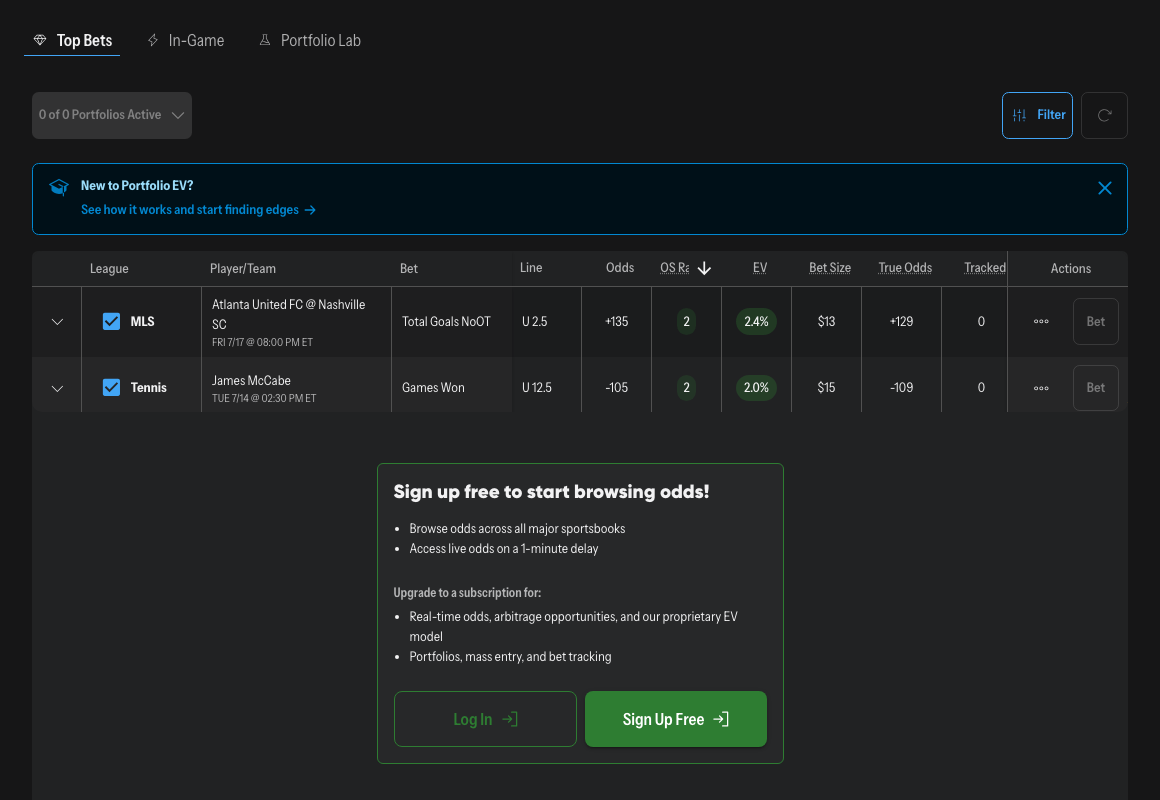
The OddsShopper +EV Screen.
A Sunday NFL card takes orders of magnitude more money than anything else on the wall, and it gets the full apparatus. An NBA Summer League game in Las Vegas in the second week of July takes a small fraction of that, so it gets a fraction of the apparatus. Often the opening number is a projection with light human oversight, posted early, adjusted only when someone bets into it hard enough to be noticed.
That produces three symptoms you can actually observe on an odds screen, rather than three things you have to take on faith:
- Books disagree with each other more. On a Week 8 NFL game, the major books cluster tightly around one number. On Summer League, the spread between the most and least aggressive number is routinely wider, because fewer traders are watching and fewer bettors are correcting them.
- Lines move slowly, and on less. A number that nobody is betting into does not move. Information that would reprice an NBA game in seconds can sit unabsorbed in a Summer League market for hours.
- Limits are low. This is the book telling you, in the only language it has, exactly how much it trusts the number.
The third symptom is the one bettors skip past, and it decides whether any of this is worth doing. Hold that thought.
What Does A "Soft Betting Line" Actually Mean?
Here is the distinction that separates people who make money in these markets from people who talk about them.
Soft describes the book's conviction: it posted a number it would not defend hard. Beatable describes yours: you can estimate the true probability better than the posted price does. Those are two different claims about two different people, and only the second one pays.
The uncomfortable part is that you probably cannot make the second claim either. Nobody reading this has a proprietary model for how many minutes a two-way contract guard plays in a July exhibition. What you do have is one thing no single sportsbook has: a view of every book's number at once, and the disagreement between them is itself the information.
The edge lives in that gap. Not inside any single book's opinion, but in the distance between the market's consensus fair price and the best individual number posted anywhere on it. DraftKings 🎁, FanDuel 🎁, BetMGM 🎁, Caesars, BetRivers 🎁 and Fanatics all price Summer League gamelines. When they disagree by a meaningful amount, one of those numbers is a materially better ticket than the others, and finding it is arithmetic rather than handicapping.
How Do You Find The True Price? De-Vigging Explained
A sportsbook's posted odds are not a probability estimate. They are a probability estimate plus a margin, and you have to remove the margin before the number tells you anything.
Convert both sides of a market into implied probability and add them together. They will sum to more than 100%. That excess is the vig, also called the hold. De-vigging is the act of scaling both sides back down so they sum to exactly 100%, which leaves you with the market's honest opinion of each outcome.
Once you have a fair probability, positive expected value is a single comparison. If some book pays you at odds implying a lower probability than the fair number, you are being overpaid for that outcome. That is a +EV bet. If no book does, you pass, and you have learned that in about 30 seconds instead of talking yourself into it over an hour.
Worked Example: How The Vig Hides An Edge
The numbers below are round, chosen to make the arithmetic legible. Live NBA Summer League prices sit on the odds screen and change through the day.
Start with one book pricing a Summer League moneyline at -130 on the favorite and +110 on the underdog.
| Step | Favorite | Underdog |
|---|---|---|
| Posted Price | -130 | +110 |
| Implied Probability | 56.5% | 47.6% |
| Sum Of Both Sides | 104.1% (a 4.1% hold) | |
| De-Vigged Fair Probability | 54.3% | 45.7% |
The row that matters is the third one. Those two implied probabilities sum to 104.1%, not 100%, and that 4.1% surplus is the hold. Nothing about it is gouging. Books charge the same ordinary margin on NFL games in November as they charge on a rookie exhibition in July. Scale both sides down proportionally and the market's real belief appears: the underdog wins 45.7% of the time.
Now check the rest of the market. Suppose the best price on that same underdog anywhere else is +122. A +122 payout only needs the underdog to win 45.0% of the time to break even. The market thinks it wins 45.7% of the time. You are being paid for an outcome slightly more likely than the price requires, and that gap is worth about +1.5% in expected return on every dollar you put through it.
That is what a soft betting line looks like from the inside. Not a mispriced blowout that everyone missed. A 0.7-percentage-point disagreement, invisible without the arithmetic, worth a penny and a half on the dollar.
See the fair price next to every book's price.OddsShopper's NBA Summer League odds screen does this comparison across every major sportsbook and shows the de-vigged number beside the posted one, with the Sharp Sportsbook Algorithm weighting the books that set the market over the ones that copy it. Use code SOFTLINE20 for 20% off your first payment of OddsShopper Pro
SO How Often Does A Summer League Line Actually Clear?
This is the number I promised you.
When we priced the NBA Summer League board for July 10, 2026, we ran all eight games through exactly the process above: de-vig every moneyline, spread and total, then compare the best available price to fair. That produced 34 bettable sides.
Exactly one of them cleared zero. A single moneyline, at a 1.87% edge, as priced on the evening of July 9, 2026.
Both halves of that result are the point. One side clearing proves the mechanism works: in a market this thin, an edge exists and the tool surfaces it without you needing a Summer League model. Thirty-three sides not clearing proves the market is not a piñata. A fair price is a fair price, and a fair price is not a bet, which holds against a rookie exhibition in July exactly as it holds against a title contender in January.
If you went looking for five plays on that board, you would have found five. Four of them would have been you, not the market.
Do Small Edges Actually Compound?
A 1.87% edge sounds like nothing. Over enough repetitions, it is the entire business model of every sportsbook you have ever used, run in reverse.
The arithmetic of compounding is unsentimental, though, and it has two inputs, not one. Expected value per bet is the first. The number of bets is the second. Professionals grinding +EV do not win because any individual edge is large. They win on volume: the arithmetic only separates itself from variance across a large number of bets, so they place a great many of them and let the small edge accumulate.
Which is exactly where our board fails the test. One qualifying side across eight games is not hundreds of bets a month. One bet, on one night. Summer League will not carry a +EV portfolio, and any article that tells you otherwise is selling you something.
What Summer League will do is teach you the motion at low stakes, during the deadest three weeks on the sports calendar, in a market where the disagreement between books is wide enough that you can watch the arithmetic work. The habit you are building, checking fair price before you check your gut, is the one that pays across every market you will bet for the rest of the year. Tracking your closing line value here tells you whether the habit is real or whether you got lucky.
What Is The Catch With Low-Limit Betting Markets?
The catch is the third symptom from earlier, and it is the expensive one.
Books cap Summer League stakes far below what they accept on a regular-season NBA game. That cap is no oversight, but the direct consequence of the same low-handle math that made the line soft in the first place: a book that has not invested in a sharp number protects itself by refusing to take real money on it. The softness and the limit are one fact, viewed from two sides.
And books limit winners. No conspiracy is required to explain it, since reserving the right to cut a bettor's maximum stake is stated policy at most shops, and consistent +EV bettors in thin markets are among the first to feel it. Anyone describing Summer League +EV without mentioning this is describing half of it.
Price the whole trade, not just the edge.A 1.87% edge, taken at whatever maximum the book will actually accept in this market, returns an expected value small enough to round to lunch money, inside a variance distribution wide enough to swallow it for weeks. The number is real. The paycheck is not.
The variance is the part people underestimate. A coach deciding at halftime that a lottery pick is done for the night turns a correctly-priced bet into a loss you never saw coming, and no amount of de-vigging protects you from it. A thin edge and a fat tail argue for the same conclusion from both directions: size Summer League smaller than you size an NBA game. The bankroll math is the math you already use. Only the inputs changed.
There is a small mercy in it. The limits do some of the sizing for you.
Which Betting Markets Have The Softest Lines?
Summer League is not special, just the clearest July example of a rule that holds year-round, which is why the skill transfers.
Be precise about which condition you are hunting, because low handle and low limits are not the same thing. Plenty of markets carry low limits while being priced razor-sharp by automated traders, and those are unbeatable and unprofitable at once. What you want is the rarer combination: low handle, limited public modeling, and books that visibly disagree with each other.
In my experience the shape fits women's college basketball, Group of Five college football, and G League basketball most cleanly, and second-tier international soccer often enough to be worth a look. I would put the WNBA on the watch list rather than the target list now; the attention it draws today is not the attention it drew five years ago. Test any of these the same way we tested Summer League, by de-vigging the board and counting how many sides actually clear, rather than taking my word or anyone else's. Not enough money flows through the soft ones to justify a sharp number, so the number stays soft, and the same de-vig comparison that surfaced one side out of 34 in Las Vegas surfaces edges there too.
The tradeoff never changes either. Softer market, lower limit. The markets that will let you bet $50,000 are the markets where thousands of sharp bettors have already scrubbed the price clean. You get to choose which problem you would rather have.
How Should You Actually Bet NBA Summer League?
Everything above is the pricing half. The handicapping half is a separate discipline, and it is where most of the recoverable information in Summer League actually lives: minutes are unpredictable, roster intent matters more than roster talent, and a coach shutting down a lottery pick at halftime moves a result more than anything on the box score. We break that down in full in how to bet NBA Summer League, including why a 40-minute game breaks your NBA totals math.
My process on a Summer League night is short, and short is the point:
- Pull every book's number on one screen. Line shopping is worth more here than in any NBA market, because the disagreement between books is wider. Skip this and nothing else you do matters.
- Read the de-vigged fair price, not the posted one. The posted price is an opinion with a fee attached.
- Bet only what clears. If the board offers one qualifying side, bet one side. The temptation to manufacture a second is the single most expensive habit in thin markets.
- Size it like the exhibition it is. A thin edge with fat variance gets a fraction of a normal unit.
- Check that you are still allowed to bet it. Summer League is not offered in every regulated state, and coverage varies book to book.
The one I keep coming back to is the third. Everything the arithmetic gives you, discipline can hand straight back.
Frequently Asked Questions
What are soft betting lines? A soft betting line is a price the sportsbook holds with low confidence, typically because the market takes little money and therefore receives little modeling attention. Soft lines move slowly, vary more between books, and carry low maximum stakes. Soft is not the same as wrong, and it is not the same as beatable.
Why are NBA Summer League lines softer than regular-season NBA lines? Handle. A book allocates traders, data and risk oversight in proportion to the money a market takes. Summer League handle is a small fraction of regular-season NBA handle, so the price gets a small fraction of the scrutiny, and the book offsets that uncertainty with low limits rather than with a sharper number.
How do you de-vig betting odds? Convert both sides of a two-way market into implied probability, add them, then divide each side by that sum. Two prices of -110 imply 52.4% each, sum to 104.8%, and de-vig to 50% apiece. The result is the market's fair probability with the sportsbook's margin removed. Our guide to removing the vig walks through the full method.
Is +EV betting on Summer League profitable? The one edge that cleared on our July 10, 2026 board was 1.87%, on a single side out of 34. Edges in this market are small when they exist at all, and they are rare. No individual bet is ever safe, whatever the expected value says. Combined with low limits, that makes Summer League a poor engine for meaningful profit and a very good place to practice the process at low stakes.
Do sportsbooks limit winning bettors in these markets? Yes. Most sportsbooks reserve the right to reduce a bettor's maximum stake, and consistent winners in thin markets are among the first to see it. This is the structural cost of the low-limit tradeoff, and it should be priced into any expectation you build around soft markets.
Where To Find The Soft Lines
The mechanism is not complicated, and it is not a secret. Books model where the money is. In July the money is not on Summer League, so the number on the wall is a guess wearing a suit, and the honest way to check it is to strip the margin out and see what the market actually believes.
What you do with that is a smaller decision than the internet suggests. One side out of 34, at 1.87%, capped at a stake the book chose precisely because it does not trust its own number. No payday lives there. A rehearsal does, and the rehearsal is worth far more than the bet, because the same three questions you are asking about a rookie exhibition in Las Vegas are the questions that will find you a real edge in a market that lets you bet real money into it.
Stop guessing at the fair price.OddsShopper compares every book's NBA Summer League moneylines, spreads and totals on one screen, de-vigs both sides, and shows you the expected value on each. Use code SOFTLINE20 for 20% off your first payment of OddsShopper Pro and see tonight's numbers before you bet them.
Betting content is intended for a 21+ audience in regulated markets where legal. Bet responsibly and never wager more than you can afford to lose.
More on this: How To Bet NBA Summer League: A Complete Betting Guide · NBA Summer League Best Bets Today: July 10 Picks · How To Win Sports Bets: A +EV Betting Strategy Guide · NBA Betting Lines Explained: Spreads, Totals & Moneylines · NBA Championship 2027 Odds: Live Title Prices By Team