Bankroll Management for Sports Betting: Units, Kelly & Sizing to Your Edge
In Summary
Bankroll management sports betting advice is the part nobody wants to read, and it's the part that decides whether you're still betting next year. The math of finding good bets and the math of sizing them are two different skills, and the second one quietly kills more bettors than bad picks do. Here's the whole thing in a paragraph: set aside a dedicated bankroll you can afford to lose, express every bet as a unit (a fixed slice of that bankroll, usually 1–3%) so one bad night can't wipe you out, and then size each bet to how much real edge you have. Bigger edge, bigger bet; thin edge, small bet. That last idea is the Kelly criterion, and in practice you bet a fraction of full Kelly to survive the swings. The trap nobody warns you about: even a +EV bettor goes broke if they over-size, and a too-cautious bettor leaves a chunk of their returns on the table by under-sizing. The hard part is knowing your real edge on each bet, which is exactly what OddsShopper's Portfolio EV tool computes, so it can recommend a stake sized to that edge and your bankroll instead of you guessing. Sizing only matters once your bets are actually +EV. If you're still on that step, start with our positive expected value explainer.
Why Bankroll Management Matters More Than Picks
Let me start with the uncomfortable truth, because it reframes everything below. You can be a sharp bettor (beating the closing line, finding real value) and still go to zero. Not because your reads were wrong, but because you bet too much, too soon, into a normal cold stretch.
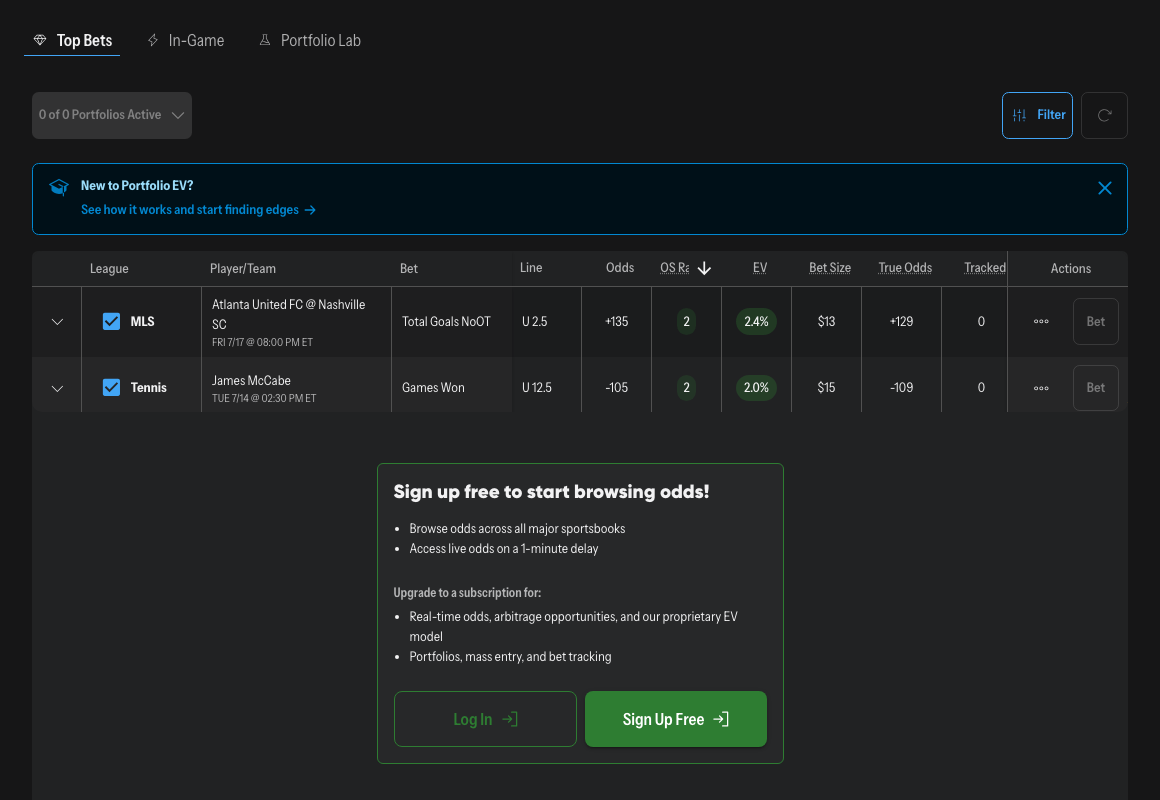
The OddsShopper +EV Screen.
Here's the blunt truth: even with a real edge on the books, a bettor with no grasp of bankroll management probably still goes to zero, because of unit sizing and underestimating how long a downswing can be. Read that twice. The edge wasn't the problem. The sizing was. People feel a win coming, dump 20% of their roll on it, lose three of those in a row, and they're done, even though their picks were fine.
So before any of the unit math, internalize the order of operations: find the edge first, then protect it with sizing. A great bet sized recklessly is a losing strategy. This guide is the second half of that sentence.
What Is a Unit in Betting?
A unit is just a fixed amount of money you treat as "one bet." Instead of thinking in dollars, you think in units, and you size every play as some number of units. The point is consistency: one rough night shouldn't represent a meaningful chunk of your bankroll.
The standard is to make a unit 1% of your bankroll, with most bettors operating somewhere in the 1–3% range per bet:
- $1,000 bankroll → 1 unit = $10 (at 1%)
- $5,000 bankroll → 1 unit = $50 (at 1%)
A few rules that come straight from how the experts coach it:
- A unit is a percentage, not a fixed dollar. As your bankroll grows or shrinks, your unit moves with it. Win a bunch and your $10 unit becomes $12; lose a stretch and it shrinks to $8. This is what keeps you from over-betting a depleted roll.
- Don't size every bet the same. A common beginner mistake is to stake every play identically, betting 100 on a +500 longshot and 100 on a -150 favorite alike. A longshot and a heavy favorite are not the same risk, and flat-staking both leaves information on the table, which leads straight into sizing to your edge.
- Cap your max bet. Most disciplined bettors never put more than ~5% of the bankroll on a single play, no matter how much they love it. The cap is there for the night your read is right and the result is still wrong.
How Big a Bankroll Do You Actually Need?
There's no magic number. It depends on the unit size you're comfortable with and how much variance you can stomach. But there's a useful frame: think in units, not dollars.
A sturdy betting bankroll is on the order of 50–100 units. If you want your unit to be $50, that implies a $2,500–$5,000 bankroll. Want $10 units? $500–$1,000. The reason for that depth isn't to bet more. It's to survive the downswing without busting or being forced to shrink your unit at the worst time.
And the downswings are longer than your gut thinks. This is the single most underestimated thing in betting. A bettor hitting 55% of their bets, a strong and sustainable win rate, will, over a full season of a few hundred wagers, still hit losing stretches of 6, 7, even 8 in a row more often than feels possible, with the occasional double-digit skid. (And don't over-read the win rate itself: a +EV bettor living on underdog prices can win well under 50% and still profit. The number that matters is your price vs. fair, not your hit rate.) That's not a broken process; that's just variance doing what variance does over a small sample. Your bankroll has to be deep enough that a string like that is a bad week, not the end. (We go deep on the psychology of riding those out in our variance and losing-streaks guide. This article is about sizing so the streak can't bust you.)
Flat Betting vs. Percentage vs. Kelly
There are three common ways to decide how much to bet. They're a ladder from "safe and simple" to "mathematically optimal but demanding."
1. Flat Betting
Every bet is the same size, say 1 unit on everything. It's simple, it's disciplined, and it's a perfectly fine place to start. The downside: it ignores how good each bet is. A play where you have a huge edge gets the same stake as a barely-+EV coin flip, so you under-bet your best spots.
2. Percentage (Fixed-Fraction)
You bet a fixed percentage of your current bankroll (e.g., 2%). As the roll grows, bets grow; as it shrinks, bets shrink. This self-corrects better than flat dollars and naturally throttles you down during a cold run. Still edge-blind, though: every bet is the same percentage regardless of how much value it carries.
3. The Kelly Criterion
This is the one that actually sizes to your edge. The Kelly criterion is a formula that tells you what fraction of your bankroll to bet given (a) the price you're getting and (b) your estimated true probability of winning. The bigger the gap between those two (i.e., the bigger your edge), the more it tells you to bet.
The plain-English version: bet size scales with your edge. A 1% edge gets a tiny stake; a 6% edge gets a meaningfully larger one. That's the whole appeal: it puts more money on your best bets and less on your marginal ones, which is mathematically the fastest way to grow a bankroll if your edge estimates are accurate.
That "if" is the catch, and it's why almost nobody bets full Kelly.
Sizing to Your Edge (Without Blowing Up)
Here's the tension at the heart of bet sizing, and getting it right is the difference between a bankroll that compounds and one that craters:
- Under-size, and you cap your returns. If you have a real edge but bet timidly, you grow your roll far slower than you could. Money left on the table is still money lost.
- Over-size, and you risk ruin. Full Kelly assumes your probability estimates are perfect. They never are (most bettors overestimate their edge), and full Kelly on an overestimated edge is a fast track to busting through a normal downswing.
The standard fix is fractional Kelly: bet a fraction of what full Kelly says, commonly half (½ Kelly) or quarter (¼ Kelly). You give up a little theoretical growth in exchange for dramatically smaller swings and a real margin for error on your edge estimates. For nearly everyone, fractional Kelly is the right default.
There's a second reason fractional is non-negotiable that the textbook formula hides: Kelly assumes one bet at a time. Real slates don't work that way. You might have eight or ten +EV bets live at once, all competing for the same bankroll. Bet full Kelly on each of ten concurrent plays and you can wake up with 40–50% of your roll in action on a single night's results, which is exactly the over-leverage Kelly is supposed to prevent. With a full simultaneous slate you have to shrink each stake further still (sharp bettors effectively divide their Kelly fraction across concurrent positions). It's another argument for sizing conservatively, and for letting a tool that sees your whole slate size it for you.
But here's the part most "bet 2% of your bankroll" guides get wrong. The bigger real-world mistake isn't over-betting. It's quietly under-betting a genuine edge. We've seen exactly this happen in practice: portfolio settings pinned to flat betting or the lowest-risk options mean betting only a fraction per bet of what the same edge warrants. The fix isn't to crank everything up. It's to stop systematically under-sizing a real edge. If your settings are pinned to the most conservative end while your edge estimates are sound, align the stake with the edge rather than betting bigger for its own sake. Aggression only pays when your edge is real and well-calibrated, and even then you still shrink for concurrent bets. When in doubt, err conservative; over-sizing an overestimated edge is what busts good bettors.
The lesson isn't "bet more for the sake of it." It's that sizing should track your edge, and if your settings are pinned to the most conservative end, you're systematically under-betting good bets and capping what your edge can earn. The right stake lives between reckless and timid, and it moves with the size of the edge in front of you.
A Real Worked Example: Sizing a Single Bet
Let me make this concrete with real numbers so "size to your edge" stops being a slogan.
Say your bankroll is $2,000, and you've found a bet you can get at +120 (decimal 2.20) whose multi-book true price devigs to about +105, implying a true win probability of roughly 48.8%. (For how you get to that true number, see the workflow in our +EV explainer.)
Plug that into Kelly. The formula is f = (bp − q) / b, where b is your net decimal odds (2.20 − 1 = 1.20), p is your win probability (0.488), and q is the chance you lose (0.512):
bp = 1.20 × 0.488 = 0.586bp − q = 0.586 − 0.512 = 0.074f = 0.074 / 1.20 = 0.061→ full Kelly says bet ~6.1% of your bankroll, about $123.
That's almost certainly too much. Full Kelly assumes your 48.8% read is exactly right; it isn't. So take half Kelly: ~3.1%, or about $61. That's the disciplined stake, sized to the edge (a healthy one here), but with a margin of safety baked in for the fact that your probability estimate is an estimate.
Now flip it: if the true price were only +115 against a +120 offer, your edge shrinks to about a third of what it was. Full Kelly drops to 1.9% ($39) and half-Kelly falls from ~$61 to roughly $19. Same bankroll, same book, and the bet size changed because the edge changed. That's the entire point, and it's the thing flat betting can't do for you.
How Portfolio EV Automates Edge-Based Sizing
Doing that Kelly math by hand, for every bet, while the line is moving, is not realistic. You'd need an accurate true-odds read on each market and a stake calculation and to act before the price moves. That's the job Portfolio EV is built to do.
The workflow is the same de-vig-and-compare that powers every +EV play: the Sharp Sportsbook Algorithm strips the vig off each market to a multi-book true-odds consensus, the tool compares each book's price to that fair number, and it surfaces the live +EV bets ranked by edge. (Even on the free side, the odds comparison and line-shopping tools let you check a price against the field by hand; line shopping is the free half of the edge.) The bankroll piece is what closes the loop. Enter your bankroll information and the tools recommend how much you should be betting on each play, with a Kelly dial that lets you choose how conservative or aggressive you want to be. You set your bankroll and your risk tolerance (the fractional-Kelly dial, conservative through aggressive), and it sizes each recommended bet to that bet's edge and your roll.
That dial is exactly the lever that matters: the difference between leaving your settings pinned to "low risk" (and under-betting all year) and tuning them to actually reflect your edge. The tool surfaces a stake; you decide how aggressive the Kelly fraction is. And the underlying Portfolio EV results are published transparently, wins and losses, not cherry-picked screenshots.
Two honest cautions sizing can't save you from:
- Sizing protects an edge; it doesn't create one. If your bets aren't actually +EV, perfect Kelly math just delays the loss. Get the +EV right first.
- +EV is a long-run process. You can size perfectly, beat the closing line, and still lose for a stretch. That's variance, not a broken system. The whole reason to manage your bankroll is to be standing when the long run arrives.
Stop running the Kelly math by hand.Portfolio EV takes your bankroll and risk dial and sizes every live +EV bet to its own edge, so you stop under-betting good spots. Start with a free 7-day trial, then code BANKROLL20 cuts 20% off OS Pro or OS Core, which works out to less than a coffee a day.
A Few Realities Before You Start
- Only bet a dedicated bankroll you can afford to lose. Never rent money, never the bills. Bankroll management starts with what goes into the bankroll.
- Don't chase. Doubling up to "get it back" is the fastest way to turn a bad night into a busted roll. Your unit is your unit, hot or cold.
- Recalculate your unit as the roll moves. A unit is a percentage, not a number you set once and forget.
- Size to your edge, not your confidence. "I really like this one" is not an edge. A measured price gap is.
- Keep records. Track every bet: stake, price, result, and closing line. It's how you know your edge is real, and in regulated U.S. markets winnings can be taxable, so a clean log is worth keeping regardless.
- It's 21+ and legal-where-regulated. Bet responsibly, in markets where it's legal and available, and never bet more than you can afford to lose.
Frequently Asked Questions
What is a unit in betting? A unit is a fixed slice of your bankroll that you treat as "one bet," most commonly 1% of the roll. If your bankroll is $1,000, one unit is $10. You then size bets in units (e.g., a 2-unit bet = $20). Because a unit is a percentage, it grows and shrinks with your bankroll, which keeps you from over-betting after a cold stretch.
How much should I bet per game? For most bettors, 1–3% of your bankroll per bet is the sane range, and never more than ~5% on a single play. The better answer is to size to your edge: bigger edge, bigger bet, which is what the Kelly criterion (ideally a fraction of it) formalizes. The Portfolio EV tool does this sizing for you once you enter your bankroll.
What is the Kelly criterion in betting? It's a formula that tells you what fraction of your bankroll to bet based on the price you're getting and your estimated win probability: the bigger your edge, the bigger the stake. Full Kelly is aggressive and assumes your edge estimate is exact, so most bettors use fractional (half- or quarter-) Kelly to cut variance and leave room for error.
How big should my sports betting bankroll be? Think in units, not dollars: roughly 50–100 units is a sturdy bankroll. If you want $50 units, that's a $2,500–$5,000 roll; for $10 units, $500–$1,000. The depth isn't to bet more. It's to survive the downswings (which, even with a real edge, run longer than people expect) without busting.
Can you go broke betting even with an edge? Yes, and it's more common than people think. Even a bettor with a real edge can go to zero through poor unit sizing and underestimating how long a downswing can be. Over-sizing into a normal cold streak busts good bettors all the time. Disciplined unit sizing and (fractional) Kelly are what keep your edge alive long enough to pay off.
Ready to stop guessing your bet sizes? Finding the edge is half the job; sizing it correctly is the half that keeps you in the game. OS Pro unlocks the full Portfolio EV feed: enter your bankroll, pick your risk tolerance, and every +EV bet comes back sized to your edge and your roll. Upgrade to OS Pro with code BANKROLL20 for 20% off your first payment and let the math size your bets for you.
More on this: Odds Boosts Strategy: Which Ones Are Actually +EV · Closing Line Value (CLV) Explained: Beat the Close · Free Bet Conversion: How to Turn a Free Bet Into Cash · How to Find +EV Bets: A Practical Workflow · Beat The Sportsbooks With A Small Bankroll