College Football Parlays: Why Most Burn Money (And How To Build Them Smarter)
Last updated: July 27, 2026
Saturdays in the fall drop 50-plus college football games across the day, and the sportsbook knows exactly what that does to a bettor. It's one of the easiest sports to talk yourself into an eight-leg parlay, because there's always another game, another ranked favorite, another "lock." The problem is that the way most people build college football parlays is the way the books hope you'll build them. If you've ever watched a CFB parlay die on the last leg for the tenth week running, the fix isn't better luck. It's understanding why the ticket was underwater the second you placed it, and building the next one differently. In a minute we'll walk through the actual two-leg math, because once you see where the money goes, you can't unsee it.
This isn't a "what is a parlay" explainer. Need the mechanics of how legs combine and pay out? Start with our parlay betting explained guide, then come back. Here we're on the CFB-specific stuff: why college football parlays leak money faster than almost any other sport, and how to build them so the math is at least on your side.
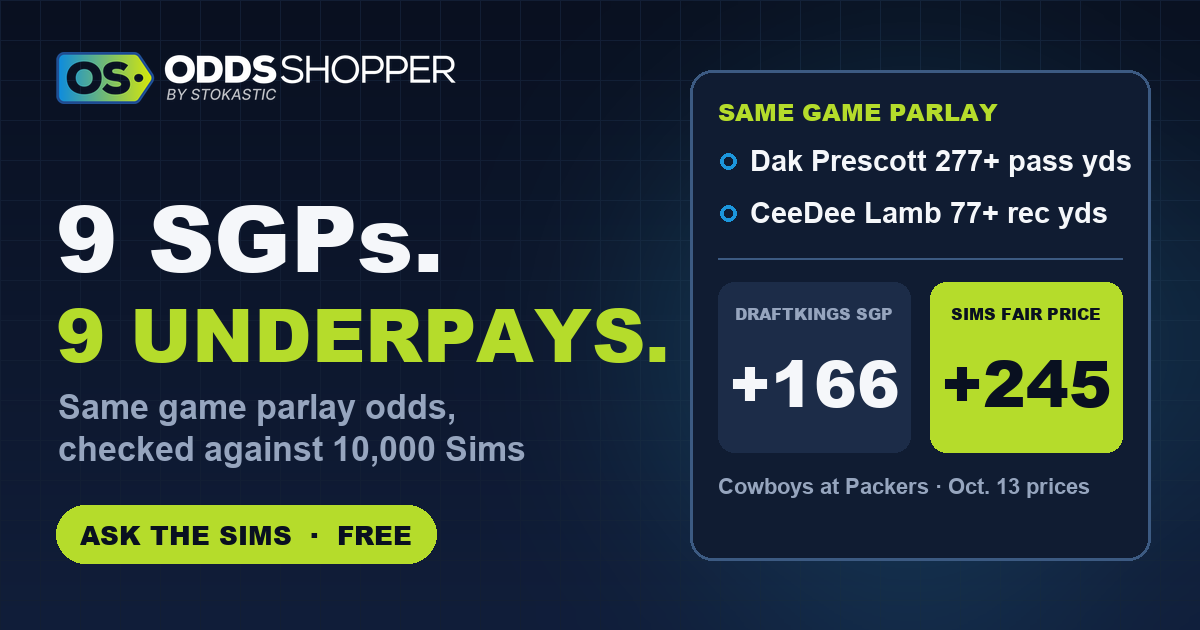
Building it on DraftKings or FanDuel instead?The free DraftKings Parlay Simulator and FanDuel Parlay Simulator on Stokastic.com price the same parlay from 10,000 Sims next to that book's odds.
In Summary (TL;DR)
- Most college football parlays lose because every leg carries the book's margin, and chaining legs multiplies those margins instead of adding them.
- CFB makes the leak worse than other sports: giant spreads tempt you into near-zero-payout favorite legs, higher variance produces backdoor covers, and books shade same-game parlay prices for correlation.
- A correlated CFB same-game parlay is only worth betting when the offered price still beats the true odds you calculate for the combination. With the hold books put on SGPs, that bar is rarely cleared.
- The durable build: 2-3 legs, each one +EV on its own, best price shopped on every leg, sized small. The Parlay Builder does the leg-finding and price-shopping part for you.
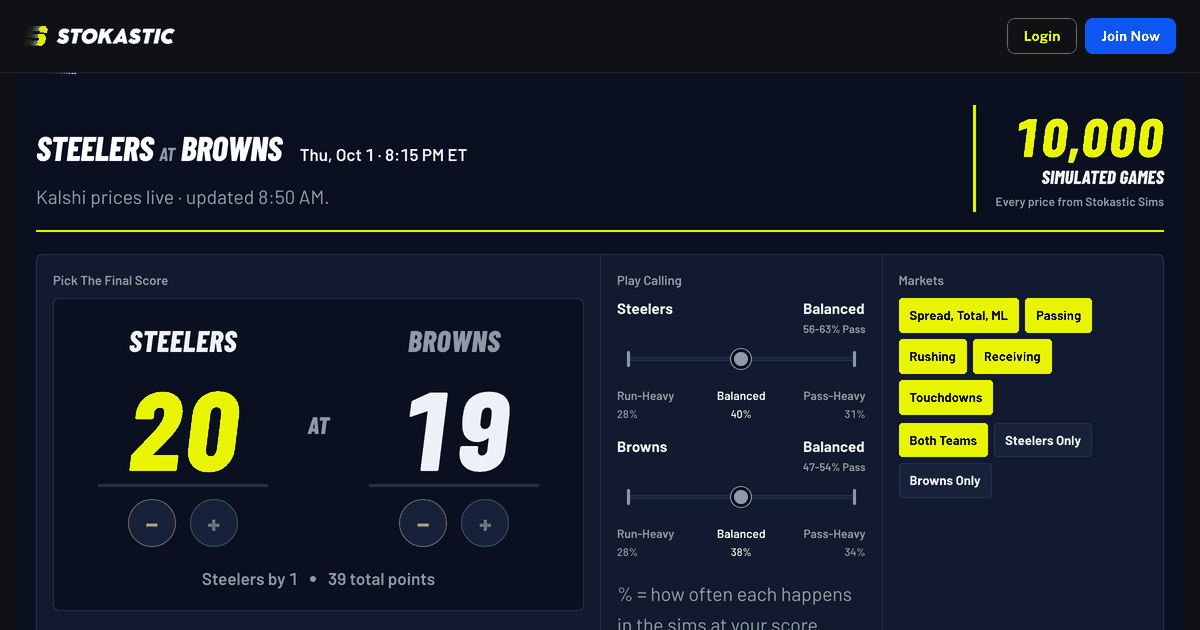 Betting it on Kalshi? Price the combo first. The Kalshi Parlay Simulator prices any combo against 10,000 simulated games of this week's game, next to the price on Kalshi.
Why College Football Parlays Burn Money
Every parlay carries a built-in tax. Each leg has the book's margin baked into the price, and when you chain legs together, those margins compound. A parlay doesn't just add the vig from each leg; it multiplies through it. That's true in every sport. College football just makes it worse for three reasons specific to the sport:
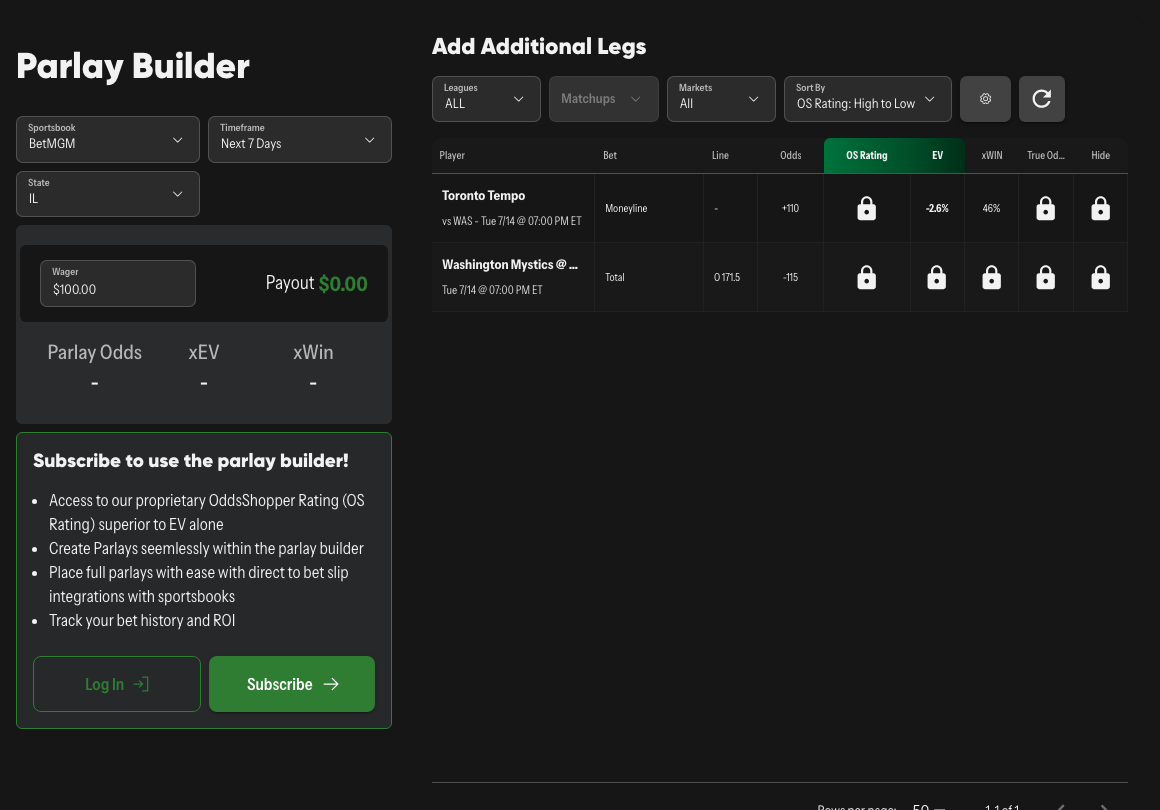
The OddsShopper Parlay Builder.
- The Spreads Are Enormous. Early-season college football is full of mismatches you never see in the NFL: a Power Four playoff contender hosting a Group of Five team as a 28-, 35-, even 40-point favorite. Casual bettors treat those games as free parlay legs ("no way they lose"), but a huge favorite priced at -2500 (and often far worse) on the DraftKings 🎁 or FanDuel 🎁 moneyline adds almost no payout while quietly piling hold onto your ticket. You're taking on real bust risk (an outright upset, a turnover avalanche, a weird special-teams game) for pennies of extra return.
- The Variance Is Higher Than The NFL. College rosters are less balanced, backups are a bigger drop-off, and blowouts get truly out of hand. That cuts both ways for a parlay. A three-score favorite can be up 42-0 at halftime and pull every starter, turning a "safe" spread leg into a live backdoor sweat. Totals swing wildly with pace and tempo offenses. More variance means more of your "should-win" legs find a way to lose.
- The Correlation Is Baked Into The Outcomes, And The Books Price It. In a blowout, the favorite covering, the game going over, and that team's star scoring are all linked. That correlation is exactly what makes same-game parlays tempting in college football, and exactly why the books shade those prices hard. More on that below.
Put it together and the honest baseline is the one every serious bettor already knows: the majority of parlays lose, and long, casually-built college football parlays lose fastest. We wrote a whole honest piece on that reality in why you can't win parlays. None of that means never bet a CFB parlay. It means respect what you're up against before you build one.
The Juice-Stacking Trap: Why "Safe" CFB Parlays Aren't
The most common way to torch money on college football parlays is to chain heavy favorites together to manufacture a "safe" even-money payout. Take four ranked teams laying big numbers on the moneyline at DraftKings or BetMGM 🎁, parlay them to around +100, and tell yourself you've built a coin flip with four near-locks.
What's actually happening: every one of those favorites carries the book's margin, and parlaying them multiplies that margin. You're not buying safety, you're compounding juice. The table below runs the real numbers for a ticket built from standard -110 legs, each treated as a fair coin flip, so you can see exactly how far the payout falls behind fair odds as the legs pile up.
| Legs (Standard -110 Pricing) | What the book pays | Fair odds if each leg is a coin flip | True hit rate | Expected loss per $100 staked |
|---|---|---|---|---|
| 2 Legs | +264 | +300 | 25% | $8.89 |
| 3 Legs | +596 | +700 | 12.5% | $13.03 |
| 4 Legs | +1,228 | +1,500 | 6.25% | $16.98 |
| 6 Legs | +4,741 | +6,300 | ~1.6% | $24.35 |
The column worth staring at is the last one. A single -110 bet costs you about 4.5% of your stake in expectation; by six legs, the same bets bundled into one ticket burn roughly a quarter of every dollar you run through them. Exact prices vary by book and market, but the direction never does: the more legs you chain, the more of your stake the ticket burns in expectation. Loading up on heavy favorites feels conservative and is one of the most expensive habits in the sport. When you truly love a big favorite, betting it straight on the moneyline hands the book far less of your money than burying it in a five-team parlay to reach a round number.
A Worked Example: Where The Money Actually Goes
That two-leg row is the math we promised in the opening, and it deserves unpacking because it's the cleanest way to see the tax. Take two standard -110 spread legs, and assume each one is a true coin flip (a 50% chance to cover, which is what a fair spread is supposed to be):
- True Odds Of Both Legs Hitting: 50% × 50% = 25%, which converts to fair odds of +300.
- What The Book Pays: a standard two-leg parlay of -110 prices pays about +264, an implied probability of roughly 27.4%.
- The Gap: you're being paid as if the parlay hits 27.4% of the time when it truly hits 25%. In money terms, one -110 bet costs you about 4.5% of your stake in expectation; parlay two of them and the ticket costs about 8.9%. The tax roughly doubles the moment you combine.
Every added leg compounds that expected loss — 13% at three legs, 17% at four, more than 24% at six — which is the entire juice-stacking story in one number. Note what the example is not saying: it's not saying two legs is bad and one straight bet is good, full stop. It's saying that when you choose to parlay, you're accepting a bigger built-in tax in exchange for a bigger payout, so the legs themselves have to carry real value to climb out of the hole.
Correlation: The Double-Edged Sword In College Football Parlays
Correlation is where college football parlays get interesting, and where they get dangerous. Two outcomes are correlated when one makes the other more likely. In a big mismatch, a dominant favorite winning by four scores, the game sailing over the total, and that team's quarterback throwing for a big number all tend to happen together.
That's the appeal of a college football same-game parlay (SGP): bundle a favorite's spread with the over and a star's passing prop, and in a blowout they can all cash at once. The real question is whether the book has already priced that correlation into the payout. When it hasn't (when the offered price still treats the legs as if they were independent) the link is a real edge. But books shade SGP prices for correlation and pile heavy hold on top, so most of the time the payout already accounts for the legs moving together. When it does, you're back to a plain value question: a correlated parlay is still +EV only if the price you're offered beats the true odds you calculate for that exact combination. Given how much hold books build into same-game parlays, that's very unlikely.
The rule for CFB same-game parlays: correlation is a real edge only when the book hasn't priced it in. Once the correlation is baked into the offered payout (which, with the hold books take on SGPs, it usually is) it buys you nothing unless the price still beats your own true-odds math. Run that number before you bet; if you can't, you're paying full freight for a link the book already accounted for.
There's a negative kind of correlation, too. A big favorite's spread and the under fight each other in the most common cover script (the favorite scoring at will), though a team that builds a lead and grinds clock is a real under script of its own. Books know all this, and on a same-game parlay they'll actually pay you more for negatively correlated legs than for independent ones. So the same test applies in both directions: does the offered price beat your true-odds estimate for that exact combination? What quietly kills tickets is chaining legs that fight each other without getting paid extra for the conflict. We break down the whole correlation question in our same-game parlay strategy guide.
Key Numbers Make Or Break A College Football Parlay
Because so many college football parlays lean on point spreads, one of the most important concepts for a spread leg is the key number. Football games land on a handful of specific margins far more often than random chance would suggest, and the two biggest are 3 and 7 (a field goal and a touchdown), with 10 and 14 close behind. Getting your spread on the right side of a key number is one of the cheapest edges available, and it matters most in a parlay, where every leg has to hit.
The wrinkle for college football, straight from our College Football Picks & Predictions shows: don't import the NFL's "3 is king" reflex wholesale. College scoring is higher and more variable, so the margin distribution is flatter — 3 and 7 are still the two numbers that matter most, but around touchdown-sized spreads, 7 is the number to respect. College games land on exactly seven often enough that the half-point between -6.5 and -7 turns a seven-point win from a push into a cover; that half-point is the difference between getting paid and getting your money back. The same logic protects a dog at +7.5 instead of +7. If you also build NFL parlays, the mechanics are identical — the weights on the numbers just shift.
When every leg has to hit, a half-point on the wrong side of a key number is a leak on the whole parlay, not just that leg. It's the cheapest edge in football and the one casual parlay bettors give away most.
This is also why teasers are popular in football: a teaser lets you move each leg a set number of points (commonly six, though it varies by book, and college teaser menus don't always mirror NFL ones), and the value comes from teasing through the key numbers (a favorite down through 7 and 3, a dog up through 3 and 7). Teasers behave more like parlays than most people realize, and CFB's extra scoring variance makes them less reliable than NFL teasers, so they're a tool to use carefully, not a cheat code. Our teaser bets explained guide covers when the math works.
How To Build College Football Parlays The Smarter Way
Everything above is the diagnosis. Here's the construction that actually respects the math. None of it promises a winning ticket, because nothing can. It keeps you from building a ticket that's underwater on price before the games even kick off.
-
Every leg has to be +EV on its own. This is the whole game. A leg is positive expected value when the price you get is better than the leg's true probability. A parlay compounds whatever is in its legs — edge or disadvantage — so a shorter parlay of real +EV legs beats a longer one padded with juiced favorites and coin-flip props. In college football that means resisting the exact leg the sport tempts you with most: the -2500 blueblood moneyline that adds pennies of payout and real bust risk. Decide the legs are +EV first, then combine.
-
Shop every leg across books. College football lines can vary meaningfully between sportsbooks, especially on the Group of Five games the books hang looser. The same spread or prop can be a half-point better (and on the right side of a key number) at Caesars than at FanDuel, and the same parlay can pay meaningfully more at one book than another. The OddsShopper odds screen puts every book's number for a game side by side, so taking the best price is a glance instead of five apps. Taking the worse number quietly raises the win rate you'd need just to break even, on every bet.
-
Keep it short and size it small. Each added leg lowers your hit rate and raises variance even when every leg is +EV, and college football is the sport where that bites hardest — a 42-0 halftime turns starters into backups, and one garbage-time touchdown flips a "safe" leg. Fewer legs, each one carrying real value, is the construction that survives a season. And because parlays swing harder than straight bets, they belong at a smaller slice of your bankroll. Our bankroll management guide has the framework; the short version is never chase a loss with a bigger parlay.
Quick gut check before you add any legwould you bet it straight at this price? If not, it has no business in your parlay. A bad leg doesn't become a good one because it's bundled with three others; the ticket just inherits its leak.
-
Only correlate when the price actually beats fair. Estimate the true odds of the correlated combination yourself, then hold that number up against the payout the book is offering. A same-game parlay is only worth it when the offered price is better than your true-odds estimate, which is the same as saying the book hasn't fully priced the correlation in. On shaded, high-hold SGPs the offered price rarely clears that bar, so the default answer is to pass.
-
Consider a round robin over one long ticket. A round robin breaks your selections into smaller overlapping parlays, so one busted leg doesn't kill everything. It costs more up front and still needs +EV legs to profit, but it spreads single-leg risk in a sport where random backdoor covers are especially common.
The hard part of all of this is finding truly +EV legs across the college football markets and books available to you, by hand. OddsShopper splits that job across its screens, in the order you'd actually work:
- The +EV screen is where the tool surfaces the college football bets whose best available price beats the no-vig fair number, with a projected edge on each. Sort by edge, and start with the Group of Five games — the thin-attention markets where this article already told you the loose numbers live.
- Throw out anything stale or already moved off the flagged price; CFB lines move fast, and a leg is only +EV at the number you actually get.
- The odds screen shows every book's number side by side, so you can confirm which side of the key number your leg sits on before it goes in the ticket.
- The Parlay Builder assembles the ticket from the legs that survive. Compare what the finished parlay pays at each book, and size it smaller than you'd size a straight bet.
Tools for thisprice any Kalshi combo on Kalshi, or the Polymarket Combo Simulator for Polymarket's book.
When A College Football Parlay Actually Makes Sense
A parlay isn't automatically a bad bet, and "never parlay" is lazy advice. The honest read is a simple do-this / not-that:
| Smart College Football Parlay | Money-burning college football parlay |
|---|---|
| 2-3 Legs, Each Independently +EV | 6-plus legs chasing a big payout |
| Best Price Shopped On Every Leg | First price you saw on one app |
| Correlation Used Only Where The Book Hasn't Priced It In | Random legs stacked because they "feel" right |
| Payout Is Whatever The +EV Legs Add Up To | Favorites juiced together to force a round even-money number |
| Sized Small, As A Higher-Variance Bet | A big slice of the bankroll on a "lock" |
If your parlay lands in the left column, you're taking a real, sized shot at a correlated or multi-leg edge. If it lands in the right column, you're paying the college football parlay tax the books are counting on. The row we keep coming back to is the payout one: the moment you catch yourself juicing favorites together to force a round number, you're rebuilding the same compounding structure as the -110 table from earlier — paying above fair price on every leg — just with more legs and a bigger expected loss. For the full price-and-value framework that applies to parlays in any sport, our parlay betting strategy guide goes deeper on shopping and closing line value. And if you'd rather start from legs a professional already likes, the free expert picks today page is the no-cost way to see what our handicappers are actually playing.
Frequently Asked Questions
Why do most college football parlays lose? Chaining legs multiplies the book's margin across the whole ticket: a single -110 bet costs about 4.5% of your stake in expectation, while a six-leg parlay of the same bets costs about 24%. College football makes it worse with huge favorites, high scoring variance, and blowouts that produce backdoor covers. Long, casually-built CFB parlays are underwater on price before kickoff, which is why the majority lose over time.
Are college football same-game parlays worth it? Only when the book hasn't already priced the correlation into the payout. SGP odds are usually shaded to account for legs that move together, with heavy hold on top, so bundling a favorite, the over, and a star's prop in a blowout is normally baked into the number. Even then a correlated SGP can be +EV, but only if the price you're offered beats the true odds you calculate for the combination, and given the hold books take on same-game parlays, that rarely happens.
How many legs should a college football parlay have? Fewer than you think. What matters is that every leg is +EV on its own, not the number of legs. A ticket of coin-flip legs wins 25% of the time at two legs and only about 1.6% at six, while the expected cost of the ticket climbs the whole way, so two or three legs with real value behind them will outlast a six-team ticket over a season. Before any leg makes the cut, ask the gut-check question: would you bet it straight at that price?
What are the key numbers for college football spreads? The two biggest are 3 and 7, with 10 and 14 next. College scoring is higher and more variable than the NFL, so the margin distribution is flatter, and around touchdown-sized spreads 7 is the number to respect: a favorite at -6.5 cashes on an exact seven-point win while -7 pushes, which makes that half-point one of the cheapest edges you can take on the leg.
Is it better to bet college football teams straight or in a parlay? Straight is usually the better price shape for a single heavy favorite; the parlay version just compounds margin on the way to an even-money number. Parlays make sense when you have multiple independent +EV legs and want a correlated or higher-variance shot, sized small.
Stop paying the college football parlay tax. The OddsShopper Parlay Builder flags the CFB legs it projects as priced in your favor, helps you build the ticket from those legs, and compares the finished parlay across the books available in your state so you leak less value as vig. Try it free for 7 days, then code CFBPARLAY20 takes 20% off your first payment of OS Pro or OS Core. Bet 21+ where legal, and only what you can afford to lose.
More on this: College Football Week 2 Predictions: The Machines Won't Take Texas · College Football Playoff Semifinal Odds · How To Bet College Football On Kalshi: Markets & Value · \ud83c\udfc8 College Football Week 0 Odds: How Kalshi Priced 8 Games · Kalshi College Football Picks This Week: Every Board, Scored