Open X or Instagram and someone just turned $10 into $40,000 on one massive parlay. What you never see is the pile of losing slips behind it, or how far down that person actually is. If your sports betting parlays keep losing, the culprit usually is not the picks you are copying. The way you build the ticket is what sinks it.
In Summary
- The lotto-ticket habit, piling on legs and alt markets to chase a bigger number, is the single biggest reason most parlays lose.
- A parlay's edge is the product of its legs. Stack bad-priced legs and you compound the loss. Stack legs priced in your favor and you compound the edge.
- "Priced in your favor" is what bettors call +EV (positive expected value): a bet whose price would profit over the long run if you made it again and again. A parlay built only from +EV legs is itself +EV; one padded with bad legs is not.
- The fix the video preaches: build the parlay from two +EV legs, sized like the higher-variance bet a parlay actually is.
- Why two? Every extra leg craters your odds of hitting and raises the price you need just to break even.
- The OddsShopper Parlay Builder lets you combine plus-EV legs and shop the best price across books, which is exactly the discipline below, done for you.
Watch The Video
This article is built from our OddsShopper breakdown on why most parlays lose and the small habit change that turns them around. Watch on YouTube.
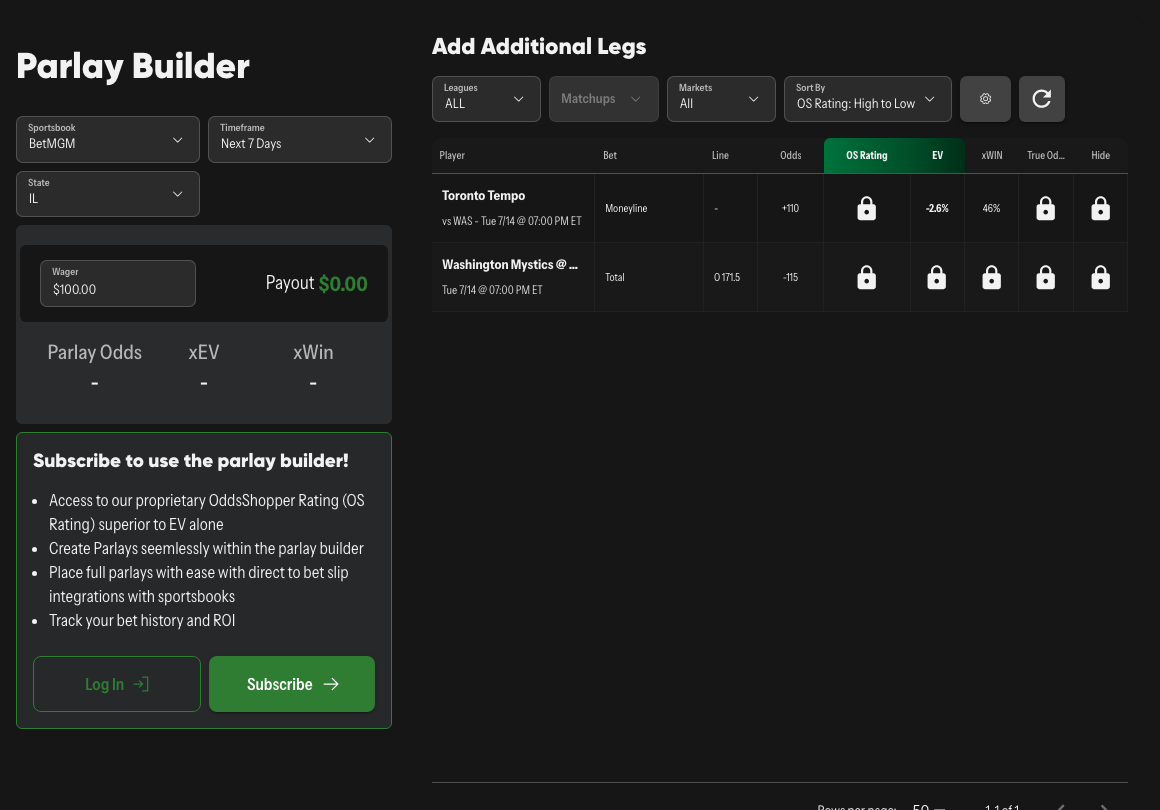
The OddsShopper Parlay Builder.
The Real Reason Your Parlays Keep Losing
The honest answer is not who you follow or what they post. It is a lotto-ticket mentality, and most of us have lived it. You see a slip turn ten bucks into a house payment and think, how hard can that be? So you load up. Four legs, five, eight, because the more you add, the bigger the number gets and the better the daydream looks.
Here is the catch nobody posts: that big payout exists precisely because the ticket almost never hits. Think about the people you actually know. How many have hit a real lottery, the life-changing kind, not a scratch-off that doubled their five dollars? Probably nobody. A bloated parlay is the same trade. The book is happy to sell you a long shot all day, because every leg you jam on top makes it more likely the whole thing dies.
Three habits do most of the damage:
- Adding Legs For The Sake Of The Number. Two legs feels small, so you climb. The size of the payout goes up and your chance of seeing a dollar of it goes down.
- Jamming In Heavy Favorites. A short favorite adds little to the payout while handing you one more way to lose. That is pure filler that only adds risk.
- Inflating With Alt Markets. You see a player at over 6.5 receptions, or 7.5 rebounds, and you bump the line up another rung. "How hard is three threes? Four? How about five?" Climb that ladder and a single leg balloons to something like +550, a long shot wearing a disguise.
More Legs, Lower Odds Of Hitting
This is the part the highlight reels skip. Every leg you add multiplies into the next, so your odds of cashing fall off a cliff fast, even when the legs are decent.
Run a simple illustration. Say each leg is a genuine 55% to win, a little better than the roughly 52% a standard -110 line implies. Here is how often the whole ticket hits as you stack them:
| Legs In The Parlay | Chance all legs hit (at ~55% each) |
|---|---|
| 2 Legs | ~30% |
| 3 Legs | ~17% |
| 4 Legs | ~9% |
| 5 Legs | ~5% |
By five legs you are cashing one ticket in 20. A plus-EV five-legger can still be a fine bet on paper, because the longer price pays for the lower hit rate. The trap is that two problems bite in the real world: the swings get brutal, and you almost never find five legs that are each truly priced in your favor. So the legs you tack on to chase a bigger number are the soft, minus-EV ones, and that is where the book's edge quietly compounds.
It's Not The Number Of Legs, It's The Number Of Plus-EV Legs
Now the part that flips the usual "parlays are a sucker bet" line on its head. A parlay is not automatically bad. It compounds the expected-value edge of its legs. Combine two legs that are each priced in your favor, each a plus-EV bet, and as long as the combined parlay price still beats the true odds, the whole ticket is plus-EV too. Combine two alt-market long shots you have no edge on and you get a ticket that bleeds money faster than a straight bet would.
So the real question was never "how many legs." It is "is every single leg actually plus-EV?" That is why "keep it to two" works as a rule of thumb, not because two is a magic number, but because on a given slate it is hard to find more than a couple of legs priced in your favor. Capping the ticket forces you to stop reaching for filler the moment you run out of real edges.
A Two-Leg Parlay That's Actually Plus-EV: A Worked Example
Picture two legs you have an edge on, each truly about 55% to win, both offered around -110 (a price that only implies about 52% to win). Each leg on its own is plus-EV, because your number beats the book's number.
Stack those two and the parlay pays +264. Two 55% legs both come in about 30% of the time, and the break-even at +264 is only about 27%. Your 30% clears the 27% you need, so the parlay is plus-EV, built entirely from plus-EV parts.
Now add three alt-market long shots you do not have an edge on. The payout balloons, the daydream gets louder, and the same ticket now needs a small miracle to cash. Same idea, opposite outcome, and the only thing that changed was the quality of the legs.
New to OddsShopper?It scans 100+ sportsbooks and flags the bets priced in your favor, then the Parlay Builder lets you stack those plus-EV legs and grab the best price across books, the exact thing this article tells you to do by hand. Try it free for 7 days, and code PARLAY25 takes 25% off your first payment of OS Pro or OS Core.
Stay In Your Lane: Stop Inflating The Ticket
Discipline here is boring, and that is the point. Keep the same approach every time instead of letting the slate talk you into a bigger swing. Two specific habits to cut:
- Stop Jamming Heavy Favorites. A short favorite glued onto a ticket adds almost nothing to the payout and one more spot where it can crack. If it is not a real plus-EV leg on its own, it does not belong.
- Stop Climbing The Alt-Market Ladder. Bumping an over up a rung, or piling on an odds boost just to make the number look beefier, turns a sound two-leg bet into a long shot. A boost or an alt only helps if the boosted price still beats the true number.
Meat-and-potatoes betting like this is exactly why nobody bothers faking a screenshot of it.
Size A Parlay Like The Higher-Variance Bet It Is
Even a clean two-leg plus-EV parlay swings harder than a single bet, so it should be sized smaller than a straight play, not the same. Do not stake a +500 parlay like a -150 single. Set the amount to the edge and the variance, and never chase a loss by supersizing the next one.
The habit in one linetwo plus-EV legs, shopped for the best price, staked smaller than a straight bet. That is the whole edge, repeated every night.
You can still take a real shot once in a while and add a third leg for fun. Just budget for it the way you would a piece of cake on a diet. The occasional indulgence is fine when the everyday habit is sound, and your bankroll can absorb it. Any single parlay can still lose, and plenty of good ones do in the short run, but the disciplined version keeps you alive long enough for the edge to play out.
How To Build A Winning Two-Leg Parlay
Put it together in four steps:
- Find plus-EV legs. Use Portfolio EV and the OddsShopper Prop Tool to surface spots where the offered price beats the true number, instead of betting a team you like.
- Keep it to two. Stop the moment you run out of real edges. No filler favorites, no alt-market reaches.
- Shop every leg. The same bet at a better number is free EV, so take the best available price on each leg. The deeper price and closing-line-value playbook lives in our parlay betting strategy guide.
- Build and size it. Combine the legs in the Parlay Builder and stake it smaller than a straight bet.
That is the whole adjustment. Not a magic pill, just a small change in how you approach the ticket, repeated night after night.
Frequently Asked Questions
Can you actually make money betting parlays? Over a large enough sample the math can work in your favor, but only if every leg is plus-EV and you size them sensibly. Any single parlay, or any short run of them, can and will lose. A parlay multiplies the value of its legs, so one built from bets priced in your favor carries that edge. The mistake is filling the ticket with long shots and heavy favorites that are not plus-EV.
How many legs should a parlay have? Two is the disciplined default, because it is hard to find more than a couple of plus-EV legs on a slate. The number itself is not magic. What matters is that every leg is priced in your favor. Each extra leg lowers your hit rate and raises the price you need to break even.
What makes a parlay plus-EV? Each leg has to be plus-EV on its own, meaning your estimate of the true probability beats the implied probability of the offered odds. Combine plus-EV legs and the parlay is plus-EV. Combine bets you have no edge on and it is not, no matter how good the payout looks.
Why do my parlays keep losing even when I pick winners? Usually because the ticket is too long or padded with soft legs. You can hit most of your picks and still lose the parlay if one filler leg misses, and the legs you added to chase a bigger number are often the ones with no real edge.
Are alt-market and same-game parlays worth it? Only when the offered price still beats the true number after the book shades it for the built-in correlation, which is rarely the case when you bump an alt line up just to inflate the payout. Treat an alt or a boost like any other leg: bet it only if the price is in your favor.
Go deeper: Same Game Parlay Strategy: One SGP, +369 or +580?.
The Bottom Line
You do not need a hot tip or a 12-leg miracle to win parlays. You need to stop betting them like lottery tickets. Two plus-EV legs, shopped for the best price and sized for the variance, is the unglamorous habit that gives your edge a chance to play out over time.
Stop donating to the book.OddsShopper finds the bets priced in your favor across 100+ sportsbooks, and the Parlay Builder stacks them into clean two-leg tickets at the best available price. Try it free for 7 days, then code PARLAY25 takes 25% off your first payment of OS Pro or OS Core.
Must be 21+. Gambling problem? Call or text 1-800-GAMBLER. Available in regulated U.S. markets where legal.
More on this: Why Jack Reed (D) Will Win the Rhode Island Senate Race · Why N'Kiyla Thomas (D) Will Win the Oklahoma Senate Race · An Insurance Agent Made History Once In South Texas · Ohio's Pandemic Doctor Is Running For A Different Job · Who Is Favored To Win Governor Of Alaska?