In Summary
A profit boost looks like the sportsbook doing you a favor: bet the same wager, collect a bigger payout if it wins. Here's the key: a boost is part of the price, and a big enough boost can flip a bet that was negative-EV on its own into a positive-EV (+EV) play. That's exactly when a boost is worth using. The mistake isn't betting a boost on a bet that wasn't already good; the mistake is betting one when even the boosted price is still worse than the true odds. So ignore the bigger payout and look at one thing: does the boosted price beat the true odds of the event happening? If it does, it's a play, whether or not the unboosted bet was. If it doesn't, no boost is large enough to save it. Below, we work through two real examples from the video, show the implied-probability and break-even math you can run on any boost, and explain why "use every boost you get" is exactly the mistake the books are counting on. OddsShopper's EV tools compare the boosted price against the fair odds for you, so you can tell a real boost from a dud in seconds.
Watch: How to Bet Profit Boosts the Right Way
The strategy below comes straight from this OddsShopper breakdown on betting profit boosts. It's worth a watch for the live examples, then read on for the math you can apply to any boost yourself.
What Is a Profit Boost, and Why Do Sportsbooks Offer Them?
A profit boost is a sportsbook promotion that increases your winnings on a qualifying bet. If you have a 50% boost and put $10 on a +500 parlay, a normal win pays $50; the boost takes that to $75. The mechanic is simple: same stake, bigger payout if the bet hits.
So why would a book hand out free upside? Because most people use boosts the way the book is hoping they will. The book knows the large majority of bettors don't profit long-term, and it knows a boost token nudges people toward exactly the bets it wants them making: long-shot, many-leg same-game parlays they'd never price-check. The book isn't being generous. It's offering a bigger payout on bets that were already losing money on average, betting that the boost won't be enough to flip them.
That's the whole game. Think of a boost as a tool, and like any tool it can help you or hurt you depending on how you use it. Used correctly, it's free EV that can even lift a bet that wasn't worth making on its own up to +EV. Used the way the book expects, it's a slightly slower way to lose.
The reframe that changes everythingstop thinking "I win more money on this bet if it hits." Start thinking "with the boost, I need this to win fewer times to come out ahead." That shift, from payout to break-even, is the entire difference between a sharp boost strategy and a losing one.
The Only Question That Matters: Does the Boosted Price Beat the True Odds?
Here's the trap. Most bettors look at a boost and see a bigger number, so they fire. A sharper version line-shops first, finds the best available price, and feels smart about it. Both can still lose, because neither one checked the price that actually matters: the true odds.
The true (or "fair") odds are what the price should be, given how often the event really happens. Getting the best number across every book is only half the job. If even the best available price is worse than the fair price, you'll lose slower than the person taking a random number, but you'll still lose. The sportsbooks know this, and it's why "I shop my odds and I'm still down" is such a common complaint.
So the real process is two steps:
- Find the true odds. You do this by leaning on sharp sportsbooks, the books whose prices most closely reflect real probability. Their number, devigged, is your benchmark for fair.
- Compare your boosted price to that benchmark. If the boosted price implies a lower win rate than the true odds say is realistic, you have a +EV bet. If it doesn't, pass, no matter how big the boost looks.
A boost helps you clear that threshold more often, but it never moves the threshold itself. This is the core of positive expected value betting: you're not predicting winners, you're betting only when the price is in your favor.
The one-line test for any boostis the boosted price better than the true price? If yes, bet it. If no, no boost is big enough to fix it.
The Math: Implied Probability and Break-Even
To read any boost, you need two numbers, and both come straight from the odds.
Implied probability converts a price into the win rate the book is charging you for. Break-even point is that same percentage read the other way: how often the bet has to win just to stop losing money. The formulas:
Go deeper: Implied Probability: Convert Betting Odds To A Win %.
- For a plus-money price (+X): break-even % = 100 ÷ (X + 100)
- For a minus-money price (−X): break-even % = X ÷ (X + 100)
That's it. Screenshot it and bake it into your process. The move is always the same: figure out the break-even win rate of the boosted price, then ask whether the true odds say the bet wins more often than that. If yes, it's +EV.
That table is the whole point of a boost: it doesn't change the bet, it lowers the bar the bet has to clear.
Worked Example 1: A Boosted Parlay
Take a same-game parlay from the video: three legs, priced at +1,400 without a boost. A $20 stake there pays about $300 if it wins. Apply a 30% boost and the price climbs to +1,820, turning that same $20 into roughly $384. Same three legs, same bet, just a better number.
The payout jump is nice, but the price is what matters. At +1,400 you'd need that parlay to win 6.7% of the time to break even. At +1,820, you only need it to hit 5.2% of the time. That 1.5-point gap sounds trivial. It isn't.
Say this bet truly wins 6% of the time, and you fire it 1,000 times at $20 each:
- At +1,400 (break-even 6.7%, you win 6%), you'd finish down about $2,000. You're winning less often than you need to.
- At +1,820 (break-even 5.2%, you win 6%), the same 1,000 bets profit about $3,000. Now you're winning more often than you need to.
Same bet, same hit rate, a roughly $5,000 swing, off a break-even gap of one and a half percentage points. That's why the boost lives in the price, not the payout. (These are illustrative long-run figures to show the mechanic; no single run of 1,000 bets plays out this cleanly, and a real edge needs a large sample to show up.)
Takeawaythis is a boost doing its real job. At +1,400 the parlay was a losing bet, it wins 6% but needed 6.7% to break even. The 30% boost is what flipped it: at +1,820 it only needs 5.2%, so the same -EV bet is now +EV. The boost didn't stretch a good bet, it turned a bad one into a good one. That is the whole power of a boost, and the reason "the bet has to be good first" is wrong.
Worked Example 2: A Boosted Player Prop
Now a prop. In the video, the best available price on a Dalton Varsho home run was +625 at one book, already the top number across the market. But the fair odds, pulled from the sharp books, were +509. A +509 true price means this bet should hit a little over 16% of the time. At the +625 you can actually bet, the break-even is under 14%.
Stop there for a second. The bet is +EV before any boost, because the price you can get (+625, break-even ~14%) is worse than the true odds (+509, ~16% to win). The market is offering you a number that should win more often than it's pricing for. That's the edge.
Now layer a 30% boost on top. The boosted price drops the break-even all the way to about 10.6%, while the true odds still say the bet wins ~16% of the time. Here the bet was already +EV before the boost, so the boost just widened a gap that was already in your favor. That's the other half of the picture: Example 1 was a bet that was -EV on its own until the boost flipped it; this one was +EV first and the boost stretched it further. Either way, the rule is the same: judge the boosted price against the true odds. Whether the unboosted bet was good is beside the point.
Flip it around and the lesson is the same. Almost anyone can slap a 50% boost on a three-leg parlay of −110 coin-flip legs and grind out a profit over time, because a boost that big can paper over a small −EV spot. But that bettor has no idea why it worked and no way to scale it. Once you're checking the boosted price against the true odds, you don't need the boost to be huge, or to bet boosts at all. You're just placing bets where the win probability beats the price. The boosts make a good process better; they don't replace it.
Want the fair-odds check done for you?New to OddsShopper? It compares every sportsbook's price (boost included) against the true, devigged odds from sharp books, so you can see instantly whether a boost actually clears +EV or just looks good. Try it free for 7 days, and code BOOST25 takes 25% off OS Pro or OS Core if you subscribe.
Which Boosts to Skip
The flip side of "find the +EV boost" is the discipline to walk away. A few that usually aren't worth your stake:
- A boost on a number that's still worse than fair. If the boosted price implies a higher win rate than the true odds support, the boost didn't do enough. Pass.
- A boost that only matches a price you could already get. If three other books already post the unboosted line at the boosted number, the "boost" is a mirage, not added value.
- A long-shot, many-leg parlay you didn't price-check. This is the exact bet the book is steering you toward with the boost. Big payout, microscopic real win rate. The boost rarely closes that gap.
A small max-stake limit is not a reason to skip a +EV boost, though. A real +EV boost is a genuine edge worth taking at any size, and stacking those small edges is how boost value adds up over a season, so take every boost that beats the fair price. The only time the cap matters is when the dollars are so trivial the bet isn't worth the 30 seconds it takes. Never let a boost talk you into a bet you wouldn't have made anyway; use it instead to bet harder on the plays that already qualify.
Size to the Edge, or the Math Won't Save You
Finding +EV boosts is only half the job. The other half is staking them so a normal losing streak doesn't take you to zero before the edge plays out. Even a genuine +EV bet loses plenty of the time, so size each play in proportion to its edge: bigger when the gap between the boosted price and the true odds is wide, smaller on the long-shot, high-variance tickets where one bad run hurts most. A fractional-Kelly approach (betting a fraction of what the full Kelly formula suggests) keeps you in the game through the swings. Two rules sit underneath all of it: never bet more on a play just because it's boosted, and never chase a loss by upping your stake. The Varsho prop and the boosted parlay above are +EV over a large sample, not the next bet. Stake like it.
How to Find Boosts That Actually Clear +EV
The math above is simple. Running it on every boost across every book, fast enough to beat the line moving, is not. That's the job OddsShopper's tools do:
- Portfolio EV and the EV calculator let you set your own sharp books to define the true odds, so you can drop a boosted price in and see immediately whether it beats fair.
- The Parlay Builder assembles +EV parlays with long-term profitability baked in, the kind of three-leg ticket a boost actually belongs on.
- The in-game EV screen lets you snipe +EV prices live, where boosts and stale lines overlap most often.
- For the next step up, the Arbitrage tool and the liquidity feed (where the sharp money sits across exchanges and prediction markets) let you tail the bettors setting the true price instead of guessing it.
You can do all of this by hand with the formulas above. The tools just make it fast enough to act before the value disappears.
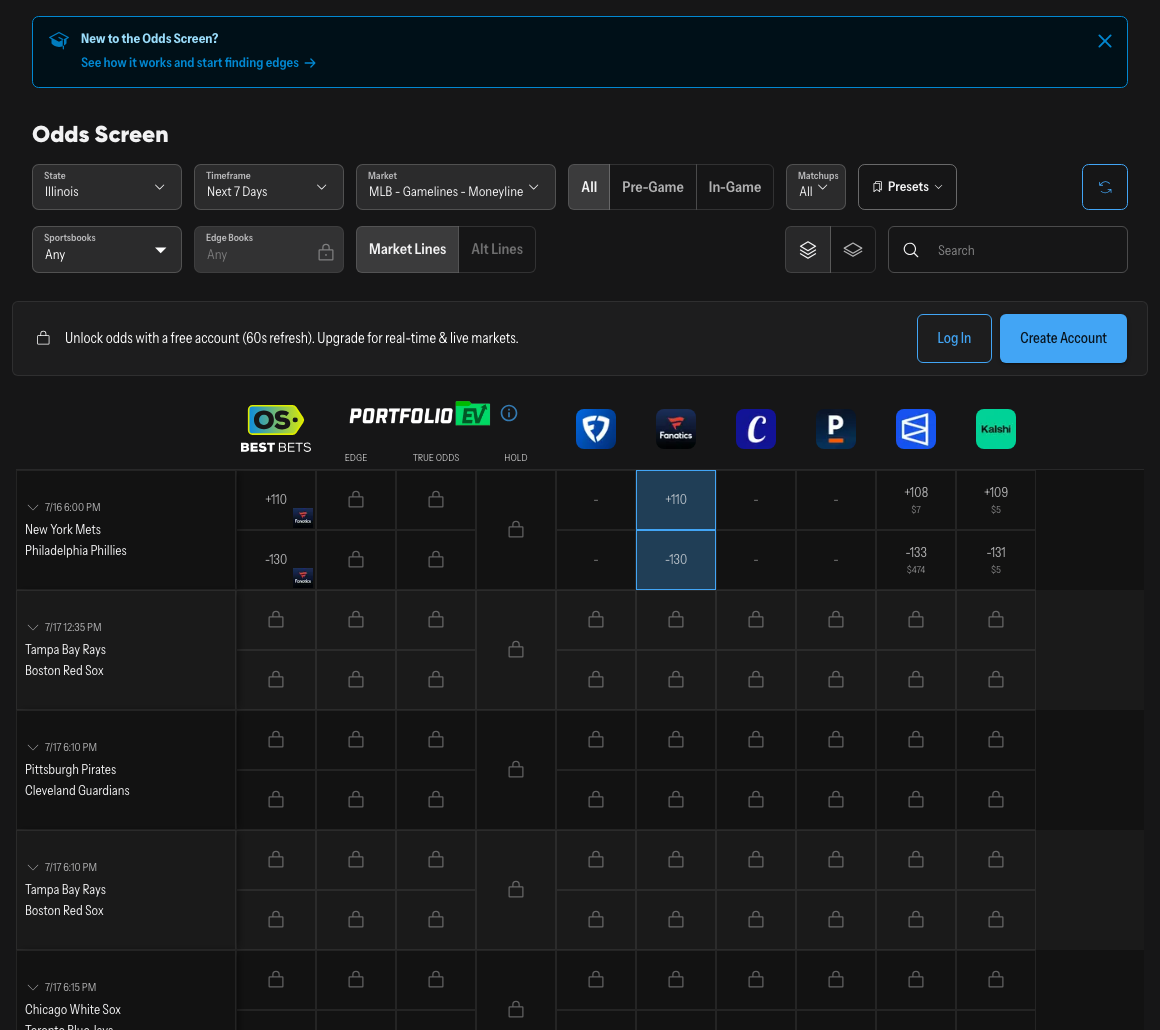 The OddsShopper live odds screen — every book's price on one board, refreshed in real time. Open the live board.
Frequently Asked Questions
Are odds boosts worth it? Sometimes. A boost is worth betting only when the boosted price beats the true odds of the event, which makes it +EV. Many boosts, especially on long-shot parlays, are still negative-EV even after the boost. Check the boosted price against the fair odds before you fire.
How do you know if a boost is +EV? Convert the boosted price to its break-even win rate, then compare it to the true (devigged) odds from sharp books. If the true odds say the bet wins more often than the break-even rate, the boost is +EV. If not, skip it. A tool like Portfolio EV does this comparison for you.
Does a profit boost make a bet more likely to win? No. A boost only increases your payout if the bet wins; it does nothing to make the underlying bet more likely to hit. It can improve a bet's expected value, but it never removes the risk of losing.
Should I use every boost the sportsbook gives me? No. Using boosts indiscriminately is the mistake the books are counting on. Use a boost only when the boosted price clears the true odds. A small max-stake limit is not a reason to skip a +EV boost, though: a real edge is worth taking at any size and those small wins stack up, so only pass if the dollars are too trivial to bother.
What's the difference between line shopping and finding the true odds? Line shopping finds the best available price across books. Finding the true odds tells you whether even that best price is actually good. You need both: shop for the best number, then check it against the fair odds before betting.
A boost is only as good as the price it leaves you with, and the only way to know is to compare the boosted price to the true odds, fast. New to OddsShopper? It scans the books, devigs the sharp prices for you, and flags which bets, boosted or not, actually clear +EV. Try OS Pro free for 7 days, then code BOOST25 takes 25% off OS Pro or OS Core if you stay, so you can stop guessing which boosts are worth it and let the fair-odds math tell you.
Betting involves risk and is for adults 21+ in regulated U.S. markets where legal. Bet only what you can afford to lose.
More on this: Live Betting Strategy: 3 Edges Sharps Exploit In-Game · Bankroll Management Sports Betting: Unit & Kelly Sizing · Closing Line Value (CLV) Explained: Beat the Close · Free Bet Conversion: How to Turn a Free Bet Into Cash · Sports Betting Strategy: How To Bet Smarter In 6 Moves