A Kalshi contract price reads as a probability because that is essentially what it is. Buy a Yes contract at 56 cents and, before fees, it pays $1.00 if the event happens and nothing if it does not, so the market is telling you it reads the outcome at roughly 56%. That readability is the whole appeal of trading sports events on a CFTC-regulated exchange, and it is also what makes the next move so tempting: pull up a sportsbook, glance at the moneyline, and decide which venue is cheaper.
That comparison is broken before it starts. A sportsbook price is not a probability estimate. Think of it as a retail price with the house's margin already baked into it: convert it straight to a percentage and you will overstate the chances across the board. Strip the margin out first and the two venues finally speak the same language.
This piece is that translation, start to finish: the arithmetic that removes the vig, the conversion into cents, the same trip in reverse, and one thing the fair number cannot do for you. That last part matters most: the devigged price is where your analysis begins, not where your decision ends.
In Summary
- A Posted Two-Way Sportsbook Market Sums To More Than 100%. That excess is the vig. Convert both sides of a two-way market to implied probability, add them up, and the amount over 100% is what the book is charging you.
- Devigging Is Division. Take each side's raw implied probability and divide it by the total. The two results now sum to exactly 100%, and those are your fair probabilities.
- Fair Probability Is Contract Cents. A 55.6% fair probability is a 55.6-cent fair contract price, rounded to whatever price increment that market quotes in. There is no second probability conversion, though the number still has to be checked against the price you can actually trade at.
- Reverse It The Same Way. A contract price in cents is already close to a probability, so converting to a book-style American price is one formula rather than a devig. Use the price you could actually trade at, not a number you eyeballed.
- Fair Value Is Not A Buy Trigger. Paying fair value is a break-even trade before costs, and exchange fees, spread, and thin books all sit on top of it. You need a price meaningfully better than fair, not equal to it.
Why A Sportsbook Price Is Not A Probability
Take any two-way market and convert both prices to implied probability. Negative American odds convert as odds / (odds + 100) using the absolute value of the price, and positive odds convert as 100 / (odds + 100). Do it on both sides and add the results together.
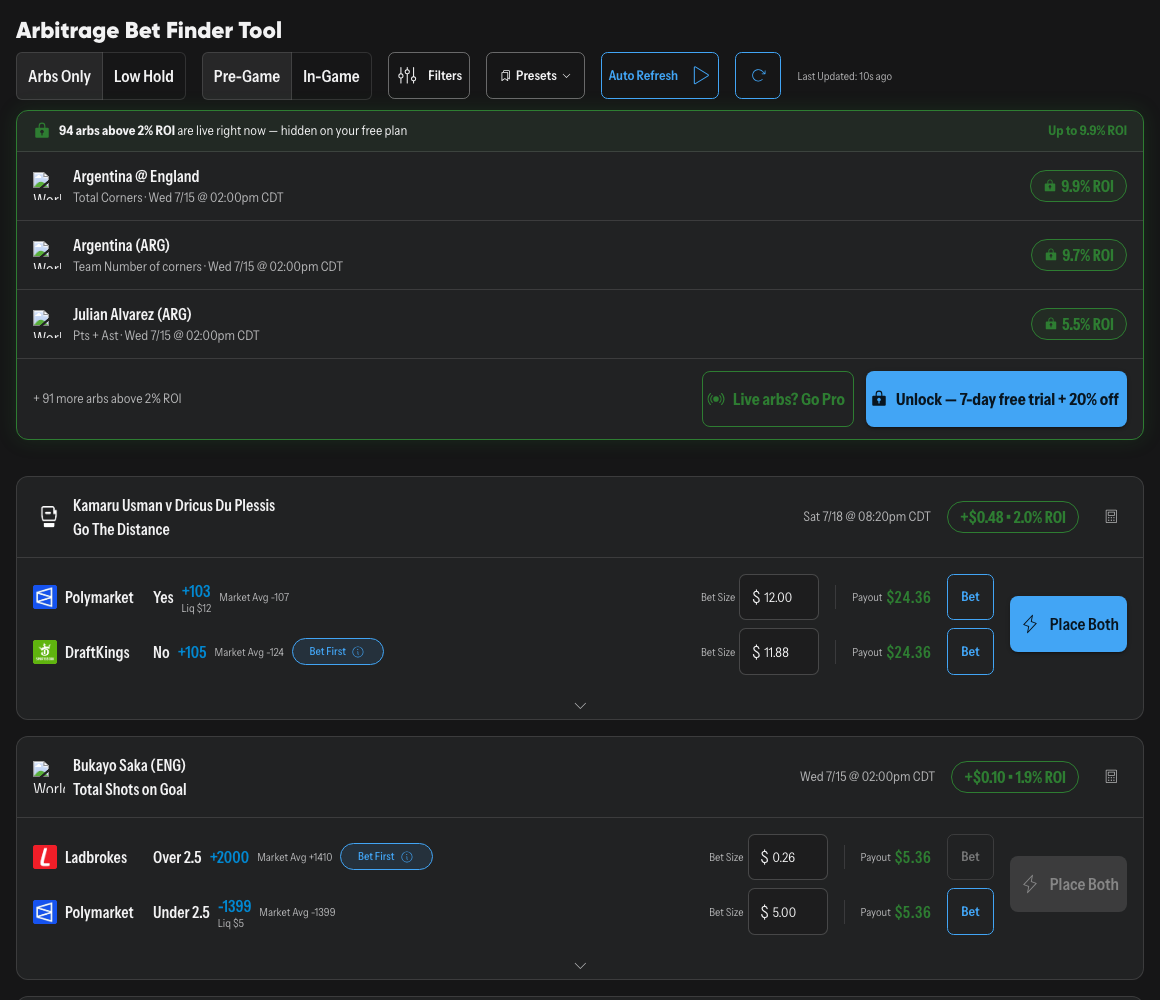
The OddsShopper Arbitrage Tool.
On a standard posted line the total will clear 100%, usually landing somewhere in the low-to-mid 100s, and that overage is the sportsbook's built-in margin, sometimes called the vig, the juice, or the overround. That margin exists because the book is not publishing a forecast. The book is publishing a price built to give it an expected edge across the market, which is a different job from estimating what will happen.
Kalshi does not work that way, and understanding why matters more than the arithmetic. On an exchange you are trading against other participants rather than against a house price, so the live quote reflects the current order book and the last trade shows where buyers and sellers actually matched. The exchange charges a trading fee rather than building a markup into the quote, though the order book still gives you a bid/ask spread to cross. Our walkthrough of how prediction markets work covers that structural difference in depth. The practical consequence is simple: a Kalshi quote is close to a probability already, and a book quote is a probability wearing a markup. You cannot compare them until you take the markup off.
How To Devig A Two-Way Line In Three Steps
The method below is the proportional approach, which splits the margin between the two sides in proportion to their size. Treat it as the standard starting point and the one worth learning first.
- Convert both sides to implied probability using the two formulas above.
- Add them. The sum is your overround. Anything above 100% is margin.
- Divide each side by that sum. The two answers now total exactly 100%, and each one is that outcome's fair probability.
That third step is the entire devig. The general math, including three-way markets where a draw is possible, is broken down in our no vig odds guide. What follows is the version pointed at an exchange screen.
Worked Example: A Book Line Into Kalshi Cents
The numbers here are illustrative, chosen to make the arithmetic clean rather than pulled from a live board. Say a book posts a two-way market at -140 on one side and +115 on the other.
| Step | Favorite (-140) | Underdog (+115) | Total |
|---|---|---|---|
| Raw Implied Probability | 58.33% | 46.51% | 104.84% |
| Divided By 104.84% | 55.64% | 44.36% | 100.00% |
| Fair Contract Price | 56¢ | 44¢ | $1.00 |
| Fair American Price | -125 | +125 | — |
The row that should stop you is the last one. The book was showing you -140 on a side its own market prices at -125 once the margin comes off. Those 15 points of American price are not an opinion or a bad line; they are the cost of doing business at a sportsbook. Trading the same event as a contract lets you go after part of that, but only if the contract is priced at or inside fair, and only after the exchange's own costs, which the next section prices out.
The one-line version: fair probability and contract cents are the same number in two costumes. Devigging is what gets you from the book's costume to the exchange's.
Now the payoff for an exchange trader. So 55.64% is simply 56 cents. If the Kalshi contract on that side is offered at 52 cents, you are buying something your devigged read says is worth about 56, and that four-cent gap is the raw edge. If it is offered at 60, the exchange is the expensive venue for that side, which is itself useful: the opposite contract has just become the cheap one on the same event.
Going The Other Direction: Contract Cents Into A Book Price
Traders often need the reverse trip, usually to check a contract against a board of American prices. This direction is easier because there is no vig to remove. Use the midpoint if you want the market's read, and the price you could actually trade at, the ask when buying, if you want your real cost.
Above 50 cents, use -(P / (100 - P)) x 100. Below 50 cents, use ((100 - P) / P) x 100, where P is the price in cents. A 56-cent contract becomes roughly -127, a 44-cent contract becomes roughly +127, and 50 cents is exactly +100. Note the rounding against the table above: 55.64% converts to -125, but the 56-cent price you can actually buy converts to -127. Rounding up by about a third of a cent moved the American price two points, and a full cent near a coin flip moves it roughly four, closer to five once you are in the high 50s. That sensitivity is why a fair number is better treated as a narrow range than a decimal. Our Kalshi odds explainer carries the full conversion chart if you would rather read it off than calculate it.
One warning before you lean on that comparison. A contract and a moneyline can look identical and settle differently, because each market resolves under its own written rules on things like suspended games, extra periods, or official results. Read the settlement terms on the specific market rather than assuming sportsbook conventions carry over.
Once you can move in both directions, the two venues stop being separate worlds. That is also the point where the same skill starts paying for itself twice, because a price gap large enough to trade in one direction is the raw material for prediction market arbitrage in the other. Our arbitrage finder does that scan continuously, and the devig you just learned is the step underneath it.
Want the fair number without the arithmetic? OS Pro removes the vig across every book we price and shows you the fair line next to the takeable one, so the only work left is comparing it to a contract price in cents. Use code FAIRCENTS20 for 20% off.
Why Fair Value Is Not Your Buy Trigger
The most common mistake we see from people who have just learned to devig is treating the fair price as a green light. That reading gets it backwards. Paying fair value is, by definition, a break-even proposition before any costs at all, so every real cost you then absorb comes straight out of a return that started at zero.
Three costs bite on an exchange:
- The Trading Fee. Kalshi charges a fee that varies with the contract's price and is heaviest around the middle of the range, where uncertainty is greatest. A coin-flip market is therefore the most expensive place to pay fair value. Our Kalshi fees breakdown has the shape of that curve.
- The Spread. You buy at the ask, not at the midpoint you eyeballed, and on a quiet market that difference alone can swallow a thin edge.
- Depth. A market can show an attractive price on a handful of contracts with nothing behind it. Our guide to Kalshi liquidity covers where the order books are deepest.
Stack those together and your real threshold sits some distance past fair, not at it. Return to that illustrative 56-cent fair value: a contract offered at 55 is not a trade, because a single cent of theoretical edge will not survive the fee and the spread. At 52 the same contract is worth a serious look. Where exactly your line falls depends on your costs and on how much confidence you have in the devigged number itself, which is a judgment call rather than a formula. Our EV Calculator will do the break-even arithmetic once you have both numbers, and the same reasoning that governs positive expected value betting applies here without modification.
Worth saying plainly: this arithmetic estimates a fair price, it does not predict an outcome, and correct math never removes the risk of losing the trade.
Putting It To Work On A Real Screen
One rule governs the whole workflow, and getting it wrong quietly poisons the output: devig both sides of the same market from the same book at the same moment. Grabbing the best price on the favorite from one book and the best price on the underdog from another does not give you a sharper input. It gives you a synthetic market whose two sides already sum to something close to 100% before you divide, so the division does almost nothing and the side opposite the outlier gets handed a fair probability higher than it deserves. That is the direction of error that makes a bad contract look cheap. If you want multiple books in the picture, devig each book's own two-way pair separately and take the consensus of those fair numbers.
From there the checks are mechanical:
- Match The Timestamp. A book price pulled ten minutes before the exchange quote is a different market. Live boards like our MLB moneyline screen let you take both sides of a market off one screen at one moment.
- Compare Against The Executable Price. Buying means comparing your fair number to the ask, selling means comparing to the bid. The midpoint is the market's opinion, not a price you can get.
- Check What Sits Behind The Quote. If the top of the book covers fewer contracts than you intend to buy, your realized price is the next level up, not the one you measured, and on a thin sports market those levels can sit several cents apart.
- Confirm The Two Markets Settle The Same Way before treating them as the same bet at all.
If you want a second opinion on the underlying event rather than the pricing, our free expert picks today page shows how our handicappers are reading the same games.
If you are new to the exchange side of this, start with our walkthrough of how to bet sports on Kalshi, or with the wider comparison of prediction markets versus sportsbooks if you are still deciding which venue suits you. Confirm current availability where you live before you fund anything, since access is platform-specific and has moved more than once. Kalshi's sports contracts are 18+ and offered on a CFTC-regulated exchange, but the state-level picture keeps shifting; our prediction market legality guide tracks it as of July 2026. Availability varies by jurisdiction and by market, legal challenges are still active, and the platform itself is the final word on whether you can access a given contract.
More on this: Devig Calculator: Find Fair No-Vig Odds From -110 Prices · Best +EV Bet Tracker: What To Look For (And What Most Skip) · Closing Line Value Vs. Variance: Your P&L Is Lying To You · How To Bet On Horses: 6 Horse Racing Bet Types Explained · Polymarket Fees Explained: What Trading Actually Costs
Devigging Odds For Kalshi FAQ
What does it mean to devig odds? It means removing the sportsbook's built-in margin from a market so the remaining probabilities sum to exactly 100%. Convert every outcome to implied probability, add them up, then divide each one by that total.
How do I convert American odds to a Kalshi contract price? Devig the two-way market first, then read the fair probability as cents. A fair probability of 55.6% is a fair contract price of about 56 cents, because a contract settles at $1.00 or $0.00.
Is the devigged fair price the price I should pay? No. Paying fair value breaks even before costs. Trading fees, the spread, and thin order books all reduce your return, so a tradeable price needs to sit meaningfully better than fair.
Which devig method should I use? The proportional method shown here is the standard starting point and is fine for most two-way sports markets. Other approaches distribute the margin differently, and they matter most on heavy favorites where the two sides carry very different prices.
Why does devigging the best price from two different books break the math? Because best-of-both prices already sum close to 100% before you divide, the division barely changes anything and the side opposite the outlier price comes out looking better than it is. Devig each book's own two-way pair, then compare the fair numbers.
Should I devig before or after checking the order book? Devig first, since that is the number you are testing the market against, then check depth before you size. A fair-looking price on a handful of contracts is a different trade from the same price with real size behind it.
Does devigging work on three-way markets? Yes, and the arithmetic is identical: convert all three outcomes, sum them, divide each by the total.
Devigging is not a signal generator and it never will be. Devigging is a translator, and its whole value is that it lets you ask one clean question about any event on the board: given what the market as a whole thinks, is this contract cheap or expensive? Answer that against the price you can actually trade at, hold yourself to a minimum edge that survives the fee and the spread, and walk away from any market whose settlement rules or order-book depth do not match the sportsbook you compared it to. Do that consistently and you are doing the same work the sharpest participants on either venue are doing.
Ready to skip the arithmetic and read the fair number straight off the screen? Use code FAIRCENTS20 for 20% off OS Pro.