The same real-world question is now priced in two different languages. A sportsbook quotes a World Cup final or an NBA game in American odds, +130 or -150. A prediction market like Kalshi or Polymarket quotes the identical outcome in cents, where a contract at 60 cents means the market is pricing it near 60 percent. Those two prices are set by different crowds, on different platforms, under different rules, and they do not always agree. Prediction market arbitrage is the practice of covering both sides of the same event across two venues when their prices disagree enough that the two legs together cost less than the dollar they pay out.
That gap is the whole story here, so let us be honest about its size up front: it is real, it is narrower than the "all-green calendar" screenshots make it look, and the places you can legally access it are a moving target. What this actually rewards is not a magic scanner. The edge goes to whoever can translate between the two price languages faster and more accurately than everyone else. And translating a sportsbook line into the same unit a prediction market uses turns out to be a single, specific calculation. We will get to that number.
In Summary
- Prediction Market Arbitrage exploits a price disagreement on the same event across two venues: a prediction market (Kalshi, Polymarket) priced in cents, and either a sportsbook priced in American odds or a second prediction market.
- Prediction markets are CFTC-regulated event contracts, not sports betting. That legal distinction matters, and it is covered below.
- The mechanism: if you can cover both outcomes for a combined cost under $1.00 (before fees), then once both legs are placed at those prices the position is structured to return $1.00 whichever side resolves. The gross gap is the difference.
- The gap is fragile. Trading fees, spreads, slippage between your two legs, sportsbook limits, and collateral tied up on both platforms at once all eat into it. None of this is a promise of profit, and this guide never states a result you should expect.
- The hard part is comparison, not execution. To spot the gap, read both venues in the same unit, the cost right now to return $1.00 on each outcome; our Arbitrage tool surfaces those crossed prices across every major book, and no-vig fair-odds pricing then tells you whether the gap is a real edge.
- Availability Is State-Specific And Changing. As of July 2026, both platforms are restricted or paused in several states, and a Minnesota law effective August 1, 2026 creates felony-level exposure for the platforms operating there (so MN access is going away). Check each platform's own eligibility rules before you do anything.
If you are brand new to the concept of locking both sides of a market, start with our sportsbook arbitrage explainer. This guide assumes you already grasp that idea and focuses on what changes when one of the venues is a prediction market.
Stay ahead of the markets.
Daily insights and expert picks on Kalshi, Polymarket, and what's moving markets.
Free forever. Unsubscribe anytime.
Two Price Languages For One Event
A prediction market is an exchange. You are not betting against a house that sets a line and bakes in a margin. You are buying and selling contracts against other traders, and each contract pays $1.00 if the event happens and $0.00 if it does not. The price, quoted in cents, is the market's live estimate of the probability. A contract trading at 42 cents is the crowd saying "about 42 percent," and if the event resolves in your favor, that 42-cent contract pays a dollar.
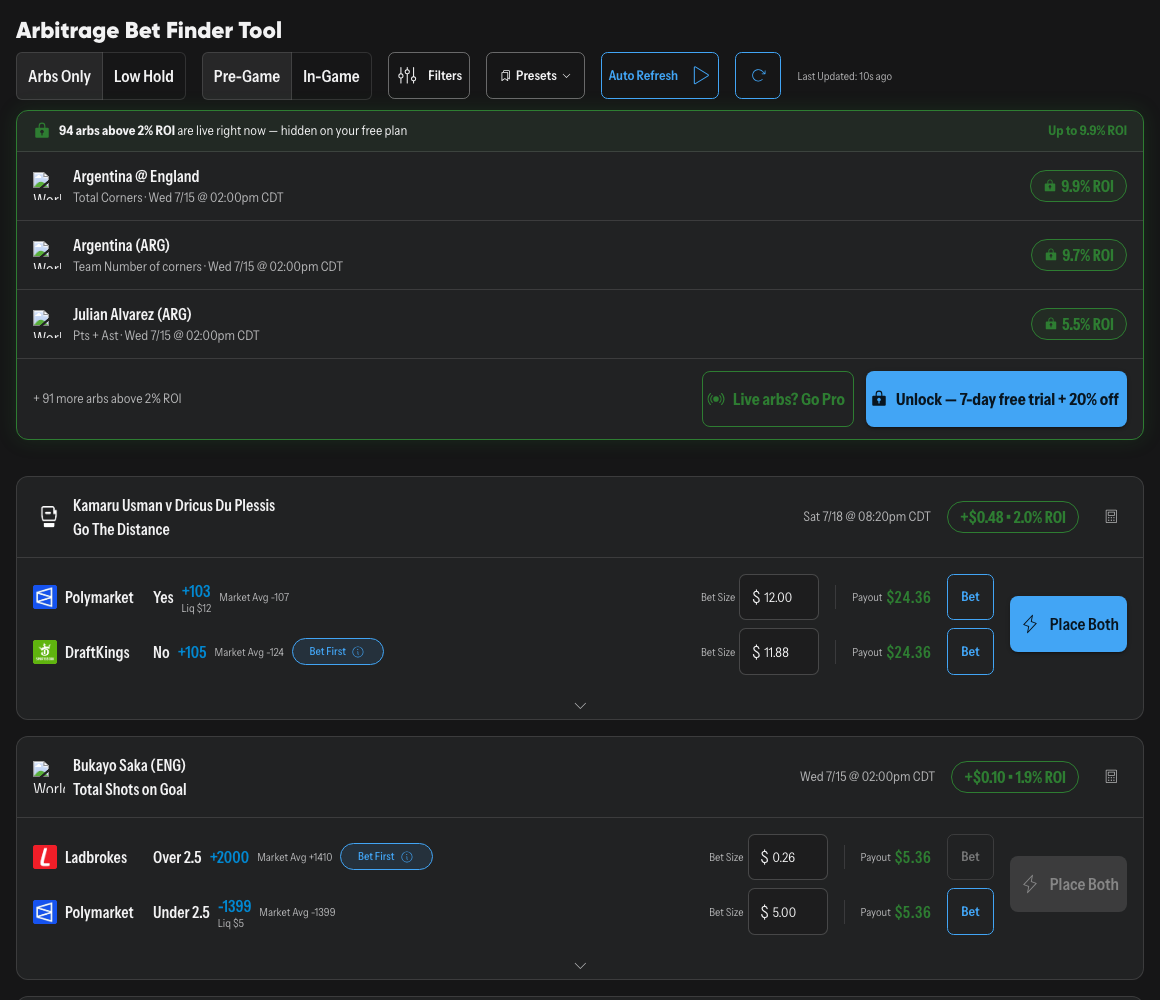
The OddsShopper Arbitrage Tool.
A sportsbook works the other way. It posts a number, it takes both sides, and it builds in a hold, the vig, so the two sides do not add up to a clean 100 percent. That hold is how the book makes money, and it is why the same event can carry a different implied probability at a book than it does on an exchange.
Here is why that difference creates an opening. The sportsbook's price reflects a margin plus wherever the recreational public has pushed the line. The prediction market's price reflects a separate pool of traders, often reacting to news on its own timeline. When those two crowds land in different places, the same outcome ends up cheaper on one venue than the other. Buy the cheap side of the question on one platform, cover the other side on the second, and if your combined cost comes in under a dollar, you have built a position that returns a dollar either way. That is the crossed market the whole strategy hunts for.
The Mechanism: A Worked Example
Let us walk one all the way through. These numbers are illustrative, chosen to show the math cleanly rather than to quote any live market.
This is the Kalshi vs sportsbook odds comparison in miniature. Say a two-way matchup, the home team versus the road team, is trading like this:
| Venue | Outcome you back | Price | Cost to return $1.00 |
|---|---|---|---|
| Kalshi (Exchange) | "Home team wins" YES contract | 53 cents | $0.53 |
| A Major Sportsbook | Road team moneyline | +130 | $0.435 |
Read the most important row first: the sportsbook has the road team at +130, which is a way of saying the book's price implies the road team wins roughly 43 percent of the time. A +130 stake of about 43.5 cents returns a full dollar if the road team comes in. Meanwhile the exchange will sell you "Home team wins" for 53 cents, and that contract pays a dollar if the home team comes in.
Add the two costs: 53 cents plus 43.5 cents is 96.5 cents. Once both legs are placed at these prices, that 96.5 cents is structured to return a full $1.00 whichever team wins. The gross gap is about 3.5 cents on the dollar, close to 3.5 percent. On the surface that looks too good to be true. Often it is.
That surface is misleading, and the next section is the reason.
Why The Gap Is Smaller Than It Looks
That 3.5-cent gross number is the ceiling, not the take-home. Four frictions stand between it and reality, and any one of them can shrink the edge to nothing or push it negative.
The one thing to remembera gross gap is a starting point, not a payout. Price the fees, the slippage, and the doubled collateral before you decide any prediction market arbitrage is worth the capital.
Trading fees. Kalshi charges a per-trade fee that is largest on near-coin-flip contracts and shrinks toward the extremes, so a leg priced at 53 cents sits close to the peak of that curve. Whatever the exchange keeps comes straight out of your 3.5 cents before you have done anything else.
Slippage between the two legs. You cannot place both sides at the exact same instant. You buy the exchange contract, then turn to the sportsbook, and in those seconds the number can move. If the sportsbook shortens the road team from +130 to +118 before you get down, the leg that was going to cost 43.5 cents now costs more, and your gap narrows or vanishes. Sharp bettors call the price that walks away from you slippage, and on a fast-moving market it is the single biggest killer of a thin arb.
Sportsbook limits. Books do not enjoy paying arbitragers. Consistent two-sided, gap-hunting action is exactly the pattern their risk systems flag, and the operational endpoint is reduced limits or, in the worst case, a closed account. Getting limited is a compliment, as the saying goes, but it also caps how long any sportsbook leg of this stays available to you.
Collateral on both platforms at once. This is the friction specific to cross-venue arbitrage, and it is the one newcomers miss. Your exchange position and your sportsbook position are not netted against each other. There is no prime broker sitting between Kalshi and DraftKings to say "these two offset, post margin once." You fund the full stake on the exchange and the full stake at the book, simultaneously, for the same event. That doubles the capital each opportunity ties up and drags down your real return on the money at work, even when the gap itself is positive.
Stack those together and the illustrative 3.5 cents is often a fraction of a cent, sometimes zero, occasionally underwater. None of that is a reason to dismiss the strategy. It is the reason speed matters more than the size of any single gap, which brings us back to the number we promised.
How To Actually Find It: Speak One Language
Remember the two price languages. You cannot compare 53 cents to +130 by eye, and that is precisely why most people never see these gaps. The fix is the calculation we promised: convert each venue's price into what it costs, right now, to return a dollar on that outcome. A prediction-market contract already reads that way, since a 53-cent contract costs 53 cents to return $1.00. The sportsbook price converts too, because +130 costs about 43.5 cents to return the same dollar. Line the two executable costs up, and a gap that was invisible becomes a subtraction problem. That cost-to-return-a-dollar comparison, not the fair probability, is what tells you an arbitrage exists.
A second number tells you whether that gap is worth trusting. Strip the vig out of the sportsbook line and you get its no-vig fair price, the book's honest estimate of the outcome once its margin is removed. That is the value read: it separates a genuine cross-venue inefficiency from a stale or limit-only quote that will vanish the moment you try to size up. You find the arb with executable prices; you judge it with fair odds.
Doing both by hand across every game, every book, and two exchanges is not realistic, which is where the right arbitrage betting tools come in — the arbitrage finder, the scanner, the prediction market arbitrage tool our own readers keep asking for. This is our lane, not because we run a prediction market, but because pricing sportsbook lines at scale is exactly what OddsShopper already does. One expectation to set honestly up front on the arbitrage scan itself: it prices and de-vigs the sportsbook side of the market in real time, so for a book-versus-exchange play you still drop the Kalshi or Polymarket cent price into that comparison yourself. That executable contract price is the one input cross-venue arbitrage always keeps manual — even though, as you will see, a separate tool does read the exchange side for signal.
- The Arbitrage tool scans every major U.S. sportsbook in real time, and the tool surfaces the crossed prices where the two sides of a market do not agree — a live, multi-book arbitrage scanner, not a two-input calculator you feed by hand. When I am hunting these gaps myself, this is the screen I keep open.
- Our no-vig, fair-odds pricing shows the true implied probability behind any posted line, so once you spot a book-versus-exchange gap — a Kalshi arbitrage or Polymarket arbitrage against a sportsbook line — you can tell whether the contract is mispriced or just noise.
- The +EV screen flags when a sportsbook price is out of line with the fair market, using expected win rate and expected ROI rather than a gut feel.
- The Sharp Action tool reads where sharp money is moving on the exchanges and prediction markets, Kalshi and Polymarket included — useful context for whether a gap is a real inefficiency or a stale quote about to snap shut. This is the piece that does look at the exchange side, so pair its read with the cent price you enter into the arbitrage scan.
The workflow is the story of this whole guide in three steps: translate both venues into the cost to return $1.00, find where those costs sum to under a dollar, and decide whether the gap survives the fees, the slippage, and the doubled collateral we just walked through. Free OddsShopper tools cover the core odds comparison.
OS Prounlocks the full real-time arb feed and the deeper de-vig and Sharp Action reads, with a 7-day free trial. New OS Pro members can take 20 percent off with code PMARB20.
Kalshi Against Polymarket: The Same Idea, One Venue Removed
Everything above pairs a prediction market with a sportsbook, but the cleanest version of prediction market arbitrage is exchange against exchange. If Kalshi prices a given outcome's YES contract at 55 cents and Polymarket prices the opposite outcome such that covering it costs less than 45 cents, the two contracts sum to under a dollar, and the same structure exists without a sportsbook leg at all.
One check matters more here than anywhere else: the two contracts have to resolve on the exact same condition. Kalshi and Polymarket often word their markets differently — the settlement source, the deadline, and how each handles a cancellation or a void can all diverge. A near-match on the headline question is not an arb; it is basis risk wearing an arb's clothes, and it can leave you holding two live positions that do not actually offset. Confirm the resolution terms line up before you treat the gap as real.
With that settled, two things make the exchange-versus-exchange version distinct. First, both venues quote in cents already, so you skip the de-vig translation entirely. Second, exchanges quote tighter spreads than sportsbooks post holds, so the raw gaps are usually thinner, and fees and liquidity matter even more. A gap you spot on paper can evaporate if the contract you need is thinly traded and your order walks the book. Liquidity is no footnote on an exchange. It is the difference between a fill and a phantom.
The Legal Line: These Are Contracts, Not Bets
This is the part you do not get to hand-wave, and it is why this article carries a review hold before it publishes.
Prediction markets like Kalshi and Polymarket are CFTC-regulated event contracts, not sports betting. That is not a marketing distinction. It is a legal one, and it cuts in a counterintuitive direction: prediction markets can be available in states where sportsbooks are not, and blocked in states where sportsbooks are live. Do not assume that because you can bet at a sportsbook where you live, you can trade event contracts there, or the reverse.
Where things stand matters less than the fact that they keep moving. As of July 2026, both Kalshi (a CFTC-designated contract market) and Polymarket (back in the U.S. through a CFTC-cleared acquisition, currently via its mobile app) are available in most states but restricted, limited, or paused for some contracts in others — and which states those are is being litigated case by case. Several state regulators have challenged how sports-related contracts are treated; several of those challenges have gone the platforms' way. That is exactly why I will not hand you a state-by-state roster here: any hard list in an evergreen guide is stale the week after it is written, and it tends to get the direction backwards. The only source that is right on the day you act is each platform's own live eligibility check at sign-up. Confirm it there, every time.
There is one date worth naming, because it is scheduled rather than contested: Minnesota. A state law taking effect August 1, 2026 creates felony-level exposure for platforms that operate, host, or advertise these markets in the state — it targets the operators, not the individual trader — and it faces a federal challenge that is unresolved as of July 2026. Treat the current rule as the operative one until a court says otherwise. The practical upshot is the same either way: if you are in Minnesota, expect access to be cut off, and do not trade these markets.
And the usual footing applies: this is a strategy that ties up real capital with real downside, so trade only what you can afford to lose, and never chase a loss with a bigger position.
The Bottom Line
Prediction markets did not invent arbitrage. They opened a new surface for it by pricing the same events a second way, in cents, set by a separate crowd trading on its own schedule. The gap that creates is genuine, and it is exactly the kind of cross-venue inefficiency that used to live only between sportsbooks. But it is thinner than the highlight-reel screenshots suggest, and once you account for fees, slippage, limits, and the collateral you have to post on both platforms at once, the winner is whoever can price the disagreement before it closes.
That speed comes down to the one move we kept returning to: getting both venues into the same language. A sportsbook line only becomes comparable to a Kalshi contract once you read both as the same thing, the cost to return a dollar, and then strip the vig to learn whether the gap is a real edge or a mirage. Before you send a single dollar, the checklist I actually run down is short and unglamorous: the two contracts resolve on the exact same condition, the prices are executable at size and not just a midpoint, the fee-adjusted cost of both legs still sums under a dollar, both accounts are funded so slippage cannot strand one leg, and your state and each platform's eligibility page say yes today. Clear all five and you have an arb; miss one and you have a story. Doing that across every book and market in real time is the difference between spotting a gap and watching it close.
Compare the true no-vig price on every sportsbook line, side by side, with the free OddsShopper odds tools, and unlock the full live arb feed and Sharp Action read with OS Pro, 20 percent off with code PMARB20 and a 7-day free trial.
Prices on this page are Kalshi's book. If you also trade on Polymarket, code OS4 gets new users a $50 trading bonus on a $10 deposit — affiliate link; terms as stated by Polymarket; 18+, availability varies by state.
More on this: Barcelona Vs Feyenoord Odds: Does The Favorite Survive The Fee? · Where Does Bitcoin End 2026? Kalshi's Price-Band Odds · The Longest Shot On This Board Might Be The Best-Kept Secret · 2026 Governor Races: Every Kalshi Board We Track · MAC Championship Odds: Ohio Never Has To Play The Favorite