Logging into a sportsbook for the first time is a lot. You get greeted by hundreds of team names, numbers, and bet types, and none of it means anything until someone explains it. The good news: the whole thing rests on a handful of basics, and once those click, the rest of the menu stops looking like a cipher and starts looking like a set of choices. Read this and the next time you open an app you will know exactly what you are looking at, plus the one habit that quietly separates bettors who win from bettors who just play.
Watch: Sports Betting 101 For Beginners
This guide is built from our own beginner walkthrough. Watch it here, then use the sections below as your reference whenever a bet slip confuses you.
How American Odds Work (Favorites, Underdogs, And Payouts)
Everything on a sportsbook starts with the odds, and the odds are just the market's estimate of how likely an outcome is. In the United States you will see American odds, which come in two flavors: a positive number and a negative number.
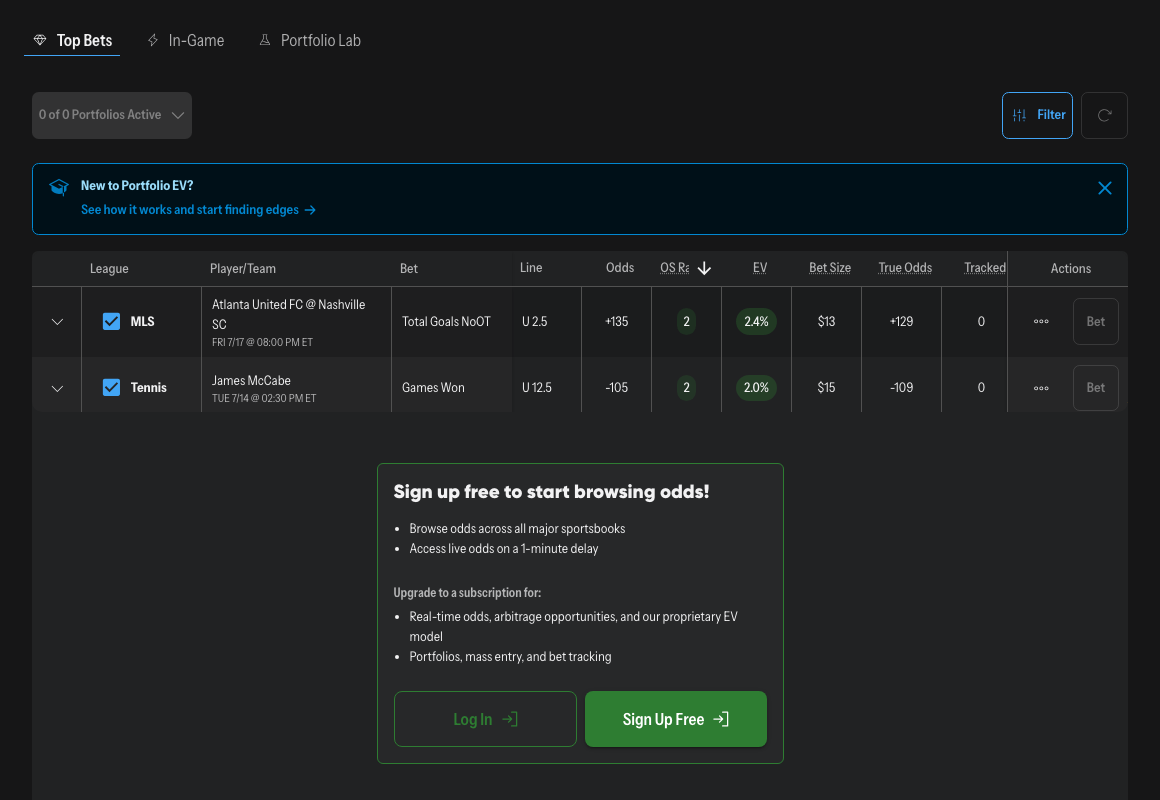
The OddsShopper +EV Screen.
The positive number marks the less likely outcome, the underdog. The negative number marks the more likely outcome, the favorite. The bigger the number gets in either direction, the more lopsided the sportsbook thinks the matchup is.
The part that trips up new bettors is what those numbers actually pay, and it is simpler than it looks:
- A positive number tells you how much profit you win on a $100 bet.
- A negative number tells you how much you have to risk to win $100.
A Worked Example: 76Ers +245 Vs Pelicans -305
Say the 76ers are +245 underdogs against the Pelicans. A $100 bet on the Sixers returns $245 in profit if they win. Now flip it: the Pelicans are the favorite at -305, so you would need to risk $305 just to win $100. Same game, very different math.
| Odds | Favorite or Underdog | What a $100 stake means |
|---|---|---|
| +245 | Underdog (76ers) | Win $245 in profit |
| -110 | Near a coin flip | Risk $110 to win $100 |
| -305 | Heavy favorite (Pelicans) | Risk $305 to win $100 |
The row worth staring at is +245 versus -305. Both are the same two teams in the same game, but the underdog pays nearly two and a half times your stake while the favorite makes you lay more than three units to win one. That gap is the sportsbook telling you, in numbers, who it expects to win, and it is why an underdog can be tempting even when it is the long shot.
Moneyline Bets: Picking A Team To Win Straight Up
A moneyline bet is the most straightforward wager there is. You are picking a team to win, straight up, and nothing else matters. Final score, margin, overtime drama, none of it counts as long as your team wins the game.
The catch is the price. In our example the Pelicans are heavy favorites, so betting them on the moneyline means risking a lot to win a little. Backing the +245 Sixers is the opposite: you risk a little to win a lot, but your odds of actually cashing are lower, because the market already told you they are the underdog. Neither is wrong, but a moneyline on a big favorite is often a poor use of your money.
That tension, wanting to bet a game without laying a huge price on a favorite, is exactly the problem the next bet type was invented to solve.
Point Spreads: How Sportsbooks Level The Playing Field
A point spread exists to make a lopsided game bettable. Instead of asking who wins, the spread asks who wins by how much, which puts two unevenly matched teams on roughly even footing.
Stick with the Pelicans and the Sixers. The Pelicans are -8 favorites and the Sixers are +8 underdogs. The negative number is again the favorite, the positive number the underdog. To "cover the spread," the Pelicans have to win by more than 8. The Sixers cover by winning outright or by losing by fewer than 8.
| Result | Pelicans -8 | Sixers +8 |
|---|---|---|
| Pelicans Win By More Than 8 | Win | Loss |
| Pelicans Win By 7 | Loss | Win |
| Sixers Win Outright | Loss | Win |
| Pelicans Win By Exactly 8 | Push | Push |
Notice the bottom row. If the Pelicans win by exactly 8, neither side wins, and that is called a push. Your stake gets refunded, like the bet never happened. That is the key difference from a moneyline: with a spread, the Sixers can lose the game and still win you money, and the favorite can win the game and still lose your bet.
The Vig (Juice): Why Both Sides Are Priced At -110
If the point spread is supposed to make the game a coin flip, you would expect both sides to be priced at +100, or "even money." Instead you almost always see -110 on each side. That extra bit is not a mistake. It is the sportsbook's fee for taking your bet, and it goes by two names: the vig or the juice.
Why does it matter? If you bet the Sixers spread and a friend bets the Pelicans spread, the book does not care who wins, because that margin is baked into both prices and it keeps the difference no matter which side lands. That roughly 10% markup on each -110 price, versus the +100 you would get at true even money, is how sportsbooks make money over time. It is also the single biggest reason the price you pay matters as much as the pick you make, which we will come back to.
Sportsbooks are not the only regulated way to put money on a game anymore, either. CFTC-regulated prediction markets price the same outcomes as yes/no contracts with a visible trading fee instead of a built-in vig; here is how prediction markets work.
Totals (Over/Under) And The Hook
The last core bet type ignores who wins entirely. A total, also called the over/under, is a bet on the combined score of both teams. The sportsbook posts a number, and you decide whether the two teams will combine to go over it or under it.
Suppose the total between the Pelicans and Sixers is 221.5. Bet the over and you need 222 or more combined points. Bet the under and you need 221 or fewer. It does not matter who wins or by how much, only where the final combined score lands.
That half point has a name: the hook. Because a basketball game cannot end on a combined score of 221.5, the hook removes any chance of a push. Your total ticket is either a clean win or a clean loss. So the next time someone at the bar groans that they "lost to the hook," you will know they got beaten by that extra half point, and you will hopefully be on the winning side of it.
The Step Most Beginners Skip: Shopping For The Best Number
You now know the four bets that make up almost every ticket: odds, moneyline, spread, and total. The habit that turns that knowledge into a real edge, the one we promised up top, is the step most beginners never take.
Remember the vig. Every book builds in its own margin, so the exact same bet is priced differently at different sportsbooks. DraftKings 🎁, FanDuel 🎁, and BetMGM 🎁 rarely post the identical number on the same game: one might have those Sixers at +245 while another shows +260 and a third sits at +250, all for the same wager. Taking +260 over +245 costs you nothing extra and pays more every single time that bet cashes. Over a full season, grabbing the better number again and again can meaningfully improve your long-term return. Bettors call this "line shopping," and it is one of the simplest edges you can hand yourself.
Doing it by hand is the problem. Nobody wants to open eight apps and compare Caesars against DraftKings against FanDuel before every bet. That is exactly what the OddsShopper odds screen does for you: it lines up the price for a bet across every major sportsbook so you can grab the best number in seconds. OddsShopper Pro goes further with its Sharp Sportsbook Algorithm, which de-vigs the market to estimate the true price and then flags the bets that are actually in your favor (positive expected value, or +EV), along with the line movement so you can see which way a number is heading.
New to OddsShopper?It scans every major sportsbook and shows you which one has the best price on the bet you already want to make, then flags the lines that are +EV. That is the line-shopping habit above, done for you in seconds. Grab your first week of OddsShopper Pro for just $1 with code MONEYLINE.
Want to see how sharp bettors put all of this together? Our guides on how to win sports bets and reading the OddsShopper odds screen are the natural next reads. Prefer to let a pro make the call? Browse the expert picks instead.
Frequently Asked Questions
What do positive and negative betting odds mean? Positive odds (like +245) mark the underdog and tell you the profit on a $100 bet. Negative odds (like -305) mark the favorite and tell you how much you must risk to win $100. The bigger the number, the more lopsided the matchup.
What is the difference between a moneyline and a point spread? A moneyline bet only needs your team to win the game outright. A point spread bet needs your team to win by a certain margin, or to lose by less than that margin, which lets you back a big underdog or a heavy favorite at a fairer price.
What is the vig in sports betting? The vig, also called the juice, is the sportsbook's fee for taking your bet. It is why both sides of an even matchup are usually priced at -110 instead of +100, and it is a standing edge for the book on every wager.
What does the hook mean in a betting total? The hook is the half point attached to a spread or total (like 221.5). It exists so the bet cannot land exactly on the number, which removes the chance of a push and makes every ticket a clear win or loss.
How do I find the best odds as a beginner? Compare the price for your bet across multiple sportsbooks and take the best number every time, a practice called line shopping. Tools like the OddsShopper odds screen do the comparison for you so you are not checking apps one by one.
The Bottom Line
Sports betting stops being intimidating the moment you can read a bet slip. Odds tell you the favorite, the underdog, and the payout. A moneyline picks a winner, a spread handicaps the margin, and a total bets the combined score, with the hook keeping it clean. Learn those and you can walk into any sportsbook and know exactly what you are doing.
The bettors who stick around tend to share one habit: they rarely take the first number they see. Comparing prices and hunting for +EV before you bet is how you stop paying full freight to the sportsbook and claw a little of that edge back for yourself. It will not hand you a winning ticket, but it stops you from beating yourself before the game even starts.
Ready to stop leaving the better number on the table? OddsShopper compares every major sportsbook and flags the +EV bets for you. Try OddsShopper Pro for just $1 your first week with code MONEYLINE.
Please gamble responsibly. If you or someone you know has a gambling problem, call 1-800-GAMBLER.
More on this: Louisiana Sports Betting Guide: Rules, Promos & Strategy · Arizona Sports Betting: Is It Legal? Apps & Rules · Illinois Sports Betting: Is It Legal? Apps & Rules · Massachusetts Sports Betting: Is It Legal? Apps & Rules · Michigan Sports Betting: Is It Legal? Apps & Tools