There are two kinds of positive EV bettors, and they tend to talk past each other. The first kind never builds a projection in their lives: they de-vig the sharpest price on the board (strip out the vig, the bookmaker's built-in margin, to recover the market's real probability), find a sportsbook hanging a number better than fair, and bet it. The second kind originates: they build their own probability for a game from scratch and bet wherever the market disagrees with them. The funny part is that both are running the same equation, EV = (win probability × decimal payout) − 1. Every wager you place has an expected value attached to it whether you calculated one or not, and the only real choice in a positive EV betting strategy is who supplies the true probability: the market, or you.
I run both, and this guide is the case for learning them in that order. I will walk through how the edge is actually calculated under each approach, where each one earns its money and where it breaks, and then the part I keep coming back to: how the two snap together into one weekly routine for prediction markets this NFL season, where the same de-vig math that finds you a better number at DraftKings can flag a mispriced event contract on an exchange.
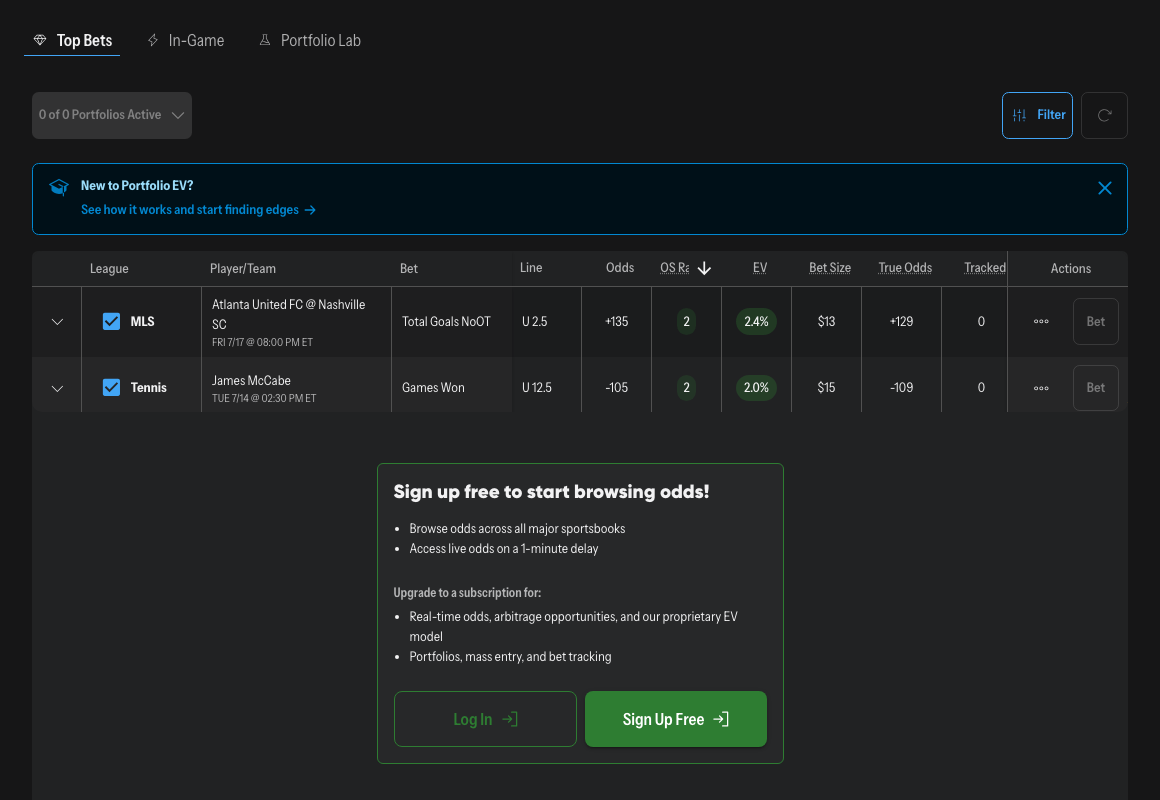 The OddsShopper +EV board — live edges ranked, with the fair price, EV and sizing on every bet. Open the live board.
What Makes A Betting Strategy Positive EV?
Quick calibration, then we move. A bet is positive EV when the price you are paid beats the true probability of winning: expected value = (your win probability × the decimal payout) − 1. A standard -110 line needs 52.38% just to break even, so any strategy that cannot say where its probabilities come from is a strategy for paying vig. If the concept itself is new, start with what +EV betting is and why the math compounds and keep the EV calculator open while you read (the expected value calculator guide shows the arithmetic on real examples); this piece assumes the basics and spends its words on the two ways to find the edge.
Where the probabilities come from is the whole fork in the road, and everything below is one answer or the other.
Top-Down: The Market Prices Your Edge
The top-down bettor treats the sharp betting market as the best-informed forecaster available on any liquid market. The sharpest prices on the board already contain the injury news, the weather, and ten thousand sharper opinions than yours. Your job is price shopping between venues, and it works in three steps.
Worked Example: De-Vig The Sharp Price, Then Shop It
First, take the tightest market you can find on the game and strip the vig out of it. Say the sharpest available two-way price on an NFL side is -120/+100 (a number picked for the walkthrough, not a live quote). That implies 54.5% on one side and 50.0% on the other, summing to 104.5%; the overage is the vig, so divide each side by the 104.5% total and the fair probabilities are 52.2% and 47.8%. Second, shop the same market everywhere else. If a softer book is still hanging +115 on the plus-money side, you now have a fair probability and a better-than-fair price. Third, do the multiplication: +115 pays 1.15 of profit per dollar, a decimal price of 2.15, and 0.478 × 2.15 = 1.028, a positive edge of about 2.8 cents on every dollar wagered. Bet, log it, repeat.
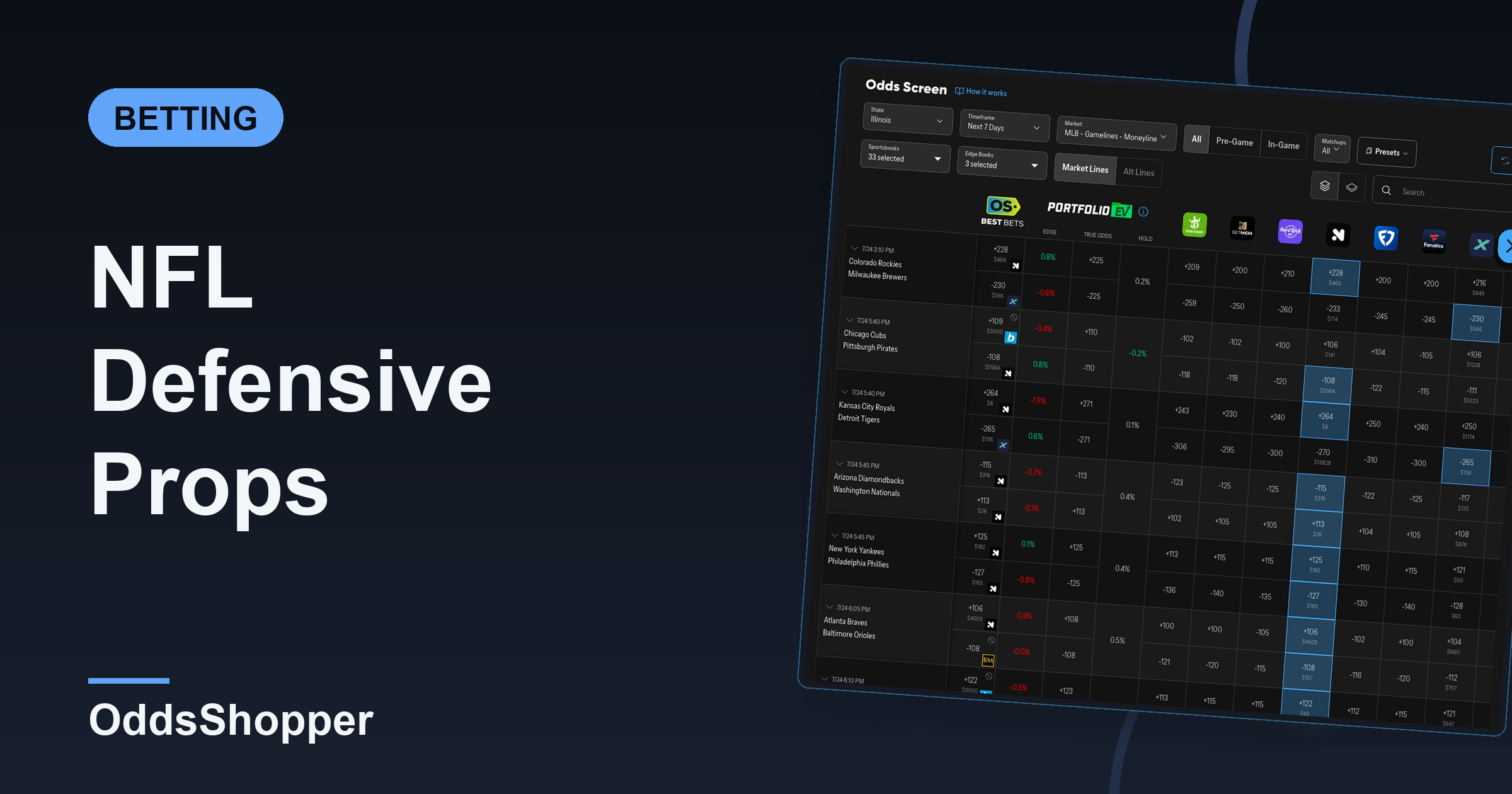
On our Positive EV Sports Betting Strategy show we toured the +EV screen on the site itself, because running this loop by hand is a full-time job: our screen runs the de-vig against the sharp price on every market it covers and ranks the results by expected ROI and win percentage, so the +EV top bets screen is effectively this paragraph, automated across 20+ major sportsbooks. If you want the button-by-button version, the guide to the +EV tool walks the whole screen.
The pros are why almost everyone should start here. You need zero modeling skill, the edge is objective and checkable, and it scales across every sport the books price, from NFL sides to tennis. The cons are structural. Your edge is capped at what the market already knows, so you will never see a number the sharp consensus has not seen; the margins are small, because on a liquid market the gap between a soft price and the de-vigged fair price rarely exceeds a few cents on the dollar; that is the width the books compete inside; every other screen user is hitting the same prices, so lines correct fast; and sportsbooks limit winners, which is why the boring craft of spreading action across books matters as much as finding the bet. If a price gap is big enough to bet both sides, that becomes arbitrage rather than EV betting, a related but different trade with its own tradeoffs.
New to OddsShopper? It scans every major sportsbook, strips the vig, and flags the bets priced in your favor, the exact top-down loop above run continuously.
Try OddsShopper free for 7 days and see exactly which bets it flags as +EV before you pay a cent. Code EVSTRAT20 takes 20% off your first payment of OS Pro or OS Core if you subscribe.
Bottom-Up: Originating Your Own Number
The bottom-up bettor answers the probability question personally. Instead of borrowing the market's opinion, you build one: power ratings you maintain, a read on a coaching staff's tendencies, film or data work on a player prop, or simple speed, seeing a lineup ruling and betting before the line moves. Now the edge calculation flips its inputs. The market's posted price supplies the implied probability, and your work supplies the true one. Take that same +115 side from the walkthrough, a price that assumes a 46.5% win rate. The market's own de-vigged fair number said 47.8%; if your homework says the real chance is 52%, then 0.52 × 2.15 = 1.118, and you are holding what you believe is an 11.8% edge, roughly four times what the top-down screen found on the identical bet. Be honest about the size of that claim, though: a four-point disagreement with a sharp NFL price is enormous, and in a liquid market your defensible gaps will mostly be one or two points, which is why origination pays best in the markets the sharps are not pricing.
That word "believe" is doing heavy lifting, and it is the entire risk profile of origination. A top-down edge is priced at purchase, sitting right there in the gap between your book's number and the sharp fair price. The originator's edge is a hypothesis, and the only honest scoreboard for a hypothesis is closing line value: did the market move toward your number by kickoff? Bet a side at +115 that closes +102 and you gained real ground on the market whether the ticket cashed or not; I will happily take a bet that beat the close and lost over a lucky win at a stale price, every time. Two cautions on that scoreboard. It only means something in liquid markets, because in a thin market a big bettor's followers can move a line without any value existing. And one result proves nothing in either direction; you never get to run the same bet back a thousand times, so overreacting to a single score is how good process gets abandoned.
What origination buys you is everything top-down cannot. Your edges are private, so nobody else is racing you to the number. You have the one structural advantage the books can never take away: they must post a price on everything, while you only fire on the handful of spots you actually know something about. And smaller markets carry bigger inefficiencies, which is exactly where a screen has the least sharp consensus to lean on. The bill for all that is time, real domain expertise in your chosen niche, and months of CLV tracking before you can tell whether you own an edge or a story.
Which Positive EV Strategy Should You Run First?
Put them side by side and the shape of the decision gets obvious.
| Top-Down (screen) | Bottom-Up (originate) | |
|---|---|---|
| Where The True Probability Comes From | The market's sharpest price, de-vigged | Your own model, read, or information speed |
| Typical Edge Size | A few cents on the dollar | Larger when real, zero when not |
| Time To First Bet | Minutes | Weeks to months |
| How You Check The Edge | Priced at purchase (gap vs. fair) | Closing line value, tracked over a sample |
| How It Fails | Small margins, shared edges, book limits | You were simply wrong, at scale |
| Scales Across Sports | Yes, anywhere books post lines | No, edge lives in your niche |
The row that decides it for most people is the failure mode. When top-down goes wrong, you ground out a small edge into a limit. When bottom-up goes wrong, you spend a season confidently betting a number that was never real, and the tuition is your bankroll. So my answer is sequencing, and it is the same answer I give friends who ask where to start: run top-down first, because it puts small, checkable edges in front of you while it teaches you. Six months of taking de-vigged edges off the screen is an education in how prices move, when they move, and which markets stay soft. Then originate in one narrow lane you know cold, grade yourself on CLV, and keep the screen running underneath. And the softest numbers on a screen are rarely main lines: player props and secondary markets stay mispriced longest, which is why props are the standard first lane for both approaches. The two are not rival schools; one is the floor and the other is the ceiling. Either way, none of it survives bad sizing: even a real edge goes to zero if you bet it in units that cannot survive a normal downswing, and downswings outlast everyone's imagination.
Where They Snap Together: Prediction Markets This NFL Season
Here is the payoff I promised, because the coming NFL season is the best live laboratory this framework has ever had. Event-contract exchanges like Kalshi, a CFTC-regulated venue, now run markets on pro football games alongside the sportsbooks. Prices there are set by other traders on an order book rather than by a bookmaker's risk desk. A market without a risk desk has no bookmaker vig baked into a two-way price, though the bid-ask spread and exchange fees still take their cut, and in a thin market that cut can run larger than a sportsbook's hold. No in-house desk sets the opening number either; the anchoring comes from traders arbing the contracts against the sportsbooks, which is strong on main game lines and thin to absent on situational contracts, so the further you get from the main lines, the more often the price drifts from fair value. Drift is exactly what both halves of this strategy hunt.
For the top-down half, only the venue changes. That 47.8% fair probability we normalized out of the sharp book price earlier converts straight into contract terms: fair value about 48 cents. De-vig the sportsbook consensus on the game, convert it into a fair Kalshi price, account for the exchange's fees, and buy only when the contract still beats fair after them. The fees are not rounding error: Kalshi's standard fee is roughly $0.07 × price × (1 − price) per contract, some markets carry different fee rules, and at our 48-cent fair value that works out to about 1.75 cents before rounding. Kalshi rounds fees up, so call it 2 cents, and run that arithmetic before you call anything an edge. The screen edge you were grinding for half a point at the books can show up as a gap of several cents on an exchange, in either direction, because recreational order flow moves contract prices in ways no bookmaker would allow. The same discipline applies on both venues: shop the number, compare it to one fair price, act only on the gap. On the tooling side, this is the lane our Liquidity Tool was built for: it monitors real-money orders on the prediction exchanges, flips each order to the sharp side, shows the dollars behind the signal, and compares that price against the sportsbooks, so you can see where exchange liquidity is deepest before you trade a thin book.
The bottom-up play is where the season gets interesting, because exchanges also list situational and novelty contracts no sportsbook posts, markets with no sharp line to de-vig at all. Season-long numbers like win totals stay on the top-down side, since every major book posts those and the consensus is worth borrowing; the origination lane is the genuinely book-less contract. In a market like that, top-down has nothing to lean on; there is no fair price to borrow. Origination is the only strategy that works, and the originator's usual weekly toolkit, key numbers, timing, and situational spots, carries over intact, priced through the same probability-first discipline as everything above. One caution carries over too. On any one-sided or illiquid market, the venue has little pressure keeping prices honest, so the thinner the book, the more your number has to be right before you touch it.
Here is the whole routine run on three contract types, with numbers picked for the walkthrough rather than quoted from any live board. A game-line contract asking 45 cents against our 48-cent fair value is a 3-cent gap, and the rounded 2-cent fee eats most of it; what survives is a real but thin edge, worth taking only if the order book is deep enough to fill you near that ask. A win-total contract asking 53 cents when the de-vigged book consensus on the same posted total says 52 is no edge at all: after the fee you are paying over fair, and the correct play is the pass. And a situational contract no sportsbook prices is a bottom-up job start to finish: list what actually drives the outcome, turn your read into a probability before you ever look at the ask, and act only when your number clears the ask plus the fee with room to spare. One pass out of three is not a failure; that is the routine working.
More on this: Underdog Playoff Best Ball Strategy: Draft To Survive · PrizePicks MLB Strategy: Price Every Line Before You Play · Same Game Parlay Strategy: Is SGP Worth It? · NFL Betting Strategy: Key Numbers, Timing & Line Shopping · NBA Live Betting: How To Find Value On Live Lines
The Wrap
So, back to the two bettors from the top who talk past each other. The strongest weekly routine this NFL season runs both approaches on purpose, in a fixed order. De-vig the sharp consensus on every game first. Sweep the sportsbooks and the exchanges for any price that beats that one fair number, and pass on thin markets where fees and spread eat the gap. Save the origination work for the single lane where you actually know more than the market and can track your closing-line record over weeks. Grade the screen bets on the gap you captured at purchase, grade your own numbers on the close, and size both so that a normal cold month is an annoyance instead of an ending. If you want to watch price-first reasoning in action before building any of your own numbers, the crew also posts today's free expert picks.
The floor is the place to start, and it is the part you can switch on before Week 1. OddsShopper runs the entire top-down loop from this guide, the de-vig, the fair price, and the ranked edges, across 20+ major sportsbooks, free for 7 days, and code EVSTRAT20 takes 20% off your first payment of OS Pro or OS Core after that.