NBA live betting is the fastest game in the building. The moment tip-off happens, the moneyline, spread, and total stop sitting still and start moving on every basket, foul, and timeout. That speed is exactly why most people lose money in-game: they chase the score instead of the price. The bettors who win at NBA live betting are doing something quieter, and it is the same thing we built OddsShopper's tools to do in real time.
This guide walks through how to bet NBA games live the smart way: what "live betting" actually is, how the odds are set, and how to spot the moments where a live basketball line is off before it corrects. The promise we want to make up front: by the end you will have a six-step in-game routine you can run in the ten seconds a live NBA number actually gives you.
TL;DR: The Live NBA Betting Routine
- Know The True Price First. Every live line has a fair, de-vigged number underneath the book's margin. Value is the gap between the posted price and that number, not the shortest odds on the board.
- Fade The Overreaction. The crowd chases runs. When a 12-2 spurt moves a number, ask whether the price overshot what actually changed on the floor before you assume it did.
- Tail Exchange Liquidity, Not The Crowd. Sharp money that can't get down at retail books often ends up on the exchanges instead, where they can get far more down than a limited retail account allows, up to whatever liquidity is sitting on the other side.
- Shop Every Single Live Number. The same in-game market prices differently at six books at the same instant, and the spread widens when lines move fast.
- Only Take A Boost That Clears Fair. A 25% boost on a bad number is still a bad number.
- Size Down. Live betting means more bets taken faster and vetted less; size for that pace. (Bankroll math here.)
If you want the general version of this process across every sport, we cover it in our live betting strategy guide. This piece is the NBA-specific application.
Watch: The Value Workflow In Action
The clearest way to learn this is to watch it. In the "Coffee Bets" session below, recorded in May 2026, OddsShopper creator Eytan Shander runs the value workflow on that day's board: pricing bets against their true (de-vigged) odds, checking whether a boost actually beats fair, shopping the number across books, and pulling up the Liquidity Tool to see where professional money is landing. The specific bets he builds are long since settled and the examples are pre-game (NBA parlays plus some MLB home-run props). Watch it for the process, not the plays. That price-first discipline is exactly what you bring to fast-moving live lines, and it is the backbone of everything below.
The parlay builder is where he starts, and the Liquidity Tool is what he calls his new go-to. It prices a slip against its fair number, and the session shows the honest version of that: he builds a parlay, checks a 25% boost against the true odds, finds the boost still leaves him short of fair, and only takes the slip once a bigger boost clears it. That loop, build then price then accept or reject, is the whole method.
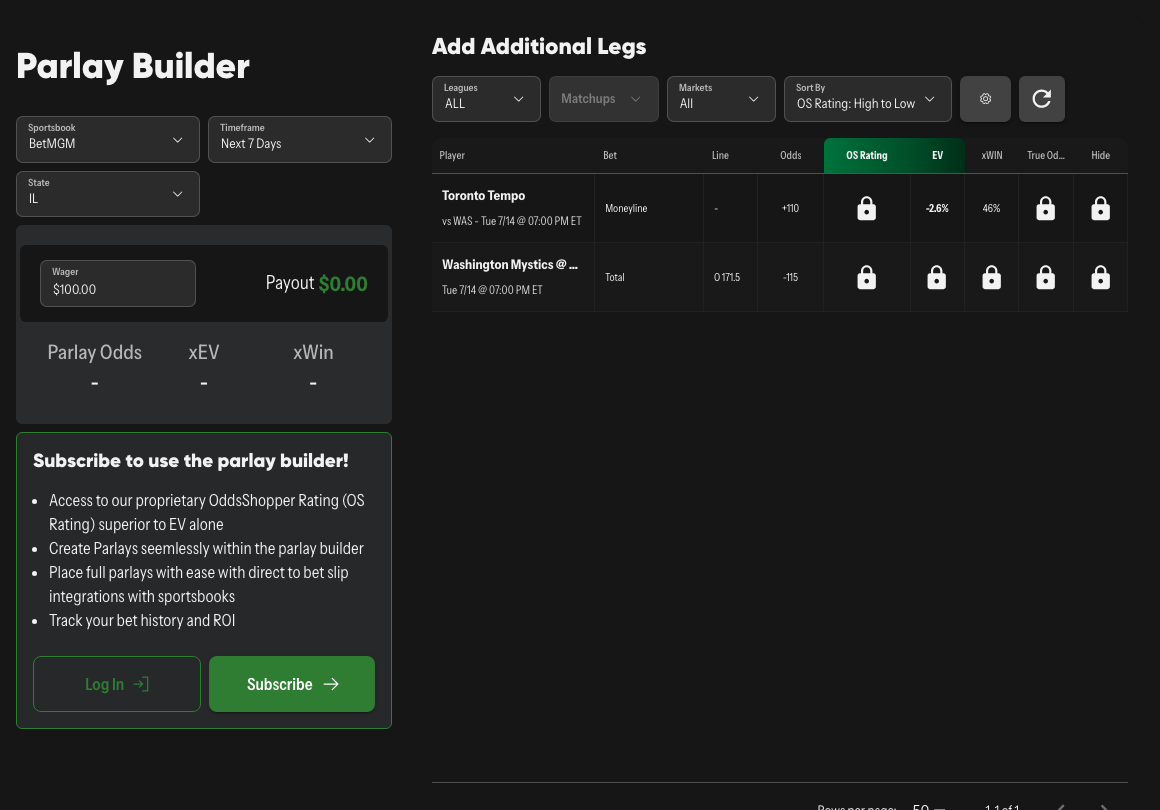
The OddsShopper Parlay Builder.
What Live NBA Betting Actually Is
Live betting (also called in-play or in-game betting) means placing a wager after tip-off, while the game is still being played. Instead of the pre-game number, you get a line that updates every few seconds based on what is happening on the court.
The sportsbooks do this with automated models that ingest the live feed and re-price the market almost instantly. A 10-0 run, a star picking up a third foul, a cold shooting stretch: each one moves the moneyline, the spread, and the total in real time. That constant movement is where the opportunity lives, and also where the traps are.
The reason live betting is beatable at all is the same reason pre-game betting is: the number the book posts is not always the right number. Your entire job is to know what the right number is before the book gets there.
| Pre-game NBA betting | Live (in-game) NBA betting | |
|---|---|---|
| The Line | Fixed until you bet it | Re-priced every few seconds |
| Time To Decide | Hours | Seconds |
| Mispriced Moments | Fewer, slower to appear | More, but they vanish fast |
| What Wins | Best price + research | Best price + speed + discipline |
The takeaway from that table: in both formats the price decides your results, but live betting punishes anyone who is slow or undisciplined about getting it.
The One Skill That Matters: Knowing The True Price
Everything in live NBA betting comes back to one idea, and it is worth slowing down on because it is the whole game.
Every betting line has a true price (also called the fair or de-vigged price), which is what the odds should be once you strip out the sportsbook's built-in margin. Think of it like the retail price on The Price Is Right: the item has a real value, and the contestants are just guessing around it. A betting market works the same way. The books post a price, but there is an actual fair number underneath it.
Whenever a book's live price is better than the true price, that gap is your edge. "Value" means exactly that, and it is the single most misunderstood word in betting.
Value is not the same as the shortest odds.A player at +180 to do something can be a better bet than a heavy favorite at -300 if +180 is generous versus the true price and -300 is not. You are not betting on what is likely to happen. You are betting on what is mispriced.
A Quick Worked Example: Same Bet, Two Prices
Here is why the price you take decides whether you win, using illustrative numbers (not a live line):
| The Bet | Price you take | What it means |
|---|---|---|
| Live Bet On Your Team, Fair Price ~ +100 | You grab +110 at one book | Paid more than fair on that team. That is +EV. |
| Same Team, Another Book | You take -105 | Paying a tax for the exact same bet. That is -EV. |
| A "Boosted" Parlay | Boost lands you below the fair number | The boost made it worse. Skip it. |
Same team, same bet, three very different results, decided entirely by the number you clicked. Over a season, that gap is the difference between a winning bettor and a losing one.
Our odds screen does this math for you. It shows the true (de-vigged) odds, the expected value, and which book has the best available price, so you are not eyeballing whether +110 is generous. You can pull up the live odds screen here and drop into the NBA moneyline board once the season is running, and we break down how to read it in our guide to the OddsShopper in-game EV screen.
Tail The Sharp Money, Don't Fight It
Here is the part the generic live-betting guides skip. A lot of sharp money does not sit at DraftKings or FanDuel at all. Winning bettors often get limited or cut off at retail books, so a good deal of professional money moves through betting exchanges (Novig, Kalshi, Polymarket, ProphetX), where they can get far more down than a limited retail account allows.
When a large bettor hits a total or an alt line on an exchange, it can leave a fingerprint: a pile of liquidity showing up on one side of the book. We built the Liquidity Tool to track that liquidity across the exchanges and surface it for you, so you can see where informed money just landed without spending hours watching order books yourself. (The general version of reading that signal is in our guide to following sharp money.)
The tell to remembera wall of exchange liquidity can point to where serious money entered a market, but read it carefully before you tail it. Liquidity sitting on one side is what a large order on the other side left behind, so work out which side created it rather than betting the side you can see.
Why it matters live: markets can overreact to what just happened on the court. The crowd chases the hot hand and piles onto a team mid-run, which can inflate that side and leave value on the other, and informed money is often sitting on the other side of that overreaction. Following that signal is one of the cleaner ways to approach a live market, because you are reading where the sharper money is going instead of reacting to the score with everyone else.
Shop Every Live Number
The books do not agree with each other, and they disagree more when things are moving fast. The exact same prop can be one price at DraftKings, a different price at Bet365, and a third at BetMGM at the same moment, and that gap only widens when live prices are moving fast. In the session above, Shander points out that the same bet can carry a different price depending on which book you pull it up at.
The habit is simple: never take the first number you see. Check it across DraftKings, FanDuel, BetMGM, Caesars, Bet365, and BetRivers, and take the best one. On a single bet it feels like pennies. Across a full NBA season of live wagers, taking the best available number every time is one of the biggest edges available to a normal bettor, and it requires zero handicapping skill. (We walk through the mechanics in how to use the OddsShopper odds screen.)
An odds-comparison tool matters even more live than pre-game, because you do not have time to open six apps before the line moves. That is the job we handed to software: the tool scans every book we cover in real time and surfaces the best available number on each market, so the comparison happens in the second you have rather than the minute you don't.
New to OddsShopper?It scans the major sportsbooks and top betting exchanges and flags, in real time, which bets are priced in your favor and where the sharp money is going. You can try it free for 7 days, and code SHANDER30 takes 30% off OS Pro or OS Core if you subscribe. See today's edges free
Boosts: Only Take One If It Beats The True Number
Live NBA slates often feature "profit boosts" and same-game-parlay boosts. They look like easy value. They are not automatically good.
A boost is only worth taking if the boosted payout is still better than the true (fair) price of that bet. It is completely possible for a 25% boost to leave you with a number that is worse than fair, while a bigger boost on the same slip clears it. Always compare the boosted price to the fair price before you tap it. And to be clear about what price discipline does and does not buy you: a boost that beats fair can still lose. Getting the better number is an edge over many bets, not a result on any one of them. If the boost does not push you past fair, you are taking a -EV bet with a bow on it.
The boost test, in one linecompare the boosted price to the fair price, not to the original price. A boost that improves a bad number into a slightly-less-bad number is still money going the wrong way.
Call back to the worked example above: the +110 that beat a ~+100 fair price was value, and the -105 on the identical bet was a tax. A boost is the same arithmetic wearing a promotional sticker. The only question is which side of fair the boosted number lands on.
This is the exact math we run for you in the OddsShopper odds screen and the parlay builder: build the live slip, see the true odds on every leg, then check whether the boosted number actually beats them before you tap. It is the same idea covered across our full OddsShopper betting tools, and we go deeper on which promos are worth taking in our odds boosts strategy guide.
Live Betting Fundamentals To Keep You Out Of Trouble
The value workflow above is the edge. These habits keep you from handing that edge back:
- Fade The Run, Don't Chase It. When one team rips off a 12-2 spurt, runs tend to regress and crowd money tends to pile onto the hot side. Check the new number against your fair number before deciding the value moved with it.
- Let Outlier Shooting Come Back To Earth, But Check Who Already Priced It. A team shooting a scorching or ice-cold three-point percentage early drifts back toward its true average, and the book's live model knows that too. The question is whether the number has over-corrected for the streak, not whether the streak will end.
- Pick Your Spot By The Price, Not The Clock. Wait until you can actually read the flow, but let the trigger be the gap between the posted number and the fair number, not a particular point in the game. The in-game EV screen exists to flag that gap the moment it opens, whichever quarter it happens in.
- Size Down Live. Live betting pushes you into more bets at worse-vetted prices, so the risk is the pace of decisions rather than the game getting more random. Many bettors use a smaller unit live than they do before tip-off, and never risk more than a small, fixed percentage of the bankroll on one bet.
- Watch Correlation In Same-Game Parlays. Combining two live legs that are secretly the same bet (two pieces of one blowout) does not multiply your edge, it multiplies your risk. This is the exact job the parlay builder does in the session above: it prices the assembled slip as a whole rather than multiplying the legs, so you see the slip's true odds instead of the number the correlation flatters.
The Bottom Line
Live NBA betting is not about predicting the next bucket. Run the six steps promised at the top and they collapse into one habit: know the fair price, question the overreaction, read where the exchange money actually went, shop the number, reject any boost that does not clear fair, and size the bet to the variance. That is a repeatable process rather than a hot streak. It is exactly what OddsShopper's real-time odds screen, live +EV betting guide, and Liquidity Tool were built to hand you in the seconds you actually have.
If you want to see the price-first discipline applied to a full board before you try it live, our free expert picks today page shows the plays our creators are on and the numbers they took to get there.
Stop leaving the better number on the table.OddsShopper shows you the fair price, the best book, and where the sharp money is landing across the NBA markets it covers. Try it free for 7 days, then 30% off OS Pro or OS Core with code SHANDER30.
Frequently Asked Questions
What is live betting in the NBA? Live betting (or in-play betting) is placing an NBA wager after the game has started, while it is still being played. The moneyline, spread, and total update in real time based on the score and game flow, so the odds you get change second to second.
How is live NBA betting different from pre-game betting? Pre-game odds are fixed until you bet them. Live odds move constantly as the game unfolds, which creates more mispriced moments but also demands faster decisions and tighter discipline about the price you accept.
How do you find value on live NBA lines? Compare the live price to the fair (de-vigged) price. When a book is paying more than the true odds, that gap is your value. Tools like the OddsShopper odds screen calculate the fair number and flag the best available book for you in real time.
Is live NBA betting profitable? No betting approach can promise a profit, and betting carries a real risk of loss. What separates bettors who last is discipline: taking the best available price, following informed money instead of the crowd, and sizing bets so variance cannot wipe them out. The bettors who struggle most tend to chase the score and take whatever number is in front of them, which is the opposite of the process above.
What is the best tool for live NBA betting? An odds-comparison and expected-value tool is the most useful, because live lines move too fast to check every book by hand. OddsShopper's real-time odds screen and Liquidity Tool show the fair price, the best book, and where professional money is landing across the exchanges.
More on this: NBA Championship 2027 Odds: Live Title Prices By Team · NBA Next Team Odds: Every Star's Landing-Spot Market, Scored · Underdog Playoff Best Ball Strategy: Draft To Survive · PrizePicks MLB Strategy: Price Every Line Before You Play · How To Bet NBA Assists Props: A Strategy Guide