Most bettors lose for one boring reason: they take the first number their app shows them. OddsShopper is built to help with that. It is a free tool suite that scans the sportsbooks for you, flags the bets priced in your favor, and shows you the best available price on every play before you click "bet." This guide walks through the main tools on the free site, what each number on a bet card actually means, and how to use them to bet smarter.
Watch The Video
The fastest way to see the tools in action is the walkthrough below. We break down the same workflow in writing underneath it.
What Is OddsShopper, And How Does It Help You Win?
OddsShopper is an odds-comparison and bet-grading platform. Two ideas sit underneath everything it does, and they are the whole reason a sharp bettor wins over time. The first is that the best price matters far more than most bettors think, and the second is +EV, or positive expected value: betting only on outcomes priced higher than their true chance of winning justifies. Finding +EV bets at the best available price is how sharp bettors tilt the math in their favor over time, even though any single bet or stretch can still lose. OddsShopper grades each play against the sharpest sportsbook on the market to estimate that edge for you, instead of leaving you to eyeball it.
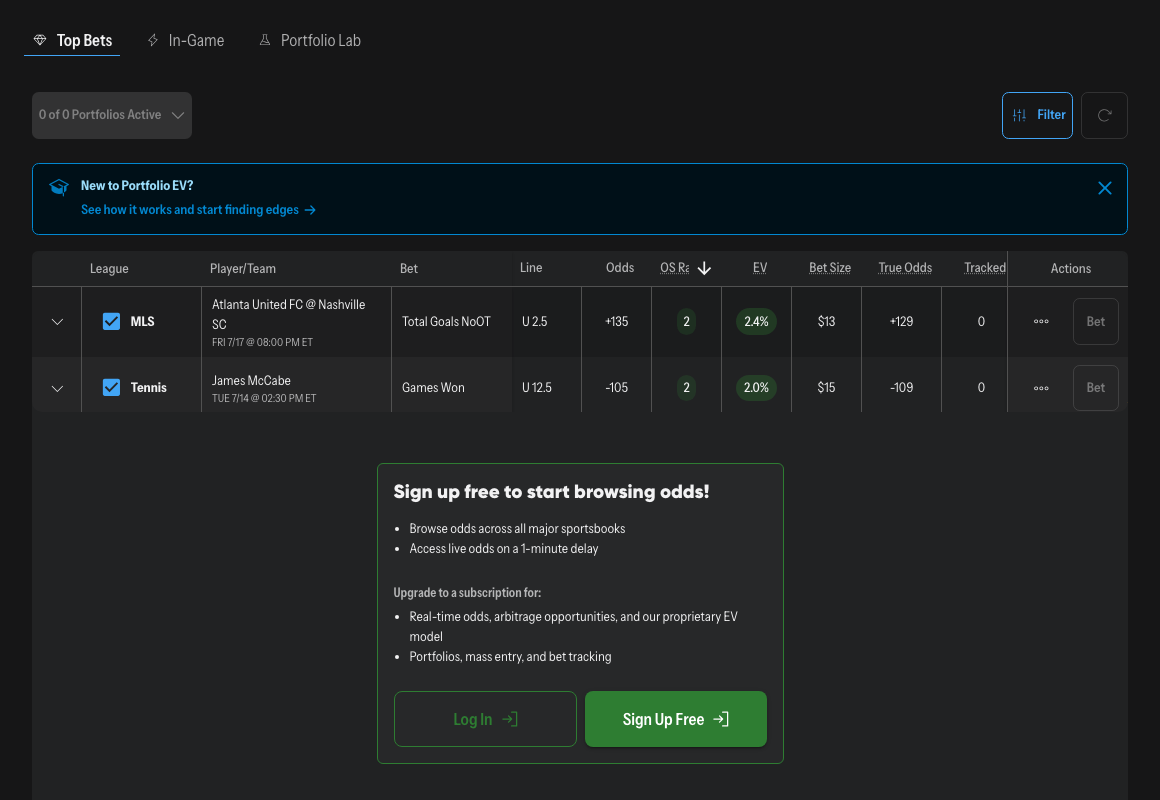
The OddsShopper +EV Screen.
The core ideaevery point of edge you give up at the window is gone for good. Getting the best number and betting only +EV spots is the whole job, and it is the job OddsShopper automates.
A Worked Example: Why +220 Beats +150
Say two books both list the same outcome, but one pays +220 and the other pays +150. The +220 is dramatically better. You risk the same dollar and win far more when it hits, and the math behind it is the difference between winning and losing over time.
- A bet at +220 has an implied break-even of about 31% (it needs to cash a little more than three times in ten just to break even).
- The same bet at +150 needs to win about 40% of the time just to break even.
Taking the worse number on every bet is how a winning handicapper still ends up a losing bettor. OddsShopper scans the books and points you straight at the better number, then grades whether the play is +EV at all. (For the full math, see our guides on implied probability and how to find +EV bets.)
Signing Up Is Free (And Actually Free)
The on-ramp is short. Use an email address or connect with your Google account, and you are in. The tools are not gated behind a hidden upgrade. Everything covered in the next few sections is part of the free site: the odds cards, the projections, the line-movement history, and the Parlay Builder.
Reading A Bet Card: X-ROI, X-Win%, And Hold
Every play in the odds screen lives on its own card, and three numbers do the heavy lifting. Learn these and the platform clicks.
| Metric | What it means | Why it matters |
|---|---|---|
| X-ROI | Expected return on investment, graded against the sharpest book | The single best read on whether a bet is +EV |
| X-Win% | The model's expected win probability for the bet | Tells you how often this should actually cash |
| HOLD | The book's built-in margin (the vig) on that market | The "ATM fee" you pay to bet; lower is better |
Take an example shown in the walkthrough: a Carolina Panthers moneyline at +400 with an expected win percentage around 21%. Those two numbers together tell the story. At +400, the price implies the bet needs to hit about one in five times (20%) to break even, and the model's 21% sits just above that line, which is exactly the kind of gap that grades +EV. You are not guessing whether the price is fair; the card grades it for you.
Hold is the one most bettors ignore. It is the margin the book bakes into a market, and it varies. A main side or total often carries a low hold, while a player prop usually carries a higher one. Seeing the hold up front tells you how much juice you are fighting through on each bet. All three numbers, X-ROI, X-Win%, and hold, are sortable, so you can line the whole board up by the metric you care about and work from the top down. If the vig concept is new, our guide to removing the vig breaks it down.
New to OddsShopper?It scans the sportsbooks, grades every bet for +EV, and shows you the best available price, the exact thing this section just taught you to do by hand. You can try it free for 7 days, and code OSTOOLS20 takes 20% off OS Pro if you subscribe. Start your free trial
Line Movement And The Bets Hiding Next Door
Open a card and you can dig past the headline number. OddsShopper tracks the line, the odds, and the full movement history for each market, with the time of day each shift happened. That history is the point: watching where a number opened and where it moved tells you why a play is live and where the market is leaning. (For the why behind those shifts, see line movement explained.)
Quick tipA number that has moved steadily in one direction since it opened is usually following sharp money. The movement history on each card shows you that story at a glance, so you can decide whether you are betting with the smart side or against it.
Each card also surfaces the related bets sitting next to your play. Open any moneyline card and you will see the correlated markets beside it, the first-half line, the spread, the total, so you can see every angle on a game from one place instead of hunting for them book by book.
Sort By Matchup And By Projection System
The board is flexible. Sort it game by game across the day's card, from the first matchup all the way through Monday Night Football, and the page shows only the bets for the matchup you picked. That makes it easy to build a read on a single game.
You can also choose the engine doing the grading, and the board gives you two:
- Sharp Sportsbook Line — prices everything off the most efficient book on the market.
- Stokastic Projection System — grades plays off our own model and numbers.
Two reads on the same board is where the value is. Where they agree, you have a stronger signal; where they diverge, you have something to dig into.
The Parlay Builder: Tickets Built For You
The Parlay Builder is where OddsShopper does the assembling. Instead of stringing legs together yourself and hoping the combined price is fair, the tool surfaces the top +EV legs and lets you shape them into a ticket. The controls are the useful part: sort by the sharp line or the Stokastic projection, filter by league or sport, and switch sportsbooks to chase the best number. Then you take full control of the legs, adding any you like and removing any you do not, so the ticket ends up built your way.
How you lean the ticket is the real lesson in parlays:
| If You Want... | Build it with... |
|---|---|
| A Higher Chance To Cash | Heavier favorites and fewer legs — a smaller payout for a better hit rate |
| A Bigger Payout | Underdog legs — long odds that hit less often but pay big |
| Player-Prop Upside | The top expected-ROI player-prop legs |
The trade-off never changes: stack heavy favorites and you raise your win probability but shrink the payout; lean on underdogs and you chase a big number that lands far less often. Because you can pull any leg you are not sold on (drop a strikeout prop, swap in a different one) and mix sports freely, the builder is a starting point you sharpen, not a black box. Our parlay strategy guide goes deeper on how to size and pick those legs.
The Arbitrage Tool And Free Content
OddsShopper covers more than traditional sportsbook bets. It also has PrizePicks markets covered, so if pick'em-style player props are your game, OddsShopper has those markets in the mix too. And it includes an arbitrage tool that finds spots where the prices across books let you cover every outcome of a market when the numbers line up. The arbitrage tool is involved enough to deserve its own walkthrough, which we cover in our arbitrage betting guide.
A note on arbitrageit locks in the gap between two prices, but it is not free money. Lines move fast and books are quick to limit bettors who arb often, so treat it as one edge among several rather than a system to lean on.
On top of the tools, the site carries free content, both written and on YouTube, where the team gives long-form explanations of why they are making certain plays. If you want the reasoning and not just the number, that is where it lives. Our sharp betting guide is a good next read.
Premium Insider Access
For bettors who want the layer underneath the tools, there is Premium Insider Access. This is a separate premium subscription, and the pitch is access rather than just a number: one-on-one insight from the OddsShopper personalities, not just a bet from Ben Rasa or a card from Lindquist, but the process behind it. Why a three-leg, six-plus-point teaser makes sense in an NFL game, or the read behind a specific player prop, the kind of explanation a tool alone cannot give you. Joining Insider Access also opens the premium Discord.
The Bottom Line
OddsShopper is, at its core, a price-and-edge engine you get for free. The odds cards tell you whether a bet is +EV and how much juice you are paying, the projection systems give you two independent reads, the Parlay Builder assembles your tickets, and the arbitrage tool flags the pricing gaps across books. The free site alone can keep you from leaving the better number on the table, which is where most bettors quietly bleed money.
Ready to put the tools to work?OddsShopper scans the sportsbooks, flags the +EV bets, and shows you the best price automatically, the whole workflow in this guide, done for you. Try it free for 7 days, then code OSTOOLS20 takes 20% off OS Pro. Start your free trial
Frequently Asked Questions
Is OddsShopper free to use? Yes. You can sign up with an email or your Google account, and the core tools, the odds cards, the projections, the line-movement history, and the Parlay Builder, are free. Premium Insider Access is a separate premium subscription for one-on-one expert insight.
What does X-ROI mean on a bet card? X-ROI is the expected return on investment for that bet, graded against the sharpest sportsbook on the market. A positive X-ROI is OddsShopper's read that the bet is priced in your favor, in other words, that it is +EV.
What is the hold on a market? The hold is the book's built-in margin, the vig, on that market. It is effectively the fee you pay to place the bet. Main sides and totals usually carry a lower hold than player props, and OddsShopper shows it on each card so you can see exactly how much margin you are paying.
Can OddsShopper build a parlay for me? Yes. The Parlay Builder surfaces the top +EV legs and assembles them into a ticket, and you keep full control to add or remove any leg and mix sports and sportsbooks. Lean it toward favorites for a higher win probability or underdogs for a bigger payout.
Will OddsShopper make me a winning bettor? No betting tool can promise that. What OddsShopper does is help you find the best price and the bets priced in your favor, which is how sharp bettors build an edge over the long run.
More on this: How To Use OddsShopper Pro: Your First 10 Minutes · What's New In OddsShopper Portfolios: The Full Rehaul · OddsShopper Winner: 850 Losses, a Five-Figure July · OddsShopper Winner: 31 Green Days, Not One Jackpot · Recent OddsShopper Hall of Fame Winners (August 2026)