Sharp Betting: How to Bet Like a Sharp and Beat the Sportsbook
In Summary
Sharp betting has almost nothing to do with picking winners. A sharp bettor wins by getting a better price than the bet is worth, over and over, across a huge sample, not by knowing who's going to win any single game. The three habits that separate sharp money from recreational money are simple to state and hard to copy: sharps bet early (the bettor placing a wager a day or two before kickoff is almost certainly a pro, not a casual), they beat the books to the news (an injury ruling is an edge for the first 30 seconds before lines move), and they bet the true price, not the team (they only fire when the number is better than fair). When you can't price a market yourself, the sharp move is to tail a proven specialist rather than bet blind. I'll walk through how each of those works with a real, concrete example below, and show you how OddsShopper's Sharp Action tool, Portfolio EV, and line-shopping data do the heavy lifting so you don't have to find the fair line by hand.
What Is a Sharp Bettor?
A "sharp" (or "wiseguy") is a bettor the sportsbook respects, and often fears. Books literally track who's sharp and move their lines based on where that money goes; sharp action is the bet flow they treat as informed. The opposite is the recreational or "square" bettor, who bets the popular team, the prime-time game, and whatever number happens to be on the screen.
Here's the part that trips people up: being sharp is not about being a better handicapper than everyone else. It's about discipline around price. A sharp will happily bet a team they think will probably lose, because the odds are better than the team's real chance of winning. Value is about price vs. true odds, not picking sides. You can bet any side profitably as long as you get a better-than-fair price. If you've read our guide on positive expected value, this is the same idea: a sharp is just someone who only bets +EV and does it relentlessly.
For more on this, see Sports Betting Strategy: How to Bet Smarter.
How Sharps Bet: The Three Habits That Beat the Sportsbook
1. Sharps bet early: square money floods in at kickoff
The single clearest tell of sharp money is when it shows up. Sharps bet a line as soon as they spot value, which is often a day or two before the game. Recreational money piles in during the last few minutes before kickoff.
The people betting games overnight, a day in advance, or two days out are almost certainly sharps. Rec bettors aren't itching to bet the Lakers two days from now. The people buying action three minutes before a game starts are the recreational crowd getting their action down.
Why does early money matter for you? Because early lines are softer. A book posts an opening number, and it hasn't yet absorbed all the sharp opinion that will shape it by game time. In a liquid, efficient market (major NBA and NFL spreads and totals) the closing line is the market's sharpest estimate of fair odds, so if you can consistently beat the closing line (called CLV, closing line value), that's strong evidence you bet a sharp number. The caveat: in a thin or illiquid market a line can move on a single bettor's action and tell you nothing. That's artificial CLV, not proof of edge. So CLV only counts where the market is deep enough that no one bet moves it; short-run wins and losses are noise either way.
2. Beat the books to the news
The second habit is speed on information. When a star gets ruled out, the line on his team should move, but books don't move instantly.
The mechanic is straightforward: one of the easiest ways to beat rec books is to beat them to the news. You get a notification that LeBron is ruled out, you go bet against the Lakers, and while the Lakers lines come down relatively quick on FanDuel 🎁, there's still a 30-second gap or so where you can place those bets before the lines move. That 30-second gap is a real, repeatable edge, but only if you (a) see the news first and (b) already know what the fair line should be once the news lands. This is also why morning lines are dangerous to trust: injury info and prices early in the day are stale, and the value lives in reacting to fresh information faster than the book does.
3. Bet the true price, not the team
This is the habit that ties the first two together. A sharp doesn't ask "who wins?" They ask "what's the fair price, and is the book offering me better than that?" The edge is the gap between the offered price and the true price.
Concretely: build (or get) a fair line for the market, then only bet when a book is offering a number better than fair. The NBA workflow looks like this: figure out a fair spread for every game, then take players in and out to see what the spread would look like if certain players play or sit, then compare that fair number to the market. Most of the time the gap is tiny or nonexistent and the right move is no bet, because many games are priced efficiently enough that both sides are -EV. Your structural edge over the book is exactly that you can sit out: the book has to post a line on everything, while you only have to fire on the handful of spots where the number is clearly better than fair. When a price you have pegged at 50/50 is being offered at the equivalent of +120, that's the bet. When it's worse than fair, you pass, even on a team you love.
A Real Worked Example: Reading Sharp Action on Lakers–Nuggets
Let me make this concrete with a real, recent-style scenario using real players.
Suppose the Los Angeles Lakers host the Denver Nuggets. On game day, with both stars in, the Lakers sit around -3.5 at -110. That's the standing number, fair-valued with Jokić in the lineup.
About 90 minutes before tip, news breaks: Nikola Jokić is ruled out for the Nuggets (right knee soreness). Here's how a sharp plays each habit:
- Bet early, beat the news: The instant the Jokić-out report hits, the fair line on the Lakers should jump. A sharp who already had the Lakers fair-valued around -3.5 with Jokić now knows the Lakers should be more like -7.5 without him. For roughly 30 seconds after the report, before FanDuel and DraftKings drag their number up, the Lakers are still posted at -3.5, and the sharp grabs it: four full points of value the book hasn't priced yet.
- Bet the true price, not the team: Notice the sharp didn't bet because they "like the Lakers." They bet because -3.5 is now a stale price against a true line of -7.5. If the news had been the reverse, with Jokić confirmed in and LeBron James out, the exact same bettor would have fired the other way, on Denver, for the same reason. The team is irrelevant; the gap between -3.5 and fair is the bet.
- Confirm with the close: By tip-off, the line settles around Lakers -7.5. The sharp got -3.5. They beat the close by four points (positive CLV), which is the proof they bet a sharp number, win or lose on the night.
That whole sequence (opening number, news, fair-line recalculation, the race to beat the book) is exactly what separates sharp action from square action. You didn't need to know whether the Lakers would cover. You needed to know the fair line and move faster than the book.
You won't catch that four-point window by hand.The Sharp Action feed and Portfolio EV recalculate the fair line the second news lands and flag the stale price before the book drags it up. Stop leaving the better number on the table: it's free for 7 days, then 20% off OS Pro or OS Core with code SHARPEDGE20.
When You Can't Price the Market: Tail the Sharps
Here's the honest part most "bet like a sharp" articles skip: you will run into markets you cannot fair-price yourself. Maybe it's a niche prop, a sport you don't follow, or a market with no clean projection. The sharp move there is not to guess. It's to defer to a specialist.
Take an exotic market you can't model: if you have no idea what the true odds should be on something like that, the right move is to tail all straight NBA sharps for it rather than guess.
That's the whole philosophy of following sharp action: when you can't originate the fair price, ride the people who can. Knowing humility about which markets you can't beat is itself a sharp trait. Just don't blindly fire every alert. Betting notifications without vetting can mean betting stale lines that haven't moved yet, so confirm the price still beats fair before you click.
The OddsShopper Tools That Do the Sharp Math for You
The reason most bettors never go sharp isn't that the concept is hard. It's that doing the work by hand is impossible. You'd have to fair-price every market, watch news on every team, and compare every book in real time. That's what our tools are built to automate:
- The Sharp Action tool surfaces where the respected money is going and how lines are moving against the public, so you can see sharp action instead of guessing at it from a forum. The tool scans every book we track in real time, which is the only way to catch a line moving the moment news lands.
- Portfolio EV is the engine for "bet the true price, not the team." It de-vigs the market down to a fair line and flags when a book is offering you better than that, turning the abstract idea of +EV into a ranked list of actual bets. It also shows the full, tracked bet history behind the approach (not cherry-picked screenshots) so you can audit it yourself rather than take a results claim on faith.
- Line shopping / odds comparison across books is non-negotiable for a sharp, because the same bet can pay +120 at one book and +140 at another, and over a big sample, always taking the best number is a meaningful chunk of your ROI. The live odds screen puts every book's price on a market side by side, so the best number is already surfaced before you fire.
The free tools show you the concept. OS Pro unlocks the full real-time Sharp Action feed, the complete Portfolio EV slate, and the faster line data you need to beat the close instead of chasing it.
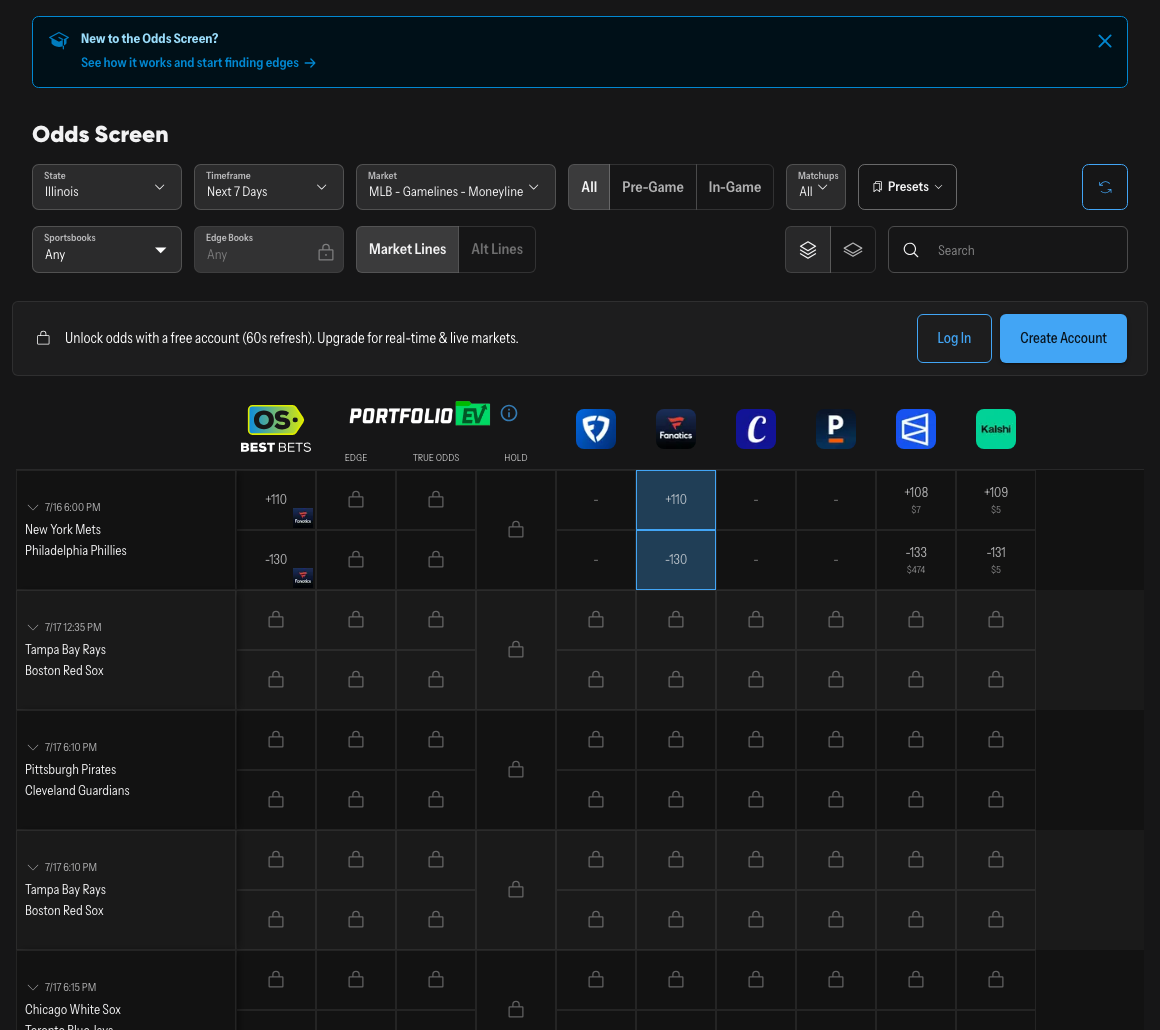 The OddsShopper live odds screen — every book's price on one board, refreshed in real time. Open the live board.
A Few Honest Realities of Betting Like a Sharp
- Sharp betting is never a sure thing. Betting +EV and beating the close is a long-game, large-sample approach. It's designed to win over time, not to make any single bet a winner. Variance is real, especially in high-variance sports like MLB, the most difficult sport to consistently do well at.
- Books fight back. Sportsbooks limit accounts they identify as sharp. Many pros spread action across multiple books and mix bet types to keep a lower profile. (Live betting, for instance, is currently harder for books to flag. See our live betting strategy guide.)
- Speed is the constraint. Lines move quickly, and by the time you act on an alert, the price may already be gone. Tooling that's fast is the difference between beating the close and missing it.
- Size to the edge, not the feeling. A sharp risks more on a fat edge and less on a thin or high-variance one, using fractional-Kelly sizing off a fixed bankroll, never a flat stake on every play and never your biggest bet on your favorite team. Enter your bankroll and the tools recommend a stake; even a real edge goes to zero without this, because downswings last longer than people expect.
- Bet responsibly. This is for bettors 21+ in regulated U.S. markets where betting is legal. Never bet more than you can afford, and don't chase losses. Sharp betting is a discipline, not a way to get even.
Frequently Asked Questions
What is a sharp bettor? A sharp bettor is a professional or highly-skilled bettor whom sportsbooks treat as informed. Sharps win by consistently betting prices that are better than fair (positive expected value) over a large sample, not by picking more winners. Books track "sharp action" and move their lines based on where it goes.
How do I bet like a sharp? Three habits: bet early (before the market sharpens the line), beat the books to the news (act in the seconds after an injury ruling before lines adjust), and only bet when the price is better than the true/fair odds, never just because you like a team. When you can't price a market yourself, tail proven sharps instead of guessing.
What is sharp money / sharp action? Sharp money is the bet flow from informed bettors that sportsbooks respect. When a line moves against the public betting percentage (most of the money on one side but the line moving the other way), that reverse move is usually sharp action. OddsShopper's Sharp Action tool helps you see it in real time.
Can you really beat the sportsbook long term? You can get an edge by consistently betting +EV and beating the closing line, which is the truest measure of a sharp bet. It's a long-game approach with real variance, and books may limit accounts they flag as sharp, so it takes discipline, multiple books, and good data. It is not a way to win every bet.
Is sharp betting legal? Betting line value and shopping for the best price is simply smart betting and is legal wherever sports betting is legal and regulated. Sportsbooks are private businesses, though, and can limit or restrict accounts they identify as sharp.
Want to actually bet like a sharp instead of just reading about it? Doing the fair-line math, watching the news, and shopping every book by hand is impossible, and that's the whole reason squares stay square. OS Pro gives you the full real-time Sharp Action feed, the complete Portfolio EV slate, and the line data you need to beat the close, the same edges sharp bettors live on. Upgrade to OS Pro with code SHARPEDGE20 for 20% off your first payment and start betting the true price, not the team.
More on this: Closing Line Value (CLV) Explained: Beat the Close · Odds Boosts Strategy: Which Ones Are Actually +EV · Bankroll Management Sports Betting: Unit & Kelly Sizing · Free Bet Conversion: How to Turn a Free Bet Into Cash · How to Find +EV Bets: A Practical Workflow