Closing Line Value Explained: How to Beat the Closing Line
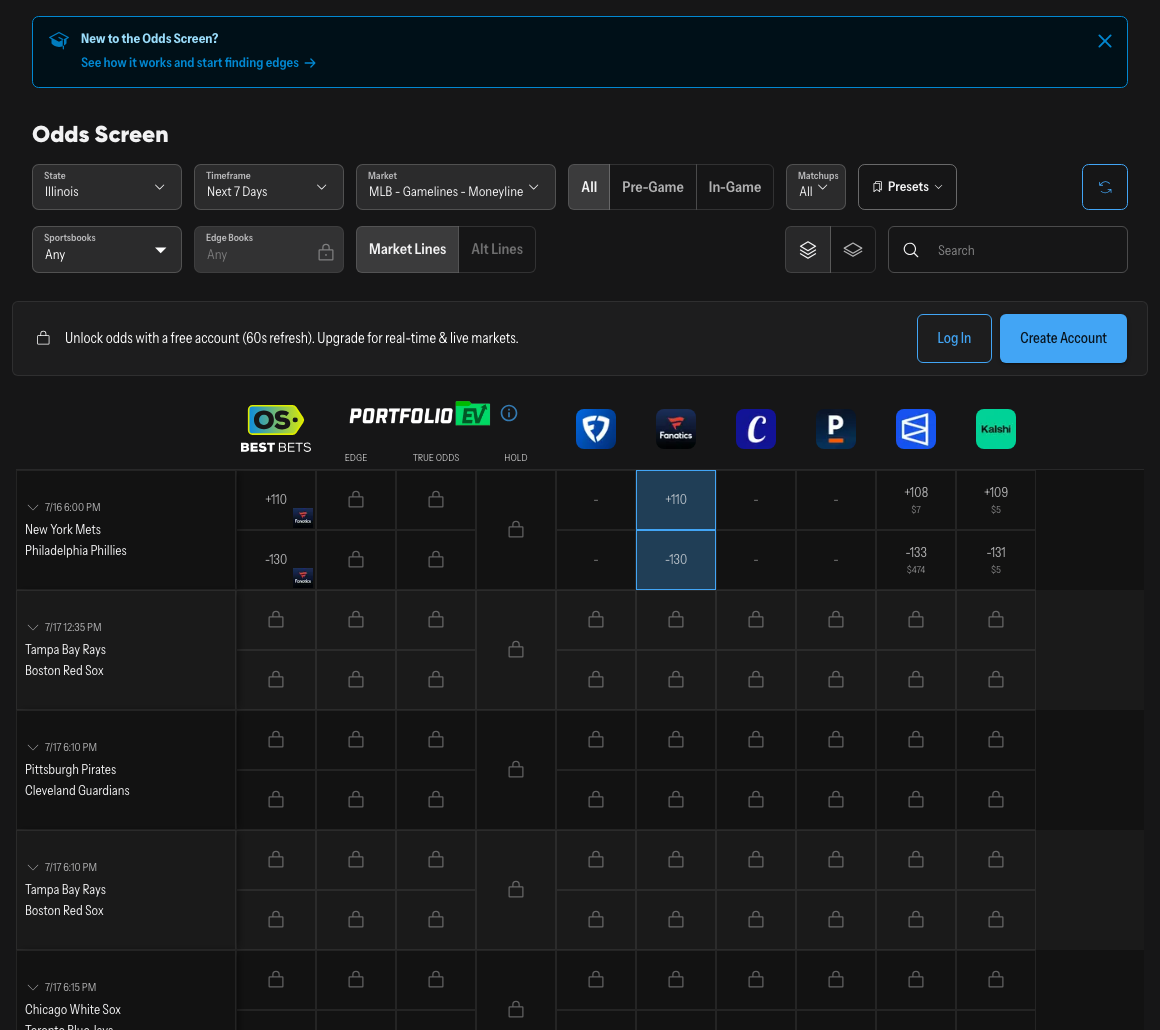 The OddsShopper live odds screen — every book's price on one board, refreshed in real time. Open the live board.
In Summary
Closing line value (CLV) is the single best long-run proof that you're a winning bettor, better than your win-loss record and better than last month's profit. The idea is simple: the closing line (the final price right before a game starts) is the market's sharpest, most-informed estimate of the true odds. If you consistently get a better price than that closing number, meaning you beat the closing line, then over a large sample you're betting at prices better than fair, and profit tends to follow. That's positive CLV. Get worse prices than the close and you have negative CLV, and you're likely bleeding over time no matter how last night went.
Here's what most CLV articles get wrong, and what this guide fixes: (1) you should measure CLV against the no-vig closing price, not the raw closing odds, because vig contaminates the comparison; (2) betting earlier captures more CLV but adds variance (injuries, weather, scratches), so it's a tradeoff, not a free lunch; and (3) artificial CLV is not real CLV, because a line moving because an influencer told their followers to bet a thin market proves nothing. CLV only validates a bet in an efficient, liquid market. I'll walk through the real math with real numbers, and show how OddsShopper's Sharp Sportsbook Algorithm and Odds Calculator let you watch line movement and compute the no-vig close instead of eyeballing it.
For more on this, see Line Movement Explained: Steam & Reverse Line Moves.
What Is Closing Line Value?
Closing line value is the difference between the price you got on a bet and the price that same bet closed at, the final number on the board right before kickoff or tip-off.
- Positive CLV: you got a better number than the close. You bet an underdog at +150 and it closed at +120 (or you bet -3 and it closed at -4.5). The market moved toward your side after you were already on it.
- Negative CLV: you got a worse number than the close. You bet -120 and it closed at +100. The market moved away from you.
Why does the closing price get all this attention? Because by game time the market has absorbed nearly everything knowable: every injury report, every weather update, every dollar of sharp money. The closing line is the crowd's final, sharpest guess at the true probability. Beating a price that good, repeatedly, is hard to do by luck. Value is about price versus true odds, not picking sides, and the closing line is the market's best available read on those true odds.
If you've read our positive expected value explainer, CLV is the measurement side of that same coin. +EV is the goal (bet prices better than fair); CLV is how you check, after the fact, whether you actually did it.
Why CLV Is the Best Proxy for "Are You a Winning Bettor?"
Your nightly results are mostly noise. You can make five smart bets and lose all five; you can make five terrible bets and hit a parlay. A single result, even a hundred of them, tells you less than you think, because you never get to replay the same bet thousands of times to see its true probability.
That's exactly why CLV is the better scoreboard. The variance problem is simple: you don't get the luxury of running the same bet back thousands of times to see its true probability, which is why overreacting to any one result is dangerous. CLV sidesteps that problem. Instead of asking "did this bet win?" (luck), it asks "did I get a better price than the sharpest version of the market?" (skill). Skill is repeatable; luck isn't.
Put concretely: if you beat the closing line on 60% of your bets over a few hundred wagers, that pattern is extremely unlikely to be an accident. You're getting good prices, and profit is the expected long-run consequence. If you're below the close, no hot streak changes the diagnosis: your process is buying bad numbers. This is why sharps weight CLV so heavily: in liquid, efficient markets the no-vig close is an honest grade of your process, while any single night's P&L is mostly noise around it. CLV isn't the whole picture. It tells you little in thin or live markets (covered below) and it doesn't replace bankroll discipline or smart market selection, which still decide whether that edge survives. But where the close is trustworthy, it's the cleanest signal that your prices are good.
How to Measure CLV the Right Way: Beat the No-Vig Closing Line
Here's the step most guides skip, and it's the one that separates a real CLV read from a misleading one. You don't compare your odds to the raw closing odds. You compare your odds to the no-vig (de-vigged) closing price.
Why? Because the posted closing line still has the sportsbook's vig baked into it. A two-way market's two sides should add up to 100% implied probability; books pad them past 100%, and that extra is the hold. If you grade your CLV against the padded number, the vig flatters or distorts your result. Strip the vig out first, and you're comparing your price to the market's true estimate.
The mechanic, step by step:
- Record your price when you bet (e.g., you took the Yankees at -130).
- At close, grab both sides of the market (e.g., Yankees -150 / opponent +135).
- Convert both closing sides to implied probability, add them up (they'll exceed 100%, and that excess is the vig).
- De-vig: divide each side's implied probability by that total to normalize back to 100%. That gives you the no-vig closing probability, the market's true estimate.
- Convert the no-vig probability back to American odds to get the fair closing price.
- Compare your price to that fair closing price. Better than fair = positive CLV.
One more thing that trips people up: which book's close do you grade against? Not, as a rule, the soft book you placed the bet at. Grade against the sharpest market's no-vig close (a Pinnacle or Circa, or a multi-book consensus). If you bet a soft book and then grade yourself against that same soft book's close, the comparison is half-circular, because soft books move late and sloppily. The honest benchmark is the sharp market's final number, because that's the price that actually reflects informed money. (It's also why you can't really "beat the close" by betting at the sharpest book itself: there's nothing softer to have beaten.)
Doing that math by hand for every bet is tedious, which is why I run closing prices through OddsShopper's Odds Calculator to convert and de-vig in seconds, and lean on the Sharp Sportsbook Algorithm to watch how a line moved between my bet and the close. The worked example below shows the full calculation so you can see exactly what the tool is doing for you.
A Real Worked Example: Grading CLV on Dodgers–Padres
Let me make this concrete with real teams and real math. Say it's a regular-season MLB game, Los Angeles Dodgers at San Diego Padres, and on Friday morning you bet the Dodgers moneyline at -130.
By first pitch, the market has moved. The closing line is Dodgers -150 / Padres +135. Did you actually get value? You can't just say "I got -130, it closed -150, so I beat it by 20 cents" — that ignores the vig. Let's do it properly.
Step 1: convert the closing odds to implied probability
- Dodgers -150 → 150 / (150 + 100) = 60.0%
- Padres +135 → 100 / (135 + 100) = 42.6%
- Total = 60.0% + 42.6% = 102.6% (the 2.6% over 100% is the vig)
Step 2: de-vig (normalize to 100%)
- Dodgers no-vig probability = 60.0 / 102.6 = 58.5%
- That 58.5% is the market's true closing estimate for the Dodgers.
Step 3: convert the no-vig probability back to a fair price
- 58.5% in American odds ≈ -141. That's the fair closing price.
Step 4: grade your bet
- You got -130. The fair closing number is -141. You bet the Dodgers at a better price than the market's true closing estimate, clear positive CLV of roughly 11 cents of true value.
Notice the difference: against the raw close of -150 it looked like you beat it by 20 cents, but against the no-vig fair close of -141 your real edge is about 11 cents. The no-vig version is the honest one. Win or lose that night, you bought a Dodgers number better than fair, and a few hundred bets like that is what a winning portfolio looks like. It's the same logic behind our how to find +EV bets workflow: get a better price than the true number, repeatedly.
Skip the by-hand de-vig math.OddsShopper's Odds Calculator strips the vig and returns the true no-vig closing price in seconds, while the Sharp Sportsbook Algorithm shows you exactly how the line moved. Stop leaving the better number on the table: it's free for 7 days, then 20% off OS Pro or OS Core with code CLV20.
Why Sharps Bet Early, and the Timing Tradeoff Most Guides Ignore
The most reliable way to beat the closing line is to bet before the market sharpens, which is usually early. The opening number hasn't yet absorbed all the sharp opinion that shapes it by game time, so early lines are softer and more beatable.
This is also the clearest tell of who's sharp. The people betting games overnight, a day in advance, or two days out are almost certainly sharps; rec bettors aren't itching to bet the Lakers two days from now. The people buying action three minutes before a game starts are the recreational crowd getting their action down. Sharps fire early because that's where the value is; the public floods in at the buzzer and pushes the line to its closing (sharpest) number. Beat that number and you were on the right side of the move.
But here's the nuance every "just bet early" article skips: earlier isn't strictly better. Betting earlier captures more CLV opportunity, but it also exposes you to more variance, meaning more time for things to go wrong before the game. The tradeoff is direct: the earlier you bet something, the more opportunity for CLV, but the more variance you take on too. Fluke injuries, changes in weather, and unforeseen circumstances all have more time to occur. Bet a baseball total three days out and you might get a great number, or your starting pitcher gets scratched, rain rolls in, and the bet you "beat the close" on never made sense to begin with.
So the practical read: bet early to capture CLV, but size for the added uncertainty and accept that some early bets will be overtaken by news. The flip side is that reacting to news faster than the book is its own edge. When an injury drops, the fair price moves instantly but the posted line lags for a few seconds. For more on reading where sharp money sits and timing your entries, see our sharp betting guide.
Artificial CLV vs. Real CLV: The Trap That Fools Most Bettors
This is the part almost no CLV article tells you, and it's the most important caveat in the whole concept: a line moving in your favor is not automatically proof you found value. CLV only validates a bet when the market is efficient and liquid.
The trap is what I'll call artificial CLV. Picture a big-following tout posting a bet in a thin, niche, low-liquidity market: an obscure prop, a minor-league side, something with little money behind it. Their followers pile in, and the line moves. Did the tout "beat the close"? Technically the number moved their way. But that movement wasn't the market discovering true value; it was just the influencer's own followers shoving the line around. When a massive influencer gives out a bet in a niche or illiquid market, the line moves purely on that person's influence. It doesn't mean value was gained. It's just the lines being artificially moved by their followers, which is much different from real CLV in an efficient or liquid market.
Two practical rules fall out of this:
- Trust CLV most in deep, liquid markets, like major-league sides and totals at high-limit books, where the closing line reflects real sharp money, not a crowd reaction. In those markets, beating the close means you beat informed money.
- Be suspicious of CLV in thin or one-sided markets. This connects to a related danger about markets you can't take both sides of: the books don't need to worry about how they price these, since you cannot short them by choosing the other side. Some of the most -EV markets are one-sided. If the market is illiquid or one-sided, the closing line isn't a trustworthy fair-value benchmark, so "positive CLV" there can be a mirage.
In short, real CLV is beating the close in a market efficient enough for the close to mean something. Anything else is just noise dressed up as an edge.
The OddsShopper Tools That Do the CLV Work for You
You can de-vig one closing line by hand in a minute. What you cannot do by hand is do it for every bet, watch every line move in real time, and tell real movement from a thin-market head-fake. That's what the tools automate:
- The Sharp Sportsbook Algorithm tracks line movement and surfaces where sharp money is going across the books we monitor, in real time. That's what lets you see how a line moved between your bet and the close, and, just as important, whether the move came from real sharp action in a liquid market or a thin-market blip you should ignore.
- The Odds Calculator does the conversion and de-vig math from the worked example above. Turn closing odds into implied probability, strip the vig, and read the true no-vig closing price in seconds, so your CLV grade is the honest one.
- Portfolio EV is the engine that puts it together: it de-vigs markets to a sharp multi-book consensus and flags when a book is offering you better than that true price, i.e., bets likely to earn positive CLV. The results are back-tested and published transparently, wins and losses included, rather than cherry-picked. Being transparent with our results is exactly what separates the approach.
The free tools let you check a price and de-vig a line by hand. OS Pro unlocks the full real-time Sharp Sportsbook Algorithm feed and the complete Portfolio EV slate, the line data you need to beat the close instead of chasing it.
A Few Honest Realities About CLV
- CLV is a long-run signal, not a per-bet promise. You can beat the close and still lose the bet; that's variance, not a broken process. Judge CLV over a large sample (100+ bets), not on last night.
- Track it, or you're guessing. Log your price and the no-vig close for every bet, then review the percentage of bets where you had positive CLV and your average CLV margin. Without the record, "I beat the close" is just a feeling.
- Liquidity is the fine print. CLV is meaningful in efficient, liquid markets and unreliable in thin or one-sided ones (see the artificial-CLV section above).
- Books limit winners. Bettors who consistently beat the close get flagged and limited. Spreading action across books and mixing bet types keeps a lower profile.
- CLV is a measurement discipline, not a way to get even. It grades whether your bets beat the market's closing number over a large sample; it won't win back a cold streak.
Frequently Asked Questions
What is closing line value (CLV) in sports betting? Closing line value is the difference between the odds you bet and the final (closing) odds right before the game starts. If you got a better price than the close, you have positive CLV; a worse price is negative CLV. Because the closing line is the market's sharpest estimate of true odds, consistently beating it is strong evidence your betting process has a real edge.
Go deeper: Sports Betting Strategy: How to Bet Smarter.
How do I measure or calculate CLV correctly? Compare your price to the no-vig closing price, not the raw closing odds. Convert both closing sides to implied probability, add them (they'll total more than 100%, and that excess is the vig), divide each by the total to de-vig, then convert the no-vig probability back to odds. If your price beats that fair number, you have positive CLV. OddsShopper's Odds Calculator does the de-vig math for you.
Why is CLV considered the best proxy for a winning bettor? Because individual results are mostly luck: you can bet well and lose, or bet badly and win. CLV measures whether you beat the sharpest version of the market (skill), which is repeatable, instead of whether a single bet won (luck). Over a few hundred bets, consistent positive CLV is very hard to achieve by accident and tends to lead to long-run profit.
Does positive CLV mean I'll definitely win money? No. CLV is a long-run signal, not a promise on any single bet, and you'll still hit losing stretches from variance. And it's only meaningful in efficient, liquid markets. In thin or influencer-driven markets, a line moving your way can be "artificial CLV" that proves nothing.
What's the difference between real CLV and artificial CLV? Real CLV is beating the closing line in a liquid market where the close reflects genuine sharp money. Artificial CLV is when a line moves only because a big influencer's followers piled into a thin, illiquid market; the movement isn't the market discovering value, just a crowd pushing the price. Only real CLV in an efficient market validates a bet.
Is it better to bet early or late for CLV? Betting early generally captures more CLV because opening lines are softer, but it adds variance, with more time for injuries, weather, or scratches to occur before the game. It's a tradeoff: bet early to capture value, but size for the added uncertainty. Reacting to breaking news faster than the book is a separate, reliable edge.
Want to actually beat the closing line instead of just measuring it after the fact? Watching line movement, de-vigging closing prices, and telling real sharp moves from thin-market noise by hand is impossible to do at scale, and that's the whole reason most bettors never know their true CLV. OS Pro unlocks the full real-time Sharp Sportsbook Algorithm feed and the complete Portfolio EV slate, plus the Odds Calculator to compute the no-vig close, giving you the line data you need to beat the market's sharpest number. Upgrade to OS Pro with code CLV20 for 20% off your first payment and start grading your bets the way sharps do.
More on this: Sharp Betting: How to Bet Like a Sharp · Arbitrage Betting Explained: A Real Worked Example · Parlay Betting Explained: The +EV Fix For Yours · Odds Boosts Strategy: Which Ones Are Actually +EV · Bankroll Management Sports Betting: Unit & Kelly Sizing