Last updated: August 4, 2026
In Summary
Almost every list of common arbitrage betting mistakes is really a list of math mistakes, and the arithmetic on the gap itself is the part that was settled before you clicked anything. What actually costs people money is the 60 seconds between the two tickets: a stake the book won't accept, a price that moves while you're logging into the second app, a second leg that never lands and quietly leaves you holding a single bet you never chose. An arb is not won when you find it. It's won when both confirmations are on your screen.
That reframe changes what you should be optimizing. Not "which arb is biggest," but "which of these two tickets is more likely to disappear, and am I placing that one first?" There's a one-number test that answers it, and it's the whole of Mistake 2 below. If you're still working out what an arb is in the first place, start with arbitrage betting explained and come back here. This piece assumes you can already read a price gap and picks up where most guides stop.
Watch The Video
Ben Rasa walks through the same idea on the OddsShopper channel, including the two-book example we build on below. It's an older recording, so a couple of the sportsbooks on screen have since changed names and the tool's tiering has moved on since it was filmed. The mechanics are unchanged, and the current product details are as described below.
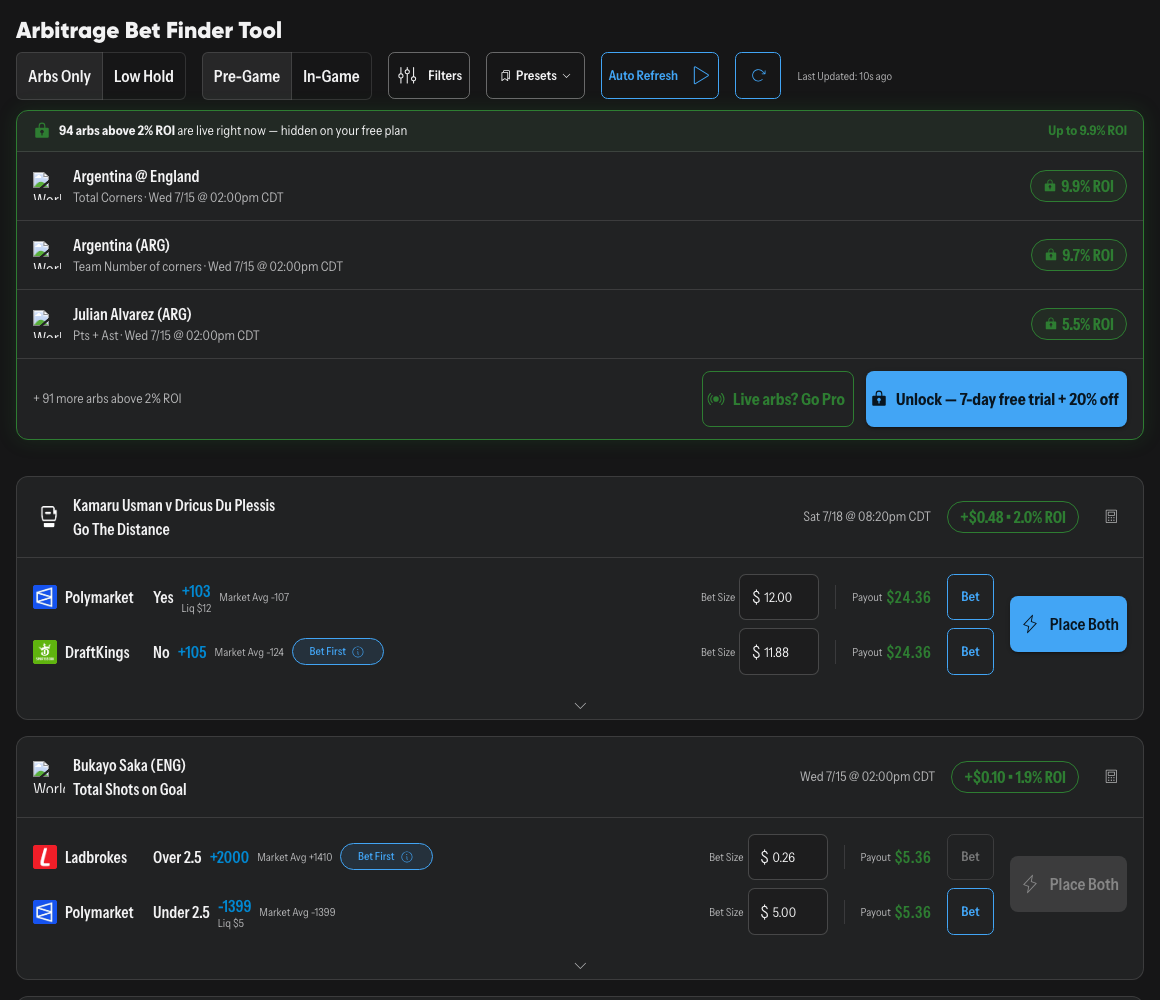
The OddsShopper Arbitrage Tool.
Mistake 1: Treating The Find As The Win
Finding the gap used to be the whole job: accounts at DraftKings, FanDuel, BetMGM and a long list of others, a spreadsheet, and hours spent hunting for a line that sat wildly out of step with the rest. That scavenger hunt is what an arbitrage finder exists to delete. The tool scans live odds from 20+ sportsbooks and surfaces the gaps as they open, so the search cost drops to roughly zero.
Which creates a trap, because a green row now feels like a finished job. Be precise about what it actually asserts:
| What The Row Tells You | What people hear |
|---|---|
| These Two Prices Existed At The Moment Of The Scan | These two prices exist |
| At These Two Specific Books, Which You May Or May Not Have Funded | At books I can bet |
| At An Unknown Stake Ceiling The Screen Cannot See | At whatever size I want |
| Assuming Both Books Grade The Market Identically | It's the same bet on both sides |
The stake-ceiling row is the one that surprises people, and it's the one no arbitrage screen anywhere can fix. A book's maximum accepted wager on an outlier price is not published, is not in any odds feed, and is frequently a small fraction of what you were planning to put down. You discover it at the betslip, which is to say after you've already committed to the sequence.
So the useful way to read the rest of this article: every mistake below lives in the window between that green row and two confirmations. None of them are math.
Mistake 2: Placing The Wrong Leg First
This is the one that separates people who bank arbs from people who collect screenshots of them.
Take a straightforward NBA example. The Knicks and the Lakers are playing. One sportsbook has the Knicks at +110 to win the game. A different sportsbook has the Lakers, the underdog on their number, also at +110. Bet $100 on each side and you already know the shape of the result: one ticket loses your $100, the other returns $110 in profit, and you're up $10 on $200 at risk. That's about 5%, and once both tickets are confirmed at those prices and settle normally, the math works out the same whichever team wins. Normally is doing real work in that sentence, and it's the whole of Mistake 6 below. (Numbers here are illustrative, chosen because they're clean. Real arbs are usually much thinner.)
The reason that gap exists at all is worth one sentence, because it tells you how fragile it is. Each +110 carries an implied probability of 47.6%, so the two sides together price at 95.2% instead of the 104%-plus a single book would normally hold. The market's vig has gone negative across the two books, and the moment either book repositions, it goes back to positive.
Which brings up the part almost nobody teaches. Those two +110s are not equally durable. Say the Knicks number exists at exactly one book, while five different books are all showing the Lakers at +110. The two prices are worth the same to your calculator and are not remotely the same to your clock.
| Side Of The Arb | Books offering the price | How fragile it is | When to place it |
|---|---|---|---|
| The Outlier (Knicks +110) | 1 | Highest. One repricing and the arb is gone. | First |
| Lightly Held Price | 2 to 3 | Moderate. A couple of moves can kill it. | First, unless the other side is thinner |
| Consensus Price (Lakers +110) | 5+ | Lowest. Every book would have to move. | Last |
One rule, no exceptions: fewer books goes down first. The top row is where it bites hardest. You get exactly one shot at the Knicks side. If that book pulls the number or moves it while you're placing the other ticket, there is no second source, and you're done. The Lakers side is the opposite: five books would all have to move before that price stops existing, which buys you time you can actually spend. Get the fragile leg down first and a race becomes a sequence.
The instinct most people have is to place the bigger stake first, or the side they're more confident about. Both are wrong here, because confidence isn't the variable. Availability is. Count the books behind each price and bet the scarce one.
New to OddsShopper?It reads live odds from 20+ sportsbooks and flags the price gaps as they open, so you're not the one running the spreadsheet. You can try it free for 7 days, and code ARBFILL20 takes 20% off OS Pro or OS Core if you subscribe.
Mistake 3: Sizing For Your Bankroll Instead Of The Book's Limit
The first reaction almost everyone has to a quoted 5% arb is the same: fine, I'll bet a million dollars on each side. It's a reasonable thought and it does not survive contact with a sportsbook.
Two things stop it:
- The Obvious One: you'd need that money sitting in every account you use, which is its own problem.
- The One That Actually Bites: the books will not take the bet. Limits on an outlier price are frequently small, and they get smaller the more the book suspects why you're there.
Your real constraint is whatever each side will accept, not whatever you can afford.
Here's the part worth internalizing: the limit is itself information. A book that happily takes $2,000 on its mainline and cuts you to a couple of hundred on the outlier number has already worked out that the number is wrong. It hasn't repriced yet, but it has stopped defending the price with size. That's why the outlier is simultaneously the leg you want most and the leg you can get least of, and why you find out at the betslip rather than on the screen.
Two consequences follow:
- Your realistic arb size is set by the smaller of the two ceilings, always.
- The ceiling on the scarce side is the one that's small, so the scarce side is what caps the whole position.
The sizing argument lands on the ordering rule independently of the timing argument. It's also worth choosing your accounts with this in mind: books vary enormously in how they treat winning arb-shaped action, and best sportsbooks for arbitrage betting covers which ones are worth funding for it.
Getting a feel for what each book accepts only comes from reps, and it's worth keeping notes. It carries a second-order cost too: consistently maxing out outlier prices is one of the clearest signals you can send about what you're doing. We cover that trade-off in full in will sportsbooks ban you for arbitrage betting.
Worked Example: What A $120 Limit Does To That 5% Arb
Run the Knicks and Lakers numbers through a live limit and the ordering rule stops being theory.
You planned $500 a side. You go to place the fragile leg first, and the outlier book caps you at $120 on the Knicks. Your arb is now a $120 arb, and that's fine:
The row worth sitting with is the last one. A $12 profit sounds like nothing next to the $50 you drew up, and it is still the same 5% rate on a smaller base, banked in about 90 seconds. Arbing aims for exactly that trade: smaller edges that can add up when execution is clean.
That asymmetry is worth one more line, because it's the ordering rule proved from the other end. The Knicks side has one ceiling. The Lakers side has five, and you can split the second leg across all of them, so its effective ceiling is roughly the sum. The scarce leg is therefore always the binding constraint on your size, which means placing it first isn't just about beating the clock. It's about finding out what the position actually is before you've committed a dollar to the other half.
Now flip the order and watch it break. Place your full $500 on the Lakers first, then discover the Knicks book will only take $120. You've got $120 of arb and $380 of a straight NBA bet you never intended to make. Same two prices, same two books, opposite outcome, decided entirely by which app you opened first.
That's why the sizing question and the ordering question are one question. The fragile leg tells you what your arb is worth. Place it first, read what the book let you get down, and size the second leg to match.
Mistake 4: Having No Plan For The Half-Filled Arb
Sooner or later you place the first leg and the second one isn't there. The price moved, the market suspended, the book cut your stake to a fraction of what you asked for. You are now stuck on one side of an arb, holding a position you never chose.
This is the moment the discipline either exists or it doesn't, because the tempting move is to do nothing and hope. Sometimes hoping works. It is still not a strategy, and it's how a low-variance approach quietly turns into ordinary gambling with extra steps.
Three responses are defensible, in roughly this order:
- Recalculate at the new price. The gap may have narrowed rather than closed. A 5% arb that's now 1.2% is still an arb. Run the real numbers rather than the ones you started with. An arbitrage calculator resizes the second leg in seconds.
- Take the partial hedge. If the market has moved against you, a leg at a worse price can still cap your downside. That's hedging, which runs on the same equal-payout math with one stake frozen.
- Accept the straight bet, consciously. Sometimes the honest answer is that you now hold a bet on the Knicks and should size the rest of your night accordingly. If you followed the ordering rule, this is the least bad version of being stuck: the leg you're stranded on is the outlier, which by definition is the best price available anywhere on that side. Deciding to keep it on purpose is very different from drifting into it.
Notice how much easier all three become when you took Mistake 2 seriously. Place the one-book price first and your unfilled leg is the one with five books behind it, which means you're shopping five sources for a replacement instead of praying at a single one. The ordering rule buys you a fallback as well as a fill.
Mistake 5: Chasing Every Number On The Screen
This one is a volume problem. A good arbitrage finder will show you more rows than you can act on, especially once you're looking past game lines. Player props are full of these, and they're where the margins get very thin: two books can hold slightly different opinions on the same player's number, and the resulting edge is a fraction of a percent rather than the tidy 5% above.
Those still count. Small edges compound, and a steady drip of them is a real way to build a bankroll. But they demand more discipline, not less, because a 0.4% arb has no room for error. On $240 across both sides that's a 96-cent return, and a single tick of slippage on the second leg wipes it out and puts you slightly negative for the same amount of work.
The rule of thumb worth writing downthe thinner the arb, the more the ordering rule matters. A 5% arb can survive a bad fill and still be profitable. A 0.4% arb cannot survive anything, so it only belongs in your night if the fragile side is going down first.
The filter that matters is whether you can realistically fill both sides right now, not how big the edge looks: do you have funded accounts at both books, is the fragile side liquid enough to take a meaningful stake, and are you actually at your desk. An arb you can't execute is a distraction wearing an opportunity's clothes. Take the ones you can complete and let the rest go. And if you keep finding yourself passing on thin two-sided edges, it may be a sign the one-sided version of the same idea fits you better — arbitrage vs +EV betting walks through that trade-off.
Mistake 6: Assuming Both Books Grade It The Same Way
Everything above happens inside the sixty-second window. It detonates hours later instead, which is why most people meet this mistake exactly once and never forget it.
Two prices that look opposite are only opposite if both books settle them identically. They frequently don't:
- Regulation Versus Full Game. Soccer markets are usually priced to 90 minutes, hockey books split regulation-time and including-overtime lines, and the two are not the same bet. Two tiles both labelled "Total" can be pricing different amounts of hockey.
- Two-Way Versus Three-Way. A soccer market priced 3-way, with the draw as its own outcome, does not offset a 2-way price on the same fixture. You'd be leaving the draw uncovered and calling it an arb.
- Prop Void Rules. Books differ on what happens if a pitcher doesn't start or a player is scratched: one refunds, another may settle. On player props that difference decides whether you had two sides or one.
- Same Word, Different Market. A game total and the two team totals added together are not the same thing, whatever the tiles say.
- Voids And Palpable Errors. A price wild enough to create a 5% arb is exactly the kind a book may later void as an obvious error. If one leg gets voided and the other stands, you're holding a naked bet you never chose, and you find out after the game has started or finished.
There's no clever technique for this one. Read both betslips before you confirm, and check that the market name, the period, and the OT and push rules actually match. Where a book publishes its house rules, that's the source of truth, not the label on the tile.
Notice this is the same lesson as Mistake 2 arriving from a different direction. There, the scarce price was the fragile thing. Here, it's the assumption that two tiles saying "Total Points, Over/Under 218.5" describe the same bet. Both cost you the same way: you thought you had two sides and you had one.
The Two-Minute Pre-Flight
Before the first click, run this. It's short on purpose, because the entire premise of this article is that you don't have long.
- Count The Books On Each Side. Fewest books is the fragile leg. That one goes first. This is the single highest-leverage habit in arbing.
- Open Both Betslips Before You Submit Anything. Type the stake into the scarce book's slip, load the consensus side in another tab, then submit the scarce leg and immediately match whatever amount it accepted. Logging in mid-arb is how the gap closes without you.
- Read Both Market Names, Not Just The Numbers. Same period, same OT treatment, same 2-way or 3-way structure. This is the ten seconds that prevents Mistake 6.
- Assume The Fragile Book's Limit Is Lower Than You Want. Decide in advance the stake you'll ask for and the smaller one you'll accept without recalculating.
- Know Your Fallback. If leg two vanishes, which of the three responses above are you taking? Decide before, not during.
- Confirm Both Tickets At The Prices You Expected. Books sometimes accept at a worse number than displayed. If the fill isn't what you priced, recalculate immediately rather than assuming the position still works.
Run through it once and it takes two minutes. Run it 50 times and it takes ten seconds, which is the point.
Frequently Asked Questions
Which side of an arb should you bet first? The side offered by the fewest sportsbooks. In the Knicks and Lakers example above, one book had the Knicks at +110 and five had the Lakers there. One repricing kills the Knicks side and there is no second source; the Lakers side needs all five books to move before it disappears. Place the scarce price first, then take the consensus price at whichever of the five is still showing it.
How much does it really matter which leg goes first? It's the difference between a $12 profit and $380 of unintended exposure, which is exactly what the worked example above shows. Same two prices, same two books, same limit. The only variable was which app got opened first.
Why do sportsbooks reject or cut my arbitrage stake? Not because you're doing anything unlawful — arbitrage betting is legal in the US; books just don't have to like it. Outlier prices usually carry small limits, and books manage exposure on numbers they believe are off. Repeatedly maxing out those prices also flags the account. Plan around the limit rather than around your bankroll, and size the second leg to whatever the first one actually accepted.
How much can actually go wrong with an arb? More than the word "locked" suggests, which is why we avoid it. It becomes a low-risk position only once both tickets are confirmed at the prices you planned and both books grade the market the same way. Before that, prices move, stakes get cut and markets suspend. After that, a leg can still be voided or graded under different OT or push rules. Most of the real arbitrage betting risks sit in one of those two windows, and most of what people call bad luck in arbing is one of them.
Are small arbs on player props worth taking? They can be, and small edges add up, but do the arithmetic before you commit a night to them. Even a 0.8% arb, twice as fat as the ones you'll mostly see on props, pays about $8 on a $1,000 turnover across both books. That's real if you're placing them consistently and it's nothing if you take one bad fill, which is why thin arbs are the ones that most reward getting the scarce leg down first.
The Bottom Line
Arbitrage rewards people who treat it as an execution problem rather than a discovery problem. A tool can surface the gap for you now. What still belongs to you is the order you place in, the stake the book will actually take, and what you do in the ten seconds after a leg goes missing. That's where the money in this either stays or leaks out, and it's why counting the books behind each price is worth more to you than finding a slightly bigger number on the screen.
None of it requires you to be fast if you're sequenced correctly. Place the price nobody else has first, and you've bought yourself the time to do everything else calmly. That was the whole difference in the worked example: the same two prices and the same $120 limit produced either a clean $12 arb or $380 of exposure you never wanted, decided by nothing but the order of the clicks. Count the books, bet the scarce side first, and the rest of the checklist follows.
If you want the gaps found for you while you focus on getting both tickets down, our Arbitrage tool reads live odds from 20+ sportsbooks in real time. Pre-game arbitrage comes with OddsShopper Core; live, in-game arbitrage, where the prices move fastest and the fragile-leg rule matters most, is on OS Pro. New users get 7 days free before anything is charged, and code ARBFILL20 takes 20% off OS Pro or OS Core after the trial.
Not ready to run your own numbers yet? Our free expert picks today are a lower-effort place to start, and how much money you can make arbitrage betting sets realistic expectations before you commit a bankroll to it.
More on this: Best Sportsbooks For Arbitrage Betting: What To Look For · Is Arbitrage Betting Legal? US Rules Explained · Prediction Market Arbitrage: How It Works (2026) · Best Arbitrage Betting Tools 2026: Ranked & Compared · Arbitrage Vs EV Betting: Which Fits Your Bankroll?