I get asked "what's the single best sportsbook for arbitrage betting?" almost every week, and my honest answer disappoints people: there isn't one. Arbing isn't a book you pick, it's a board you scan. The books that matter most to me are simply the ones whose prices disagree with everyone else's at the right moment, and that book is different on a Tuesday night than it was on Sunday afternoon.
So the real question isn't "which book," it's "what makes a book useful to an arber, and how many of them do I need in my rotation?" That's what this guide answers: the four traits I actually screen for, the categories of books worth an account, and why breadth beats loyalty every time. If you're still fuzzy on the mechanics, start with arbitrage betting explained and come back; from here I'm assuming you already know how a two-sided arb works.
TL;DR: How To Pick The Best Sportsbooks For Arbitrage Betting
- There Is No Single Best Book. An arb only exists when two books disagree, and you can't predict which one will be off on a given night, so "which sportsbooks for arbitrage" is the wrong question — how many is the right one.
- Screen Every Book On Four Traits: line diversity (does it hold its own opinion?), limits tolerance (how long the account survives), settlement speed (how fast your bankroll recycles), and promo generosity (free rolls that stack on top of an arb).
- Keep A Bench Across Four Categories: mainstream books, regional/secondary books, DFS-style pick'em apps, and betting exchanges. Arbs form across categories, so the best arbitrage betting sites are the ones you watch together.
- Breadth Is The Edge. Possible arbs grow far faster than the books you add, which is why the best books for arbing are all of them, scanned at once — the exact job OddsShopper's Arbitrage Finder does across every major sportsbook in real time.
Why "Breadth" Is The Real Answer To "Best Book For Arbing"
Arbs come from one thing: two books disagreeing on the same market at the same moment (the full mechanics live in arbitrage betting explained). That disagreement is fleeting and random about where it shows up. Sometimes it's a soft regional book slow to move a soccer total. Sometimes it's a mainstream book that hung a stale player prop while the market corrected everywhere else. It's not automatic, either: you still have to get both legs down before either price moves, and books limit consistent winners, which is exactly why the setup matters more than any one book.
Here's the part most "best books" lists get wrong: you can't predict which book will be the off one. So the value of any single book to you isn't how sharp or soft it is on its own, it's how much it widens your net. Two books give you the disagreements between two prices. Ten books give you the disagreements across dozens of price pairs. The number of possible arbs scales far faster than the number of books you add, which is exactly why the pros run wide accounts instead of one "perfect" one.
That's the whole thesis of OddsShopper's Arbitrage Finder: it watches every major sportsbook across every sport at once and surfaces the price disagreements the instant they appear, so you're not the person refreshing four tabs hoping to catch a line before it moves. Breadth is the edge, and no human tab-hopping replicates it.
Stop leaving arbs on the table because you were watching the wrong four books. OddsShopper's Arbitrage Finder scans every major sportsbook in real time and flags every qualifying price disagreement the second it appears. Start with OS Pro free for 7 days, and code ARB20 takes 20% off your first payment when you subscribe.
see the live arbs free for 7 days
The Four Traits That Make A Sportsbook Arb-Friendly
When I decide whether a book earns an account, I run it through four screens. Each one measures the same thing: how much the book helps me arb, regardless of how strong it looks as a general sportsbook.
1. Line Diversity (Its Own Opinion Vs. The Field)
Any given book only earns its spot if it disagrees with the others often enough to create gaps. Books that simply copy the market consensus tick-for-tick give you almost no arbs, because their price is everyone else's price. The valuable books are the ones with their own opinion: regional operators, newer entrants building market share, and books that are slower to move on secondary markets like alternate totals, first-half lines, and player props.
It's the same skill as line shopping, just automated and two-sided. Line shopping finds the single best price on one side; arbing finds two prices on opposite sides that, once both legs are locked, add up to a return regardless of who wins. A book that frequently shows up as the outlier on line-shopping scans is more likely to create arbs whenever another book offers a playable price on the opposite side.
2. Limits Tolerance (How Long An Account Lasts)
Every arber runs into the same wall eventually: plenty of books don't want to be the off-price side of a locked bet, and they'll limit or restrict accounts they flag as winning or arbing. It's common enough that you should plan around it, and I cover it in depth in arbitrage limits and getting banned.
For book selection, the practical read is a spectrum, and it runs opposite to what a lot of people assume. Recreational and heavily promo-driven books are often the quickest to profile and throttle arbers and bonus abuse, because their whole model is casual volume and they don't want informed money. The sharpest books and the betting exchanges tend to tolerate far more action, since their prices are already tight and they're comfortable taking on smart bettors; the trade-off is that same efficiency means they throw off fewer soft outlier prices to arb against in the first place. Either way, assume limits are part of the game. A book's tolerance sets its shelf life in your rotation, not whether you use it, which is another argument for breadth: keep a deep bench so that when one account gets throttled, you haven't lost your ability to complete arbs.
3. Settlement Speed (Getting Your Bankroll Back In Rotation)
Arbing is a bankroll-velocity game. Your capital is split across two books on every play, and it's tied up until both legs settle and you can withdraw or redeploy. One that grades quickly and pays out fast lets the same bankroll work more arbs per week, while a book that sits on winnings for days is quietly capping your volume even if its prices are great.
I weight this heavily on high-frequency markets. If I'm going to be placing dozens of bets a week at a book, slow settlement and clunky withdrawals compound into a real drag on how much the account can actually earn me.
4. Promo Generosity (Free Rolls That Stack On Top Of The Arb)
The softest, most promo-heavy books serve a second purpose beyond their raw prices: their bonuses, boosts, and profit-boost tokens can turn a break-even or thin arb into a clearly positive one. A boosted price on one leg widens the gap in your favor. Here arbing and positive EV betting blur together, because a promo-inflated line is often the most +EV number on the board.
The catch is that promo-heavy books are also the ones watching bonus abuse most closely, so I treat promos as a bonus layer, not the foundation of a rotation. When they're there, they stack beautifully on top of an arb; I just don't build my account roster around them.
The Categories Of Books Worth Knowing (And What Each Is Good For)
Rather than rank individual operators (a list that goes stale the week a book changes its risk model), it's more useful to think in categories. Every book you'd consider falls into one of these, and each plays a different role in an arbing rotation.
| Book Category | Examples | Role in arbing | Watch-out |
|---|---|---|---|
| Mainstream Books | DraftKings 🎁, FanDuel, BetMGM, Caesars | Deep markets and liquidity; the core side of most arbs | Often quickest to limit consistent winners |
| Regional / Secondary Books | Smaller state-licensed operators | Frequent outlier prices, especially on secondary markets | Thinner limits; can be slow to settle |
| DFS-style Pick'em Apps | PrizePicks, Underdog and similar | Fixed-payout props that sometimes misprice vs. the sportsbook market | Not true two-way books; correlate carefully |
| Betting Exchanges | Prophet Exchange and peer-to-peer platforms | You take the other side of a user's price; often no line-copying at all | Liquidity varies; a commission applies to net winnings |
The takeaway isn't about favoring exchanges or DFS apps. Arbs form across these categories, so the roster you want spans all of them. A price on a mainstream sportsbook against a mispriced pick'em line, or a sharp book against a peer-to-peer exchange, is exactly the kind of cross-category disagreement a scanner catches and a human staring at one app never will.
What An Arb Across Books Looks Like: A Worked Example
Here's an illustrative two-book example so the criteria above land concretely (real books, round numbers to show the mechanic, not a live line):
Say a tennis match is priced with one player at +115 on DraftKings and the other player at +105 on a slower regional book that hasn't moved off its opening number. Both sides landing at plus money is what makes this example obvious, but that's just this case; the signal that matters is whenever the two implied probabilities add up to under 100%, whether or not either side is a favorite. Converting to implied probability here: +115 is about 46.5% and +105 is about 48.8%, which sums to roughly 95.3%, under 100%. That gap under 100 is your margin.
Stake it proportionally across the two books and, once both legs are placed and settle normally at these two prices, the stake split returns more than you laid out no matter which side wins (assuming both legs stand — a voided, cancelled, or max-bet-capped leg breaks the hedge and leaves you exposed on one side); that ~4.7% gap below 100% works out to a positive return of just under 5% on the total you staked in this illustration. The exact return depends on the stake split and the prices, but the shape is the point: the arb only exists because two different books held two different opinions at the same moment. Widen your set of books and these shapes appear far more often. That's also the honest reason breadth matters more than any one operator: I didn't need DraftKings or the regional book to be "the best," I needed both on my screen at the same instant.
How I Actually Find These Without Living In Ten Tabs
Manually, arbing is a tab-management nightmare: you'd need accounts at every category above, all open, all refreshing, and the reflexes to place both legs before either price moves. The prices that create arbs are the prices that are about to get corrected, so speed is everything.
That's the exact job OddsShopper's Arbitrage Finder does for you. It runs the Sharp Sportsbook Algorithm to establish a no-vig fair price for each market, and then the tool scans every major sportsbook in real time and flags the moment two of them disagree enough to create an arbitrage opportunity, with the stake split already calculated. You're not hunting the disagreement, you're just deciding whether to fire it. You can also eyeball the raw price spread yourself on the live odds screen for any sport to see how far apart books really sit on the same market.
Because the tool is watching the whole market instead of your four open tabs, it catches disagreements you'd never see manually and hands you the completed stake math, so the only thing left is the decision to fire. The free tier lets you see live arbs to get a feel for it; the full real-time feed and the deeper markets sit behind OS Pro.
Which sportsbook is best for arbing? All of them, scanned at once. OddsShopper's Arbitrage Finder watches every major sportsbook and does the fair-price math for you, so you catch the disagreement instead of chasing it. Try OS Pro free for 7 days, then code ARB20 takes 20% off your first payment.
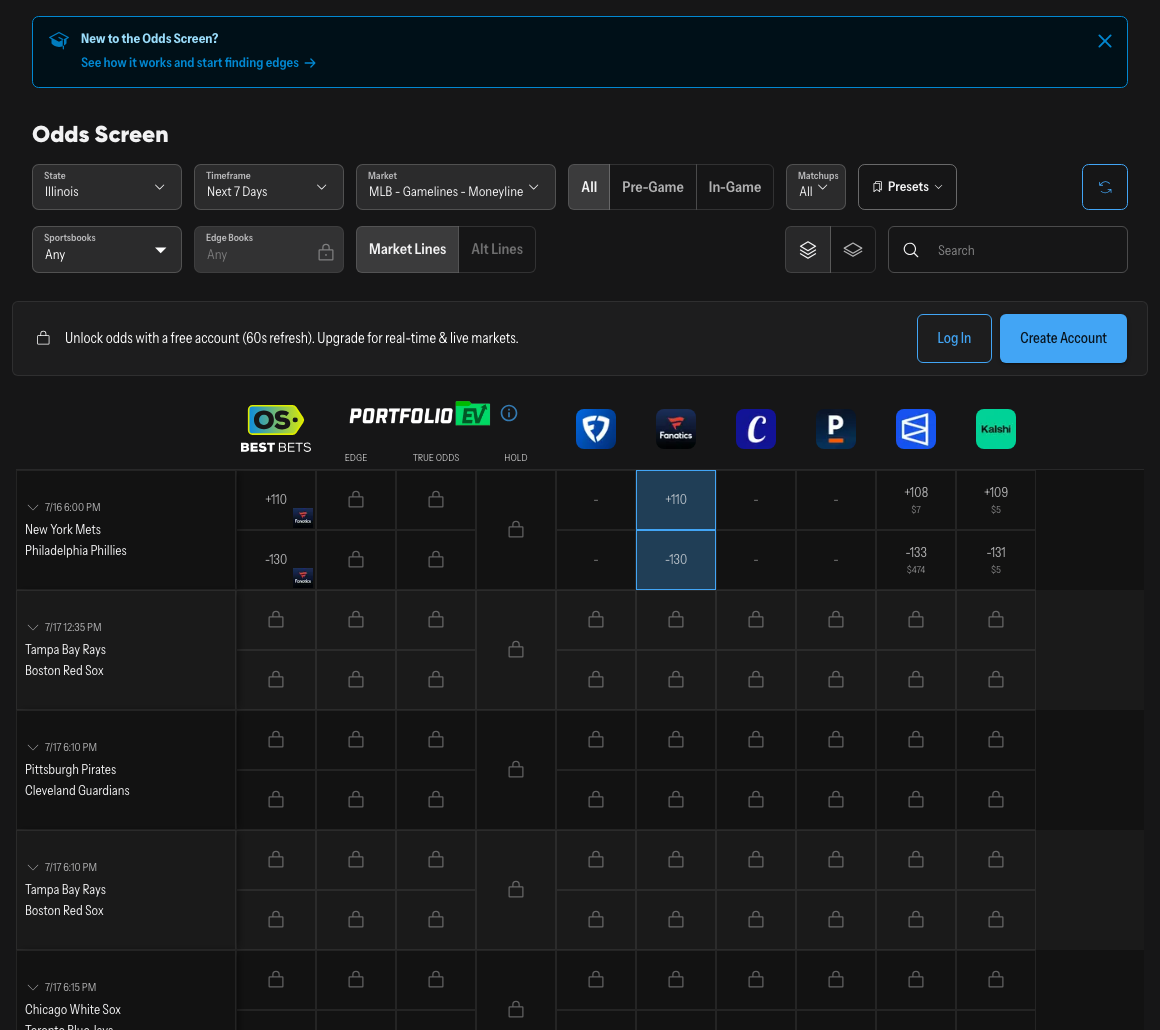 The OddsShopper live odds screen — every book's price on one board, refreshed in real time. Open the live board.
Frequently Asked Questions
What is the best sportsbook for arbitrage betting? There isn't a single best one, and any list that names one is missing how arbing works. An arb exists only when two books disagree on a price, and you can't predict which book will be the off one on a given night. The best setup is the widest one: as many quality accounts as you can maintain, scanned together so you catch disagreements wherever they surface.
How many sportsbooks do I need to arbitrage bet? More is better, and the reason is arithmetic: the number of price pairings that can disagree grows much faster than the number of books you add. Four books give you six possible pairings; eight books give you 28. A handful across different categories (a couple of mainstream books, a regional or two, an exchange) is a workable start; serious arbers run many more. A scanner like OddsShopper's covers every major sportsbook at once so your reach isn't capped by how many tabs you can watch.
Are DFS pick'em apps good for arbitrage betting? They can be, but carefully. Apps like PrizePicks and Underdog offer fixed-payout props that occasionally misprice against the sportsbook market, which creates cross-platform opportunities. They aren't true two-way sportsbooks, though, so treat them as one more source of disagreement rather than a standalone arbing solution.
Will sportsbooks ban me for arbitrage betting? Some will limit or restrict you over time, and recreational, promo-heavy books tend to move fastest on accounts they flag as winning or arbing. It's the main reason to keep a deep bench of accounts rather than relying on one or two. See our full breakdown of arbitrage limits and getting banned for what flags accounts and how to extend their shelf life.
More on this: MLB Division Odds On Kalshi Vs Sportsbooks: 3 Tightest Races · US Open Tennis Odds 2026: Kalshi vs the Book on One Knee · Prediction Markets vs Sportsbooks: Kalshi Odds Gaps Today · Arbitrage Betting Mistakes: Why Your Arb Doesn't Fill · Do Different Sportsbooks Have Different Odds On The Same Game?
The Bottom Line
Stop shopping for the "best" arbitrage sportsbook and start building the widest board you can watch. Screen books on line diversity, limits tolerance, settlement speed, and promo generosity, keep a bench across mainstream, regional, DFS-style, and exchange categories, and let a real-time scanner do the fair-price math across all of them at once. The edge was never one perfect book; it's catching the moment two ordinary books disagree, and having every one of them on your screen when they do.