Is Arbitrage Betting Legal? The Honest Answer For US Bettors
Last updated: July 21, 2026
The first question almost everyone asks me before they place a single arb is some version of "wait, am I allowed to do this?" It's a fair worry. You're betting both sides of the same game to try to lock in a profit, and that feels like it must be against some rule. So let me answer it straight, from someone who's been doing this for years: arbitrage betting is legal anywhere sports betting is legal. You're placing ordinary bets at licensed, regulated sportsbooks. There's a real catch, but it isn't the police. It's the books themselves. Let me walk you through exactly where you stand.
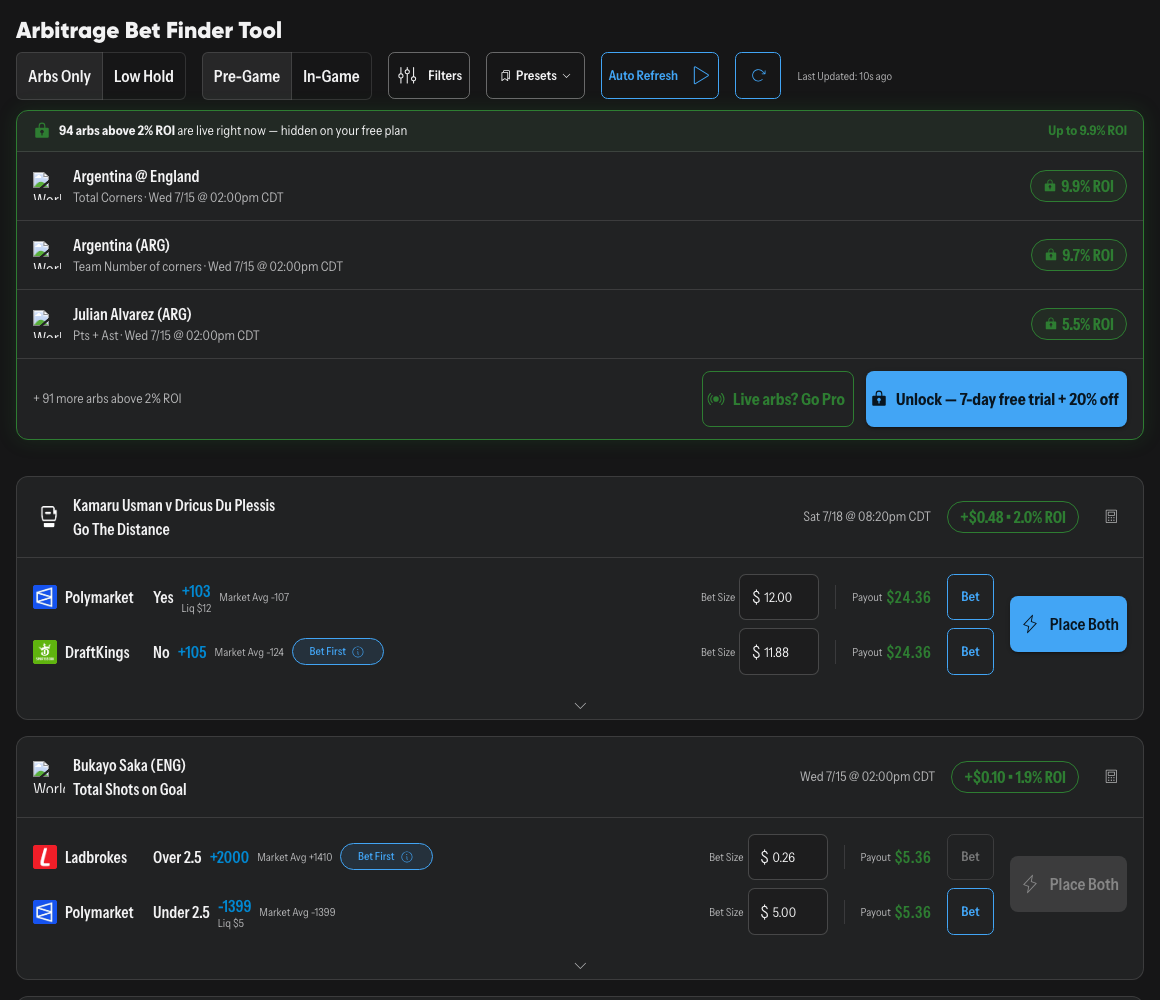 The OddsShopper Arbitrage Finder — live two-book locks with stakes and payouts. Open the live tool.
TL;DR: Is Arbitrage Betting Legal?
- Yes, It Is Legal Anywhere Sports Betting Is Legal. An arb is two ordinary bets at two licensed books, and two legal bets do not add up to an illegal one.
- No Federal Law Bans It. After PASPA fell in 2018, legality became a state question: legal in the growing majority of states that have authorized sports betting, and simply not available in the ones that have not (California and Texas among them).
- It Is Not Cheating. You are line shopping two publicly posted prices, which breaks no law, though a book may still treat steady arbing as sharp action and limit you under its own terms.
- The One Real Catch Is The Books, Not The Law. A sportsbook can stake-limit or close a winning account. That is a terms-of-service call, not a criminal one. How limits actually play out and how to slow them down.
- Taxes Still Apply. In the US, arbitrage profits are taxable income; keep records and talk to a tax professional.
One honest caveat up front: "locking in a profit" is the math on paper. In practice an arb only holds if both legs are accepted at the price you saw and settle under compatible rules. A voided leg, a stake limit, or a number that moves before you cover the other side can change the result. The full mechanics live in arbitrage betting explained.
So this piece is not about how the two-sided math works. It is about the question that keeps people from ever starting: is it legal, and can you get in trouble?
The Short Answer: Legal Where Sports Betting Is Legal
Here is the whole thing in one line. If you can legally place the underlying sports bets from where you are physically located, you can generally arb with them. Arbitrage is not a separate activity with its own laws. When you arb, you place two normal, fully legal bets at two legal sportsbooks. Each bet on its own is legal, so placing both is legal too. I have never seen a US law that criminalizes arbitrage betting at licensed books, but the important qualifier is that the underlying bets still have to be legal where you are, placed with licensed operators, and within each book's rules.
Think about who you are actually dealing with. You are betting at DraftKings 🎁, FanDuel 🎁, BetMGM 🎁, Caesars, and the other state-licensed operators. Every one of those bets is a regulated transaction the state already approved. The state does not care whether you also placed the opposite side at a different licensed book. Each leg is its own legal transaction, and pairing two of them does not create some new offense.
You will also see arbing called a surebet (or surebetting), and it carries the identical legal status: legal wherever sports betting is legal. It is the same activity under a different name, not a separate thing with its own rules.
The nuance the good articles get right, and the thin ones skip, is that the risk in arbing was never legal. It is contractual. A sportsbook is a private business, and it can limit or close an account it decides it does not want. That is a terms-of-service issue, not a law-enforcement one. For ordinary arbing at licensed books, law enforcement is not the realistic concern. Most often a book simply caps your bet size, though it can also restrict markets or close the account. I will come back to that catch, because it is the part that actually matters.
Federal Vs. State: Where The Rules Actually Live
People hear "is it legal in the US?" and expect one national answer. Sports betting does not work that way, and neither does arbing.
At the federal level, the old nationwide ban (PASPA) was struck down by the Supreme Court in 2018. That decision did not make betting legal everywhere. It handed the decision to each state. So there is no federal law that legalizes sports betting, and no PASPA-style federal ban on arbitrage. Other federal laws can still touch gambling operations, payments, and interstate activity, but none of them turns an ordinary two-sided bet at licensed books into a crime.
That means your answer is a state answer. If the specific bet, operator, and your physical location are all legal where you are, using that bet as one leg of an arb is generally not a separate illegal act. If your state has not authorized sports betting, you cannot legally bet there at all, which means there is no legal arb to place either. As of 2026 a large and growing majority of states have live legal sports betting, including big markets like New Jersey, Pennsylvania, Michigan, Illinois, Colorado, Arizona, New York, Ohio, and Virginia. A handful of holdouts (California and Texas among them) still have not authorized it.
A few practical rules that follow from state-by-state legality:
- You Have To Be Physically Inside A Legal State To Place A Bet. The apps use geolocation to confirm it. Standing in a legal state matters, not where you happen to live.
- You Cannot Spoof Your Location To Bet From A Banned State. Faking geolocation to get around the rules is where you would actually be breaking one. Do not do it.
- Age Minimums Vary By State And Operator. Most online books require 21, but a few legal jurisdictions allow sports betting at 18, so check the rule where you are physically located.
None of that is arbitrage-specific. It is the same rulebook every recreational bettor already follows. Arbing does not add a single legal requirement on top.
This is a plain-English explainer, not legal advice, and state laws change. Confirm sports betting is legal and regulated where you are before you place any bet.
Why Arbitrage Is Not "Cheating"
The guilt a lot of new arbers feel comes from thinking they are exploiting a loophole or pulling one over on the book. You are not. Here is what is really happening.
Arbitrage exists because different sportsbooks post different prices for the same event. DraftKings might have one side at +105 while FanDuel has the other side at +102. Those two books simply disagree about the true odds, and for a short window their prices leave a gap. You are not hacking anything. You are shopping. You spotted two publicly posted prices that, taken together, lock in a small margin, and you took them, exactly the way a shopper buys the same product cheaper at one store than another.
The books know this happens. It's a normal feature of an open market with dozens of independent operators pricing the same games. Most arbs look exactly like this: two mainstream apps a couple of cents apart on the same total, the gap alive for barely a minute before one side moves. Nothing clever, nothing hidden, just two prices that disagreed and a short window to act. The line-shopping habit every sharp bettor uses is the same skill, just aimed at one side instead of both. Arbing is not a trick. It aims to lock in a small edge through disciplined price comparison, and there's nothing dishonest about betting a number a licensed book chose to offer you.
Common Myths About Arbitrage Betting
Most of the fear around arbing comes from myths that sound plausible and fall apart the moment you check them. Here are the ones I hear most, side by side with what is actually true.
| The Myth | The reality |
|---|---|
| Arbing Is Illegal Or A Form Of Fraud | Legal wherever sports betting is legal. You are placing two ordinary bets at licensed books. |
| You Can Be Arrested Or Fined For It | Not for ordinary arbing at licensed books; the realistic consequence is a private book limiting your account. (Illegal conduct like underage or spoofed-location betting is a separate matter.) |
| It Only Works At Shady Offshore Sites | The price gaps show up between mainstream US-licensed books like DraftKings, FanDuel, and BetMGM. |
| The Winnings Are Tax-Free Because It "Isn't Really Gambling" | Betting winnings are taxable income in the US, the same as any wager; losing legs are handled separately under stricter deduction rules. |
| A Good Tool Makes Your Account Limit-Proof | No tool can promise that. Software helps you find and spread arbs, but it cannot stop a book from capping a winner. |
Notice the through-line: none of these myths is about the law. Every real constraint on arbing is a business decision by a private company, which brings us to the one catch that actually matters.
The One Real Catch: Books Can Limit You
So if it is legal and it is not cheating, where is the catch? Right here. A sportsbook can decide it does not want your action and cut you off. This is the single thing that actually constrains arbing, and it is worth being honest about.
The reason is simple business. An arber only ever takes prices that beat the book, so over time your account stops being profitable for them. In response, books protect their margin, usually by stake limiting you: you go to bet $500 and the app only accepts $15. The account still works, it is just throttled down to a size where you cannot make real money. Occasionally a book will restrict certain markets or close an account outright. All of it is allowed under the terms of service you agreed to at signup, the same way a casino is allowed to show a card counter the door.
This is not a legal penalty. An account limit by itself is not a criminal record. A book simply stops being useful to you, and you move your volume elsewhere. I have been limited plenty of times over the years, and every single time it was a business decision by a private company, never a legal one. The full playbook for stretching an account's life lives in will sportsbooks ban you for arbitrage betting — if you take one thing seriously, make it that, because limits are the real ceiling on how much you can arb, not the law.
New to OddsShopper?It scans every major sportsbook available in your state, strips the vig, and flags the price gaps that make an arb possible, the same gaps you would otherwise hunt for by hand across a dozen apps. Try OS Pro free for 7 days, then code ARB20 takes 20% off OS Pro or OS Core if you subscribe.
What About Taxes On Arbitrage Winnings?
Legal to do is not the same as tax-free, so let me cover the basics, with the honest caveat that I am a bettor, not an accountant, and this is not tax advice.
In the US, gambling winnings are taxable income, and that includes arbitrage profits. A few things worth knowing:
- Winnings Are Reportable. The IRS treats betting profits as income whether or not a book sends you a form. Some payouts trigger a tax form from the operator; many arb-sized wins will not, but that does not change that the winnings count.
- Netting Is Not Automatic. The rules on offsetting losing bets against winning ones are stricter than people assume, which matters for arbing because your "losing" leg is baked into every play by design.
- Keep Records. Because arbing is high-volume, a simple log of stakes and results makes tax time far easier and is your paper trail if you ever need one.
One more honest note: recent federal changes have made it less favorable to write losing bets off against winning ones, which hits high-volume arbers hardest because a losing leg is built into every play. It can leave you owing tax even on a slim or near-break-even year, so the after-tax math is not the same as the pre-tax math. I am not going to put a number on it here, because tax rules move and your situation is yours. Some bettors still arb profitably after tax, but that is exactly why this is the one area where you should talk to a qualified tax professional rather than take a betting site's word for it. Legality and tax treatment are two different questions, and I would rather you get the tax one from an expert.
How To Actually Find Legal Arbs
Once you know it is legal, the work is finding the price gaps before they close, and that is a real problem. The opportunities live in the disagreements between books, they are small, and they vanish in minutes. Refreshing a dozen sportsbook apps by hand is how you miss them.
This is the part where real-time odds comparison does the heavy lifting. That is the whole job of an arbitrage finder: the tool scans every book available in your state at once, strips the vig, and surfaces the two-sided price gaps the instant they open, a small margin that varies market to market and closes within minutes, so you are acting on live, actionable numbers instead of stale ones you scraped together by hand.
Finding the gap is only half of it, though. The habits that actually keep an arb from turning into a loss are the ones I learned the hard way:
- Confirm Both Books Grade The Market The Same Way. A "player total" or an overtime rule that differs between two operators can void one leg and leave you exposed, so read both books' rules before you fire.
- Place The Harder Side First, Then Cover Immediately. The limited or low-max leg is the one likely to be cut or moved, so get it down first, then take the other side before the number drifts.
- Skip The Gap The Math No Longer Supports. If a max-stake cap or a stale price has already eaten the edge by the time both legs would land, pass. A margin that only exists on paper is not an arb.
The same de-vigged, cross-book view also powers positive EV betting, which is the natural next step for a lot of arbers who want a higher ceiling once they are comfortable. Same legal footing, same odds-comparison muscle, just a different way to use the edge.
Bottom Line
Is arbitrage betting legal? Yes. Anywhere sports betting is legal, arbing is legal, because all you are doing is placing two ordinary bets at two licensed books. There is no federal law that bans arbitrage as a strategy, in legal betting states the issue is sportsbook terms rather than criminal law, and nothing about it counts as cheating. The only real constraint is that a sportsbook, as a private business, can limit or close your account, and the smart move is to manage that reality rather than fear a legal one that does not exist. Handle your taxes like the taxable income they are, stay inside a legal state, and the rest is just finding the gaps fast enough to act on them.
More on this: Arbitrage Betting Mistakes: Why Your Arb Doesn't Fill · Is Betting On Elections Legal? The Federal Rule And The State Patchwork · Is Kalshi Legal? The State-By-State Answer 2026 · Best Sportsbooks For Arbitrage Betting: What To Look For · Prediction Market Arbitrage: How It Works (2026)
Frequently Asked Questions
Is arbitrage betting legal in the US? Yes, in any state where sports betting is legal and regulated. When you arb, you are placing two normal, legal bets at two licensed sportsbooks, and covering both sides does not turn two lawful wagers into an unlawful act. There is no federal ban on arbitrage as a strategy, and in legal betting states the real issue is sportsbook terms and account limits, not criminal law. State rules still govern whether and how you can place the underlying bets, so this is general information, not legal advice.
Is arbitrage betting illegal anywhere? Ordinary arbitrage at licensed books is generally not treated as a separate crime; the illegal part would be placing an underlying bet that is not legal where you are. Where it is effectively off the table is any state that has not legalized sports betting at all, because there is no legal bet to place there in the first place. The activity that would break a rule is faking your location to bet from a state where betting is banned, so never spoof geolocation.
Is surebetting the same as arbitrage betting, and is it legal too? A surebet is just another name for arbitrage: betting all outcomes so that, provided both legs settle as placed, you come out ahead regardless of which side wins. It carries the exact same legal status: legal wherever sports betting is legal. Same activity, same answer.
Can I get arrested or fined for arbitrage betting? For ordinary arbing at licensed books, arrest or a fine is not the realistic concern. The likely outcome is a sportsbook limiting your bet size or closing your account, which affects your betting, not your legal record. Illegal conduct around it, like betting underage, spoofing your location, using an unlicensed book, or not reporting taxable winnings, is a separate matter that can carry consequences.
Do I have to pay taxes on arbitrage betting winnings? Yes. In the US, gambling winnings, including arbitrage profits, are taxable income whether or not a book issues you a tax form. The rules on offsetting losses are stricter than most people expect, so keep a record of your bets and talk to a tax professional about your situation. This is not tax advice.
Why do sportsbooks limit arbitrage bettors if it is legal? Because it costs them money, not because it is against the law. An arber only takes prices that beat the book, so the account is unprofitable for the operator, and a private business is allowed to decline or restrict a customer. See will sportsbooks ban you for arbitrage betting for how limits actually play out and how to slow them down.
*Arbing is legal wherever sports betting is legal, and the only hard part is finding the price gaps before they close. OddsShopper Pro scans every major sportsbook in real time, strips the vig, and flags the two-sided gaps that make an arb possible. Try it free for 7 days, then use code ARB20 for 20% off your first payment of OS Pro or OS Core.