Arbitrage vs EV betting is the fork almost every bettor hits after they graduate past parlays and hunches: do you chase the lock-it-in math of arbitrage, or the bigger long-run edge of positive expected value? I've run both for years, and the honest answer is that they solve different problems for different bankrolls. One pays you a little almost every time it fills cleanly. The other pays you a lot, eventually, if you can stomach the swings.
This is not a "which one is objectively better" piece, because that question has no clean answer. It's a "which one fits you right now" piece. Below I'll lay out how the two sports betting strategies actually differ, walk through the same $100 run through each, and give you the trade-offs nobody selling a subscription likes to say out loud.
TL;DR — arbitrage vs EV betting in one breathArbitrage is the low-variance on-ramp — a small, locked-in return with no model required, ideal for a smaller bankroll. +EV betting is the higher-ceiling next step — bigger long-run ROI, but real variance you have to survive. Newer or smaller bankroll? Start with arbitrage. Ready to ride swings for a bigger edge? Graduate to +EV. Most serious bettors eventually run both.
Arbitrage Vs. +EV Betting: The Core Difference
When people ask about arbitrage vs positive EV betting, they're really asking which trade-off fits them, not which one is "real." Both are legitimate, math-driven edges. If you're brand new to either concept, read our full breakdowns first (arbitrage betting explained and positive EV betting), then come back for the head-to-head. In one sentence each:
- Arbitrage means staking both sides of the same market at two different sportsbooks whose prices disagree enough that you lock in a small return no matter who wins.
- +EV (Positive Expected Value) Betting means placing one side at a price that beats its fair, no-vig probability, so you're a long-term winner even though any single bet can lose.
The cleanest way to see the gap is side by side:
| Arbitrage betting | +EV betting | |
|---|---|---|
| What It Needs | Two books pricing one market far enough apart | A fair (no-vig) price the book hasn't matched |
| Outcome Per Bet | Small return regardless of the result | Variable; you win some, lose some |
| Variance | Very low | High; the edge only shows over hundreds of bets |
| Edge Ceiling | Small (typically 1% to 3%, occasionally more) | Larger long-run ROI |
| Model Needed | None | Yes, or a tool that de-vigs the market for you |
| Main Risk | A book limits your account or voids a leg | Downswings; you need bankroll and discipline |
| Effort | Fast and mechanical | Ongoing, higher volume |
That table is the whole article in miniature. Arbitrage trades ceiling for certainty. +EV trades certainty for ceiling.
Why Arbitrage Is The Low-Variance On-Ramp
I point most newcomers to arbitrage first, and it's the reason the strategy has a reputation as the lowest-stress way to grind out a profit (even though, as I'll cover below, it isn't truly free of risk).
The appeal is psychological as much as financial. You place two bets, the game ends, and your bankroll ticks up by a dollar or two. No model, no read on the matchup, no sweating the fourth quarter. Because you're covering both outcomes, you don't need to be right about anything except the math, and the math is fixed the moment both bets are down. For a bettor who has only ever lost money guessing, that first locked return is a genuine mindset shift: betting can be a spreadsheet exercise, not a gut check.
It's also the fastest way to learn the mechanics that make you money everywhere else, starting with implied probability and moving quickly when a price is off. If you can find and execute an arb, you already understand line shopping, which is the foundation +EV betting is built on.
The catch is the ceiling. These arbs are small (I mostly see 1% to 3% returns, occasionally more on a stale line), they don't appear constantly, and the books that offer the softest prices are exactly the ones quickest to limit winners.
Why +EV Betting Has The Higher Ceiling
Positive expected value is the step up, and it's where the real long-term money lives. It also asks more of you.
Instead of covering both sides, you bet one side at a price you believe is better than it should be. The core skill is figuring out the true probability of an outcome, then only betting when the sportsbook's price implies a worse probability than that. Our step-by-step guide on how to find +EV bets turns that skill into a repeatable daily workflow. Do that consistently and you can lose plenty of individual bets and still come out ahead over a large sample, the same way a casino loses individual hands and still wins.
The ceiling is the draw. A steady diet of +EV bets at, say, a 3% to 5% edge compounds into a far bigger return than arbitrage's thin margins, because you're not splitting your stake across both sides; the full bet works for you. There's no upper limit on how much edge a badly mispriced market can hand you, whereas an arb is capped by how far two books happen to disagree.
The cost is variance. You can be a +EV bettor and still be down after 50, 100, even 200 bets. The edge is real, but it only reliably surfaces over a large sample. That demands a bigger bankroll, strict bet sizing, and the emotional discipline to keep firing correct bets through a cold stretch.
A Worked Example: The Same $100, Two Ways
Numbers make this concrete. Take a two-way moneyline between the Boston Celtics and Miami Heat, and run $100 through each strategy.
The arbitrage version. Say DraftKings hangs the Celtics at +105 (implied 48.8%) while FanDuel has the Heat at +102 (implied 49.5%). Add those implied odds: 48.8% plus 49.5% equals 98.3%. Because the total is under 100%, there's an arb. You size each side so both payouts match — about $49.63 on the Celtics and $50.37 on the Heat (an arbitrage calculator does that stake-splitting for you). Whichever team wins, you get back about $101.75. Your return is about $1.75, locked in once both bets are accepted at these prices, regardless of which team wins — assuming neither leg gets voided, cut, or limited before it lands, which is the one execution risk arbers manage. Small, but low-risk.
The +EV version. Now suppose you de-vig the market and conclude the Celtics' true win probability is 45.5%, a fair price of about +120. If a book is offering them at +140, that's a positive-EV bet. Your expected value on $100 is (0.455 × $140) minus (0.545 × $100), which equals $63.70 minus $54.50, or about +$9.20 per $100 wagered (roughly a 9% edge). But you only win that bet about 45% of the time. Fire it once and you'll probably lose; fire a few hundred bets like it and that 9% edge is what shows up.
That's the trade on one bet: arbitrage handed you a fixed ~$1.75 (barring an execution hiccup), while +EV handed you a far larger expected number attached to a coin-flip-ish outcome you have to survive.
Want the tool that finds these for you?OddsShopper scans 100+ sportsbooks in real time and flags both, live arbs and the +EV bets priced in your favor. Try it free for 7 days, and code ARB20 takes 20% off your first payment of OS Pro if you subscribe.
The Honest Trade-Offs
The marketing for both strategies skips the parts that actually decide whether you'll succeed. Here's the unvarnished version, factor by factor.
| Factor | Arbitrage | +EV betting |
|---|---|---|
| Bankroll Needed | Small; once both legs are down you get roughly your stake back either way | Larger, to absorb the swings without over-betting |
| Variance | Near zero | High; judge results over hundreds of bets |
| Book Longevity | Accounts get limited fast (the pattern is obvious) | Also gets limited, but usually slower |
| Effort | Quick and mechanical, but you must pounce | A volume game; the edge needs a lot of bets |
| Skill Required | Just the math | Estimating true probability (or a tool that does) |
A few of those deserve a sentence more. Book longevity is the one nobody warns you about: both strategies get you limited or banned, arbers faster because the pattern is obvious, so treat book access as a resource to manage rather than a given (read arbitrage limits and getting banned before you scale up either approach). On bankroll, the +EV danger isn't being wrong, it's sizing too big a fraction on each play, which is how +EV bettors go broke while being right. None of these are dealbreakers. They're the real inputs, and they're why the "better" strategy depends entirely on your bankroll, your temperament, and how long you want your accounts to last. Neither one runs on autopilot.
Which Should You Start With?
The arbitrage or EV betting decision usually comes down to three things: your bankroll, your stomach for variance, and how long you want your accounts to last. Here's the concrete rule I actually use: if your betting bankroll is under about $1,000, or you know a 15-to-20-unit losing stretch would make you quit, start with arbitrage — the drawdown that ends most +EV careers simply isn't there. Once you can push a few hundred bets through without flinching at a cold month, +EV earns its keep. Here's how I'd route it if you asked me at a bar:
| Start With... | If you... |
|---|---|
| Arbitrage | Are newer, have a smaller bankroll, or know you'd bail the first time a "profitable" strategy went cold. It builds the line-shopping habit and pays you while you learn, with far lower drawdown risk. |
| +EV Betting | Have the bankroll to ride variance, the discipline to size bets small, and want the strategy with the higher long-run ceiling. Most serious bettors end up here. |
They aren't mutually exclusive, either. I run both from the same screen: arbs when they pop, +EV as the steady grind underneath. The skills stack, because the de-vig math that finds +EV bets is the same math that tells you whether an arb is real. And note the flip side of selectivity here: when a market is efficiently priced, the correct +EV play is often no bet at all, and no arb existing simply means you sit that one out. Neither strategy requires action on every game.
How I Find Both With OddsShopper
Doing either of these by hand (refreshing 100+ sportsbooks, de-vigging every market, catching a stale price before it moves) is close to a full-time job. It's the part I automate.
The OddsShopper Arbitrage Finder scans 100+ sportsbooks across every major league in real time, and the tool surfaces arbs the moment two books disagree enough to lock one in; the free tier lets you see arbs form, and OS Pro unlocks the full feed — including live in-game arbs and the deeper markets. For the +EV side, Portfolio EV de-vigs each market down to a fair no-vig price, then flags the bets priced in your favor with an EV number attached — the same calculation from the worked example above, run across every book at once. One subscription covers both tools, which is why I don't treat this as an either/or. If you want to pressure-test the money side first, we break down how much you can actually make arbitrage betting and which sportsbooks last longest for arbers.
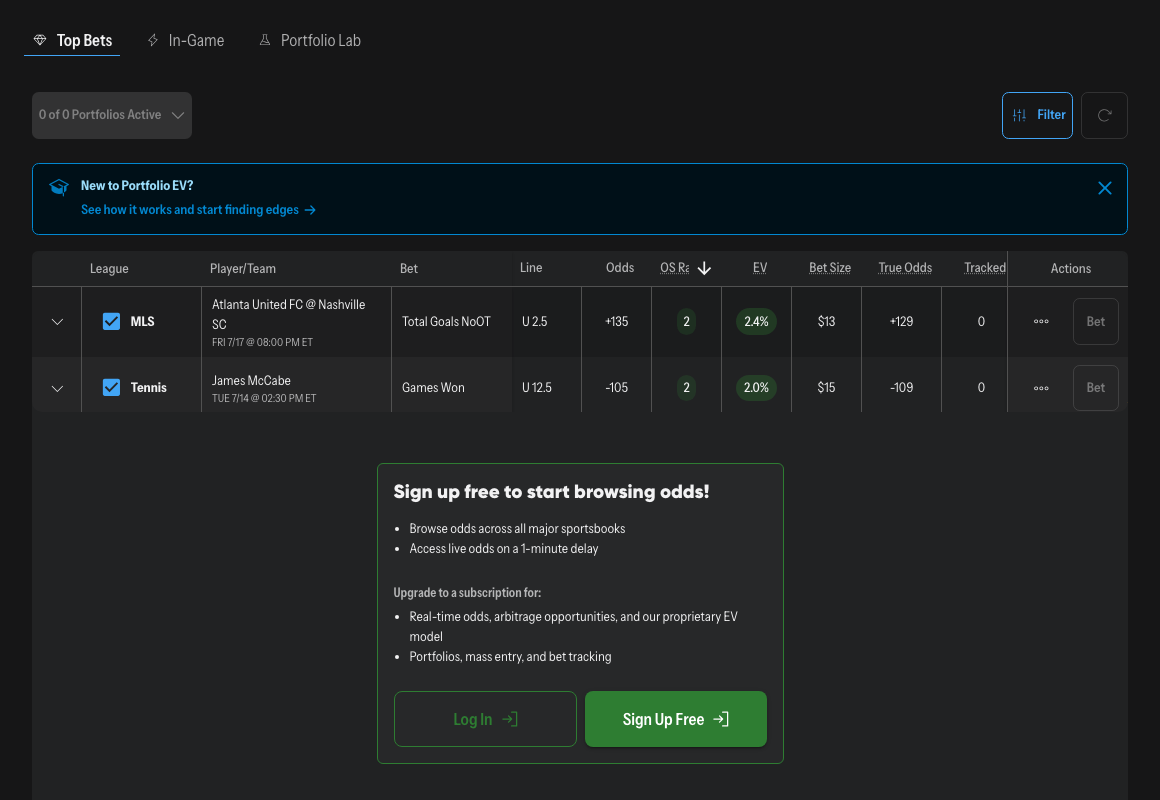 The OddsShopper +EV board — live edges ranked, with the fair price, EV and sizing on every bet. Open the live board.
Price gaps are not limited to sportsbooks either. Kalshi and other event exchanges list the same outcomes at their own prices, and comparing prices across exchanges works the same way.
FAQ
Is arbitrage betting or +EV betting more profitable? +EV betting has the higher long-run ceiling because your full stake works for you and there's no cap on a market's mispricing. Arbitrage is more consistent but pays small, capped returns. In the $100 example above, that's the gap between a fixed ~$1.75 arb and a +$9.20 expected value on a single +EV bet you only win ~45% of the time — small-and-sure versus bigger-but-bumpy.
Is arbitrage betting safer than +EV betting? Per bet, yes. An arb locks in a small return regardless of the result, while a +EV bet can lose. The shared risk is that sportsbooks limit or ban winning accounts on both, and arbers tend to get flagged faster.
Can you do arbitrage and +EV betting at the same time? Yes, and many bettors do. They rely on the same core skills (line shopping and de-vigging), so you can run +EV as your steady strategy and take clean arbs when they appear.
Do you need a model to bet +EV? Not necessarily. You need a fair, no-vig price to compare against the book's price. You can build that yourself, or use a tool like Portfolio EV that de-vigs the market and surfaces the +EV bets for you.
Which is better for beginners, arbitrage or +EV? Arbitrage is the friendlier on-ramp: smaller bankroll, near-zero variance, and it teaches the line-shopping mechanics +EV is built on. Many bettors start with arbs and add +EV once they can ride the swings.
More on this: Arbitrage Betting Mistakes: Why Your Arb Doesn't Fill · Best Sportsbooks For Arbitrage Betting: What To Look For · Is Arbitrage Betting Legal? US Rules Explained · Prediction Market Arbitrage: How It Works (2026) · Best Arbitrage Betting Tools 2026: Ranked & Compared
In Summary: Which Fits You?
Think of arbitrage as the low-variance on-ramp: small, low-risk returns with no model required, ideal for a smaller bankroll or a bettor who won't tolerate downswings. +EV betting is the higher-ceiling next step, offering bigger long-run ROI in exchange for real variance, a bigger bankroll, and discipline. Neither is "better" in a vacuum; the right call depends on your bankroll, your temperament, and how long you want your accounts to survive. The good news is you don't have to choose forever, and the same de-vig math powers both.
Whichever you run, the bottleneck is finding the prices fast enough to matter. OddsShopper does that across 100+ sportsbooks in real time: the Arbitrage Finder for locked-in arbs, Portfolio EV for +EV edges. Try it free for 7 days, and use code ARB20 for 20% off your first payment of OS Pro.
Betting involves risk. Bet only what you can afford to lose, and only where it's legal in regulated U.S. markets. 21+. If you or someone you know has a gambling problem, call 1-800-GAMBLER.