How to Hedge a Bet: When to Hedge, How Much, and When to Let It Ride
In Summary
Hedging a bet means placing a wager on the other side of a bet you already have, so you come out ahead (or at least lose less) no matter how the event finishes. It's a risk-management move: you're trading away some of your potential upside in exchange for a more certain, smaller result. The classic spots are a futures ticket one game from cashing, a parlay with only the last leg left, or a live bet that's swung your way. The honest part most guides skip: hedging is not free money. When you place that second bet, you pay the sportsbook's vig all over again, so you almost always give up a little expected value (EV) to buy certainty. That's a fine trade if the certainty is worth more to you than the EV, but it's a risk-tolerance decision, not a math cheat code. Below we'll walk the hedge stake formula, a real worked example with the numbers, and when hedging beats letting it ride. OddsShopper's Free Bet Converter and live odds do the hedge math for you so you can size the second leg before the line moves.
What Is Hedging a Bet?
Hedging is placing a new bet on a different outcome of an event you already have action on, to reduce your variance on the result. You started with one position; the hedge adds a second position that pays when the first one doesn't.
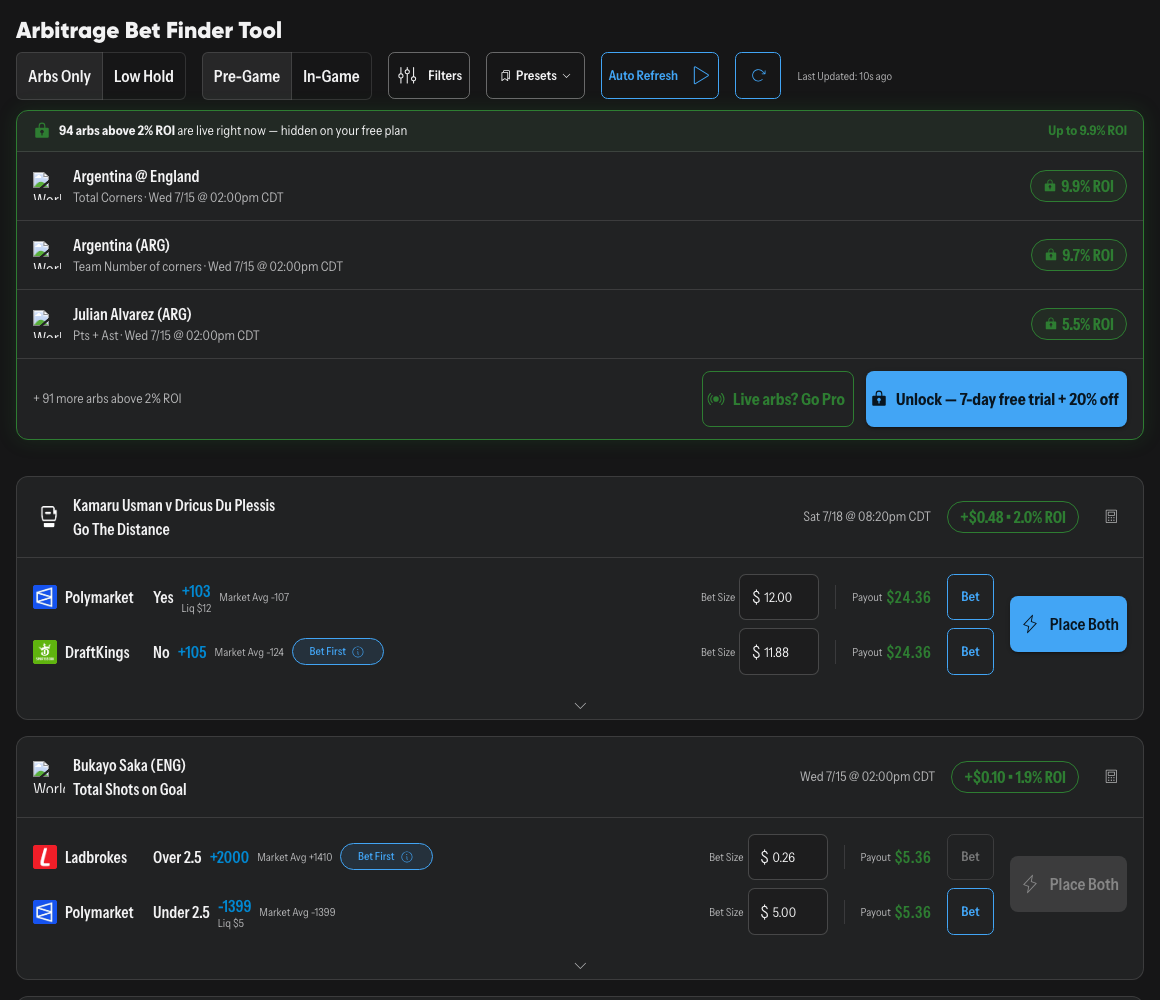
The OddsShopper Arbitrage Tool.
The simplest mental model: you have a bet that's currently live and winning on paper, such as a long-shot futures ticket whose team just made the final, or a five-leg parlay down to one leg. Right now you either win big or win nothing. Hedging lets you convert some of that "win big or bust" into "win a known amount either way." You give up the top of your payout to take the zero off the table.
Two things define a hedge:
- You already have the first bet. A hedge is always reactive. It responds to a position you hold and to how the odds have moved since you placed it.
- You're betting against yourself, on purpose. The hedge wins exactly when your original bet loses. That feels strange the first time, but that's the whole point: it's insurance.
The reason hedging works at all is that the price moved. When you bet a team to win the title at +400 and they reach the final, the new odds on the final are much shorter. Those two prices, your locked-in +400 and the current price on the other side, are what create the room to lock in a result.
When to Hedge a Bet (and When to Let It Ride)
Hedging isn't something you do on a whim. It earns its keep in a handful of specific situations:
- A futures ticket near payout. You bet a team or player to win a championship months ago at long odds, and now they're one game away. The payout is large relative to your bankroll, and a single game decides everything. This is the most common and most defensible hedge.
- A parlay with the last leg left. Your other legs all hit, and you're sitting on a big potential payout riding on one final game or prop. Hedging the last leg turns a coin-flip-for-everything into a known result.
- A live bet (or SGP) one leg / one event away. In-game, the odds on the other side are now cheap enough that you can cover it. Live markets make hedging easy because you can often do it inside the same app.
- The number is life-changing relative to your roll. If the swing between "win" and "lose" is big enough to change your month, locking in a chunk can be the right personal call even though it costs EV.
And the flip side, when to let it ride:
- If the bet is small relative to your bankroll. If losing the whole thing wouldn't sting, you're paying vig to insure something you don't need insured. Let it run.
- If you bet it because it was +EV and it still is. You don't hedge a good price into a worse one for no reason. Hedging or cashing out a +EV bet hands back the edge you earned. Only override that for the risk-tolerance reasons above.
- If the hedge price is bad. Sometimes the other side is so juiced that the hedge barely moves your worst-case outcome while torching most of your upside. Run the numbers first.
The honest framing is this: cashing out is really more about risk tolerance than anything else. Sometimes you're willing to trade equity for a certain payout, but be aware that's exactly what you're doing, because books don't offer it for charity.
That's the whole thing in one sentence. Hedging and cashing out are the same idea (trade equity for certainty), and the book builds its cut into the price either way. So hedge with your eyes open.
How to Calculate a Hedge Bet (the Formula)
To lock in the same profit no matter which side wins, you size the hedge so the hedge bet's total return equals your original bet's total return. The formula:
Hedge stake = (original total return) ÷ (decimal odds of the hedge)
Where original total return is your original stake × your original decimal odds (i.e., your stake back plus your winnings). A couple of conversions you'll need:
- American + odds → decimal:
(odds ÷ 100) + 1. So +400 → 5.00. - American − odds → decimal:
(100 ÷ odds) + 1. So −180 → 1.556.
Once you have the hedge stake, your secured profit on either outcome is: original total return − original stake − hedge stake.
You can do this by hand, but the second leg is usually a race against a moving line, which is exactly why a hedge calculator exists. Enter your original odds and stake plus the current price on the other side, and it spits out the precise hedge stake and your locked result instantly. OddsShopper's Free Bet Converter handles this conversion-and-hedge math, and the live odds and Arbitrage tool show you the best current price on the side you need to hedge, because where you place the hedge changes the number (more on that below).
Step-by-Step: How to Hedge a Bet
If you're a beginner who's never hedged before, here's the step by step, start to finish:
- Confirm you're in a real hedge spot. You hold a bet that's live and winning on paper: a futures ticket near payout, a parlay down to its last leg, or a live position that's swung your way.
- Find the current price on the other side. Pull up the opposite outcome's number right now, and shop it across books. A better hedge price means more value kept.
- Convert to decimal and get your original total return. Original stake × original decimal odds = the amount you're locking in.
- Calculate the hedge stake. Hedge stake = original total return ÷ the hedge side's decimal odds (or let the calculator do it).
- Check what it costs you. Compare the secured result to the EV of letting it ride. If the certainty is worth the EV you give up, proceed; if not, let it run.
- Place the hedge, fast. Lines move. If the price shifted since step 2, recalculate before you fire.
- Record it. Track your stakes, books, and net result for your bankroll (and taxes).
The skill here is judgment and speed, not arithmetic. The calculator handles the math.
A Real Worked Example: Hedging a Super Bowl Futures Ticket
Say back in September you put $50 on the Kansas City Chiefs to win the Super Bowl at +400 (decimal 5.00). They make it. Your ticket is now one game from paying $250 total (your $50 back plus $200 profit). If they lose the Super Bowl, you get nothing.
The Chiefs are favored in the game, so the book prices their opponent at +160 to win it (decimal 2.60). That's your hedge side. Plug it in:
- Hedge stake = $250 ÷ 2.60 = $96.15 on the opponent.
Now check both outcomes:
- Chiefs win the Super Bowl: your futures pays $250. You lose the $96.15 hedge. Net = $250 − $50 (original stake) − $96.15 = +$103.85.
- Opponent wins: your hedge returns $96.15 × 2.60 = $250. You lose the original $50. Net = $250 − $96.15 − $50 = +$103.85.
Either way you walk with about $103.85 locked in, instead of "+$200 or nothing." For a $50 ticket, taking a near-certain ~$104 off the table is a perfectly reasonable risk-tolerance call.
But here's the EV cost most guides hide. Suppose the game line has the Chiefs at −180 and the opponent at +160, a ~2.7% hold. De-vig it and the fair chance the Chiefs win is about 62.56% (Chiefs −180 → 64.29% implied, opponent +160 → 38.46%, summing to 102.75%; 64.29% ÷ 102.75% ≈ 62.56%, leaving the opponent ≈ 37.44%). Letting the futures ride is worth, on average, 0.6256 × $200 + 0.3744 × (−$50) ≈ $106.40. Hedging locks $103.85. So hedging through that priced-in vig costs you roughly $2.55 of expected value: small here, but real, and it scales with the size of the bet and the juice on the hedge side. You're not getting "free" profit; you're paying ~$2.55 to delete the variance. Whether that's worth it is your call, not the math's.
One important nuance, though: "hedging always costs EV" isn't a law. That $2.55 cost exists because the +160 hedge side carries the book's hold. The hedge is itself a bet, so its price has a fair value too, and if you can hedge at a number that's actually better than fair (a soft, underpriced other side, found by shopping every book), the cost shrinks toward zero and can even flip slightly positive. That's the difference between hedging into a juiced number and hedging into a good one. So before you assume you're paying a tax, de-vig the hedge side and check: you might be giving up almost nothing, or, in the rare spot where the line has moved far enough that your locked price beats both sides' fair, the hedge is effectively an arbitrage. The takeaway isn't "never hedge, it costs EV"; it's "price the hedge like any other bet."
Related reading: Sports Betting Strategy: How to Bet Smarter.
Want to see it on a live ticket? The Free Bet Converter and live odds let you drop in your original price and the current number, and it shows the exact hedge stake plus what you're giving up, so you decide with the real numbers in front of you, not a gut feeling.
Size the hedge before the line moves.OS Pro runs the Free Bet Converter math and the live Arbitrage feed so you can see your exact hedge stake, your locked result, and the best price on the other side in one place. Start with a free 7-day trial, then code HEDGE20 cuts 20% off OS Pro or OS Core, which works out to less than a coffee a day.
How to Hedge a Parlay
A parlay hedge works the same way, with one wrinkle: you only hedge the last open leg, and you treat the parlay's full potential payout as your "original total return."
Walk it through: you've got a four-leg parlay where three legs already hit, and the ticket pays $760 total if the last leg, the Boston Celtics moneyline at FanDuel 🎁, also wins. Say the Celtics are −120 (decimal 1.83) in tonight's game. To lock equal profit, you'd hedge the other team:
- The opponent is +105 (decimal 2.05). Hedge stake = $760 ÷ 2.05 = $370.73 on the opponent.
- If your parlay leg hits: $760 − your original parlay stake − $370.73.
- If it misses: the $370.73 hedge returns ~$760, minus your original parlay stake.
The exact locked number depends on your original parlay stake, which is why you run it through a calculator rather than eyeballing it. The same honest caveat applies: you're paying the vig on that last-leg market to convert "all or nothing" into "known either way." And remember the broader point from our parlay strategy thinking: if your parlay legs were +EV to begin with, hedging the last one is you choosing certainty over the edge you built. Sometimes worth it, sometimes not.
Hedging vs. Arbitrage vs. Cashing Out
These three get lumped together constantly, but they're different animals:
- Hedging is reactive risk management on a bet you already hold. You placed bet #1, the price moved, and now you bet the other side (usually at the same book or a different one) to reduce variance. You typically give up some EV to buy certainty. You choose to do it; nobody forces the spot.
- Arbitrage is proactive: you spot two books pricing the same market out of line with each other and bet both sides at the same time, at prices that come out ahead no matter who wins. You're not insuring an existing position; you're exploiting a pricing gap that exists before you place anything. Arbitrage aims for a small low-risk return on purpose; hedging is salvaging or locking a position you already took. (We cover the full mechanic, the margin formula, and how to find arbs in Arbitrage Betting Explained.)
- Cashing out is the sportsbook offering to buy your bet back for a number they set. It's hedging on autopilot (convenient, one tap, no second account), but the book prices the cash-out in its own favor, so you're handing it even more vig than a manual hedge usually costs. When you hedge yourself, you control the size and you can shop the other side for a better price.
The throughline: arbitrage is the only one of the three that's structurally trying to win the spread between two prices. Hedging and cashing out are both about trading some EV for certainty; they just differ in who sizes the bet (you vs. the book). If your goal is "lock low-risk value," learn arbitrage. If your goal is "I have a big live position and I want to sleep tonight," that's a hedge.
A Few Realities Before You Hedge
- Shop the hedge price. The other side's number is the whole ballgame. A worse price on the hedge side means a worse locked result, so use live odds across books to hedge at the best available number, the same discipline as line shopping any bet.
- Hedging costs vig, every time. Each leg pays the book its margin. That's the structural reason hedging usually costs EV, so bake it into your decision.
- Lines move; act fast. The price you saw a minute ago may be gone. If the hedge side moves before you place it, recalculate, and don't fire the old stake.
- Don't hedge out of fear by default. If a bet is small for your bankroll and you only want to hedge because watching it is stressful, that's a sign to size your bets smaller next time, not to pay vig to escape every position.
- Don't burn free bets hedging. A bonus bet is worth the most when you extract its value, not when you spend it insuring something. The Free Bet Converter shows how to turn a promo into the most cash with the least risk.
- Winnings are taxable. In the U.S., sports-betting profits are reportable income, so keep records of your stakes and net results. (Not tax advice; check your situation.)
Frequently Asked Questions
What does it mean to hedge a bet? Hedging means placing a bet on a different outcome of an event you already have a wager on, so you reduce your variance: you come out ahead, or lose less, regardless of how it finishes. It's insurance on a position you already hold, and you typically trade some potential upside for a more certain result.
Is hedging a bet a good idea? It depends on your risk tolerance, not on the math. Hedging usually costs you a little expected value because you pay the sportsbook's vig on the second bet. It's a smart move when the swing is large relative to your bankroll and certainty is worth more to you than the EV you give up, and a poor move when the bet is small or the hedge price is bad.
How much should I hedge? To lock the same profit either way, hedge stake = (your original total return) ÷ (the decimal odds of the side you're hedging). Your original total return is your stake × your original decimal odds. A hedge calculator does this instantly and shows your locked result.
What's the difference between hedging and arbitrage? Hedging is reactive risk management on a bet you already have, and it usually costs you a little EV. Arbitrage is proactively betting both sides of a market across two books at prices that come out ahead no matter who wins. You exploit a pricing gap before placing anything, rather than insuring an existing position.
Is hedging the same as cashing out? They're close. Cashing out is the sportsbook offering to buy your bet back at a price it sets: convenient, but priced in the book's favor. A manual hedge lets you choose the other side and shop for a better number, so you usually keep more of your value than you would taking the cash-out.
Is hedging a bet legal? Hedging is legal wherever sports betting is legal and regulated. You're just placing ordinary bets on both sides of an event you have action on. Where you can do it comes down to whether betting is available in your jurisdiction, not to hedging itself. (Sportsbooks are private businesses and set their own account rules.)
Can you hedge a parlay? Yes. You hedge only the last open leg, treating the parlay's full potential payout as the amount you're locking. Just remember you're paying vig on that final-leg market to convert "all or nothing" into a known result.
Hedging is a tool, not a free lunch, and the side you hedge, and the price you get on it, decide how much value you keep. OS Pro gives you the Free Bet Converter for the hedge-and-conversion math, plus the live Arbitrage feed and real-time odds so you can hedge at the best available number instead of whatever your one book offers. Upgrade to OS Pro with code HEDGE20 for 20% off your first payment and stop leaving value on the table.
More on this: Odds Boosts Strategy: Which Ones Are Actually +EV · Bankroll Management Sports Betting: Unit & Kelly Sizing · Closing Line Value (CLV) Explained: Beat the Close · Free Bet Conversion: How to Turn a Free Bet Into Cash · How to Find +EV Bets: A Practical Workflow