How Much Money Can You Make Arbitrage Betting?
I get asked this more than almost anything else about betting, usually phrased as some version of "is arbitrage actually worth my time?" The honest answer is that arbing pays like a small part-time job, not like a lottery ticket. You will not turn $500 into $50,000 by summer. But if you have the bankroll, the accounts, and a fast way to spot the gaps, it can throw off a lower-variance return most months, though the exact figure swings with execution, account limits, and how many gaps show up. Here is what those numbers really look like, and the levers that move them.
If you are brand new to the concept, start with arbitrage betting explained and come back. This piece assumes you already know an arb is covering both sides of a market across two books at prices that lock in a return no matter who wins. What I want to answer here is the money question.
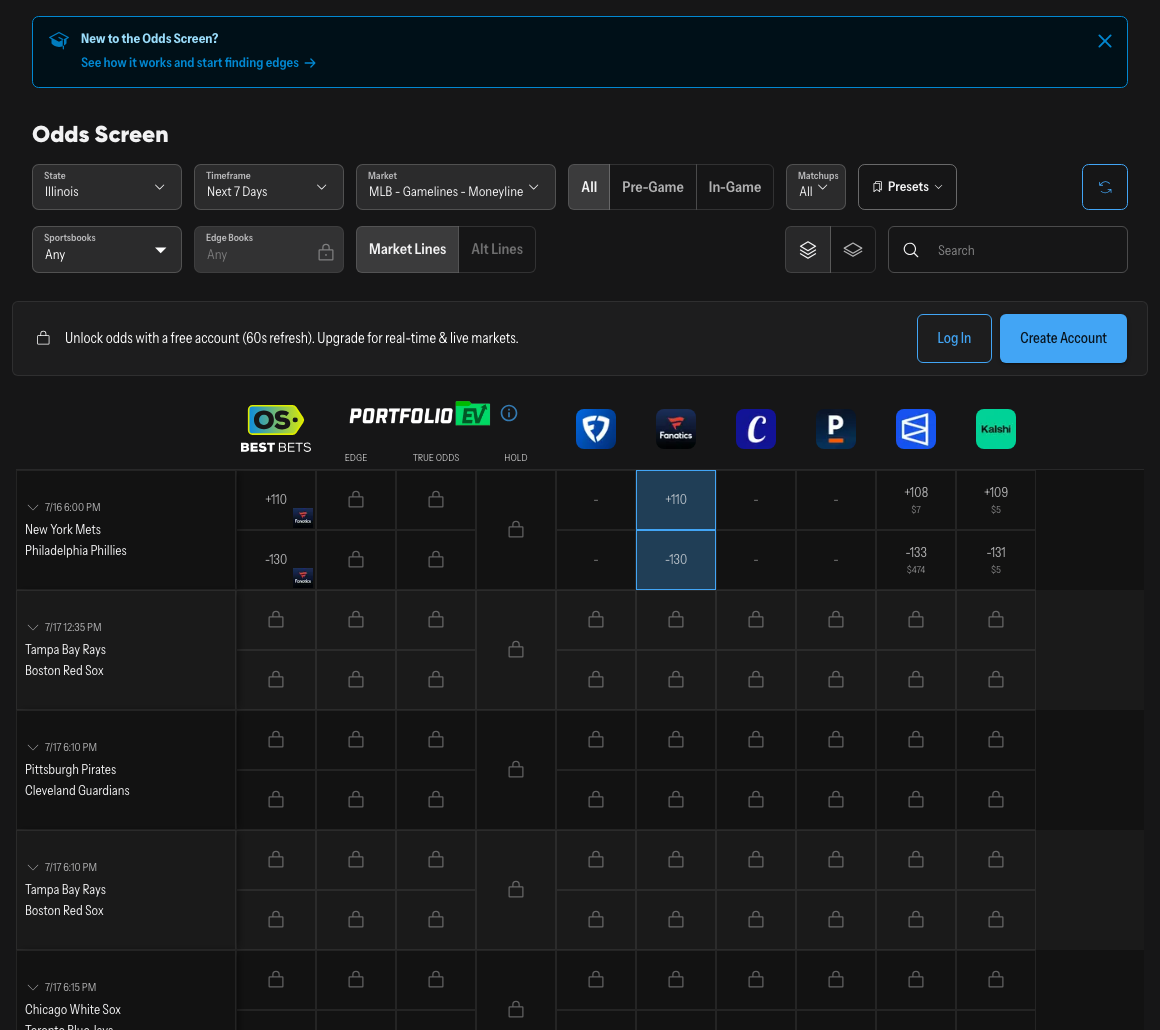 The OddsShopper live odds screen — every book's price on one board, refreshed in real time. Open the live board.
What A Single Arbitrage Bet Actually Pays
Almost every arb you can catch on free tools lands between 0.5% and 2% ROI on the money you put in play. That is the whole game right there. A 1% arb on $500 of total stake is $5. A 2% arb on the same $500 is $10. Occasionally a stale line or a pricing error opens something bigger, but those are rarer and they vanish fastest.
The per-bet payout is small on purpose. Arbitrage isn't about hitting a big number once. It's about hitting a small number over and over, hundreds of times a month, while carrying very little risk on any individual bet. So the real profit question is never "how much per arb," but "how many arbs can I place, at what stake, before the gaps close?"
Three numbers set your monthly total:
- Stake Per Arb: how much you can put in play each time (a function of your bankroll and how it is spread across books).
- Number Of Arbs Placed: how many opportunities you actually catch and fill both legs on.
- Average ROI: usually around 1% on free pre-game arbs, higher if you can reach the >2% and live in-game gaps.
Multiply those together and you have your answer. Let me put real dollars on it.
A Worked $2,000 Bankroll Example
Say you start with a $2,000 bankroll spread across five or six sportsbooks so you always have money on both sides of a market. A comfortable stake per arb at that size is $400 in total action ($200 a side, adjusted for the prices).
At an average of 1% ROI, each arb nets about $4. That sounds like nothing, so watch what turnover does to it:
| If You Place… | At $4 profit per arb | Over ~22 active days |
|---|---|---|
| 1 Arb/Day | $4/day | $88/month |
| 2 Arbs/Day | $8/day | $176/month |
| 3 Arbs/Day | $12/day | $264/month |
Now the honest part before you multiply that bottom row out. Your screen will show far more arbs than you can actually bank: some vanish before you place the second leg, some books are slow to accept the bet, and some you simply miss while you're at work. For most part-time arbers grinding free pre-game gaps, 1 to 2 clean arbs a day is a realistic banked rate, which puts you around $88 to $176 a month on a $2,000 bankroll. That tracks the conservative-to-active band in the scaling table below. Banking 3 or more every single day is possible, but it's an aggressive pace on free tools, and only that pace gets you to the ~13% ($264) bottom row of the turnover table. Treat 13% as a rare best-case that sits above the scaling table below, not the expectation.
The real risk on any single arb isn't a small loss, it's ending up one-legged: the second bet doesn't fill, the line moves, or a leg gets voided, leaving you holding a live position instead of a locked margin. Place both legs fast, confirm them, and the per-bet risk stays low.
That gap between what the market offers and what you personally catch is the entire story of how much you can make. Close it and your number climbs. Everything below is a lever on that gap.
This is why speed and coverage decide your realistic upside.OddsShopper scans live odds across 110+ sportsbooks and ranks every open arb by margin in real time, with the exact stake for each side already calculated. Try it free for 7 days, then code ARB20 takes 20% off OS Pro or OS Core if you stay.
Scaling By Bankroll: A Realistic Table
Because your per-arb dollars scale directly with your stake, a bigger bankroll makes the exact same effort pay more. The percentage return stays similar; the absolute dollars grow. Here is a realistic monthly-profit grid, expressed as a return on your total bankroll, for a part-time-to-dedicated arber:
| Bankroll | Conservative (~3%/mo) | Typical (~6%/mo) | Active + more books (~9%/mo) |
|---|---|---|---|
| $1,000 | $30 | $60 | $90 |
| $2,000 | $60 | $120 | $180 |
| $5,000 | $150 | $300 | $450 |
| $10,000 | $300 | $600 | $900 |
The $88–$176 realistic band from the worked example sits inside the $2,000 row here, between the conservative and active tiers. A few things to read out of the table honestly:
- The Percentage Does Not Care How Rich You Are, But The Dollars Do. The same 6% month is $120 on $2K and $600 on $10K for nearly identical work. Arbitrage rewards capital.
- These Are Not Guaranteed Monthly Figures. They are what a disciplined arber can realistically target; a slow week of few opportunities, a limited account, or a mis-sized stake pulls the actual number down.
- The Right-Hand Column Requires More Than Money. Hitting the ~9% tier means more funded books, faster execution, and reaching the higher-margin and live arbs, not just a bigger balance.
If you reinvest instead of pocketing the profit, those numbers compound. A conservative 3% a month would turn $2,000 into about $2,850 over a year, on paper. I say "on paper" for a reason: sustaining a fixed monthly rate for 12 straight months is optimistic once account limits and thin opportunity stretches enter the picture, so treat compounding as the upside case, not the plan.
The Levers That Actually Raise Your Return
If you want a bigger number than the "typical" column, there are only four things to push on. This is where the ceiling on free, manual arbing shows up, and where a real tool earns its keep.
- Bankroll. The cleanest lever. More capital spread across more books means a larger stake per arb and more simultaneous positions. Nothing else changes the absolute dollars as directly.
- Book access. An arb only exists between two specific books that disagree. The more sportsbooks you are funded at, the more two-book combinations exist, and the more arbs you can reach. Two accounts see a trickle; eight or ten see a real feed. (This is the same principle behind line shopping: more books mean more mispriced numbers.)
- Speed. Pre-game arbs live for seconds to minutes; live in-game arbs can live for seconds. The faster you spot the gap and place both legs, the more of what you see you actually bank. Manual hunting across a dozen book tabs simply loses this race most of the time.
- Access to the bigger edges. The 0.5–2% pre-game arbs are the free, crowded tier. The arbs above 2% and the live in-game arbs are where the return per bet jumps, and they are exactly the ones that close fastest and are hardest to catch by hand. Reaching them is the difference between the "typical" and "active" columns above.
Notice that three of those four levers are about seeing more, faster. That is not a coincidence, and it is where I lean on OddsShopper's Arbitrage tool. The free tier surfaces arbs up to 2% ROI so you can see the concept working across 110+ books. OS Pro's Live Arbs feed unlocks the full real-time stream, including the arbs above 2% and the live in-game gaps the free tier doesn't show, plus the exact stake sizing for each side, so you are placing bets instead of doing math while the line moves.
The table below shows what each tier lets you catch:
| What Raises Your Return | Free Arbitrage tool | OS Pro Live Arbs |
|---|---|---|
| Books Scanned | 110+ | 110+ |
| Pre-Game Arbs (0.5–2%) | yes | yes |
| Arbs Above 2% ROI | not shown | full range |
| Live In-Game Arbs | not shown | yes |
| Real-Time Stream | sample view | full live feed |
| Stake Sizing Built In | yes | yes |
SO, Is Arbitrage Betting Worth It?
For the right person, yes, with clear eyes about what it is. Arbing earns its keep if you have a few thousand dollars you can leave spread across sportsbooks, the discipline to place both legs cleanly, and you value a low-variance monthly return over the thrill of a big score. A realistic part-timer nets about $88 to $176 a month on a $2,000 bankroll: quiet, repeatable-looking upside when execution is clean, not a windfall.
It's not worth it if you have $200 total, no patience for account management, or you're expecting a fast windfall. And there's one more cost that never shows up in a profit table: sportsbooks limit bettors they identify as pure arbers. That's a real constraint on how long you can run and how big you can scale, and it's worth reading how arbers get limited and banned before you go all-in. Many bettors treat arbitrage as one steady piece of a wider positive-EV approach rather than the whole plan, precisely to stay under the radar and keep a higher ceiling.
One more line item that eats into the headline number: taxes. In the U.S., betting profits are reportable income, so your real take-home is after tax, not the gross monthly figure. Keep records of your stakes and net results. (That's not tax advice, just part of an honest profit picture.)
The arithmetic favors you; the discipline is where it's won or lost. If those numbers above look worth your time, the only thing standing between you and them is how many arbs you can actually catch.
More on this: How Much Money Should You Put On Kalshi? Bankroll Rules For Event Contracts · How Much Gold Is Left? What The Numbers Actually Say · Arbitrage Betting Mistakes: Why Your Arb Doesn't Fill · How Much Is My Pokemon Card Worth? How Card Prices Are Set · How Does Kalshi Make Money? The Charge You Can't See
Frequently Asked Questions
How much money can you make arbitrage betting? Realistically, a part-time arber nets around $88 to $176 a month on a $2,000 bankroll, since most free arbs return 0.5–2% and your profit scales with stake and how many you place. A few hundred a month is possible only at a more aggressive pace or a larger bankroll. Bigger bankrolls, more books, and faster execution push that higher, but it is steady low-variance income, not a big single-bet payday.
What is a realistic monthly ROI for arbitrage betting? For most part-time arbers grinding free pre-game opportunities, roughly 3% to 9% per month on your total bankroll is a realistic target. The higher end of that range requires more funded books, faster placement, and reaching the arbs above 2% and the live in-game gaps.
Is arbitrage betting worth it? It's worth it if you have the capital to spread across several books, the discipline to place both legs cleanly, and you value a steady low-risk return over a big win. It's not worth it on a tiny bankroll or if you're expecting a fast windfall, and account limiting caps how far you can scale.
Do you pay taxes on arbitrage betting profits? In the U.S., yes, betting winnings are reportable income, so your take-home is lower than the gross monthly profit you calculate. Keep records of your stakes and net results and treat the after-tax figure as your real return. This isn't tax advice; check your own situation.
How much do you need to start arbitrage betting? There is no fixed minimum, but you need funded balances at several sportsbooks at once because an arb lives across two of them. Your dollars scale with your stake, so a small bankroll earns small absolute profits per arb even when the percentage is solid. A few thousand dollars spread across five or six books is a comfortable starting point.
Why don't arbitrage bettors just bet huge to make more? Two reasons: your bankroll has to stay funded on both sides of every market you want to arb, so you can only stake a fraction at a time, and sportsbooks limit accounts that consistently bet both sides of a market. Betting big and obvious gets you cut faster, which is why arbers spread action across many books and stakes.
Can arbitrage betting be a full-time income? It can for a few people with large bankrolls, many funded accounts, fast tools, and a tolerance for constant account management, but for the large majority it is a strong side income, not a salary. The limiting risk and the capital required are the two ceilings that keep most arbers part-time.
*The size of your arbitrage paycheck comes down to how many good gaps you can catch before they close. OddsShopper scans 110+ sportsbooks in real time and hands you both sides plus the exact stakes, so you're placing bets instead of hunting them. OS Pro unlocks the full Live Arbs feed: the arbs above 2% and the live in-game edges the free tier doesn't show. Try it free for 7 days, then use code ARB20 for 20% off your first payment of OS Pro or OS Core.
See today's edges free Bet responsibly, 21+.*