You have probably seen the screenshots: a bettor posting a slip with tens of thousands of dollars on a single play and a profit graph that only goes one direction. The instinct is to want their bets in your account, at your books, before the price disappears. Here is the good news about sharp money — the hardest part, finding what the sharps are actually backing, is now a screen you can read in a few seconds instead of a signal you have to reverse-engineer from a line that already moved.
In Summary (TL;DR)
- What Is Sharp Money? It is the wagering of professional, winning bettors — the money that moves lines rather than following them. Their biggest positions land on exchanges and prediction markets first, and the rest of the market catches up.
- How You Usually Notice It: reverse line movement (the line moves toward the side taking fewer bets) and steam moves (a fast, synchronized shift across books). By the time you see either on a rec book, the value is mostly gone.
- How To Get Ahead Of It: the OddsShopper Sharp Action tool reads the order books on Novig, ProphetX, Polymarket, and Kalshi, flags the wagers it identifies as sharp action, and shows you where to place the same bet on a regular sportsbook — sometimes at a better number than the sharp got.
- This Guide walks the applied workflow: read the feed, filter it to bets you will actually place, save a preset, and track your closing line value after you bet. It is a how-to-tail workflow, not a sharp-betting primer — if you want the foundation first, start with our sharp betting guide.
Watch: How To Copy Sharp Action
The walkthrough below covers the Sharp Action tool step by step on screen. Watch on YouTube.
Where Sharp Money Shows Up First
Recreational sportsbooks set a number and adjust it as money comes in. The people moving those lines are not betting blind at DraftKings 🎁; the biggest professional money lands on exchanges and prediction markets, where there is no house to limit a winning player and the price reflects real two-sided demand. Novig, ProphetX, Polymarket, and Kalshi are the venues that matter here. When a pro gets serious money down on one of them, that order book is the earliest honest signal of where the price is headed.
That timing is the whole point of a sharp money tracker. When a big sharp position filters through to the recreational books, you see it as reverse line movement — the price drifting toward the side that is taking fewer tickets, because the money is lopsided even when the bets are not — or as a steam move, several books lurching the same direction at once. Both are real tells. The problem is they are lagging tells: by the time the number moves on your book, you are chasing a price that already corrected. Reading the action at the source is how you bet the number before it moves, which is the same reason closing line value is the cleanest long-run proof that you are betting the right side.
How The Sharp Action Tool Surfaces Sharp Money
Inside OS Pro, the Sharp Action tool lives on the left-hand menu. Its default view is exactly what it sounds like: the wagers the tool believes are sharp, parsed from the order books on Novig, ProphetX, Polymarket, and Kalshi. If you would rather just see raw size, switch to All High Liquidity Orders and the feed shows the biggest dollar amounts being wagered on those venues, sharp-flagged or not.
In one row, the tool surfaces the exact bet a professional just made, the price they got, and the cheapest book where you can copy it — the whole "what are the sharps on, and where do I place it" question answered on a single line. Each row reads left to right:
| Column | What it tells you |
|---|---|
| Liquidity | The dollar amount wagered on the sharp position, and which venue it lives on |
| The Bet | The exact market and selection the sharp is taking |
| The Line | The price the sharp got on the exchange or prediction market |
| Best Rec Book | The best available recreational sportsbook for that same bet, and its odds |
| Arb | The arbitrage percentage between the sharp price and your available rec-book lines |
| Off-Market | How far the exchange price sits from the average of the books you have selected |
The two columns I read first are arb and off-market. The arb column is one of the ways the tool identifies sharp action in the first place; the off-market column shows how far the exchange price sits from the average of the books you selected. A line sitting well off that average is the on-screen size of the gap between the exchange and your rec books — often the same imbalance that shows up later as reverse line movement once the books catch up. When the gap is wide enough to open an arbitrage against the rec books, the price is following real money, not public sentiment.
A Real Example: Tailing A $5,914 Sharp Bet
Here is a single row from the feed, and it is the one that sold me on the workflow. Someone posted $5,914 on Novig, flagged as sharp action, on Kyle Stowers over 1.5 hits plus runs plus RBIs. The line the sharp got was -151. Scroll across to the rec-book column and the best available price for that exact bet was BetMGM 🎁 at -140.
That price difference is the real takeaway. You are not just copying the play; you can copy it at a better number than the professional paid. Press the bet button on that row and it populates the wager directly in a BetMGM bet slip, so there is no retyping the market or the selection. Getting -140 where the sharp settled for -151 is extra expected value on a position a pro has already done the work to identify — and expected value, not the outcome of any one bet, is the whole game. (If that idea is fuzzy, our expected value guide breaks down why the price you pay decides your edge as much as the side you pick.)
New to OddsShopper?The Sharp Action tool scans the sharp exchanges and your sportsbooks at the same time and shows you, in one row, the bet a professional just made and where to get it cheapest. That whole feed is part of OS Pro. You can try it free for 7 days, and code SHARPER25 takes 25% off your first payment if you stay.
Filtering The Feed To Bets You'll Actually Place
A raw feed of every sharp order is noise if half of it is on books you do not have or sizes you do not care about. The filters narrow it to your situation:
- Your Sportsbooks. If you only bet FanDuel and DraftKings, select those two and the feed only recommends bets you can place at them.
- Arb-Eligible Books. You can drop specific books from the arb calculation. Bet365, for example, runs soft and often posts off-market odds, so you may not want its prices skewing the arb column.
- Sharp Sources. Keep all of Novig, ProphetX, Polymarket, and Kalshi on, or isolate one if you only want Kalshi signal. Leaving all four on is the recommended default for the widest read.
- Leagues. A sport selection is not just the top league; basketball, for instance, pulls in Australian, Chinese, and EuroLeague games. If you only want the NBA, deselect the rest.
- Liquidity Floor. Set the minimum size that counts as a signal. A $700 floor keeps the feed to meaningful money; drop it to $150 to see more action, or push it to $1,500 and up to see only the heaviest bets.
- Off-Market And Arb Minimums. Require a minimum off-market percentage or a minimum arb percentage before a bet shows — a direct way to demand real reverse line movement before a row earns your attention.
- Odds Range. Cap the prices you see. If you only want plus-money bets, set the range accordingly; the same works for minus-money only.
There is one more filter worth understanding: match or beat the sharp's price. Turn it on and the feed only surfaces a bet when one of your books offers the sharp's line or better; I leave it on by default. But I will flip it off when I want more volume and can live with a slightly worse number, because a couple of cents off the sharp's price is a reasonable trade — getting +102 where the sharp got +104 is fine. Taking -150 where the sharp got +104 is not, because at that point you are making a different bet, not the same one.
Saving Presets SO Your Feed Is Ready Every Time
Once your filters are set, save them as a named preset. The next time you log in, select that preset and every book, source, league, floor, and odds setting loads automatically. Name it for the strategy it represents so the feed you want is one click away instead of a rebuild every session.
Placing And Tracking Your Bets
The bet button sends the wager to the right sportsbook's bet slip, but the workflow does not end there. After you place a bet you can track and hide it, which removes that row from the Sharp Action screen so you are not staring at action you already took. Everything you place flows into the My Bets tab, where you can see the line you got, the current line, and your closing line value on each position. That last number is the honest scoreboard. Grabbing -140 while the sharp paid -151 is line value in the moment — you already beat the exchange price. CLV is the separate, longer-run measurement: your entry price versus where that same market actually closes. If the rec book keeps moving your way after you bet, My Bets shows it through the current line and your CLV, and that is how you confirm the edge over a real sample rather than on one Tuesday's results.
No edge wins every single bet. Following sharp action puts you on the side professionals are backing at a price they would take — whether that holds up for you is exactly what the My Bets CLV column is there to prove over a real sample, not one Tuesday. Size every position to your bankroll and let the sample do the talking.
Sharp Money In NFL Season
The signal is sport-agnostic, but the NFL market is where most bettors first notice sharp money, because reverse line movement and steam show up so visibly on a Sunday board. As soon as a sharp NFL row surfaces in the tool, cross-check it against the real-time NFL odds screen to shop the number across every major book, and keep the NFL injury report open — injury news moves NFL lines fast, so knowing why a number moved tells you whether to trust a sharp-action row or fade an overreaction.
For any sport, the same habit closes the loop: when a row catches your eye, pull it up on the live odds screen — shop the number across every major book so you confirm you are getting the best available price before you fire, not just the first one the tool showed you.
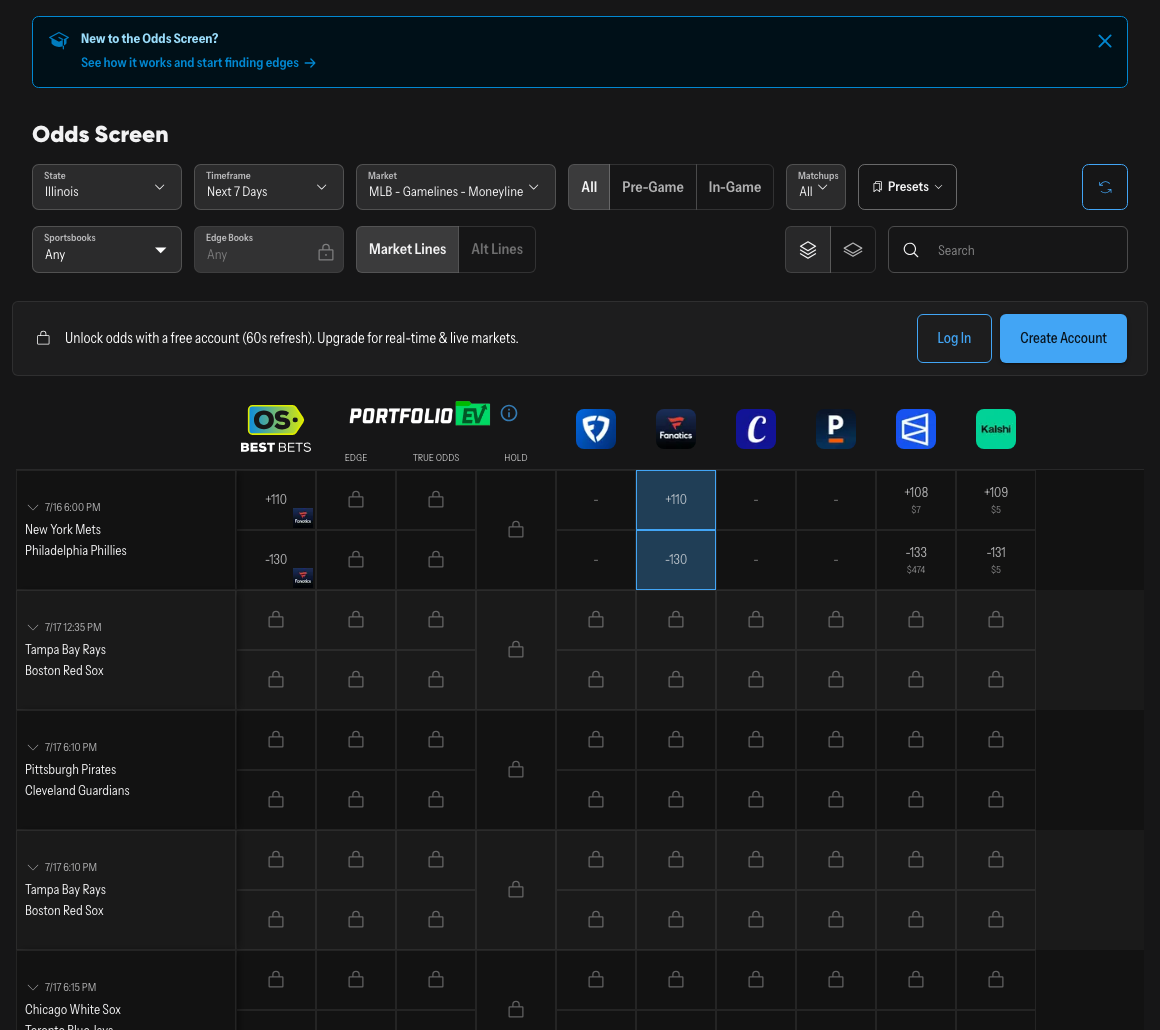 The OddsShopper live odds screen — every book's price on one board, refreshed in real time. Open the live board.
Frequently Asked Questions
What Is Sharp Money In Betting?
Sharp money is the wagering of professional, long-term winning bettors — the money that moves a line instead of following it. Because sharps get their largest positions down on exchanges and prediction markets before recreational books adjust, that action is the earliest read on where a price is headed.
What Is Reverse Line Movement, And How Does It Relate To Sharp Money?
Reverse line movement is when a line moves toward the side taking fewer bets — the public is on one side, but the line shifts the other way because the sharp money is heavier. It is a classic sharp tell. The Sharp Action tool's off-market column shows you that same imbalance at the source, before the rec book line finishes moving.
Where Do Sharp Bettors Actually Place Their Bets?
On exchanges and prediction markets such as Novig, ProphetX, Polymarket, and Kalshi, where there is no sportsbook to limit a winning player. OddsShopper's Sharp Action tool reads those order books to flag what it identifies as sharp action.
Can I Really Get A Better Line Than The Sharp?
Sometimes, yes. In the example above a sharp took -151 while the best recreational book offered -140 on the same bet. The tool shows the best available rec-book price next to the sharp's price, so you can take the better number when it exists.
How Much Sharp Money Is Worth Following?
That is up to you. The liquidity floor lets you set a minimum size, with $700 a common default. Lower it to around $150 to see more action, or raise it past $1,500 to see only the heaviest professional bets.
Will Following Sharp Money Win Every Bet?
No — and any tool that promises otherwise is not being straight with you. The value is in the price you get and the side you are on, not in any single result. Size each bet to your bankroll so no one loss stings, and judge the approach by your closing line value across a large sample rather than by last night's score.
Start Following Sharp Money Today
Reverse line movement and steam moves are the market telling you, a beat too late, where the sharp money already went. The Sharp Action tool hands you that same information a beat early — the bet a professional just made and the cheapest place to copy it, side by side. That feed, the arb and off-market reads, the My Bets CLV tracker, and the rest of OS Pro are built to do by default the exact thing this guide just walked through by hand, and there are free expert picks today waiting while you set it up. Try it free for 7 days, and if you stick around, code SHARPER25 takes 25% off your first payment.
More on this: Reverse Line Movement Betting: How To Spot Sharp Money · Line Movement Explained: Steam & Reverse Line Moves · How Much Money Should You Put On Kalshi? Bankroll Rules For Event Contracts · How Does Kalshi Make Money? The Charge You Can't See · Where Prediction Markets Are Sharp, And Where They Are Soft