Few things in betting feel worse than watching a bet win and then finding it missing from your settled history, replaced by a status that says "voided" and a stake quietly sitting back in your balance. The first question that screen raises is always some version of "can they actually do that?", and the honest answer is better than it feels in the moment: a void is not a loss, most voids are mechanical and boring, and the rules that produced yours are written down. The whole picture comes down to five ordinary reasons plus one contentious clause, and by the end of this piece you will know which one hit your bet, what you can actually do about it, and the one escalation route almost nobody mentions.
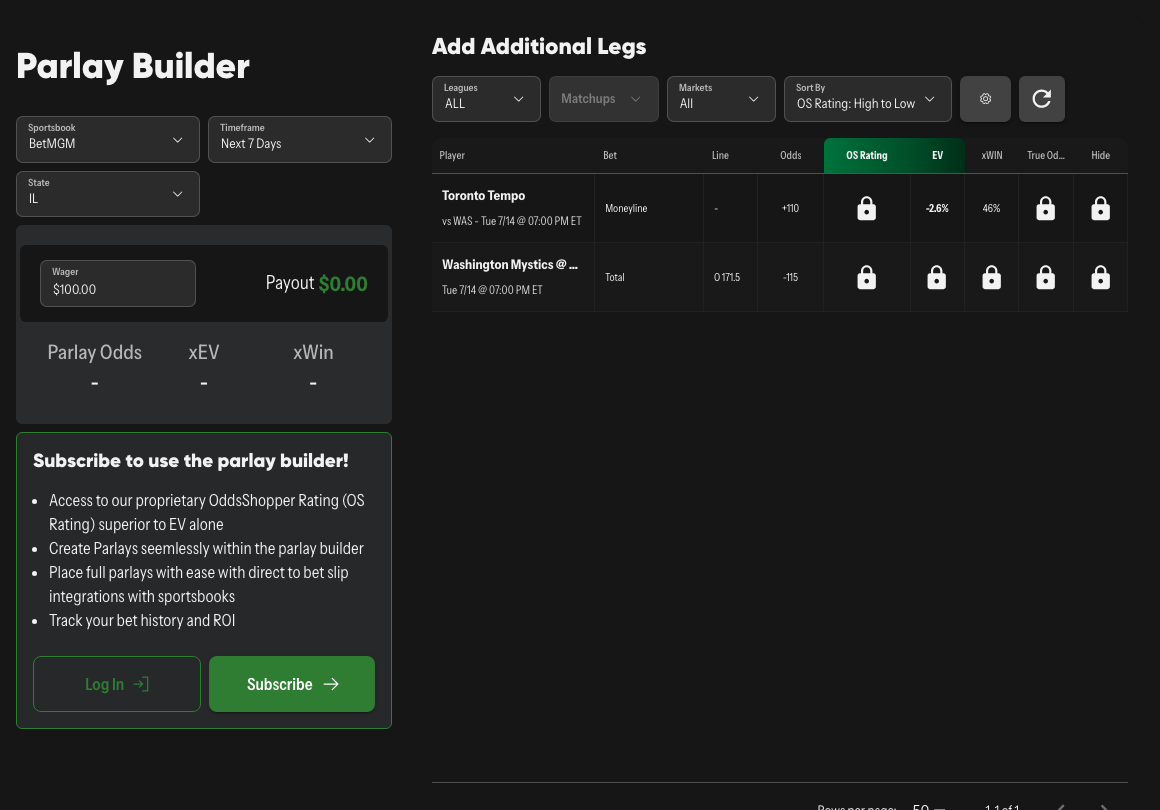 The OddsShopper Parlay Builder — every leg graded live (EV, xWin, true odds) before you lock a ticket. Open the live board.
The Quick Answer
Why did my bet get voided? Because the sportsbook cancelled the wager and returned your stake, as if the bet never happened, and the cause is almost always one of these: the event was postponed or abandoned, the player in your prop did not participate, a market was corrected against official data, a leg of your parlay voided and the ticket was recalculated, the bet breached a stated rule or limit, or the book ruled the price an obvious error under its palpable-error clause. That last one is the only controversial case, and it is the one where a bet you already "won" can be unwound.
OddsShopper exists for the pricing side of this problem: its Odds Screen shows what every major book is charging on the same market, which is exactly how you tell a great number from a mistaken one. You can try OddsShopper Pro free for 7 days, and code OS15 takes 15% off your first month if you stay.
Below: the four outcomes bettors mix up, all six void reasons in plain English, a worked palpable-error example from bet slip to refund, and the dispute options that actually exist.
A Void Is Not A Loss, A Push, Or A Rejected Bet
Before diagnosing your void, it helps to be precise about what happened, because bettors arrive at this question conflating four different outcomes that look similar on a statement and are treated completely differently by the book:
| What Your Account Shows | What actually happened | Where your stake went |
|---|---|---|
| Voided / Cancelled | The book accepted the bet, then unwound it under a specific rule | Returned in full, win or lose |
| Lost | The bet stood and the outcome went against you | Kept by the book |
| Push | The bet stood and landed exactly on the number (a 3-point favorite wins by 3) | Returned in full |
| Rejected / Not Accepted | The bet never existed; the book declined it at submission | Never left your balance |
The row worth pausing on is the push, because it is the one most often mislabeled as a void. A push is a bet that ran its full course and tied; a void is a bet the book erased under a rule, sometimes before the game, sometimes after settlement. The refund looks identical, but the mechanics are not. A push is the bet's own outcome; a void is the book overriding that outcome under a rule. A correctly graded push leaves little to dispute, while a void should always trace back to a written clause you can ask the book to name. So the real question is which clause got invoked on yours.
The Routine Reasons Bets Get Voided
Most voids are the settlement system working as designed, and none of these should worry you:
- The Event Was Postponed, Abandoned, Or Cancelled. Books set a window inside which a delayed game can still count, and the windows differ by sport and by book: some markets hold bets when the game completes within a stated number of hours of its original start, others void the moment the event slips past its scheduled day. Miss the window and bets on that game are voided and refunded; the exact hours live in your book's house rules, sport by sport, and an MLB rainout is the classic way to find out what yours say.
- Your Player Did Not Participate. On most player props at most U.S. books, a scratched starter or a healthy inactive voids the prop rather than grading it a loss. The fault line is how each book defines "participate," and that definition can be narrower than bettors assume: a scratched MLB starting pitcher is the clean void case, while a position player who takes one at-bat has usually participated, and some books void only if the player never enters the game at all. That definition varies by book and market, which becomes important later in this piece.
- The Market Was Settled, Then Corrected Against Official Data. Books grade off official league feeds. When a scoring change comes down, affected markets are usually regraded against the corrected result; a void happens in the narrower case where the correction removes the market's basis entirely, like a stat reassigned away from the player your prop was on.
- A Leg Of Your Parlay Voided (The Whole Ticket Wasn't). One postponed game does not kill the ticket; the voided leg drops out and the parlay re-prices at the remaining legs' combined odds. Your 4-leg ticket at +1200 becomes a 3-leg ticket at whatever those three legs multiply to. That recalculation is pure odds math, the same math the OddsShopper Parlay Builder runs when it assembles a ticket from positive-EV legs, so a shrunken payout on a reduced ticket is not the book shorting you.
- The Bet Breached A Stated Rule Or Limit. Stake caps on a market, eligibility rules, restricted-territory rules, or bets placed after an event's cutoff all get voided when caught, whatever the outcome would have been.
Every reason on that list is mechanical: an input to the bet disappeared, so the bet was unwound. Notice the pattern in all five, because it sets up the exception. In each case something outside the price broke. The sixth reason is different in kind: nothing about the game changed at all. The book is saying the price itself was wrong, and that is where the arguments start.
Palpable Error: The Clause That Covers Obvious Mistakes
Every major sportsbook's house rules reserve the right to void bets accepted at an obviously wrong price, usually under the name "palpable error" or "obvious error." The category covers things like an extra digit on a price (+2150 posted where the market says +215), a line attached to the wrong game or the wrong team, inverted prices between a favorite and an underdog, or a number that survived a data-feed failure. The clause is disclosed in the terms you agreed to at signup, it is standard across the industry, and in regulated U.S. states the operator's house rules run under the oversight of the state's gaming regulator.
Read plainly, the clause means this: a bet is an agreement at a price, and when the price was a clear mistake rather than an opinion, the book can unwind the agreement and return your stake, even after the bet has settled as a winner. What counts as "obvious" is the book's call in the first instance, which is exactly why the practical takeaway sits with you before the bet, not after it. An implausibly good number carries real risk of not standing. Whether that trade-off is written the way you would write it is for you to judge from the terms themselves; what matters for your bankroll is knowing the clause exists before a too-good number tempts you into planning around a payout that may get unwound.
The cleanest way to understand how one of these actually plays out is to walk through a whole void, start to finish.
A Worked Example: From Bet Slip To Voided In Three Days
Say it is a Sunday morning in the NFL season, and the Jets are a home underdog. You shop the market: at DraftKings, FanDuel, and BetMGM the board reads +215, +218, +220. One book is showing +2150. You bet $100 on the Jets at +2150, the Jets win outright, and your account briefly shows roughly $2,150 in profit. By Tuesday the bet reads "voided," and your $100 stake is back. Here is that timeline, stage by stage (the numbers are illustrative, but the shape is exactly how these cases run):
| Stage | What happens | What your account shows |
|---|---|---|
| Sunday, 10Am | You place $100 on the Jets at +2150 while the rest of the market sits around +218 | Open bet at +2150 |
| Sunday Night | The Jets win; automated settlement grades the ticket | Settled win: $2,150 profit, $2,250 total credit |
| Monday | A settlement review catches the price: +2150 posted where +215 belonged, an extra-zero typo under the obvious-error rule | Under review or unchanged |
| Tuesday | The bet is voided under the palpable-error clause and the stake returned | Voided, $100 back in balance |
What made this bet vulnerable was visible before kickoff, and this is the detail I keep coming back to: the number was not merely the best price on the board. Every other book had the Jets between +215 and +220, and this one said +2150. Go back to the four-outcome table above and note which row this lands in. Not a loss. Financially, the bettor ends with the original $100 back, though the reversed settlement and the days of counting money that was never going to stay are a real cost of their own. A price 5 or 10 cents better than the field is line shopping and it is the whole point; a price roughly ten times the field is almost never an opportunity. The market disagreeing with one book that hard is the signature of an error.
What You Can Do About A Voided Bet (And What You Can't)
You have more standing than the status screen suggests, but less than the angriest forum thread promises. In order:
- Ask support which rule was invoked. Request the specific clause from the house rules and the record of the price at the time your bet was accepted. Books should have both on file, and a request phrased as "which rule, and what was the accepted price" gives you the best chance of a usable written response, where "this is theft" gets a template.
- Check the explanation against the market. If the voided price was wildly off every other book at that timestamp, the error story checks out. A price that was in line with the market, on the other hand, is worth pressing on, politely and in writing.
- Escalate to your state regulator if the explanation does not hold up. Here is the payoff of betting in a regulated market, and the step most bettors never learn exists: regulated U.S. sports betting markets have a designated regulator that takes consumer complaints against licensed operators. The sequence matters. Most state processes expect you to exhaust the book's internal dispute route first and come away with a written decision, and some put a short filing window on complaints after that decision lands, which is why you ask for the determination in writing early. Depending on the state the regulator is a gaming commission, a lottery, a control board, or a consumer-protection agency, and tribal markets route disputes through tribal gaming authorities, so check who licenses your book. Filing is free, it creates a paper trail, and it is the appropriate venue for a dispute the book will not resolve. None of this promises a particular outcome, and none of this is legal advice; it is simply the mechanism that exists.
- Accept the boundary. When a price was properly ruled an error under the disclosed rules, the remedy is your stake back, not reinstatement of the typo price, and you already have it.
How To Make Voids Rarer
Two habits remove most void risk before you ever place the bet. First, know your book's participation rules before betting player props, because "my guy sat and the bet lost anyway" and "my guy sat and I got refunded" are both real policies depending on the book and market; 30 seconds in the house rules tells you which one you are holding. Second, treat a wildly off-market number as a warning, not a windfall. Line shopping wins you the extra 10 or 15 cents that beating the closing line is made of. What it does not do is hand out numbers an order of magnitude past the field; those are mistakes, not gifts.
Both habits need one input: knowing what the market price actually is. That is precisely what the OddsShopper Odds Screen does. It lines up live odds across every major book on one page and grades each against the no-vig fair price, the market's true number once the book's margin is stripped out (here is how the de-vig math works). The fair number is a benchmark, not a betting trigger: it tells you where the market thinks the price should be, which turns "this looks good" into "this is a measured few cents better than fair," the comparison winning bettors live by; how much better it needs to be before a bet is worth making is its own question. What the benchmark settles instantly is the other extreme: a price with no market anywhere near it is not value, it is a void waiting to be processed.
The market is how you tell a real outlier from a mistake that will not stand. OddsShopper compares every book's price against the no-vig fair number for you, free for 7 days, and code OS15 takes 15% off OS Pro after the trial.
Voided Bet FAQ
Can A Sportsbook Void A Winning Bet?
Yes, in specific disclosed circumstances, and palpable error is the big one: a bet accepted at an obviously wrong price can be voided even after it settles as a win, with the stake returned. Post-settlement changes can also follow official scoring corrections, though those usually land as a regrade rather than a void; unwinding the bet entirely depends on the book's house rules. What books do not get is an open-ended undo button: a void has to trace to a written house rule, the clause has to name a specific error, the book has to be able to show the price it accepted and where the market stood at that timestamp, and in regulated states the operator answers to its regulator for how the rules are applied.
Do I Get My Stake Back When A Bet Is Voided?
Yes. A void returns your full stake, as if the bet never happened; that refund is what separates a voided bet from a losing one. Cash stakes come back as cash. A wager placed with a bonus bet generally comes back as the bonus bet rather than cash, per the book's promo terms, and if you are sitting on returned bonus bets, the free bet converter shows how to hedge a bonus bet into cash and what share of its face value you can realistically expect to keep.
Can I Dispute A Voided Bet?
Yes, through a real sequence: ask support for the specific rule invoked and the accepted price, compare that explanation against where the market stood, and if it does not hold together, file a complaint with the authority that licenses the operator in your state (a gaming commission, lottery, control board, or consumer-protection agency depending on the state, or the tribal gaming authority in tribal markets). Attach the bet ID, the accepted price with its timestamp, and the book's written explanation; a documented complaint is the kind a regulator can act on. What no venue will do is reinstate a price properly ruled an error, so the honest goal of a dispute is testing whether the rule was applied fairly, not recovering the phantom payout.
Does One Voided Leg Void My Whole Parlay?
No. The voided leg drops out and the ticket recalculates at the combined odds of the legs that remain: a 4-leg parlay with one postponed game becomes a 3-leg parlay at the 3-leg price. The payout shrinks because the math has one fewer multiplier in it, not because you were penalized, and you can sanity-check the new number yourself by multiplying the decimal odds of the surviving legs. Only if every leg voided would the whole ticket refund.
More on this: Why Byron Donalds (R) Will Win The Florida Governor Primary · Are Prediction Markets Dangerous Gambling? Why They Feel Smarter Than A Bet · Why Ben Ray Lujan (D) Will Win The New Mexico Senate Race · Why Bert Mizusawa Will Win The Virginia Senate Race · Why Bill Hagerty Will Win The Tennessee Senate Race
The Undo Button, Read Calmly
Go back to the feeling that brought you here: a bet you may well have won, erased by a status word you had never thought about. You can now read that screen for what it is. A void is the settlement system hitting undo under a written rule, your stake is already back, and the cause was one of six things, five of them mechanical and one of them a mispriced number that was never going to stand. The playbook is short: get the clause, check it against the market, escalate to the regulator if it smells wrong, and stop chasing prices that are too good to survive. The bettors who almost never see this screen are not luckier; they simply know what the market price is before they bet, take the best real number on the board, and let someone else bankroll the fantasy that a typo is a retirement plan. That market view is the product: try OddsShopper Pro free for 7 days, and code OS15 takes 15% off your first month if you stay.
21+ only. Sports betting is legal only in regulated U.S. markets where available. Nothing here is legal or financial advice; bet within a bankroll you can afford, and if it stops being fun, call 1-800-GAMBLER.