Here is the part the guys selling $99 pick packages don't want to admit: the real answer to how to beat the sportsbook has nothing to do with being smart. You need a repeatable edge, one process you run over and over until the math tips in your favor. The bettors who quietly win, year after year, almost never win by being geniuses. They win by picking one of a small number of proven approaches and staying disciplined about it.
There are five of these approaches, and every profitable sports bettor I know lives inside at least one of them. By the end of this piece you will know which of the five fits your time, your temperament, and your bankroll, and which one is the easiest to start copying today. None of them require you to out-handicap the entire market. They just require you to stop betting like everyone else.
In Summary
- You Don't Have To Be Smart To Beat The Book, You Have To Be Repeatable. Winning sports bettors run one repeatable process, not a hot streak.
- The Bonus Hunter milks profit boosts and +EV promos on bets they were making anyway. Lowest-hanging fruit there is, with one trap: skip the pre-made parlay boosts, they're usually still minus-EV.
- The Originator builds a private edge in a soft, niche market. High ceiling, but time-consuming, and deadly if you're feeding it bad data.
- The Market-Based Bettor does zero handicapping and lets the odds themselves reveal the value. This is the lane OddsShopper's tools are built for, and it's the simplest of the five to start.
- The Tailer follows a proven sharp for a cut of their edge. It works, as long as you vet the person first, because the space is full of frauds.
- The Arbitrageur locks both sides of a mispriced market to bank a profit on either outcome. Real edge, real headaches: big bankroll, fast limits, and you have to beat the line move.
Watch The Video
The full rundown of all five bettor types, with the honest catch attached to each, is in the original OddsShopper video — watch it on YouTube at the link below. (Pictured is the kind of arbitrage screen bettors use to spot these mispriced markets.)
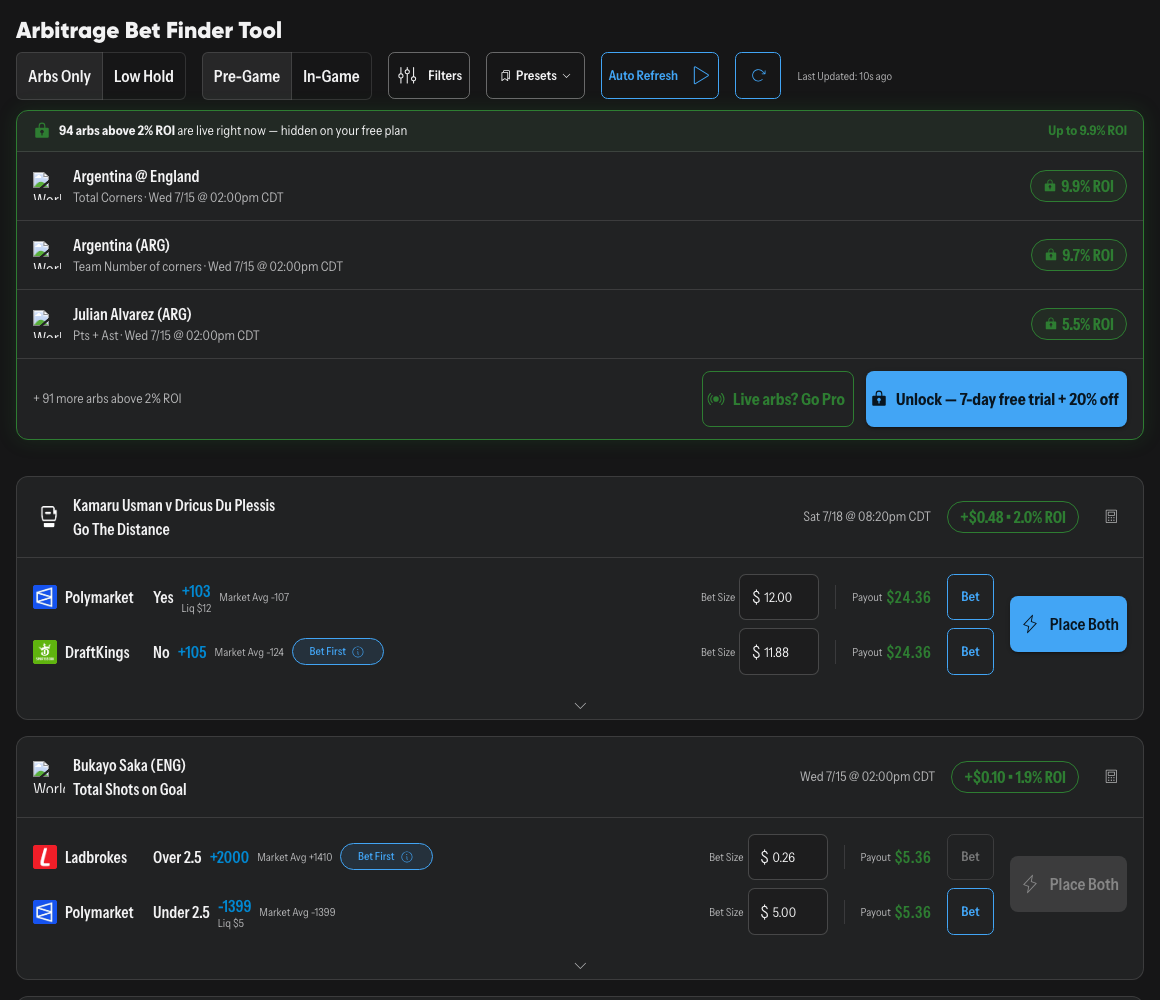
The OddsShopper Arbitrage Tool.
1. The Bonus Hunter: The Lowest-Hanging Fruit In Betting
It's the easiest, lowest-hanging fruit in all of betting, and you should pluck it straight off the sportsbook's branches. Keep accounts open on every book you can, then always take advantage of their profit boosts and +EV promotions. The logic is almost too simple: you were going to place the bet anyway, so why not place the more profitable version of it?
Say you were about to bet $50 on a moneyline at +120. That's a $60 profit if it hits. Apply a 30% profit boost to the same ticket and your win jumps to $78 for the identical bet. You did nothing different except attach a promo to a wager you already liked. Do that consistently and it won't make you rich, but it will absolutely build your bankroll from the side, one boosted ticket at a time.
There's one catch, and it's the difference between a real edge and a leak: run like the plague from the pre-made parlay boosts. Those flashy "boosted" multi-leg specials the book pushes to the top of the app are almost always minus-EV even after the boost, because the book started from a bad price and gave you a small discount on it. A boost only helps when the underlying bet was fair to begin with. If you want to understand which promotions actually move the needle, our guide to odds boost strategy breaks down the good from the bait, and are free bets worth it does the same for free-bet offers.
2. The Originator: Build Your Own Edge In A Soft Market
The originator takes a different tack than the bonus hunter. Where the bonus hunter leverages the offers the book hands out, they manufacture their own bets from an angle nobody else is working. You don't need to be a genius to do it, you just need one thing the rest of the market doesn't have.
For some originators that edge is situational, like understanding NBA rotations and playing time better than anyone else in the market. For others it's a niche corner of the board, some soft, low-attention market they dive into until they're the resident expert. When you're actually good at it, origination is the most profitable of the five, because you're finding value before the market has priced it in at all.
It also comes with the two biggest catches on this list. First, it is wildly time-consuming if you're not automating your research, hours of work for edges that decay fast. Second, and this is the one that quietly ruins people, originators constantly build bets on garbage data and stats without realizing it, then wonder why a "profitable" model bleeds money over a full season. Your edge is only as good as the inputs behind it. If you want to walk this path the right way, start with a real process for finding +EV bets instead of a spreadsheet full of numbers you can't trust.
3. The Market-Based Bettor: Let The Odds Do The Work
Remember the promise up top, that one of these five is far simpler to start than the rest? This is it, and it's the method the creator behind the video uses for a huge share of his own bets.
The market-based bettor does essentially zero traditional research. No poring over stats, matchups, and injury reports. Rather than try to out-think the market, you let the market tell you where the value already is. The idea is that when two sportsbooks disagree on a price, one of them is out of line, and the better-priced side can be a positive-expected-value bet once you compare it to a fair, no-vig estimate of the true odds. You're not predicting anything. You're just harvesting the disagreements.
How well does it work? The creator reports clearing roughly $6,000 in profit last month on under an hour of work a day, and he says he uses OddsShopper's tools to do it. That's one bettor's personal result, not a typical outcome and not something you should expect to match, but it shows what the style is built for: it scales with software, not with hours. The tool scans every major sportsbook in real time, compares each price to a fair, no-vig baseline, and surfaces the bets where you're getting the better of it. You can see the raw version of this on the live odds screen — shop the number across every major book, where the same market can be priced differently from one book to the next, and OddsShopper's Portfolio EV tool is what turns that spread into a ranked list of +EV plays.
A Worked Example: Two Books, One Wrong Price
Numbers make this concrete. Say the pick is a favorite moneyline. At the sharpest book on the board, that favorite is priced at -120 and the underdog at +100. Strip the vig out of that two-sided market first: -120 implies a 54.5% win probability and +100 implies 50%, and those two add up to 104.5% instead of a clean 100% — that extra 4.5% is the book's hold. Divide the favorite's 54.5% by that 104.5% total and the fair, no-vig chance the favorite wins is about 52%, which is roughly -108 in fair odds.
Now you scan the rest of the board. A slower book still has that same favorite at +100 — a 50% implied price on a team the market says is really 52% to win. That gap is the whole game: you're being paid as if it's a coin flip on a bet that's better than a coin flip. The edge isn't a prediction about the game; it's the disagreement between the two prices, and it lasts only until the slow book catches up. This is exactly the mispricing a market-based bettor lives on, whether it's an NBA moneyline, a player prop, or an NFL spread where a half-point of shopping swings the whole ticket. The tool surfaces those gaps across every book in real time so you're not clicking through 12 apps to find the one that's slow.
New to the market-based approach?OddsShopper scans every major sportsbook in real time and flags the bets priced in your favor, so you skip the handicapping and just bet the disagreements. Try it free for 7 days, and code EDGE20 takes 20% off OS Pro if you subscribe.
If you'd rather see the mechanics behind it first, how to use the OddsShopper odds screen walks through reading the board the way a market-based bettor does.
4. The Tailer: Ride A Proven Winner
The tailer isn't a tuxedo fitter. It's the bettor who follows someone else's plays for a profit, and there is nothing wrong with it. As long as you're making consistent money betting sports, it does not matter how you got there, you've found an edge. Even if that edge is simply riding the coattails of a sharp, profitable bettor, it counts. Plenty of sharps are profitable enough over a big enough sample that patiently tailing them can work, as long as you vet the record first — though no edge is certain to hold forever. Who cares if it isn't the most impressive way to win.
Here's the obvious catch, and it's a big one: the space is crawling with scammers and frauds selling fake records. Before you hand anyone your hard-earned money, vet them 100%. This is the same discipline the originator needs with data, applied to people instead: your results are only as trustworthy as the source behind them.
The vetting rulenever pay for plays off a wall of cherry-picked screenshots. Demand a verified, long-term track record before you tail anyone with real money.
To separate real sharps from sellers, read how to follow sharp money, and what is the Tails betting app covers how to tail transparent, track-recorded experts instead of anonymous accounts. If you want to see what a vetted, track-recorded read looks like before you tail anyone, our free expert picks today are posted with the reasoning attached.
5. The Arbitrageur: Lock In A Profit On Both Sides
The arbitrageur, or "arber," takes the market-based idea to its logical extreme. Arbitrage is a type of betting where you lock in a profit on both sides of an event whenever two sportsbooks post odds that are misaligned with each other, the kind of gap that opens on a player-points prop when one book is slow to update its number.
Here's how the mechanic works, with illustrative numbers. Say one book prices the over on a points prop at +105, and another book prices the under at +105. Bet $100 on each side, $200 at risk total. Whichever result hits pays back $205, so you clear $5 no matter what happens on the court. When the two prices are misaligned far enough that both sides pay out more than they should, the profit is locked the moment you place both tickets.
That two-sided profit is real, but it comes with serious drawbacks, and this is why arbitrage sits last on the list rather than first:
- You Need A Large Bankroll. The edges are tiny percentages, so it takes real capital to turn them into meaningful money.
- You Will Get Limited Quickly. Books hate arbers and cut their bet sizes fast once they're flagged.
- You Have To Beat The Line Move. If you don't lock both sides before the odds shift, you're left holding a naked, unhedged position, and your would-be profit becomes a coin flip.
If the concept appeals to you, arbitrage betting explained covers the full mechanic, and is arbitrage betting legal answers the question everyone asks next.
Which Bettor Should You Be?
Five approaches, five very different demands on your time, money, and skill. Here's how they stack up:
| Bettor Type | Research required | Bankroll needed | Time per day | Best for |
|---|---|---|---|---|
| Bonus Hunter | Low | Low | Low | Quick, no-brainer value |
| Originator | Very high | Low | High | Deep-niche specialists |
| Market-Based | Very low | Medium | Low | New bettors who want low research — start here |
| Tailer | Low | Low | Very low | Bettors who can vet a sharp |
| Arbitrageur | Medium | High | Medium | Bettors with capital and patience |
The row I keep coming back to is the market-based bettor: very low research, low daily time, and a medium bankroll is enough to get going. It's the rare approach that asks almost nothing of your handicapping ability and hands the hard part to a tool, which is exactly why it's the one I'd point a new bettor toward before any of the others.
Notice too that four of the five archetypes lean on the same underlying skill: recognizing when a price is out of line. The bonus hunter needs it to spot a boost worth taking, the market-based bettor lives on it, the tailer is outsourcing it to a sharp, and the arber is exploiting it in real time. Only the pure originator tries to build value from scratch, and that's precisely why it's the hardest road. Beating the sportsbook, at its core, is one skill wearing five different outfits.
The Bottom Line
You were never losing for lack of brains, you were losing for lack of a process. So pick the one that fits you, and the decision is short in every lane: grab the boosts today because it's free value you're already leaving behind; run market-based tools if you want an edge without the research; only originate if you can trust your own data; and only arb if you have the bankroll and the speed to beat the line move. Every one of the five beats the book with an ordinary brain and unusual discipline about one repeatable thing.
If you want the shortest path from "betting for fun" to "betting with an edge," the market-based lane is it: let the odds do the work you used to do by hand. Remember the two-book gap from the worked example above, the slower book still paying +100 on a team the market had at 52%. That gap is the whole game: find the price that's wrong, and bet it before the book fixes it. For a wider view of the toolkit, our sports betting strategy hub ties these approaches together.
Start where the edge is easiest to grab.OddsShopper scans every major sportsbook in real time and flags the +EV bets automatically, so the market-based approach takes minutes, not hours. Try it free for 7 days, then code EDGE20 takes 20% off OS Pro.
See today's edges free Bet responsibly, 21+ where legal.
Frequently Asked Questions
Do you have to be smart to beat the sportsbook? No. Winning bettors rarely out-think the whole market. They pick one repeatable edge, like hunting bonuses, tailing a proven sharp, or betting market disagreements, and run it with discipline. The process does the work that raw intelligence can't.
What is the easiest way to start beating the book? Bonus hunting is the lowest-hanging fruit: keep accounts on multiple books and attach profit boosts and +EV promos to bets you were already making. Just avoid the pre-made parlay boosts, which are usually still minus-EV even after the boost.
What is a market-based bettor? A market-based bettor does almost no traditional research. Rather than handicap games, they let disagreements between sportsbooks reveal which prices are off, then bet the side that's better than its true odds. Tools like OddsShopper scan every major sportsbook to surface those +EV bets automatically.
Does arbitrage betting really lock in a profit? Only under specific conditions: when both sides are placed at the quoted prices before either line moves, arbitrage produces a fixed payout no matter the result. In practice it's harder than it sounds, because you need a large bankroll, books limit arbers quickly, and if the line moves before you place the second leg, that edge disappears.
Is tailing another bettor a legitimate strategy? It can be, if the person you're following is a proven, profitable sharp over a long, verified sample. The danger is the flood of scammers selling fake records, so vet anyone completely before risking money, and favor experts with transparent, tracked results over anonymous screenshots.
More on this: Why Is My Sportsbook Withdrawal Pending? What It Means · Best Sportsbook Promos: Which Ones Are Really Worth It · Sportsbook Hold Calculator: Beat The Vig When You Bet · Beat The Sportsbooks With A Small Bankroll · Best Sportsbook Promos This Week