Yesterday I wrote about winning on PrizePicks at $5 a card after the app limited my account, and the one thread from that piece that deserves its own article is correlation. It is the highest-leverage idea in pick'em, it survives any account limit, and it fits in five honest questions. The fourth question is the one where players quietly leak money.
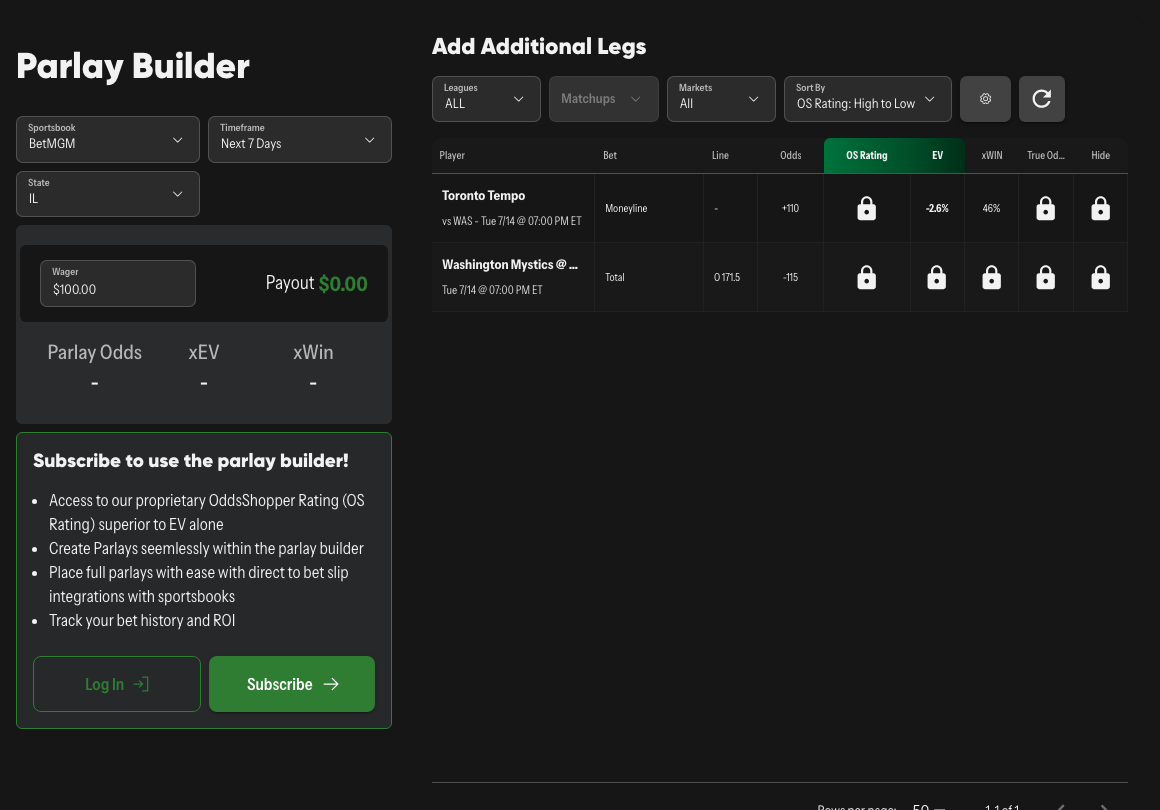 The OddsShopper Parlay Builder — every leg graded live (EV, xWin, true odds) before you lock a ticket. Open the live board.
The Quick Answer
PrizePicks entries are parlays at heart, so every leg you add lowers the chance the card cashes. The counterweight is that many statistically correlated combinations, like two teammates' production lines in the same rally-friendly park, still pay full multipliers, the exact thing a sportsbook same game parlay reprices against you. Below: the parlay math, a real four-bat MLB build, and the two-step payout double-check most players skip.
Are PrizePicks Entries Just Parlays?
In essence, yes. A power play needs every leg to hit, and a flex play pays a reduced ladder when one leg misses, which makes both of them multi-leg tickets whose difficulty compounds with size. Need the refresher on how the power and flex formats differ? The short version is that the payout table is doing parlay math either way.
The numbers from my limits piece show the shape of it. A 3-pick power returns six times the stake in total, and running that table backwards, each leg has to hit about 55 percent of the time to break even, roughly a -122 price per pick. Stack six legs instead of three and a perfect card becomes far rarer, which is why the 6-pick flex pays 25 times the entry for running the table. More legs means a bigger number and a smaller chance of seeing it. So why would anyone who respects that math keep building six-leg cards? Because of the next question.
Can You Correlate Picks On PrizePicks?
Yes, and the seam is where the whole strategy lives. Sportsbooks tax correlation aggressively: bundle a quarterback with his receiver in a same game parlay and the book generally reprices the ticket before you submit. On PrizePicks, some combinations are blocked or carry downgraded payouts, but plenty of statistically correlated combinations still pass through at the full multiplier. Legs that win together and lose together, paid as if they were independent coin flips, tilt the table toward you. A rally in one lineup lands on consecutive hitters as a cluster, so a leadoff single becomes the next man's RBI becomes the third man's run scored, and hits+runs+RBIs squares on those bats ride the same wave.
New to OddsShopper? Our tools compare every major sportsbook's prices against pick'em boards and flag the squares priced in your favor, which is the double-check this whole article teaches by hand. The trial is free for 7 days, and code LINDY25 takes 25% off your first week or month after that.
What Does A Correlated MLB Card Look Like?
Take the 6-pick flex I walked through in yesterday's article, $5 to pay $125 on a perfect card. Four of the six legs were bats in one game, Twins at Athletics at Sutter Health Park, two hitters from each side, all on more than 1.5 hits+runs+RBIs. One hitter-friendly park and one high-scoring night pull every bat in the game upward at once, and each same-team pair can still cluster inside its own batting order. The other two legs were one-off plays in strong spots of their own, because a correlated core does not excuse filler around it. The blueprint travels to any MLB slate: find the game most likely to turn into a track meet, load correlated bats into it, and surround them with legs you would play on their own merits. Our entry builder walkthrough covers the mechanics of assembling the shell.
How Do I Double-Check The Payout Before I Submit?
Here is the question where the money leaks, and the answer is two checks that take under a minute. Correlation helps you only when the payout table survives with limited to no downgrade, so verify that before anything else.
| The Check | Sportsbook same game parlay | PrizePicks card |
|---|---|---|
| How Correlation Is Priced | The book generally reprices the ticket, so correlated legs shrink the payout | Some combos are blocked or downgraded, many pass at the full multiplier |
| What The Slip Shows | One adjusted combined price | The standard payout table, unless your combo was demoted |
| Your Job Before Submitting | Compare the ticket price to the legs multiplied separately | Confirm the full multiplier survived, then price every leg against the books |
The row that matters most is the middle one. The slip tells you everything before you submit: if your 6-pick flex is not showing the standard full table, the app has demoted your combination and the math has changed, so rebuild the card until the full table comes back. The second check is the price of each leg. On the standard power and flex cards this article builds, every square implies a price in a roughly -118 to -122 window, and DraftKings, FanDuel, and BetMGM quote the same player markets all day, which makes the de-vigged book price, the fair number with the sportsbook's cut stripped out, the measuring stick. Our PrizePicks board screen runs that comparison for every square, and I keep the live odds screen open beside it to shop the number across every major book and see which game environments the market believes in. Remember that pick'em lines move for reasons, so a number you priced this morning deserves a second look at night.
More on this: PrizePicks Limits: How I Still Win MLB Entries At A Card · PrizePicks MLB Strategy: Price Every Line Before You Play · Free PrizePicks Optimizer Guide · PrizePicks Entry Builder: Build +EV Picks, Not Guesses · PrizePicks Power Play Vs Flex Play: Strategy Guide
When Should I Skip The Correlation?
When the legs cannot stand on their own. Correlation is a bonus on top of picks that already clear the price bar, never a substitute for them, and a six-leg stack of bad prices is six bad bets holding hands. Skip it too when the only version the app accepts is a downgraded one. And watch the direction of the correlation: hitter overs on both sides of one game can ride the same run environment, the way yesterday's four-bat build did, but a pitcher's strikeout over paired with production overs from the bats he faces is a card fighting itself, and so is any build that needs one leg's shootout and another leg's pitching duel. The discipline from yesterday's piece carries the day here: no leg earns a slot until the book market says its side clears the pick'em breakeven.
The whole framework fits in a pocket, and none of it needs my account history to work. Cards are parlays, correlation is the one lever that fights the parlay math for free, and the double-check makes sure it stays that way. If you want live cards to measure your own builds against, the OddsShopper crew posts free expert picks today every slate.
Stop guessing whether a square is priced in your favor. OddsShopper Pro compares pick'em boards against every major sportsbook and flags the legs worth building around, free for 7 days, with code LINDY25 good for 25% off your first week or month after that.