If you play PrizePicks, the first real decision you make on every slip is not which players to pick. It is what kind of entry to build. The PrizePicks Power Play vs Flex Play choice comes first, then, on each leg, a standard line, a goblin, or a demon. Most players pick by feel, and that feel is exactly what the house is counting on. I look at every one of these choices the same way I look at any bet: which option is priced in my favor over time. It is the same portfolio mindset behind every card on Live With Lindy — no slip stands alone, each pick is a position you either want or you don't. This guide walks through Power vs Flex and demons vs goblins the way an edge-focused player actually thinks about them, and shows where the OddsShopper Pick'Em Entry Builder does the math for you. Stick with me to the end, because one of the most consistently underpriced edges on any PrizePicks board is not the entry type at all — it is correlation, and I will come back to it.
In Summary (TL;DR)
- Power Play pays more but every pick must hit. It is a parlay, so its value is the combined edge of its legs. Add one bad leg and you drag the whole slip down.
- Flex Play pays out partially if you miss a leg. You trade top-end payout for lower variance. That is a bankroll and variance choice, not a "safer" free lunch.
- Goblins And Demons Are Payout Adjustments, Not Value Signals. A goblin is an easier line for a smaller payout. A demon is a harder line for a bigger one. Neither is good or bad until you compare the adjusted payout to the true probability.
- The Only Question That Matters On Every Leg Is Whether It Is +EV once you de-vig the market and account for the payout. That is the same discipline that separates the small minority of long-term winners from everyone else.
- Correlation Is An Edge PrizePicks Often Underprices — but only when the displayed payout has not already been adjusted for it. In a Power Play, picks that tend to move together can raise your real hit rate; always check the final multiplier, since PrizePicks discounts or restricts some same-game combos.
Power Play Vs Flex Play: What Actually Differs
A Power Play is all or nothing. Pick 2 to 6 players, and every single leg has to land for the slip to cash. In exchange, the multiplier is higher. Mechanically, this is a parlay, and that matters more than it sounds.
A Flex Play softens the all-or-nothing math. On larger entries you can typically miss a leg and still collect a reduced payout. You are buying a partial safety net, and you pay for it with a lower top-end multiplier. (For the exact payout math behind each entry size, our friends on the DFS side break it down in how PrizePicks multipliers work.)
| Entry Type | Every leg must hit? | Miss-a-leg outcome | Top-end payout | Variance | Best when |
|---|---|---|---|---|---|
| Power Play | Yes | Whole slip loses | Higher multiplier | Higher | Every leg clears the +EV test |
| Flex Play | No (larger entries) | Reduced payout | Lower multiplier | Lower | One leg is shaky and you want to cut variance |
The row that trips people up is the Flex "miss-a-leg" cell. It looks like free insurance, but you are financing that reduced payout out of your own multiplier — it is a trade, not a gift. The exact multipliers, entry-size limits, and how many legs a Flex entry lets you miss all shift over time and by sport, so always read the current board in the app before you build; treat any number you remember from last month as stale.
Here is the trap. Flex feels safer, so newer players default to it on slips where every leg is already strong. If you believe all of your legs are priced in your favor, the higher Power multiplier compounds that edge, and Flex leaves money on the table. Flex earns its keep when you are less sure of one leg and want to cut variance, not as a blanket "play it safe" setting.
The Only Question That Matters: Is The Pick +EV?
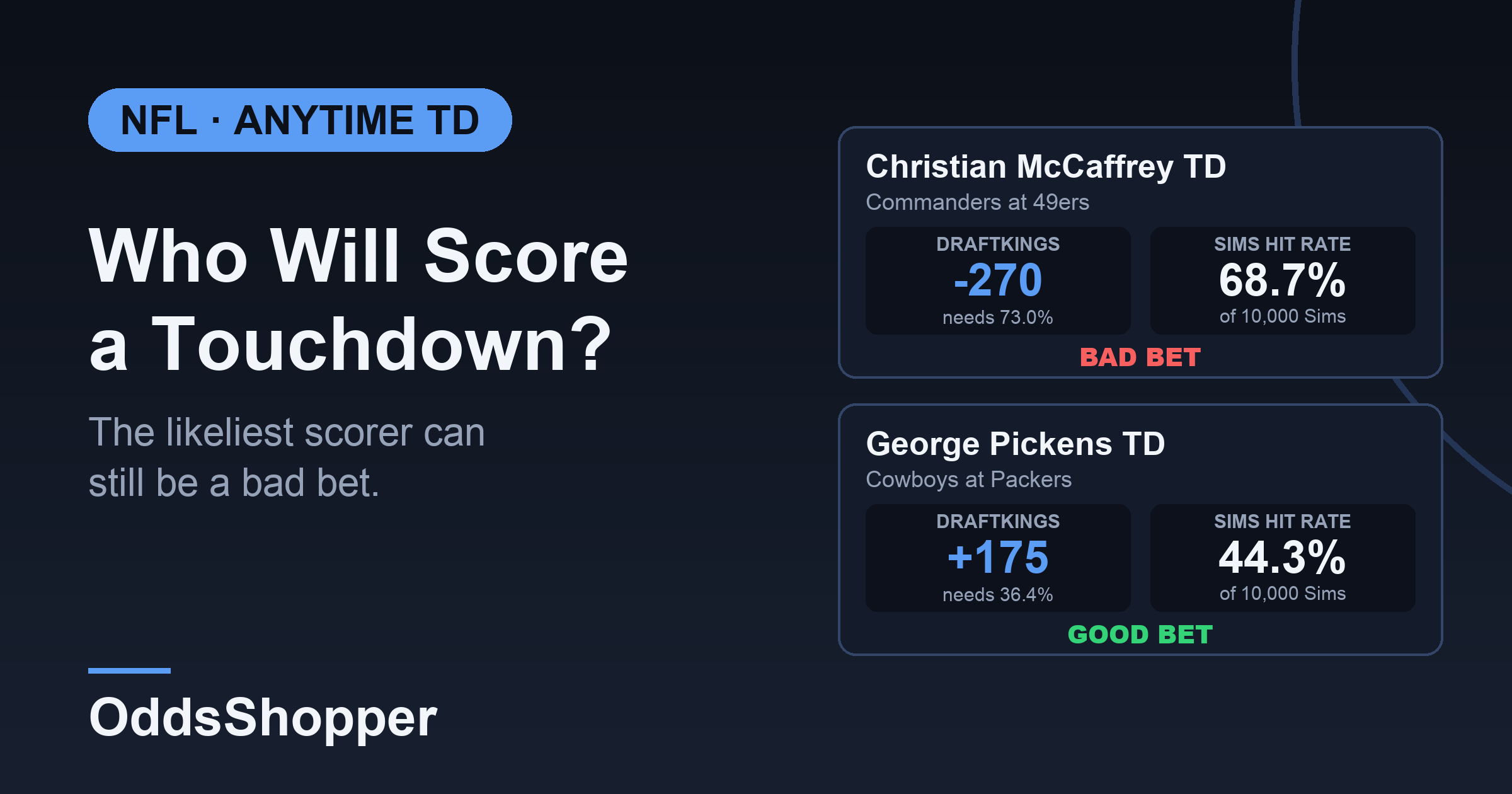
Expected value is the whole game. A pick is +EV when the real probability it hits is higher than the payout implies. PrizePicks has been shifting real-money play toward its peer-to-peer Arena format, where Power Play and Flex Play act as the payout structures inside skill-matched pools rather than a pure against-the-house line; where entries still run against the house, the framing is the classic fixed-payout pick'em. Either way the math for you does not change: the payout on a random slip is set below fair, the way any operator builds a margin into its product, so the default state of a random slip is negative EV. You beat it by finding the spots where a line is soft relative to the true number.
The honest way to find the true number is to de-vig the market. Take both sides of the same prop at an efficient sportsbook, strip out the vig so the two implied probabilities sum back to 100%, and you have a no-vig fair price to measure the PrizePicks line against. Do that leg by leg and you separate the picks where PrizePicks is a step behind a moving line from the ones where it is priced dead-on. You can run the raw math yourself with our EV calculator, but doing it across a full board by hand is where it falls apart.
That is exactly what a PrizePicks optimizer is for. The OddsShopper Pick'Em Entry Builder compares each PrizePicks line to the sharper market — the de-vigged consensus across efficient sportsbooks that serves as the fair-odds proxy — and to our projections, then flags the picks where you are getting the better of the number. The tool surfaces only the mispriced legs; it skips the rest of the board so you are not guessing which players feel good. Most of any given board is priced about right and simply is not worth an entry, so selectivity is itself part of the edge — and catching a line before it moves, then holding your number as the market catches up, is the closing-line-value habit every winning bettor lives on.
In a Power Play this is non-negotiable, because a parlay multiplies the EV of its legs. Stack 3 +EV picks and you compound an edge. Slip in one leg that is negative EV because it "completes the card," and you compound that loss right back into the slip.
Demons And Goblins: Payout Adjustments, Not Free Value
PrizePicks dresses some lines up as demons and goblins, and the names do a lot of psychological work. (If the terms are new to you, here is the full primer on what demons and goblins are at PrizePicks.)
- A goblin is an easier line, set closer to or below the projection, and it pays less. It looks like safe value.
- A demon is a harder line, set further from the projection, and it pays more. It looks like cheap upside.
These are special projections, and PrizePicks sets which direction each one can be played and can change that, so confirm what is actually available in the app before you build — do not assume a standard More/Less choice on every one. Both framings are bait if you take them at face value. The right move is the same as evaluating a boost on a sportsbook: the adjustment only helps if the new payout more than covers the change in true probability. A goblin that drops the payout more than it raises your real hit rate is a bad deal even though it cashes more often. A demon that pays a premium worth more than the drop in hit rate is a real edge.
Worked Example: Goblin, Standard, Or Demon?
Say PrizePicks lists a star guard at Over 24.5 points as a standard pick, offers a goblin at Over 21.5 for a reduced payout, and a demon at Over 28.5 for a boosted one. The question is never which one feels comfortable. It is which version, at its specific payout, beats the player's true scoring distribution. If our projection and the de-vigged market both peg his true line near 25 points, the standard Over 24.5 is close to a coin flip, the goblin at 21.5 should hit far more often than its smaller payout implies it needs to, and the demon at 28.5 needs a real leap that its premium may or may not pay for. Run that same check on every leg and the right pick usually is not the one that felt obvious. That comparison is tedious to do by hand across a full board, which is the entire reason the optimizer exists.
Stop guessing which goblin is "safe."The OddsShopper Pick'Em Entry Builder compares the available standard, goblin, and demon projections against the de-vigged market and our own numbers, then surfaces the spots that grade out +EV. Use code FLEXPLAY20 for 20% off your first OS Pro payment.
When Power Play Wins, And When Flex Wins
Once your legs clear the +EV test, the Power vs Flex call is about variance and bankroll, not safety.
- Lean Power when you are confident every leg is +EV and you are sizing the entry small enough to ride out the swings. The higher multiplier is where the long-run profit lives.
- Lean Flex when every leg still clears your +EV threshold but you want lower variance or a smaller downside profile — not as a place to hide a weak leg. If a leg is negative EV, the move is to cut it, not to cushion it inside a Flex entry.
Size each entry to your edge, not to how excited you are about the slip. A common, sober rule of thumb is risking only 1% to 2% of your bankroll per entry so that a normal cold streak, which every +EV approach goes through, never knocks you out of the game. Judge results over a large sample — dozens of slips, not one — never off last night.
Correlation: The Edge PrizePicks Underprices
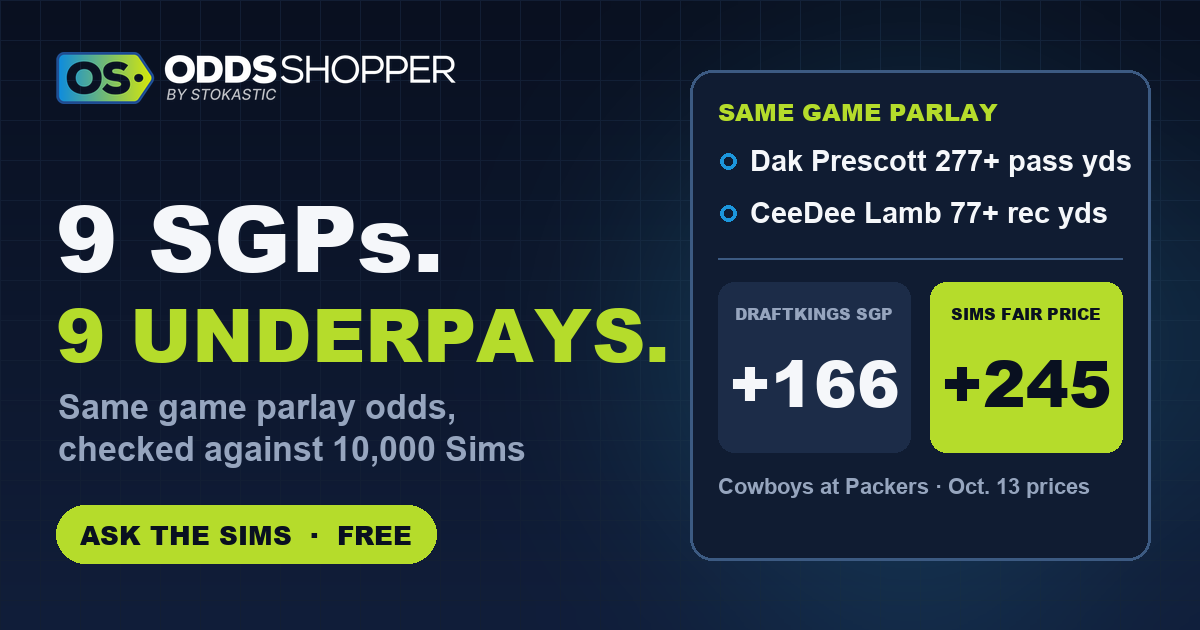
This is the part most guides skip, and the payoff to the promise I made up top. In a Power Play, where everything must hit, picks that tend to rise and fall together quietly raise your real probability of sweeping the slip. A quarterback going over his passing yards and his top receiver going over receiving yards is not two independent events. When the offense pops, both tend to land.
Sportsbooks know this and tax it heavily inside same-game parlays, pricing the correlation into the payout. Correlation can still be an edge on a pick'em entry — but only when the displayed multiplier has not already adjusted for it. PrizePicks now discounts the payout on some same-game and same-team combinations, and restricts others outright, so the move is not "stack any two correlated overs." It is to find correlated pairs the board still lets you play at a payout that has not fully priced the link, and to check the final multiplier before you submit. Picture a Power Play that pairs a quarterback's passing yards over with his number-one receiver's receiving yards over. When that passing game gets going, both tend to land together, so your real chance of sweeping the pair is higher than if you treated them as two unrelated picks. The flip side is the risk you accept: if the script turns run-heavy or the offense stalls, they tend to miss together too. It is not a sure thing, and PrizePicks may cap or reprice the combo — so verify it on the current board, where the optimizer surfaces only the correlated pairs you can actually build.
New to the Stokastic side?If you build cards on Underdog and Sleeper too, the Stokastic Prop Tools project every PrizePicks and Underdog player, blend in the market, and rank the whole board by expected win rate — so your legs start from real edges, not hunches. Try them free, then use code PROPS10 for 10% off your first payment.
How I Build An Entry
- Pull the full board into the optimizer. Start from the picks the Pick'Em Entry Builder flags as +EV against the de-vigged market, not from players you have a hunch about.
- Cross-check the number. For any leg I am unsure of, I open the live player-prop odds — shop the number across every major book to see where the sharp price on that exact prop actually sits before I trust the PrizePicks line.
- Check standard vs goblin vs demon on each. Take whichever version is most +EV at its payout, and drop legs that do not clear the bar.
- Look for correlation among your +EV legs if you are building a Power Play.
- Choose Power or Flex based on how confident you are and what your bankroll can absorb.
- Size the entry small — 1% to 2% of bankroll — and track every slip so you are grading yourself on the long-run sample, not last night.
If you would rather ride someone else's homework on a given night, our free expert picks today show you what the OddsShopper analysts are actually playing, with the reasoning attached.
FAQ
Is a Flex Play safer than a Power Play? It lowers variance because you can miss a leg and still collect a reduced payout, but you pay for that with a smaller top multiplier. It is a variance trade, not free safety. If every leg is strongly +EV, Power has the higher long-run value.
Are goblins the smart, safe play? Not automatically. Go back to the worked example: a goblin that drops a guard's line from 24.5 to 21.5 cashes far more often, but if the payout falls by more than the hit rate rises, you are paying for safety you do not need. A goblin is only value when its reduced payout still beats the true, de-vigged probability of that easier line. Some clear that bar, many do not.
What is a demon on PrizePicks? A demon is a harder line that pays a premium. It is worth taking only when that premium more than makes up for the lower chance of hitting, the same way a boost is only good once the bet clears +EV.
Does correlation help in a Flex Play? Less than it helps in a Power Play, and it can even work against you. Correlated legs tend to all hit or all miss together, which pushes results toward the extremes — great for a Power Play that needs a clean sweep, but it undercuts the whole point of a Flex, whose partial-payout tiers reward spreading your risk so a single miss still cashes. Save your correlated pairs for Power Plays; build Flex entries from legs that move more independently.
How do I know which picks are +EV? Compare each PrizePicks line to the de-vigged sharper market and solid projections. The OddsShopper Pick'Em Entry Builder does that across the whole board and flags the mispriced picks for you. If you also play the other apps, our PrizePicks vs Underdog vs Sleeper breakdown compares where the softest lines tend to live.
Is PrizePicks legal? PrizePicks is available in many U.S. states, but its product format, availability, and minimum age (18, 19, or 21 depending on where you are) all vary by jurisdiction and change over time. Check what is offered and the eligibility rules where you play, and stay within your means.
Build Smarter Entries
Come back to the choice we opened with. Power or Flex, goblin or demon, correlated or not — every one of them collapses into the same move: take the option that is priced in your favor after you de-vig the number, and skip the rest. Before you submit any slip, run the same five-step check I do: confirm the current multiplier in the app, cut any leg that does not clear your +EV threshold, check whether a same-game combo repriced the payout, pick Power or Flex based on the variance your bankroll can absorb, and only fire if the expected value still survives all four. The entry type just decides how you carry the edge; correlation is where it quietly compounds, and it is the reason a disciplined Power Play beats a nervous Flex more often than the "safe" label suggests. Doing all of that by hand across a full PrizePicks board is the hard part, and it is exactly what the tools are built for.
Find the +EV picks, the right entry type, and the correlation angles in one place with the OddsShopper Pick'Em Entry Builder. New members get 20% off their first OS Pro payment with code FLEXPLAY20.
More on this: PrizePicks Correlation FAQ: The 5 Questions That Matter · PrizePicks Limits: How I Still Win MLB Entries At A Card · PrizePicks MLB Strategy: Price Every Line Before You Play · Free PrizePicks Optimizer Guide · How To Play Boom Fantasy: Strategy & Promo Code OS7