I've watched sharp, disciplined bettors quietly hand back their first-half profit in August, and it almost never happens because their reads got worse. It happens because the game underneath the number changed and their bets didn't. MLB betting after the All-Star break is a different sport than the one you handicapped in April, and the single biggest mistake is refusing to admit it: you keep betting the team you scouted in the first half while the roster, the pitching staff, and half the league's motivation have all quietly moved on without you.
The Quick Answer
The biggest mistake in MLB second half betting is anchoring: pricing a team off its first-half stats, reputation, and record while the trade deadline (Aug. 3 in 2026), accumulating pitcher fatigue and innings caps, and the split between contenders and sellers change what you're actually wagering on. The sharpest books re-price those shifts within minutes. The crowd, the slowest books, and the lower-limit derivative markets lag behind, and that lag is where the value hides. The full breakdown below covers the three levers that do most of the damage, deadline roster turnover, tired arms and the first-five fix, and the second-half totals trap, plus a worked example of re-pricing an August favorite and the checklist I actually run before a second-half bet.
The Real Mistake: You're Betting A Team That No Longer Exists
Anchoring is the tendency to lean on the first number you learned and adjust too little from there. In baseball it's brutal, because a full-season stat line is a giant, comforting sample that feels like truth. By August, a starter's ERA is built on 20-plus outings, but if three of his best came in April against a lineup that has since traded away two bats, that number is describing a matchup that can't happen again.
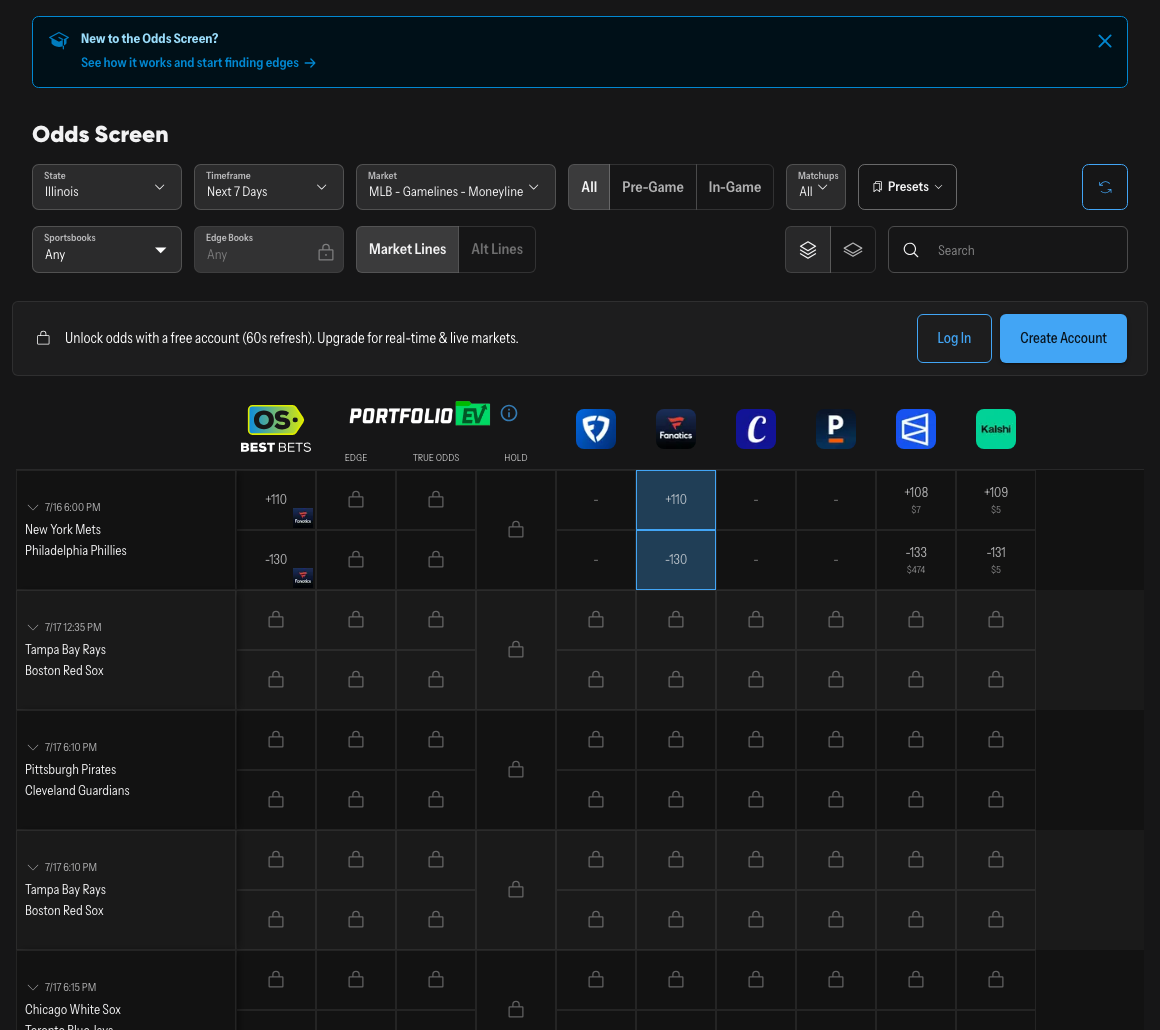
The OddsShopper Odds Screen.
The market knows this, but it knows it unevenly. The sharpest books move toward the current roster within minutes of the news. The crowd, the slower books, and the lower-limit derivative markets take far longer — especially first-five lines and team totals. That lag is the beatable part of the board. Your job in the second half is simpler than memorizing more trends: keep asking one question before every bet: am I pricing the team that takes the field tonight, or the one I met in the spring? Everything below is just the list of things that quietly change the answer.
The Trade Deadline Quietly Rewrites The Roster
The trade deadline, set each season between late July and early August (Aug. 3 in 2026), is the loudest event in the second half and the one bettors under-adjust to the most. A contender adds a shutdown reliever, and its late-inning win probability jumps in a way the team total and the slower derivative markets haven't fully absorbed yet. A seller ships its ace and its best hitter for prospects, and suddenly the "good pitching team" you've backed all year is throwing a bullpen game with a Triple-A call-up hitting cleanup.
Two habits protect you. First, treat the deadline as a hard reset on every team's profile, because the season-long numbers are now partly describing players who are gone. Second, respect bullpen changes as much as rotation changes. A pen that added a legitimate high-leverage arm is a different animal in the seventh and eighth, and this is precisely where a shaky bullpen turns a good starter's outing into a loss.
From deadline week through the two weeks after it, run three quick checks before you bet a full game, an F5 line, or a total:
- Compare Tonight's Lineup With The One That Built The Season-Long Numbers. If two of the top five bats are new or gone, the aggregates are describing a different team.
- Confirm Who Actually Owns The Eighth And Ninth Innings Now. Bullpen roles reshuffle faster than any other part of a roster, and the closer listed on a season stats page may no longer be the guy.
- Scan The Team's Transaction Log From The Past Week. Arms that arrived, arms that left, and starters shifted to new roles all move the true price before the slow books catch up.
That single idea, trust the arm you can see and not the pen behind him, is the thread running through the next section, too.
Tired Arms And Innings Caps Change What You're Betting
By late July, every pitching staff is carrying fatigue the April version didn't. Velocity dips a tick, the third-time-through-the-order penalty gets steeper, and young starters approach innings limits that will end their seasons early or push them to short leashes. None of that shows up cleanly in a season-long ERA, but all of it changes the shape of tonight's game.
This is the case for baseball's most surgical second-half market: the first five innings. Betting the first five (F5) isolates the two starters and takes a tired, patched-together bullpen out of your bet entirely. When you trust a starter but not the arms behind him, which is the norm in August, the F5 line lets you back the part you actually believe in. It's the difference between betting "this team wins" and betting "this starter beats that starter for five," and the second bet is far more honest about what you know.
The run line plays the same role from the other direction: when a fatigued fly-ball arm is exposed in a hitter's park, laying -1.5 with a trusted starter against him is often better value than a heavily juiced moneyline.
Second-half arms are one of the easiest inputs in baseball to misprice. Re-price the pitcher you're actually getting tonight, not his April self, then check the price at every book.
Get OS Pro and re-price tonight's board for 20% off your first payment with code SECONDHALF20.
Motivation Splits The League: Contenders Vs. Sellers
In April, all 30 teams are, in theory, playing to win. By September, the incentives have split: contenders manage every game like the leverage matters now, while sellers prioritize auditions, workload management, and next year's roster, and the second half is where that split widens every single day. A team chasing a division or a wild card is managing its bullpen like October depends on it. A team 12 games out is auditioning rookies, resting veterans, and playing for next year. Same league, same schedule, completely different bet, even when the price looks identical.
This is where team situation out-predicts team talent, and it shows up most on the moneyline and the run line. Watch how a seller actually manages its bullpen after it deals: the closer is often traded or eased out of high-leverage work, save chances go to arms the club is auditioning for next year, and a one-run lead in the eighth is suddenly far less safe than the season-long bullpen ERA suggests. Contenders run the opposite direction, tightening their best relievers onto the highest-leverage innings like October has already started. A home contender facing a seller with a shortened bullpen is worth a fresh run-line and moneyline look whenever the current lineup, bullpen availability, and price all support it, precisely because the price is often still anchored to two season-long records that no longer describe how either team is playing tonight. But be disciplined about which "trend" you trust: the only edge here is the concrete, current situation (this roster, this motivation, tonight), not a lazy narrative like "this team is 7-3 in its last 10." Recent form is a tiebreaker, never the case.
The Totals Trap After The Break
Here's the reflex that costs casual bettors the most in July and August: hammering overs because it's hot, the ball carries, and the offenses "feel" locked in. Warm air really does help the ball travel, and it's a real input for totals, but the market prices that weather in long before you do, so "it's hot, take the over" is not an edge. It's a tax you volunteer to pay.
The under-considered side: staffs come back off four days of rest, contenders have just imported bullpen help, and a well-rested top starter can go deep in his first outing back. None of that promises a lower-scoring second half, but it's the input the "it's hot, take the over" crowd never prices. Recreational money gravitates toward overs in hot-weather games, so when a number has been shaded up on heat and reputation alone, the less popular side is at least worth checking against your own number rather than dismissing automatically. Price the pitching and the park first, and let the temperature be the last 10% of the read, not the first.
Park still rules the totals conversation. Great American Ball Park, Coors Field, Yankee Stadium, and Citizens Bank Park inflate runs and homers, while Oracle Park, Petco Park, and T-Mobile Park suppress them. A fatigued fly-ball starter in Cincinnati with the wind blowing out is a real over spot and a live MLB home run prop angle, but that's a specific, current read, not a blanket "summer means overs" bet.
A Worked Example: Re-Pricing A Contender In August
Say a first-place team has ridden its rotation all year, and its full-season moneyline reputation makes it a chalky home favorite, the sort of number that looks, illustratively, like -150 most nights. Now layer in what the season-long line doesn't: its best setup man hit the injured list in mid-July, and the front office stood pat at the deadline instead of replacing him. Its All-Star starter is 15 innings from a career high, so the club has quietly moved him to a soft five-and-out, and the pen owns the sixth. Their opponent, meanwhile, just added a legitimate closer and is fighting for a wild card.
The reputation says "lay the favorite." The current roster says something very different: you're getting five innings of a workload-managed ace, then a bullpen missing its best arm, against a hungry team that upgraded. Now do the arithmetic the price is hiding. A -150 line implies about a 60% win probability (150 divided by 250). Losing the eighth-inning arm and capping the ace at five innings is plausibly worth a couple of points of win probability on its own, and if you make it two to three points, fair value lands nearer -130 to -135 than -150. A slower book still hanging the old number is charging you for a team that is no longer on the field. The disciplined play might be the opponent's first-five line, or simply passing a favorite the market hasn't re-priced yet. (Prices here are illustrative; always pull the live number before you bet.) The point isn't the exact ticket; it's that the season-long line and the tonight line have quietly come apart, and only one of them is real.
Put the whole mistake on one page and it looks like this: every column on the left is the first-half number the crowd keeps betting, and every column on the right is what actually changed underneath it.
| What You Priced Off (First Half) | What changed by August | The bet it points to |
|---|---|---|
| A Team's Season-Long Record And Reputation | Deadline additions/subtractions rewrote the roster | Re-price the current team, not the aggregate |
| A Starter's Full-Season ERA | Fatigue, innings caps, shorter leashes | The first five innings, not the full game |
| "Good Bullpen" From The First Three Months | Traded or worn-down high-leverage arms | Fade late-inning spots; bet the arm you trust |
| Both Teams "Playing To Win" | Contenders push, sellers coast | Situation over talent; back the motivated side |
| "It's Summer, Bet The Over" | Rested, reinforced pitching after the break | Price the starters and park; the shaded side is usually the over |
The most telling row is the middle one: the bullpen you graded in May is the part of a roster most likely to be gone or gassed by August, which is exactly why the first five keeps coming up as the second-half bet that survives every one of these shifts.
How To Actually Adjust: A Second-Half Checklist
A real second half MLB betting strategy doesn't require a new system. It requires re-running the same read with fresh eyes on the current roster:
- Re-Handicap The Current Roster, Not The Season Line. Who was added or subtracted at the deadline? Is this the same bullpen that built the record?
- Price The Pitcher You're Getting Tonight. Weigh fatigue, innings caps, and third-time-through penalties over a stale ERA, and when the starter earns your confidence but the relief corps hasn't, move to the first five.
- Check Motivation Before Talent. Contender or seller? Playing for October or for October's roster next year?
- Let Value, Not The Popular Side, Pick Your Totals. The crowd's on the over; price the pitching and park first. See how do sportsbooks make money for why the popular side is usually shaded.
- Shop Every Number. A stale, reputation-driven line is beatable at the book that's slowest to move, and the same game routinely hangs at different prices across DraftKings, FanDuel, BetMGM, and Caesars, where even a few cents of difference compounds over a 162-game season: getting -105 instead of -110 is worth about $4 on every winning $100 bet, and across a few hundred bets a year that gap is a bankroll of its own. Compare every price on the live odds screen, shop the number across every major book, and de-vig the market to see the true implied probability underneath.
- Grade Yourself On The Number You Got, Not The Result. Closing line value tells you if you're actually beating the market. A good bet can lose and a bad bet can win, so the number you locked in is the only honest scorecard.
The tools do the mechanical part so you can spend your read on the roster. The OddsShopper live MLB odds screen puts every major book's price on one screen (here's how to use the odds screen if it's new to you), and OS Pro layers in the +EV feed: the tool surfaces the bets where one book's price sits off the market's consensus, which is especially useful after the deadline, when rosters and bullpen roles are changing faster than the slower books track them. If you'd rather see how our experts are attacking the second-half board, start with the free expert picks today.
The Second-Half Edge Is Discipline, Not A Secret
The bettors who win after the All-Star break aren't running a different playbook than they did in April. They're just refusing to let April's numbers do August's thinking. Once the deadline passes, the rosters get rewritten, the arms are tired, and the standings have split the league into two very different kinds of teams, and every one of those changes is an invitation for the slower corners of the market to be a beat behind.
My own pre-bet routine in August takes about 90 seconds: compare tonight's lineup against the pre-deadline regulars, check who has thrown in the last three days out of each bullpen, note any workload cap on either starter, and only then look at whether the price still leaves anything after the vig. Re-price the team on the field tonight, size your bets with a plan you can survive a cold week with (see bankroll management), find the best number, and let the rest of the market keep betting a team that no longer exists.
Re-price tonight's actual roster and shop every second-half number with OS Pro, 20% off your first payment with code SECONDHALF20.
More on this: MLB Hit Props Today · MLB Home Run Picks Today (8/19): Shohei Ohtani & More · MLB Picks Hub: Today's Live Boards and Series · MLB Strikeout Props Today · MLB Total Bases Props Today
Frequently Asked Questions
What Is The Biggest Mistake MLB Bettors Make After The All-Star Break?
Anchoring, meaning you price a team off its first-half stats, record, and reputation when the trade deadline, pitcher fatigue and innings caps, and the contender-vs-seller motivation split have already changed what you're actually betting on. Re-handicap the current roster before you bet.
Should I Bet Overs Or Unders After The All-Star Break?
Neither by default. The popular second-half play is the over, since hot weather makes the ball carry, but the market prices that in, so when a total has been shaded up on heat alone, the leftover value tends to sit on the less popular side, especially with rested pitching right after the break. Price the starters and the park first, and read totals case by case rather than blanket-betting overs.
How Does The Trade Deadline Change MLB Betting?
The deadline, which MLB sets each season between late July and early August (it falls on Aug. 3 in 2026), can rewrite a team's roster overnight. A contender that adds a high-leverage reliever or a seller that trades its ace and top hitter is a different team than its season-long numbers describe. Treat the deadline as a reset and re-price every team's profile from it.
Why Bet The First Five Innings In The Second Half?
Because of what the bet actually settles on. An F5 wager grades at the end of the fifth inning, so it pays off the two starting pitchers and nothing else: no seventh-inning meltdown, no closer who was traded last week. By late summer that's the cleanest way to bet the one part of a pitching staff you can still evaluate with confidence.
Do Second-Half Stats Matter More Than Full-Season Stats?
Not automatically. A hot three weeks is a small sample, and leaning on it is just anchoring in the other direction. The question worth asking isn't "which stat window is right" but whether tonight's roster and situation still match what either window describes: who's on the team now, how fresh the pitching is, and whether the club is chasing October or playing out the string.