If you have bet a point spread in football or basketball, you already know most of what the run line does. The MLB run line is baseball's version of that spread, and it is almost always set at the same number: 1.5 runs. Bet the favorite and they have to win by two or more; bet the underdog and they can lose by one and still cash. The reason it sits at 1.5 instead of moving game to game is that baseball is low-scoring and decided by one run more than any other major sport, so the books standardize the line and move the price instead. This guide breaks down how the run line pays compared to the moneyline, when each side makes sense, what alternate run lines are, and why shopping the number is the part that quietly decides whether you come out ahead.
Go deeper: How to Bet Baseball on DraftKings: MLB Odds Made Easy.
In Summary (TL;DR)
- The MLB run line is a fixed 1.5-run spread. The favorite is laid at -1.5 (must win by two or more); the underdog is taken at +1.5 (wins, or loses by exactly one).
- It flips the price compared to the moneyline. Laying -1.5 with a favorite turns a steep moneyline price into a plus number, while +1.5 on a dog turns a long price into a short, near-even one.
- Neither side is "safe," and often neither side is a bet. One-run games are a huge share of the MLB schedule, so +1.5 is not a free pass and -1.5 is not an easy win. A side is worth betting only when it is priced better than its true chance, and plenty of run lines are priced so tightly that both sides are negative value. When that is the case, the correct play is no bet.
- Alternate run lines (such as -2.5 or +2.5) let you move the number off 1.5 in exchange for a longer or shorter price.
- The number you take matters as much as the side. The same run line can pay meaningfully more at one book than another, so shop it every time.
What Is the Run Line in Baseball?
The run line is the point spread for baseball. Because final scores cluster so tightly (a 4-2 or 3-1 game is the norm, not a blowout), sportsbooks set the spread at 1.5 runs in nearly every game rather than sliding it around the way an NFL spread moves from -3 to -10. That gives you two sides:
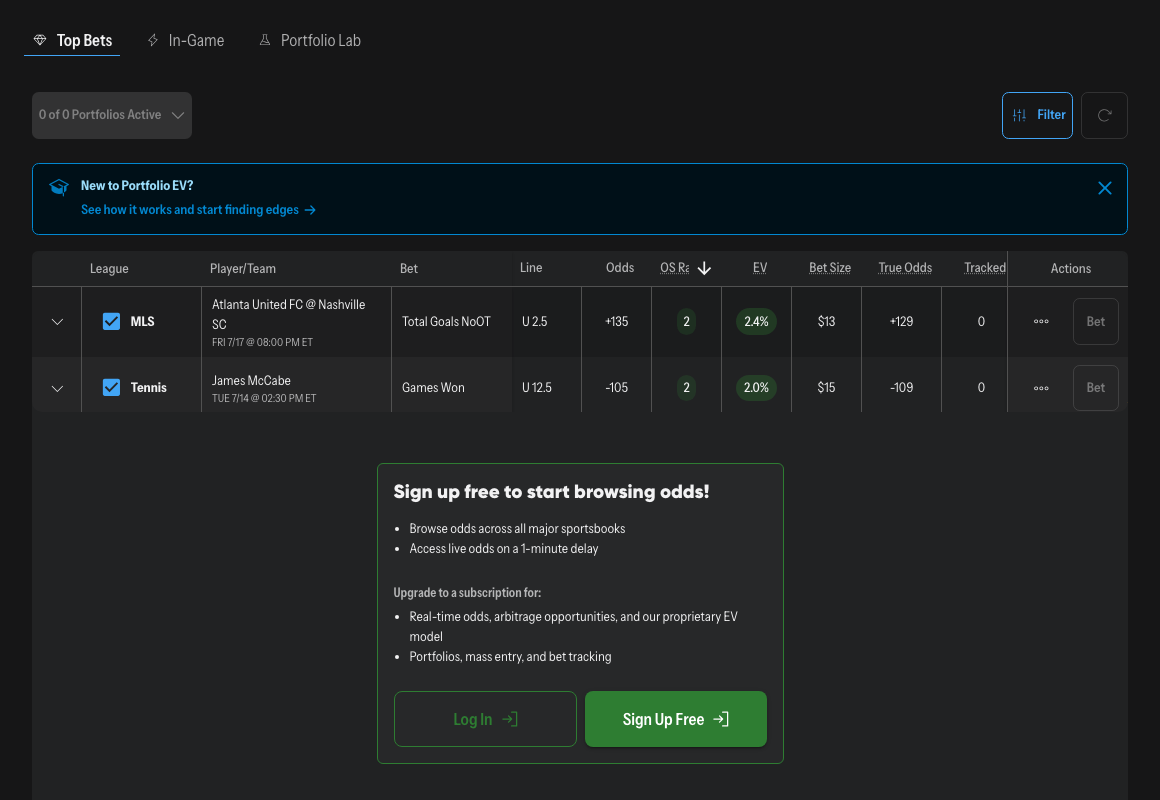
The OddsShopper +EV Screen.
- Favorite -1.5: the favored team must win by two or more runs for the bet to cash. A one-run win does not cover.
- Underdog +1.5: the underdog wins the bet if it wins outright or loses by exactly one run. A two-run loss does not cover.
So a run line bet is really a bet on the margin, not just the winner. That single half-run is doing a lot of work, because so many baseball games are decided by exactly one run. If you want the full vocabulary around this (moneyline, total, first-five innings, and the rest), our MLB betting terms glossary lays out every market in plain English.
Run Line vs Moneyline: How the Payout Changes
The moneyline is a straight bet on who wins, with no margin attached. The run line takes that same game and bolts on the 1.5-run requirement, and that changes the price in opposite directions depending on which side you take.
Laying -1.5 with a favorite shortens your risk. A heavy moneyline favorite forces you to risk a lot to win a little. By asking that team to also win by two or more, the book rewards you with a much friendlier number. Say a favorite is -190 on the moneyline. Move to the run line at -1.5 and that same team might be priced around +130 instead, because covering by two is harder than simply winning. You are trading a tougher condition for a better payout.
Taking +1.5 with an underdog shortens your price. Go the other way and the math inverts. Say a dog is +160 on the moneyline. At +1.5 on the run line, the extra run of cushion makes the bet cash far more often, so the price drops to something like -150. You are paying for safety: a one-run loss now wins instead of losing.
The key idea is that the run line and the moneyline are two prices on the same game, and the run line simply repackages the risk. Neither is automatically the better bet. Which one is worth taking depends entirely on the price relative to the real chance of each outcome, which is exactly what a devig tells you. If the term is new, our walkthrough on how to remove the vig shows how to strip the book's margin out of a price so you can compare it to the true odds.
When to Take a Favorite at -1.5
Laying -1.5 with a favorite is most defensible when you think the game is likely to be a comfortable win rather than a coin-flip finish. A few spots fit:
- A dominant starting pitcher against a weak lineup, where you expect the favorite to build a lead and the bullpen to protect a multi-run margin.
- A lopsided matchup in which the moneyline price is so short that the straight bet barely pays, so the run line gives you a real return for the same opinion.
- Spots where you expect a late insurance run. Baseball margins often stretch in the eighth and ninth when a trailing team brings in weaker relievers or pulls its infield in, which can turn a one-run game into a two- or three-run final.
The catch is the one-run game. Even strong favorites win by exactly one run often enough that -1.5 loses plenty of bets it "should" win on the moneyline. That is the trade you are making, and it is only worth making when the plus-money price compensates you for it.
When to Take an Underdog at +1.5
Taking +1.5 with an underdog buys you a run of cushion: the dog can lose by one and you still cash. That is valuable in a sport where one-run games are everywhere. Reasonable spots include:
- A live underdog with a capable starter, where you expect a tight, low-scoring game that stays within a run either way.
- A short underdog whose moneyline price is not long enough to be worth the outright risk, but whose +1.5 number is short enough that the added safety is worth it.
- Games you expect to stay close into the late innings, where a one-run final is a real possibility rather than a blowout.
The trade here runs the other direction. You are paying a price (often -150 or worse) for that cushion, so the underdog can win the game outright and you still only collect the shorter run line payout. Just like -1.5, +1.5 is worth it only when the number beats the true probability of the dog staying within a run. It is never a free pass, because a meaningful share of games are decided by two or more runs.
Alternate Run Lines: Moving Off 1.5
Most books also offer alternate run lines that let you shift the number off the standard 1.5 in exchange for a different price.
- Push a favorite out to -2.5 (must win by three or more) and the price gets longer to reward the tougher ask.
- Pull an underdog in to -1.5 (now the dog has to win by two) for a longer price, or buy extra cushion at +2.5 (loses by two and still cashes) for a shorter one.
Alternate lines are useful when your read is specifically about the margin, not just the side. If you expect a blowout, a favorite at -2.5 pays more than -1.5 for the same game. If you only trust the dog to keep it within a couple of runs, +2.5 lowers your risk further. The principle does not change: the alternate number is worth taking only when its price is longer than the true chance of that margin. Shifting the line just moves where on the payout curve you are betting.
New to OddsShopper? It scans 100-plus sportsbooks at once, lines up every run line price side by side, and uses our Portfolio EV tool to flag the side priced better than its true odds, which is the exact work this article just walked you through, done automatically. Start with a free 7-day trial, then code RUNLINE20 takes 20% off OS Pro or OS Core.
How to Shop the Run Line (the Part That Decides Your Season)
Picking the right side is only half the job. The other half is getting the best available number on that side, because the same run line is not priced identically across books.
Here is why it matters. Say you like a favorite at -1.5 and your read is right. One book has that run line at +120, another has it at +135. Bet $100 at +120 and a win returns $120; bet the same $100 at +135 and the win returns $135. Same team, same game, same outcome, and an extra $15 in your pocket for doing nothing but checking a second screen. Over a full 162-game season of run line bets, that habit is often the difference between a small profit and a small loss, even before any handicapping skill enters the picture. Always taking the best price is free value, and betting one book's number every time quietly hands that value back.
The trickier point is that the best number on the screen is not automatically a good bet. Line shopping wins you EV only against a worse price on the same wager; the best of several prices can still sit on the wrong side of the true odds. So you do two things in order: find the side that is priced better than its real chance (the +EV side), then take the best available number on it. Some games will not offer either, because the run line is priced efficiently and both sides sit below their true value. Forcing a bet on those games is how an edge leaks away, so passing is a real option on the board, not a failure to act. That is the whole edge, and it is what our tools are built to do across every MLB market.
The OddsShopper MLB odds screen lines up every book's run line, moneyline, and total in one place so you always see the best available number. Layer on the OS Pro Sharp Sportsbook Algorithm, which prices the true odds off the sharpest books, and Portfolio EV flags the run lines priced in your favor instead of leaving you to eyeball it. If you want the underlying method first, our guide on how to find +EV bets breaks down how a price becomes a value bet.
A Worked Run Line Example
Walk through a single game to see how the pieces fit. Say a favorite is -180 on the moneyline, which implies they win the game a little under two-thirds of the time. You think they are a real bet, but the -180 price barely pays. So you look at the run line, where that same team is +125 at -1.5.
Now the question is the margin. Strip the vig out of the run line market and you get the book's fair read on how often this team wins by two or more. If your read, or the model, says that true chance is higher than what +125 implies, the run line is the +EV side and pays you better than the moneyline for essentially the same opinion. If the true chance of a two-run win is lower than +125 implies, you pass on the run line, and if the moneyline is not priced in your favor either, the right move is to make no bet on the game at all. Then, having settled on the side, you shop it: if a second book has that -1.5 at +135, you take +135, not +125. The numbers here are illustrative, so always run the live board, but the process never changes: devig to find the side, then shop for the best number.
Bottom Line
The MLB run line is just baseball's 1.5-run spread, and it is one of the first markets every baseball bettor should understand. Laying -1.5 with a favorite trades a tougher condition for a better payout; taking +1.5 with a dog pays for a run of cushion. Neither side is safe and neither is a trap. The right bet is whichever side is priced better than its true chance, taken at the best number you can find across books. Get those two habits down, size every bet to your bankroll rather than to how much you like a team, and the run line becomes one of the cleaner ways to bet baseball.
FAQ
What is the run line in MLB betting? The run line is baseball's point spread, set at 1.5 runs in nearly every game. The favorite is laid at -1.5 and must win by two or more runs to cover; the underdog is taken at +1.5 and cashes if it wins outright or loses by exactly one run.
Why is the MLB run line almost always 1.5? Baseball is low-scoring and one-run games are extremely common, so books standardize the spread at 1.5 runs and adjust the price instead of moving the number. That keeps a consistent line across games while still letting the odds reflect each matchup.
What is the difference between the run line and the moneyline? The moneyline is a straight bet on who wins, with no margin attached. The run line adds the 1.5-run requirement, which shortens a heavy favorite's risk (a -190 moneyline favorite might be plus money at -1.5) and shortens an underdog's price (a +160 moneyline dog might be around -150 at +1.5).
Is taking +1.5 on the underdog a safe bet? It is safer than the moneyline because the dog can lose by one and still cash, but it is not a sure thing. A meaningful share of games are decided by two or more runs, and you pay for the cushion with a shorter price, so +1.5 is only worth it when the number beats the underdog's true chance to stay within a run.
What is an alternate run line? An alternate run line lets you move off the standard 1.5, for example laying a favorite at -2.5 (win by three or more) for a longer price, or buying an underdog +2.5 (loses by two and still cashes) for a shorter one. It is useful when your read is specifically about the margin, and the alternate number is worth taking only when its price beats the true chance of that margin.
More on this: MLB Home Run Picks Today (8/19): Shohei Ohtani & More · How To Bet MLB Home Run Props (And Find The Edge) · MLB Home Run Leader Odds: The Rockies Bat Kalshi Ignores · MLB Home Run Cheat Sheet: Kalshi & Polymarket Contracts (August 19, 2026) · MLB Home Run Parlay Today: A Lottery Ticket With An Opinion
Ready to Bet the Run Line
Once you can read the run line, winning comes down to two habits: betting only the side that is priced better than its true chance, and taking the best available number on it. New to OddsShopper? It scans 100-plus sportsbooks, lines up every MLB run line in one place, and flags the +EV side for you with the OS Pro Sharp Sportsbook Algorithm and Portfolio EV, so you stop leaving the better number on the table. Start with a free 7-day trial, then code RUNLINE20 takes 20% off OS Pro or OS Core.
Start your free trial Shop the live board on the OddsShopper MLB odds screen, and bet responsibly (21+, where legal).