First five innings betting, the bet you will see listed as F5 or 1st 5 on the board, settles your wager after the fifth inning instead of waiting for the final out. That one change matters more than it sounds. A full-game baseball bet rides on both teams' bullpens, and bullpens are noisy, matchup-driven, and often the least predictable part of a roster. The F5 market hands the game to the two people you can actually scout: the starting pitchers. This guide explains how first five innings betting works, the moneyline, run line, and total versions, why sharp bettors lean on it, how it pairs with NRFI, and how to make sure you are getting the best number on every one.
In Summary (TL;DR)
- F5 (first five innings) bets settle after 5 innings. The bullpen never touches your ticket, so you are betting the starting pitchers and the top of each lineup.
- There are three main F5 markets: the first five moneyline (who is ahead after 5), the F5 run line (a -0.5 or +0.5 spread through 5), and the F5 total (combined runs through 5).
- Why bettors use it: starters are far easier to handicap than a manager's bullpen decisions, and it removes late-game variance like a blown save or a position player mopping up a blowout.
- F5 pairs naturally with NRFI (No Run First Inning) and with first-three-innings markets for bettors who want to isolate the early game even further.
- The edge is the same as any market: strip the vig to find the true price, bet only the side priced in your favor, and shop every book for the best F5 number.
What Does F5 Mean in Betting?
F5 stands for "first five innings." When you place an F5 bet, the sportsbook grades it on the score at the end of the top and bottom of the fifth inning, then ignores everything that happens after. If the game is 3-1 after five and then the trailing team scores six in the eighth, your F5 bet on the team that led 3-1 still wins. The full-game result is irrelevant once your five-inning window closes.
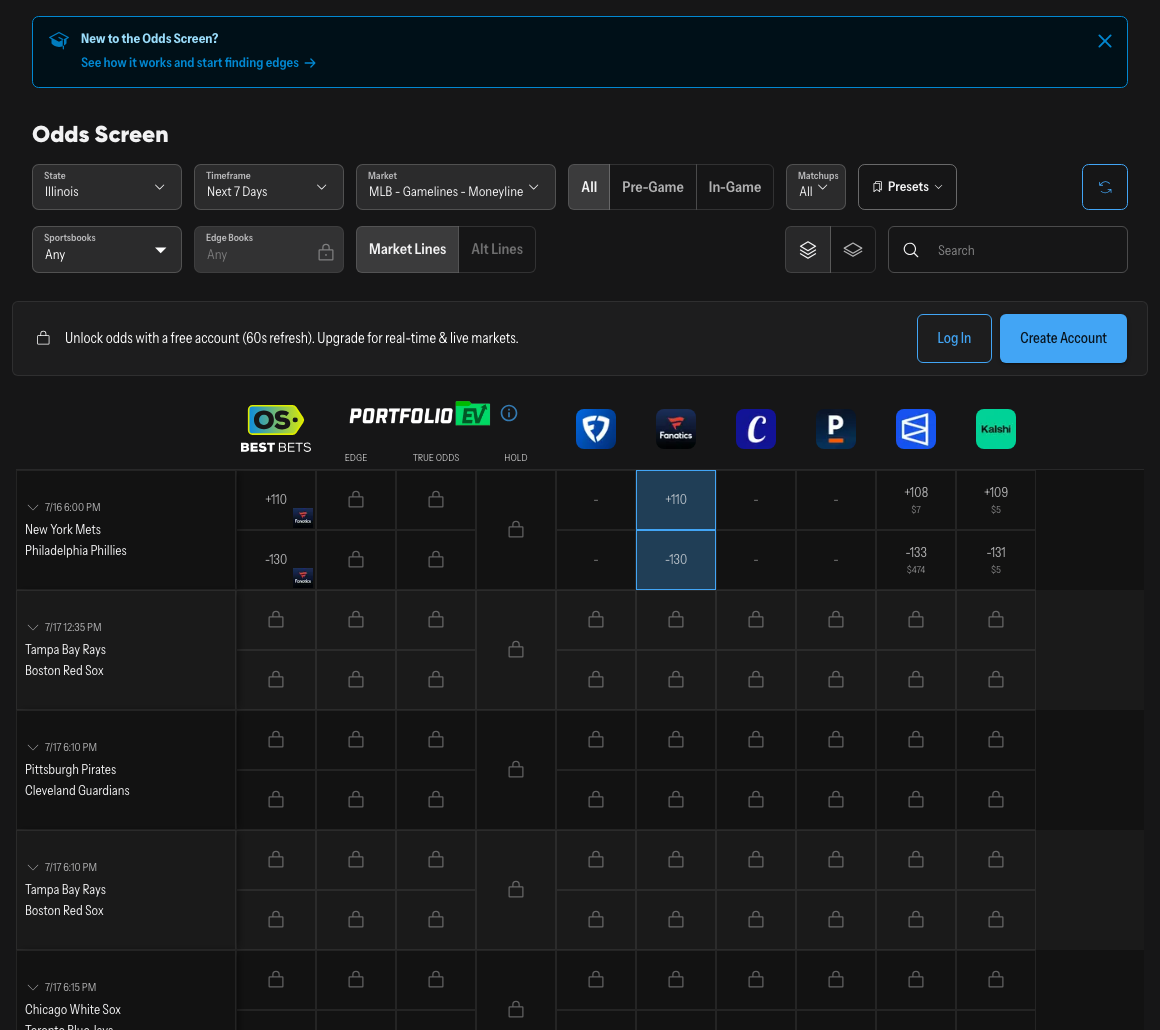
The OddsShopper Odds Screen.
You will sometimes see this called "1st 5 innings," "first half" (baseball's version of a first-half bet), or simply the 5-inning line. They all mean the same thing. The same idea exists in shorter slices too, like first-three-innings markets, but five innings is the standard because it is the point a starting pitcher most often reaches before the bullpen takes over. If you want the full glossary of baseball terms around these markets, our MLB betting terms guide has the rest.
Why Bet the First Five Innings Instead of the Full Game?
The case for F5 comes down to one word: bullpens. When we handicap a full-game bet, we are not just sizing up the two starters, we are also betting on which relievers each manager calls, in what order, and how they perform on the night. That is a lot of moving parts you cannot see until they happen.
Cutting the game off after five hands you a cleaner question. Now we are betting the matchup we can actually study: the two starting pitchers and the regulars at the top of each lineup who get the most plate appearances early. Starters throw a known repertoire, carry a track record, and face the heart of the order in those first five innings. Relievers, by contrast, are matchup chess pieces that change every night.
There is a second reason. F5 removes the late-game noise that has nothing to do with the better team. A garbage-time rally in the ninth, a position player pitching in a blowout, a closer blowing a save he should not have entered, none of that touches an F5 ticket. You are isolating the part of the game with the most signal and the least randomness, which is exactly where a real handicapping edge tends to live.
The flip side, and it is worth saying plainly, is that five innings is a smaller sample than nine. A strong team has fewer innings to assert itself, so a sharp starter on a weaker team can be live in the F5 market even when the full-game line is lopsided. That is a feature if you read it right and a trap if you treat F5 like a discounted version of the full-game bet.
The Three First Five Innings Markets
There are three F5 bet types, and they mirror the full-game board.
First Five Innings Moneyline
The F5 moneyline is a straight bet on which team is ahead after five innings. Because a five-inning game can end tied, books handle the draw one of two ways: a 3-way F5 moneyline lists home, away, and tie as separate prices, while a 2-way F5 moneyline removes the tie, so a 3-3 score through five pushes and your stake is refunded. Always check which version a book is offering, because it changes the price and how a tie settles.
Say a team's ace is on the mound against a back-end starter, and the full-game moneyline is around -160. On the F5 moneyline that same team might sit closer to -140, because five innings gives the favorite less room to pull away and the price reflects the tie possibility. The numbers there are illustrative, so always pull the live board, but the pattern is the point: F5 moneylines often sit a touch shorter on favorites than the full game.
First Five Innings Run Line (Spread)
The F5 run line is baseball's spread applied to the five-inning score. Because five innings produce fewer runs than nine, the standard hook is usually -0.5 / +0.5 rather than the full game's -1.5 / +1.5. A team at -0.5 through five simply has to be leading after the fifth, while +0.5 cashes if that team is ahead or tied. Some books also post a -1.5 F5 alternate for bigger payouts if you expect a fast start from the favorite.
First Five Innings Total
The F5 total is the combined runs both teams score through five innings. Lines typically land around 4.5 or 5.5 depending on the starters and the park, versus the 8 to 9 you see on a full game. F5 totals are a clean way to bet a pitchers' duel: if you have two front-line arms going, the F5 Under isolates that read on the part of the game they actually pitch, instead of leaving you exposed to two shaky bullpens in the late innings. The reverse holds for two weak starters in a hitter's park, where the F5 Over targets the early scoring before the matchup gets muddied.
How F5 Pairs With NRFI
F5 and NRFI (No Run First Inning) are cousins. NRFI is a yes/no bet on whether any run scores in the very first inning, and like F5, it is a bet on starting pitching rather than bullpens. If you already lean on NRFI because you trust two starters to navigate the top of the order cleanly, the F5 Under is the natural extension of that same read across five innings instead of one. Our NRFI betting guide breaks the first-inning version down in full.
The two are not the same bet, and that is the useful part. NRFI is binary and over in 15 minutes; the F5 total gives that pitching read room to breathe across five innings, with more ways to be right. Some bettors ladder them: an NRFI play on the same game where they also like the F5 Under, treating both as expressions of the same "the starters dominate early" thesis. Just remember they are correlated, not independent, so size them as one position, not two unrelated bets. And if you fold them into a same-game parlay, the book usually prices that correlation in, charging a built-in tax that can quietly turn two reasonable-looking legs into a -EV ticket. A correlated same-game parlay is only worth it when the book has mispriced the correlation and the combined number still beats its true odds, never just because two early-game bets feel like they belong together.
Finding Value in First Five Innings Bets
Knowing the F5 markets is half the job. The other half is knowing whether the number in front of you is actually any good, and that comes down to two habits.
First, strip out the vig. Every posted price has the book's margin baked in, which is why the two sides of an F5 market imply more than 100 percent combined. The true price is what is left after you remove that margin, and a bet is only worth making when the side you want is priced longer than its real chance of cashing. If the devig math is new to you, how to remove the vig walks through it step by step. The key idea: removing the vig lowers an inflated implied probability to the fair number, and value is any price longer than that fair line.
Second, shop every book. F5 markets are thinner and less efficient than full-game lines, which means the same bet can hang at meaningfully different numbers across sportsbooks. Taking the best available price is free expected value, every time. But line shopping only helps when you are beating a worse price for the identical bet, so the best book on the screen can still sit inside the fair number, which is why you check the price against the true odds, not just against the other books. The OddsShopper MLB odds screen lines up every book's F5 moneyline, run line, and total in one place so you always see the best number, and it flags how each price compares to fair.
This is where the OddsShopper tools do the work we would otherwise grind out by hand. The Portfolio EV tool devigs each F5 market and surfaces the side priced in your favor, and the Sharp Sportsbook Algorithm benchmarks the offered number against a sharp, true-odds estimate so you are not just beating a soft book, you are beating the fair price. For a full walk-through of that workflow, see how to find +EV bets.
Worked Example: Reading an F5 Total
Say two strong starters are facing off and the F5 total is posted at 4.5, with the Under at -105 on the best book you can find. Convert that -105 to its implied probability and it lands around 51 percent, which is the win rate you would need just to break even at that price, before the book's margin is stripped out. Devig across both sides and the fair chance of the Under might come back closer to, say, 53 percent. That is the move that matters: the fair number (53 percent) sits above the break-even the price demands (51 percent), so a fair price would be around -113 and you are getting -105. That is longer than fair, which is what "priced in your favor" means. If your own read, or the OS Pro true-odds estimate, agrees the early scoring stays under 5 runs about 53 percent of the time, the Under at -105 is a +EV bet. If the fair number had come back at, say, 49 percent instead, the same -105 would be shorter than fair and you pass, even though it is the best Under price on the board. The figures here are illustrative, so always run the live market, but the process never changes.
New to OddsShopper? It scans 100-plus sportsbooks and flags the F5 bets priced in your favor, doing the devig and the line shopping this article just walked through, automatically, in seconds. Start with a free 7-day trial, then code F5BET20 takes 20% off OS Pro or OS Core.
FAQ
What does F5 mean in betting? F5 means "first five innings." An F5 bet is graded on the score after five innings are complete and ignores everything that happens afterward, so the bullpen and late-game swings never affect the result.
How is an F5 moneyline different from a full-game moneyline? A full-game moneyline rides on all nine innings, including both bullpens. The F5 moneyline only cares who is ahead after five, so you are betting the starting pitchers and the top of the order rather than relief decisions. Many books also offer a 3-way F5 moneyline that lets the game settle as a tie through five.
What happens to an F5 bet if the game is tied after five innings? It depends on the market. A 3-way F5 moneyline lists the tie as its own outcome, so a tie loses a straight home or away bet. A 2-way (tie-removed) F5 moneyline pushes and refunds your stake on a tie. The F5 run line uses a -0.5 / +0.5 hook to avoid ties entirely. Always check which version your book posts.
Is F5 betting better than betting the full game? Neither is automatically better. F5 is useful when your edge is in the starting pitching matchup and you want to avoid bullpen variance. The full game is the play when you have a read that extends to the relievers and the back of the lineup. Bet whichever market gives you a price longer than the true odds.
How does F5 betting relate to NRFI? Both are bets on starting pitching rather than bullpens. NRFI is a first-inning yes/no on whether any run scores, while the F5 total extends that same pitching read across five innings. They are correlated, so if you bet both on one game, treat them as a single position and size accordingly.
More on this: First Week Album Sales: Bridgers Tracking 110-120K · BMW Championship First Round Leader Odds: Scheffler Tops Kalshi's Board At 10 Cents · FedEx St Jude First Round Leader Odds: Kalshi's Flattest Board Of Playoff Week · What Does First Inning Runs Mean? The F5 And RFI Bets Explained · Rocket Classic First Round Leader Odds: A Wide-Open Board
Bottom Line
First five innings betting is not a gimmick or a shortcut. It is a way to bet the part of a baseball game you can actually handicap, the two starting pitchers, while sidestepping the bullpen noise that decides so many full-game tickets. Pick your market, F5 moneyline, run line, or total, based on whether you have a read on the winner, the margin, or the run environment through five. Then do the two things that turn a good read into a good bet: remove the vig to find the true price, and shop every book so you never leave the better number on the table. Whatever you bet, size it to your edge and your bankroll, not to how confident you feel, and play 21-plus and within your means where betting is legal and available.
Shop every F5 moneyline, run line, and total in one place on the OddsShopper MLB odds screen, then let OS Pro Portfolio EV and the Sharp Sportsbook Algorithm flag the side priced in your favor. Try it free for 7 days, and code F5BET20 takes 20% off OS Pro or OS Core if you subscribe.