Most new bettors start by asking who's going to win. Over under betting asks a different question, and once it clicked for me it became the bet I reach for most: forget the winner, just decide whether the game will be high-scoring or low-scoring. That's the whole idea behind a totals bet, and it's one of the most beginner-friendly ways to wager on the NFL, NBA, MLB, and just about any other sport.
This is over under betting explained from the ground up: exactly how totals work, what the number and the -110 price mean, and how to find the best version of the bet before you place it.
In Summary
- An over/under (also called a total) is a bet on the combined points or runs both teams score, not on who wins.
- The sportsbook posts a number. You bet the Over if you think the teams will combine for more, the Under if you think they'll combine for less.
- Both sides usually carry -110 juice, so you risk $110 to win $100. That small tax is the book's edge, and beating it starts with shopping for the best number.
- A half-point in the total (like 8.5) leaves no middle ground, so one side has to win. A whole number (like 8) can land exactly on the total, which is a push and refunds your stake.
- The same logic powers team totals (one team's score) and applies across sports, with pace, weather, and starting pitching the biggest movers.
What Is A Totals (Over/Under) Bet?
A totals bet is a wager on the combined final score of both teams. The sportsbook sets a projected number, and you simply pick a side: will the real combined score finish over that number or under it?

The OddsShopper Odds Screen.
Here's the part that trips people up at first. The result of the game doesn't matter. A blowout and a nail-biter can both go Over or Under. If the total is 48 in an NFL game, a 35-31 shootout (66 points) cashes the Over no matter who won, and a 13-9 grind (22 points) cashes the Under. You're betting on the scoreboard, not the trophy.
Betting the environment instead of the outcome is why totals are such a clean entry point. You don't need a strong opinion on which team is better, only on the environment: fast or slow, high-scoring or low-scoring.
One-line definitionan over/under is a bet on how much both teams score added together, with the game's winner completely out of the picture.
How The Sportsbook Sets The Number
The total isn't a guess. Oddsmakers build it from each team's scoring rate, the pace they play at, the matchup (a strong defense pulls it down, a leaky one pushes it up), and conditions like weather or the starting pitcher. They post an opening number, then move it as money comes in and as news breaks, so a star sitting out or a wind shift can shift the line before kickoff.
Your job isn't to out-model the book on every game. It's to find the spots where you think the posted number is off, and then bet the side that's priced in your favor. This is the same positive expected value idea that runs under every smart bet, and it's worth understanding in full if you're new — see our guide to finding +EV bets. The books also move the number as bets pour in, which is its own tell; if you want to read those swings, our line movement guide breaks it down.
Reading The Line And The -110 Juice
A totals line looks like this:
Over 8.5 (-110)Under 8.5 (-110)
The 8.5 is the total. The -110 is the price, often called the juice or vig. A price of -110 means you risk $110 to win $100. If you'd rather bet smaller, a $10 bet wins about $9.09.
That extra $10 per $100 is how the book makes money. Charge juice on both sides and it profits over time even on a coin-flip line. Strip that juice back out and you get the "fair" price the total should trade at with no house tax — the exact math in our how to remove the vig guide, and the number I lean on later to spot a mispriced total. Understanding the price is half the battle, and if odds formats are still fuzzy, start with how to read betting odds.
A Worked Dollar Example
Say I like the Over 8.5 runs in a Yankees-Red Sox game at -110, and I bet $55.
- It Cashes (9+ Combined Runs): I win $50, and get back my $55 stake, for $105 total.
- It Loses (8 Or Fewer Combined Runs): I'm out the $55.
Now here's why the price matters as much as the side. Suppose one book has that same Over 8.5 at -110 and another has it at -105. Same bet, same number, but at -105 my $55 wins about $52.40 instead of $50. Over hundreds of bets, taking the better price on the same side is free EV you'd otherwise leave behind. It's not a small detail. It's the whole reason line shopping exists.
Betting The Over Vs The Under
The decision is straightforward once you know what each side needs:
- Over wins when the combined score is higher than the total. You're rooting for offense, pace, and points.
- Under wins when the combined score is lower than the total. You're rooting for defense, slow play, and missed shots or stranded runners.
A quick mental model I use: the Over needs things to go right offensively for both teams, while the Under often just needs one team to stall. Neither side is inherently smarter. The edge is in whether the number is too high or too low, not in some rule that "unders are safer."
| You bet the OVER if... | You bet the UNDER if... | |
|---|---|---|
| What You Expect | A high-scoring, fast-paced game | A low-scoring, grind-it-out game |
| You're Rooting For | Offense, pace, points | Defense, slow tempo, stops |
| Helps Your Side | Good weather, weak pitching/defense, no-huddle pace | Wind/rain, ace pitchers, elite defenses |
| Hurts Your Side | Aces, bad weather, injuries to scorers | Backup arms, dome/clear skies, blowout pace |
Pushes And Half-Points
You'll notice most totals end in .5 (like 8.5 or 47.5). That half-point exists on purpose: you can't score half a run or half a point, so a number like 8.5 forces a result on one side. The combined score is either 9+ (Over) or 8 and under (Under). No middle ground.
A whole-number total works differently. Say the line is at 8 and the teams combine for exactly 8 runs; neither Over nor Under is right. The result is a push, and the book refunds your stake in full. A push isn't a win or a loss, just a do-over.
Quick tipwhen a total sits on a whole number, the half-point on either side is worth real money. Shopping for a book that already offers the half-point you want can be the difference between a push and a loss on a tight game.
Team Totals Vs Game Totals
Everything so far has been the game total (both teams combined). Sportsbooks also post team totals, which are the same bet on a single team's score.
- Game Total: Over/Under on Lakers + Celtics combined, say 224.5.
- Team Total: Over/Under on just the Lakers, say 114.5.
Team totals are handy when your read is about one side. Maybe you think a high-powered offense keeps rolling even if the opponent stays quiet, or a banged-up lineup is going to struggle. Instead of guessing how both teams interact, you isolate the one you actually have an opinion on.
The over/under logic doesn't stop at teams, either. It runs straight down into player totals — a quarterback's passing yards, a pitcher's strikeouts, a hitter's total bases. Each one is an over/under on a single number, priced with the same juice, and it's why player props betting feels familiar the moment you understand a game total. Hold onto that idea; it's where I'll show you a real edge in a minute.
How Totals Differ From The Moneyline And Spread
Totals are one of the three core bet types, and they answer a different question than the other two:
- Moneyline: who wins the game, straight up — no math, just pick the winner at the posted price.
- Point Spread: who wins after a handicap is applied to the favorite. If that side of the board is new to you, our point spread betting guide walks through the hook and the -110 price the same way this one does.
- Total (Over/Under): how much both teams score combined, with no bearing on who wins.
What Moves A Total
A few factors do most of the work in pushing a number up or down:
- Pace And Style. Fast, no-huddle or up-tempo teams produce more possessions and more points. Slow, ball-control teams drag the number down.
- Weather. Wind and rain suppress passing and kicking in the NFL and knock down fly balls in MLB. Heat and a hitter-friendly park push baseball totals up. Indoor games remove weather entirely.
- Pitching And Defense. In baseball, the starting pitchers are the single biggest input. Two aces can drop a total a run or more; two shaky arms lift it. In basketball and football, elite defenses and key injuries to scorers move the number.
- Injuries And Rest. A star scorer sitting out, or a team resting starters in a meaningless game, changes the math fast.
Short Per-Sport Notes
- NFL: The number itself sits in the low-to-mid 40s, but that's not what I bet. I bet the wind. Once a forecast crosses ~15 mph the passing and kicking game shrinks, and the total should drop with it, so a stale line that hasn't moved on the weather is my first stop. Our NFL totals betting guide goes deeper on the football side.
- NBA: The tallest totals on the board (220 and up) come with the tallest swings, and the lever I watch is rest — a back-to-back or a quietly-announced load-management night can knock several points off a number the market is slow to adjust. Pace tells you the ceiling; rest tells you whether it shows up.
- MLB: This is where the totals get personal, because two names, the starting pitchers, set almost the whole line, with the park and wind close behind. A first-five-innings total lets me bet those two arms and dodge a shaky bullpen entirely, and the same over/under math runs down into pitcher strikeout props, which is exactly the market where I found the Yesavage edge above.
A Real Totals Edge, From Today's Board
Enough theory. Here's the payoff I promised: a live look at what "the number is priced in your favor" actually means, using two real over/under markets from OddsShopper's board on July 24, 2026. Both are pitcher totals — a strikeout total and a hits-allowed total — which behave exactly like the game totals above, just on one player's number.
The trick is comparing the price you can actually take against the de-vigged fair price (the juice-free number from earlier). When the takeable price is longer than fair, the total is mispriced in your favor.
| Over/Under Market | The bet | Best takeable price | De-vigged fair | Edge |
|---|---|---|---|---|
| Trey Yesavage Strikeouts (5.5) | Under 5.5 | -110 (Bet365) | -128 | +7.2% |
| Bryce Miller Hits Allowed (4.5) | Under 4.5 | +125 (Bet365) | +116 | +4.2% |
The Yesavage line is the one I keep coming back to. Fair value on the Under was -128 — meaning it "should" cost you $128 to win $100 — but Bet365 was letting you take the same Under for just -110. You're getting a materially better price on a bet the market itself says is a favorite, and that gap is the +7.2% edge. That's not a hunch about strikeouts; it's the price being wrong, which is the only edge that survives over a full season.
Notice both best prices came from the same book here, but that won't always be true, and you'd never know which book had the edge without checking all of them. Finding it is the entire job, and it's exactly what the tool below does for you.
Line Shopping The Best Total (Where OddsShopper Comes In)
One habit separates bettors who beat the juice from those who feed it: the total and the price are not the same at every book. One sportsbook might post Over 8.5 (-110) while another has Over 8 (-105) or even Over 8.5 (-105). Same game, different number, different payout — the exact Yesavage gap you just saw, only now on a game total. Taking the best available version of your bet is free expected value, and over a season it adds up to real money. Capturing it is the core of what the OddsShopper odds screen is built to do.
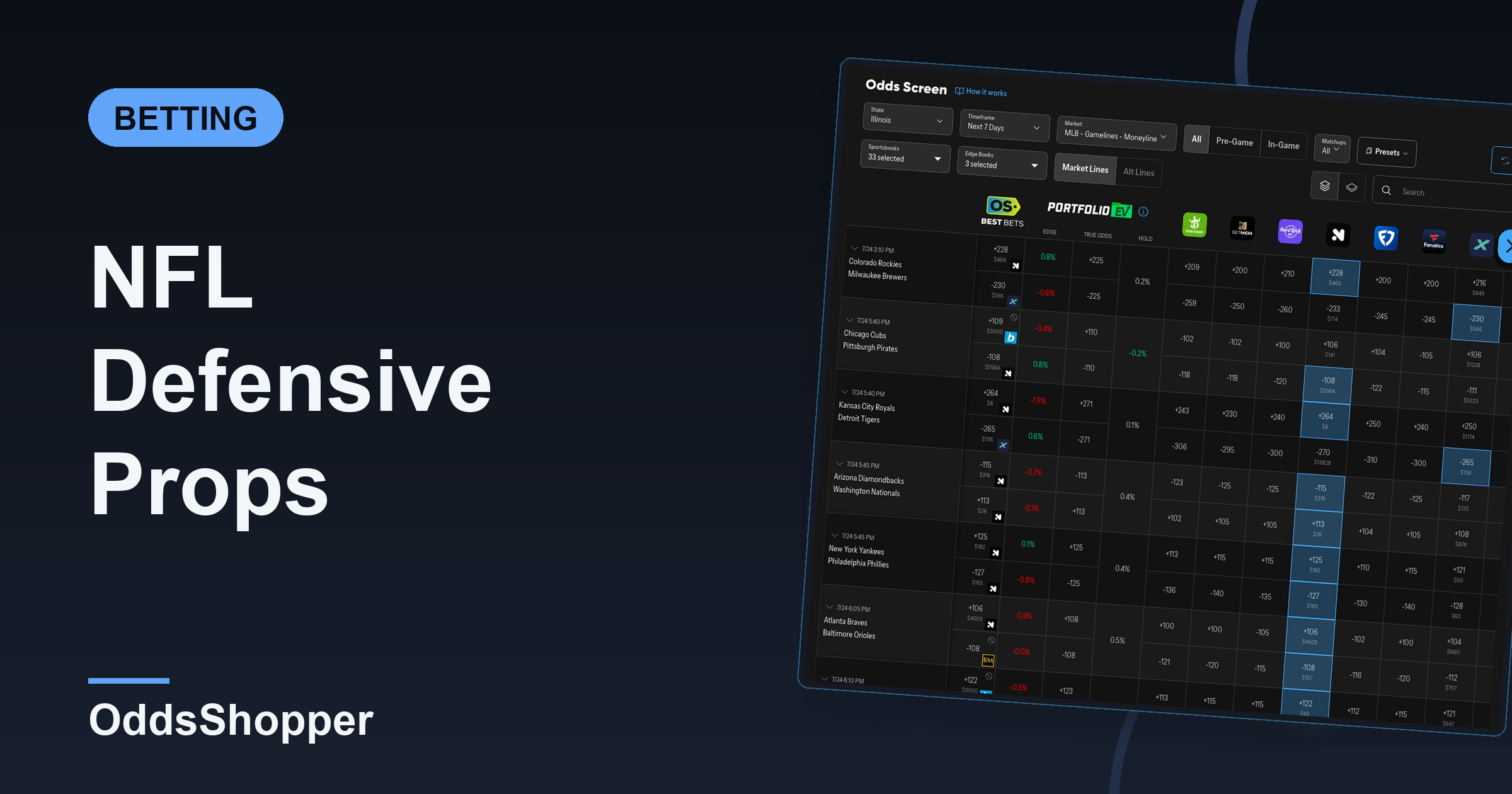
Checking that by hand across a dozen apps is tedious, which is exactly the gap OddsShopper's live odds screen fills. It lines up the total and the price for a game across every major sportsbook side by side, so you can see in seconds who has the best number and the best juice on the side you want.
New to OddsShopper?It scans every major sportsbook and shows you, in one screen, which book has the best total and the best price on the over/under you're eyeing, so you never leave value on the table by betting at the first app you opened. Code TOTALSEDGE20 takes 20% off your first OS Pro or OS Core payment: Get 20% off OddsShopper Pro.
For bettors who want to go a step further, OddsShopper Pro's Portfolio EV tool compares the offered total against a fair, sharp-market price — the same de-vigged-fair-vs-takeable math behind the Yesavage edge above — and flags the spots where the over/under is actually priced in your favor, which is the difference between betting a number you like and betting a number that's mispriced.
FAQ
What does over/under mean in betting? It's a bet on the combined score of both teams. You bet the Over if you think they'll score more than the posted number and the Under if you think they'll score less. The winner of the game doesn't matter.
What is the -110 on a totals bet? That -110 is the price, or juice. At that price you risk $110 to win $100 (a $10 bet wins about $9.09). The book charges that small tax on both sides as its edge, so getting the best price you can find directly improves your return.
What happens if the score lands exactly on the total? In the event the line is a whole number and the combined score matches it exactly, the bet is a push and your stake is refunded. That can't happen on a half-point total like 8.5, where one side has to land.
Is the over or the under the better bet? Neither is better by default. The edge comes from whether the posted number is too high or too low, not from a blanket rule. Bet the side where you think the number is mispriced, and take the best available price.
What's the difference between a team total and a game total? A game total is the combined score of both teams. A team total is the over/under on just one team's score, which is useful when your read is about a single side rather than the matchup as a whole.
More on this: NFL Preseason Event Contracts, Explained In 60 Seconds · What Does Over 2.5 Goals Mean? Soccer Totals, Explained · Golf Betting Odds Explained: Outrights, Top-10S And Matchups · Golf Matchup Betting Explained: 2-Ball And 3-Ball Strategy · Virginia Tech Win Total 2026: CFB Over 6.5 Wins
The Bottom Line
An over/under keeps it simple: decide whether a game will be high-scoring or low-scoring, then bet the Over or the Under. Learn what the number and the -110 price mean, respect pushes and half-points, and remember that the same bet can be worth more at one book than another.
That last point is where most of your long-term edge hides. Before you lock in any over/under, shop it. OddsShopper lines up the best total and the best price across every major sportsbook in one place. Use code TOTALSEDGE20 for 20% off OS Pro or OS Core: Get 20% off OddsShopper Pro.
Betting involves risk. Bet only what you can afford to lose, 21+ where legal. No result is ever certain.