The over/under looks like the friendliest bet on the NFL board. You don't have to pick a winner, sweat a backdoor cover, or read a coach's mind. You just decide whether Sunday's game clears a number or falls short. That simplicity is exactly why it's a trap for most people, and an edge for the few who treat a total the way the sharp side does: as a scoring forecast built from the spread, the environment, and the weather, not a gut feeling about "these two offenses can score."
This guide covers how NFL totals betting actually works, how to pull the implied team totals hiding inside every game, what really moves the number, and the one structural lean we keep coming back to. If you're brand new to the concept, our over/under betting explained primer defines the basics; here we're applying them to pro football.
What An NFL Total (Over/Under) Actually Is
An NFL total is a bet on the combined final score of both teams, with nothing to do with who wins. The book posts a number, say 47.5, and you bet whether the two teams together score more (over) or fewer (under) than that. Most totals are priced around -110 on each side, which is the vig, the book's built-in margin. Lay $110 to win $100.
When the number is a whole figure like 44, a game that lands exactly on it is a push and your stake is refunded. That's why you'll see hook numbers like 44.5, so the book avoids refunds and forces a decision. If a book hangs 43.5 and you don't love it, another book might sit on 44, and that half point is worth shopping for, as long as you know which way you want it: the under bettor wants the 44, and the over bettor wants the 43.5. Sportsbooks don't move in lockstep, so the same game can be 43.5 at DraftKings 🎁 and 44 at FanDuel 🎁 within the same hour.
Quick tipthe "true" total lives under the vig. Strip the juice off both sides (a no-vig, or de-vigged, price) and you're looking at the market's honest scoring estimate, not the one padded with the book's margin. That de-vig read is the reference point every side bet is measured against.
That's the whole mechanic. The skill isn't understanding the bet; it's understanding the number.
Betting a Kalshi combo on this game?Kalshi combo builder before you buy it: 10,000 simulated games price every combo next to the price on Kalshi.
Turning The Spread And Total Into Implied Team Totals
Here's the move that separates a totals bettor from a spectator. Every game total secretly contains two implied team totals, the number of points the market expects each team to score on its own. You get them from the total and the spread with simple arithmetic:
- Favorite's Implied Total = (game total ÷ 2) + (spread ÷ 2)
- Underdog's Implied Total = (game total ÷ 2) − (spread ÷ 2)
Enter the spread as a plain positive number here, the size of it rather than the sportsbook's signed version. A game listed at -7 goes into these formulas as 7; the plus and minus are already doing their work in the two lines above.
Say a game has a total of 47 and the favorite is laying 7. Split the 47 in half (23.5 each), then hand the favorite half the spread and take it from the dog:
| Team | Implied Team Total | How It's Built |
|---|---|---|
| Favorite (−7) | 27 | 23.5 + 3.5 |
| Underdog (+7) | 20 | 23.5 − 3.5 |
| Game Total | 47 | 27 + 20 |
That 27 is roughly three touchdowns with the extra points and two field goals (21 plus 6). Suddenly the total isn't an abstract 47; it's a claim that the favorite outscores what an average NFL offense puts up on a normal Sunday, and that the dog still scrapes together 20. The single most useful thing implied totals do is let you sanity-check the number against reality. If that favorite just lost its top two receivers and faces a top-five pass defense, 27 is a stretch, and the under is where the disagreement lives. Implied team totals are also the backbone of team-total prop bets, where you wager on one side's scoring alone.
Want this done for you, across the whole board?OddsShopper Pro runs this same arithmetic for you, stripping the vig off the market to show a no-vig fair number and flagging the books whose total disagrees with it, across every major sportsbook at once. It's free for 7 days.
start your free trial Or take 20% off your first month of OS Pro or OS Core with code NFLTOTALS20.
What Actually Moves An NFL Total
A total is a live estimate, and it breathes all week as information arrives. The big levers, in rough order of impact:
| Lever | Direction It Pushes the Total | Why |
|---|---|---|
| Wind Over ~15 Mph | Down | Kills the deep passing and kicking game; offenses stall, field goals get shaky |
| Starting QB Out | Usually down | A backup drags the whole offense's implied total with him |
| Dome / Clean Weather | Up | No wind or rain, so passing and kicking run at full efficiency |
| Fast, No-Huddle Pace | Up | More plays for both teams means more scoring chances |
| Key Skill Injury (WR1, RB1) | Down for that side | Vacated production isn't fully replaced |
Everything in that table is table stakes, and the one line worth stealing from this section isn't in it: read the gust line, not the average. A steady 15 mph wind is survivable, and offenses adjust to it by the second quarter. Gusts to 25 are what actually wreck timing routes, deep balls, and long field goals, because a quarterback can play into a constant wind but he can't play into an unpredictable one. The average is the number the forecast leads with and the number the casual bettor stops at, which is exactly why it's already in the line. The gust line is the one that isn't always priced.
That gap is the whole reason weather is the lever casual bettors underrate the most. Wind above roughly 15 mph grounds the passing attack and cuts hard into the make rate on long field goals, and books shade the number down for it, but often not enough. A dome game with two up-tempo offenses is the opposite: a clean, controlled environment where the over case is real. The point isn't to memorize the table; it's to ask what conditions this specific game actually happens in before you bet its number.
The Case For Disciplined Unders
That structural lean I promised you up top is a read on the market as much as on the games. Public money has a well-worn habit of crowding onto two things almost every week: favorites and overs. People bet the teams they like to win, and they'd rather root for touchdowns than punts. From where we sit at OddsShopper, watching the same total across every major book at once, that lopsided action shows up as a price rather than a mystery: the extra juice tends to settle on the over, because a book that knows which side the room is taking has no reason to make that side cheap. When the crowd leans that hard one way, the over is the side more likely to be carrying the worse number and the worse price, and the quieter value tends to collect on the under.
That does not mean blindly betting every under, and any NFL totals strategy that collapses into "always take the under" is just a different flavor of betting the vibe. It means starting from a disciplined under bias and making the over earn your money. Before you take an over, the game should give you a concrete reason: a dome, two fast offenses, both quarterbacks healthy, an implied team total the matchup actually supports. Absent that, the boring under is usually the side the market is quietly overpricing against. Discipline here is a style, not a slogan, and it's the closest thing to a repeatable edge a totals bettor has.
Why Teasing Totals Is A Trap
Teasers tempt totals bettors because moving a number six points in your favor feels close to free. It isn't. A teaser is a parlay where you buy points on each leg in exchange for needing every leg to hit, and the math only works when those bought points cross the key numbers football actually lands on.
For spreads, those keys are 3 and 7, the most common margins of victory, which is why the standard 6-point NFL teaser lives on point spreads. Totals don't share that structure. Combined NFL scores don't stack up on one or two dominant numbers the way winning margins do at 3 and 7; they spread themselves thin across a wide band running from the high 30s up into the 50s, so dragging a total six points rarely lands you across a threshold worth the cost, and the book prices the move to keep its edge. The rule is simple: don't tease totals. If you insist on moving one at all, 41 and 51 are the least-bad numbers to tease through, and even then the edge is thin. Everywhere else, you're paying a premium to buy points that don't buy you wins. For the full mechanics of when teasers do make sense, our teaser bets explained guide walks through the spread version step by step, and our NFL teaser betting guide runs the break-even math on the six-point version specifically.
Buying A Half-Point On A Total Usually Buys Nothing
The teaser trap has a smaller cousin that catches more people, because it looks so cheap. Most books will sell you a half-point on a total for around 10 cents of extra juice: take your under from 44 to 44.5 and pay -120 instead of -110. It feels like insurance. Usually it's a donation.
The reason is the same 3-and-7 logic that killed the teaser: bought points only pay when they cross a number the sport actually lands on. On a spread that logic holds up, because 3 and 7 are where NFL games truly cluster, which is why moving off 3 at a cheap price is the half-point purchase most likely to earn back what it costs. Our NFL key numbers guide is the full accounting of why those two figures carry so much of the spread market. Combined scores have nothing approaching that spike. They spread themselves across the high 30s and 40s without concentrating on any one figure the way margins concentrate on a field goal and a touchdown, so the half-point you just bought most often moves you from one thinly-populated number to another, and you paid 10 cents for the privilege.
Run it as a rule instead of a reflex:
| The Move | Verdict | Why |
|---|---|---|
| Buying A Half-Point On A Spread, Through 3 Or 7, At ~10 Cents | Worth it | You're crossing where games actually land |
| Buying A Half-Point On A Total, At ~10 Cents | Usually a pass | No key number as strong as 3 or 7 to cross; you paid for a rounding error |
| Buying Onto The Whole Number (Under 43.5 → Under 44, Or Over 44.5 → Over 44) | Situational | You're buying a push, not a win. Only pays if that exact number is live |
Read that last row carefully, because the direction is where people cost themselves money. Buying a push at 44 means moving toward the whole number from the losing side of it: an under bettor goes 43.5 → 44, an over bettor goes 44.5 → 44. Both now get their stake back if the game lands exactly on 44. Go the other way and you've done the opposite of buying, since an under at 44.5 already wins on a 44 final and paying to slide it to 44 sells that win back for a refund.
The Worked Example: What That Half-Point Has To Be Worth
The way to settle this is to price it, so let's price it. The 10 cents isn't charged once. You pay it on every bet, including the ones you'd have won anyway. The half-point only pays you back on the games that land on that one exact number. So run the arithmetic:
- At -110, a winning unit returns $0.909. At -120, that same win returns $0.833.
- The buy costs you $0.076 on every winner. On a total that's close to a coin flip, that's about $0.038 per bet.
- Moving an under from 43.5 to 44 turns a loss into a push at 44, a swing worth a full unit on that one number.
- Set them equal: 44 has to land roughly 3.8% of the time just to break even.
Do it for the other direction and the bar is higher. Moving from 44 to 44.5 converts a push into a win, which is worth $0.833 rather than the full dollar, so that exact number now has to land about 4.5% of the time to pay for itself. That gap is why the table rates the two rows differently, and why the "insurance" instinct is backwards: the purchase that turns a loss into a push is the cheaper of the two, and the one that turns a push into a win is the one that's usually a donation. Cheaper is not the same as good, though. Both bars sit above what any single combined score realistically hits, which is why the verdict on the whole family of moves stays "usually pass" rather than "here's your edge."
Now sit with what a ~4% bar actually asks. You need one specific combined score to hit more than one game in every 25. A real frequency estimate has to clear that bar before you hand the book 10 cents, and if you don't have one, you're not buying a half-point, you're guessing at a price the book set on purpose. The read on the NFL over/under market is that the half-point purchase is a spread tool that got sold to totals bettors on feel.
How To Bet NFL Totals The Smart Way
Once you've got a read on a number, the last edge is execution, and it's the one most people skip:
- Build the implied team totals first. Split the total, apply the spread, and ask whether each side's number is realistic given injuries and matchup.
- Check the environment. Wind, dome or outdoor, pace, and any quarterback question. These are the inputs the opening number may not fully reflect.
- Shop the number, then shop the price. A total of 43.5 at one book and 44 at another is a real half point, and which one you want depends on your side. On the OddsShopper NFL odds screen the tool surfaces every book's total and its juice side by side in one row, so the best number and the best price are a glance apart instead of a tab-hopping exercise.
- De-vig the number to check yourself. OddsShopper Pro's Sharp Sportsbook Algorithm strips the vig off the market to show a no-vig fair total, so you can see whether the under you like is actually priced in your favor or just feels like it should be.
- Be willing to pass. Most totals on any given Sunday are priced efficiently, and no rule says you need action on a game. The sharpest week is often the one where you bet three totals instead of 13, and size to the edge rather than the excitement.
Those middle steps are where the tools pay for themselves. Taking an under at 44 instead of 43.5, or at -105 instead of -115, doesn't feel dramatic on any single Sunday, but over a season those half points and cheaper prices are the difference between a bettor who beats the closing number and one who quietly feeds the vig. For the broader picture beyond totals, the how to bet on NFL hub covers spreads, moneylines, and props, and our NFL betting strategy guide ties them together. The implied team totals you build here also power the player-prop markets: our NFL player props and NFL rushing yards props guides run the same arithmetic one player at a time, and if you'd rather watch a number move than predict it, live NFL betting is where an in-game total reprices itself every drive. When you're ready to hunt the half-point across the market, our NFL odds comparison guide covers the shopping mechanics. Just don't confuse a game total with a season win total, which is a completely different futures market.
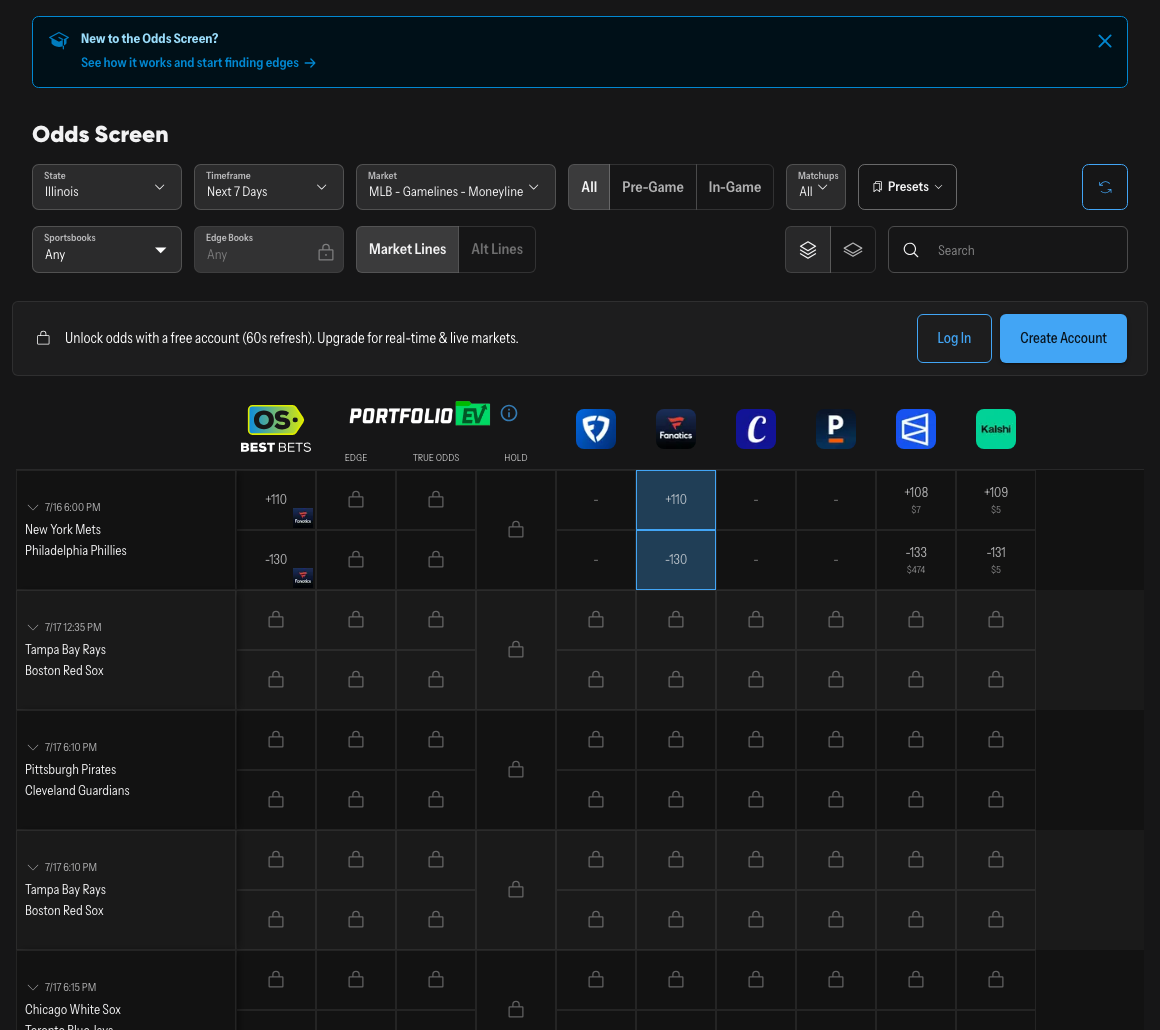 The OddsShopper live odds screen — every book's price on one board, refreshed in real time. Open the live board.
NFL Totals Betting FAQ
What is a total in NFL betting? A total, or over/under, is a bet on the combined points both teams score in a game. If the total is 47 and the teams combine for 48, the over wins; 46 and the under wins; exactly 47 on a whole number is a push.
What is an implied team total? It's the number of points the market expects one team to score by itself, pulled from the game total and the spread. Split the total in half, then add half the spread to the favorite and subtract it from the underdog.
Does overtime count toward the over/under? Yes. NFL totals settle on the final score including overtime, which is why a game sitting exactly on the number in the last minute of regulation is so uncomfortable for under bettors. Any points scored in OT count the same as points scored in the first quarter.
Why do totals move during the week? New information moves them: wind and weather forecasts, a quarterback ruled out, a key skill injury, or heavy money on one side. A number posted Monday can look very different by Sunday morning.
Should I bet the over or the under in the NFL? Neither by default. Start from a disciplined under lean, since public money floods overs and favorites, then let a specific game (a dome, fast pace, healthy offenses) earn an over. Bet the number and the matchup, not the storyline.
Is it worth teasing NFL totals? Generally no. Teasers reward crossing the spread keys of 3 and 7, and combined scores have no comparable structure to cross. If you move a total at all, 41 and 51 are the least-bad numbers to tease through, and the edge is thin even there.
The Bottom Line
NFL totals betting rewards the opposite of what makes it popular. The crowd sees a simple over/under and bets the direction that feels fun; the disciplined bettor sees a scoring forecast, tests it against the implied team totals and the weather, and leans under until a game gives a real reason to go the other way. Do that, shop for the best number instead of taking the first one you see, and skip the teaser shortcut, and you're playing the same total everyone else is, just from the harder, sharper side of the ledger.
Ready to stop leaving the better number on the table? OddsShopper scans every major sportsbook and shows you which one has the softest NFL total and the best price on the side you want. Try it free for 7 days, then use code NFLTOTALS20 for 20% off your first payment of OS Pro or OS Core.
More on this: NFL Win Totals 2026: Kalshi Vs DraftKings Vs FanDuel · Don't Bet NFL Preseason Totals Before Reading This · NFL Win Totals 2026: All 32 Teams On Kalshi, Scored · NFL Win Totals 2026: How The Futures Market Works · NFL 2026 on Kalshi: Every Board We Track