What Is A Teaser Bet? How Teasers Work In Football And Basketball
Last updated: July 29, 2026
A teaser bet is the wager I reach for when two NFL lines sit in the narrow band where six points buys me both key numbers — not just when a spread makes me nervous. Instead of laying a touchdown or backing a short dog at face value, a teaser lets me nudge every spread my way before kickoff. The trade is simple and worth understanding before you place one, so let me walk through exactly how teasers work, what teaser payouts look like in practice, and the one spot where they can actually become defensible.
In Summary
At its core, a teaser is a parlay variant: you combine two or more point spreads or totals into one wager, and in exchange for tying them together, the sportsbook lets you move each line a set number of points in your favor. Football teasers usually shift the line 6, 6.5, or 7 points; basketball teasers shift it 4, 4.5, or 5 points. The catch is the same as any parlay: every leg has to win, or the whole ticket loses. Because you've made each leg easier, the payout is smaller than a straight parlay, and often less than even money. Teasers are mostly worth it in the NFL, where moving a spread through the key numbers of 3 and 7 crosses the most common final margins, the idea behind the famous "Wong teaser." Below I'll break down the points, the payouts with real dollar examples, and when a teaser is a smart bet versus when you're just paying for the illusion of safety.
What Is A Teaser Bet?
Every teaser starts life as a point spread or over/under parlay. You pick two or more games, and instead of taking the posted line on each, the book hands you a block of points to spend across every leg in the same direction.
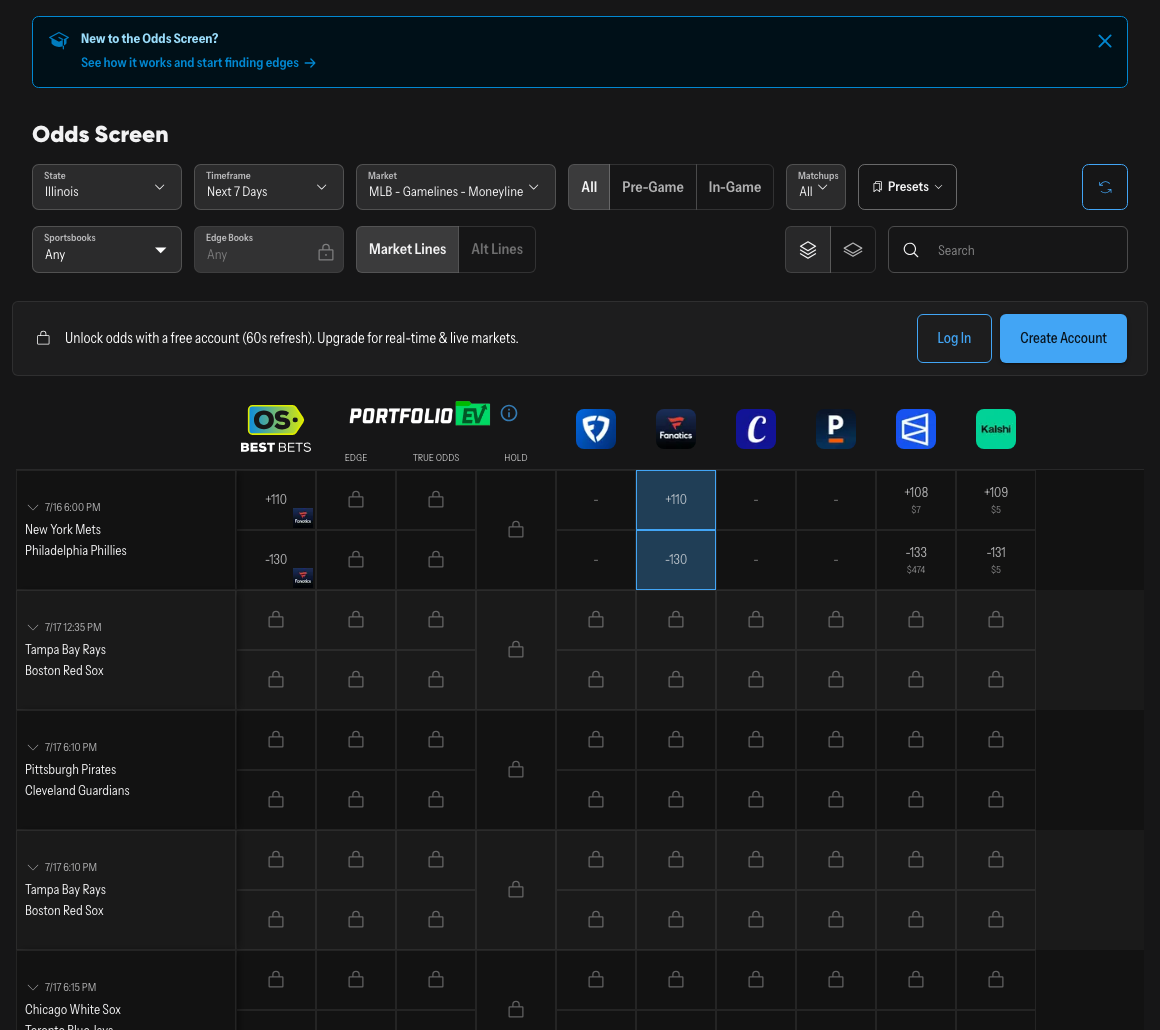
The OddsShopper Odds Screen.
Say the Chiefs are favored by 7.5 and the total in another game is 44.5 (illustrative numbers, not today's lines). In a 6-point teaser I could take the Chiefs down to -1.5 and push that total up to 50.5 if I'm on the under (or down to 38.5 for the over — my choice). Every leg moves by the same teaser amount, and I get to pick the side that helps me on each one. I've made both bets easier to win.
Nothing is free, though. The price you pay for those extra points is twofold: the payout shrinks, and every leg still has to win. Miss one leg and the ticket is dead, exactly like a standard parlay. If you're new to how the prices themselves work, our guide on how to read betting odds covers the American-odds basics I'll lean on below.
How Teaser Points Work In Football Vs. Basketball
The number of points a teaser gives you depends on the sport, because scoring margins are different. The standard ladders:
| Sport | Common teaser sizes | Why this size |
|---|---|---|
| NFL / College Football | 6, 6.5, or 7 points | Football is scored in 3s and 7s, so 6-7 points crosses real margins (the key-number edge below is an NFL thing — college margins are far less concentrated) |
| NBA / College Basketball | 4, 4.5, or 5 points | Basketball margins are less concentrated on key numbers, so the move is smaller |
A few mechanics that hold at almost every book:
- You Choose The Direction On Each Leg. Tease a favorite down (lay fewer points) or a dog up (get more points). On a total, move it down for an over or up for an under.
- Many Books Let You Mix Spreads And Totals in the same teaser, and some allow football/basketball combinations — but eligibility varies by sportsbook and state, so check before you build the ticket.
- Most Books Require At Least Two Legs, and many let you go up to 10 or more (the more legs, the lower the hit rate).
- Bigger Teases Cost More. A 7-point football teaser pays less than a 6-point one, because you're buying an extra point of cushion on every leg.
Teaser Payouts: What A Teaser Actually Pays
Here's where teasers surprise beginners. A standard two-team, 6-point football teaser traditionally pays -110, meaning you're risking more than you stand to win even though you've moved both lines your way — and most US online books now shade that two-teamer to -120 or -130. The payout only climbs above even money once you add enough legs, typically three or more on a 6-point football teaser.
The classic (Vegas) 6-point football teaser ladder looks like this. Treat -110 as the number you're shopping for, not the number you'll usually find — prices vary by sportsbook and have drifted worse over time:
| Legs (6-Pt Football Teaser) | Classic (Vegas) ladder | $100 risk returns |
|---|---|---|
| 2 Teams | -110 | $190.91 total ($90.91 profit) |
| 3 Teams | +160 | $260 total ($160 profit) |
| 4 Teams | +265 | $365 total ($265 profit) |
Five-team-and-up ladders vary too widely from book to book to print a "typical" number — check the posted price before you build one.
Basketball teasers run on their own book-specific ladder, and the value is usually weaker — not because the price is dramatically different, but because the 4-point move doesn't cross margins anywhere near as valuable as the NFL's 3 and 7. The exact numbers differ book to book, which is the first reason line shopping matters here: DraftKings, FanDuel, BetMGM, and Caesars each set their own teaser pricing, and the same two-team 6-point teaser can be -110 at one book while another sits at -120 or worse — that gap is pure cost you can avoid.
A Worked Dollar Example
Let's make it concrete with a two-team, 6-point NFL teaser at -110 (again, illustrative lines — not today's board):
- Leg 1: Chiefs -7.5, teased down to Chiefs -1.5
- Leg 2: Bengals +2.5, teased up to Bengals +8.5
You bet $110 to win $100. Both teased spreads have to cover:
- Both Cover → you collect $100 profit (a $210 return on your $110).
- Either One Fails → you lose the full $110.
That's the whole proposition. You made each side roughly six points easier, and in return you laid -110 instead of getting a parlay's bigger payout. The question that decides whether this is smart isn't "does it feel safer," it's "did those six points move me across enough likely outcomes to justify the price." In the NFL, sometimes they do.
When Teasers Are +EV: Crossing The Key Numbers Of 3 And 7
This is the part most beginner guides skip, and it's the only reason a sharp bettor ever touches a teaser. NFL games don't land on random margins. Because scores are built from field goals (3) and touchdowns (7), final margins cluster hard on 3 and 7, by far the two most common margins of victory. A teaser is only valuable when those extra points drag your number across both of them.
That's the idea behind the Wong teaser, named after gambling author Stanford Wong, who popularized it. The classic version is a 6-point teaser on legs that start in these ranges:
- Underdogs Of +1.5, +2, Or +2.5, teased up to +7.5, +8, or +8.5 (crosses both 3 and 7)
- Favorites Of -7.5, -8, Or -8.5, teased down to -1.5, -2, or -2.5 (crosses both 7 and 3)
In both cases the six points carry your number through the two margins where the most games actually finish, which is the logic sharp bettors use to justify paying the teaser price at all. (For the football-only version of this, with the exact key-number spots and current pricing, see our NFL teaser betting breakdown.)
How high is that bar? On a two-team teaser at -110 you risk 110 to win 100, so the whole ticket has to cash about 52.4% of the time (110 / 210) just to break even. Because both legs must hit, each leg needs to win roughly 72.4% of the time on its own (the square root of 0.524, since 0.724 × 0.724 ≈ 0.524, assuming the two legs are independent). Standard spreads cover around 50%, nowhere near enough. Crossing both 3 and 7 is what gives a Wong leg a fighting chance at that bar — the whole game is finding legs where the key numbers you cross justify the price you're laying.
Heads up, the edge has narrowed.Sportsbooks know the Wong teaser. Many now price two-team teasers at -120 or -130 (which raises the break-even bar) and shade lines to make the ideal starting numbers scarcer. At -120 the ticket has to cash 54.5% (120/220) and each leg about 73.9%; at -130 it's 56.5% (130/230) and roughly 75.2% per leg — the difference between a Wong leg being playable and being a slow leak. The concept is still the soundest reason to play a teaser, but it's an edge to hunt for, not a money printer, and it depends entirely on getting the right base spreads at the right price.
This is exactly where I lean on tools. The whole play hinges on the starting number: the lower a favorite's line to begin with (-7.5 is better than -8.5, because it teases down to -1.5 instead of -2.5), the easier the teased leg, and those prices differ across books.
New to OddsShopper?The tool scans every major sportsbook at once and surfaces the best available number on every side, so you can grab the strongest base spread before you tease off it — a -7.5 instead of a -8.5 is the difference between a -1.5 and a -2.5 teased leg. Code TEASEREDGE20 takes 20% off your first payment on OS Pro or OS Core, so you can line-shop every teaser leg for less.
Why Basketball Teasers Rarely Pay Off
Football has key numbers; basketball doesn't, really. No single NBA margin commands anything close to the share of outcomes that 3 and 7 do in the NFL — basketball margins don't cluster strongly enough on any number — so moving a spread four or five points doesn't cross any special cluster of likely outcomes. Now run the same break-even math from above on it: a two-team, 4-point NBA teaser at -110 still needs each leg to hit about 72.4%, the identical bar the football version faces, except the points you bought cross nothing special on the way. That's my decision rule in one line: if the teaser price demands Wong-level hit rates without Wong-level key numbers, it's a pass. I'll occasionally tease an NBA total when pace and rest both point the same direction, but as a default strategy, basketball teasers are where teaser profits go to die. If you bet hoops, the points you save are usually better spent shopping the straight spread or total for the best number.
Teaser Push Rules (Read These Before You Bet)
Because teased lines often land on whole numbers, ties happen, and books handle them three different ways. This is the first thing I check in the house rules before placing a teaser at any book, because it changes the math:
- Some Books Void Or Refund A Two-Team Teaser when one leg pushes and the other wins — at several major books, a two-teamer with a push is no action, not a win.
- Some Books Drop The Pushed Leg and re-grade a larger teaser with one fewer team: a three-team teaser becomes a two-team teaser at the two-team price.
- Some Books Grade A Push As A Loss ("ties lose") — the harshest version, and the one you most need to know about in advance.
There is no standard — read your book's teaser rules once and you'll never have to again. And when you can, tease to a half-point number (-1.5 rather than -2) so a push is impossible on that leg in the first place.
Teaser Vs. Parlay Vs. Straight Bet
All three are ways to bet sides and totals, but they trade risk and reward differently:
| Bet Type | How it works | Payout | Risk |
|---|---|---|---|
| Straight Bet | One side or total at the posted line | Standard (~-110) | One outcome; lowest variance |
| Teaser | 2+ legs with each line moved in your favor | Lower than a parlay, often below even money | All legs must win, on easier numbers |
| Parlay | 2+ legs at the original lines, odds multiplied | Highest; grows fast per leg | All legs must win, on the harder numbers |
Put real dollars on it and the trade is obvious. Take the same two -110 spreads and $100: bet them straight and each wins $90.91 on its own; parlay them at the original numbers and the ticket pays about +264 ($264 profit, both must cover the full spreads); tease them 6 points at -110 and the ticket pays $90.91 — but both legs got six points easier. The teaser sits between a straight bet and a parlay. You give up the parlay's fat payout to make each leg easier, accepting a smaller return for a higher hit rate. A parlay keeps the original spreads and pays much more, but every leg is tougher. None of them is "best" — they answer different questions. A teaser's job is to buy you cushion through the spots where it actually matters. In practice, I only reach for the teaser over a straight parlay when both of my legs sit right on the NFL key numbers; if they don't touch 3 or 7, I'd rather keep the original lines and take the bigger parlay price, or just bet each side straight.
The one-line rule of thumba teaser only earns its lower payout when the extra points cross NFL key numbers (3 and 7). Everywhere else, you're paying for cushion you don't need.
How I Shop A Teaser Before Placing It
Two prices decide whether a teaser is worth it: the base spread on each leg and the teaser payout itself. Both move from book to book, so I never place a teaser on the first line I see. My routine:
- Find the best base number on each leg. Half a point matters most near 3 and 7. Grabbing a favorite at -7.5 instead of -8.5 lands your teased line at -1.5 instead of -2.5, a real difference because -2.5 still loses the games your team wins by two.
- Compare the teaser price. A two-team 6-point teaser at -110 versus -130 is a big difference in your break-even rate over a season.
- Check the push rule at the book offering the best price.
- Only tease through key numbers in football, and skip basketball teasers unless you have a specific read.
Doing that by hand across a dozen sportsbooks is slow, which is the point of an odds-comparison tool. OddsShopper lays every book's number side by side on its live odds screen, so you can see at a glance which book has the friendliest base spread and price before you build the ticket. (Line shopping isn't just a teaser thing, it's the single most reliable edge in betting; our guide on how to use the OddsShopper odds screen shows why a half-point and a few cents of juice add up to real money.)
More on this: NFL Preseason Event Contracts, Explained In 60 Seconds · Golf Betting Odds Explained: Outrights, Top-10S And Matchups · Golf Matchup Betting Explained: 2-Ball And 3-Ball Strategy · NFL Teaser Betting Strategy: Wong Teasers & Key Numbers · Point Spread Betting Explained: Read The Spread
Frequently Asked Questions
What is a teaser bet in simple terms? A teaser is a parlay where the sportsbook lets you move each leg's point spread or total in your favor, usually 6 points in football or 4 in basketball. Every leg still has to win, and in exchange for the easier lines you accept a smaller payout than a regular parlay.
How many points do you get in a teaser? Football teasers typically give you 6, 6.5, or 7 points; basketball teasers give 4, 4.5, or 5. You apply the same number of points to every leg and choose the direction that helps you on each one. The more points you take, the lower the payout.
What does a teaser bet pay? A standard two-team, 6-point football teaser traditionally pays -110, though most US online books now price it at -120 to -130, so you risk more than you win. The payout climbs above even money as you add legs (roughly +160 for three teams, +265 for four on the classic ladder), but exact prices vary by sportsbook, so compare them.
What is a Wong teaser? A Wong teaser is a 6-point NFL teaser built on legs that cross both key numbers, 3 and 7. The classic spots are underdogs of +1.5 to +2.5 (teased to +7.5 to +8.5) and favorites of -7.5 to -8.5 (teased to -1.5 to -2.5). Crossing the most common margins is the reasoning behind why those legs can hit often enough to beat the price, though books have since tightened the pricing.
What happens if a teaser leg pushes? It depends on the book, and there is no standard. Some books void or refund a two-team teaser with a push, some drop the pushed leg and re-grade a larger teaser with one fewer team, and some grade a push as a loss. Check the rule before you bet, and tease to a half-point line when you can to avoid the tie entirely.
Can you teaser totals as well as spreads? Yes. Many books let you tease over/unders the same way you tease spreads, moving the total up for an under or down for an over, and many let you combine spreads and totals in one teaser — though eligibility varies by sportsbook and state.
A teaser only earns its price when the points cross 3 and 7, and whether they do is decided by the base spread you start from. OddsShopper lays every major sportsbook's number side by side, so the -7.5 that teases down to -1.5 never slips past you while you're staring at somebody's -8.5. Use code TEASEREDGE20 for 20% off your first payment on OS Pro or OS Core, and never tease off a bad number again.