The Wong teaser is one of the best-known "beat the book" plays in football betting, and it was good enough that the books eventually rewrote their prices to blunt it. The whole idea is simple: move two NFL point spreads six points in your favor so each one sweeps across both numbers football games land on most, 3 and 7. Do that and you buy an outsized jump in win probability on every leg. The catch is that the sportsbooks know the play as well as you do, so the modern Wong teaser is no longer an automatic profit. It is a price-shopping bet, and the same two legs can be a slim value at one book and a quiet loser at another. This guide covers the exact rules, why the classic edge compressed, and how to tell a real Wong leg from a lookalike that just feels safe.
This is a strategy piece for bettors who already know what a teaser is and why 3 and 7 matter. If you want the ground floor first, read our teaser bets explained guide for how teaser points and payouts work, and our NFL key numbers breakdown for why those two numbers dominate the spread. For the broad view of every NFL teaser angle, our NFL teaser betting strategy hub is the place to start. This page zooms all the way in on the Wong.
In Summary
- The Wong Teaser Is A Two-Team, 6-Point NFL Teaser built only on legs where those six points cross both key numbers, 3 and 7: favorites of -7.5 to -8.5, and underdogs of +1.5 to +2.5.
- It Was A Real Edge For Years. Qualifying legs are widely cited in betting literature as winning in the mid-70s, above the roughly 72% each leg needed at the old -110 price, though no rigorous public sample pins the exact figure down.
- The Edge Compressed, It Did Not Vanish. Books now price the standard two-team teaser near -120 to -135, which pushes the required win rate right up against that historical hit rate.
- The Play Is Now A Price Bet. The teaser is +EV only when the combined true probability of your qualifying legs clearing, at the price you are paying, beats the break-even, and a trap when it is not. The number in front of you decides it.
Where The Wong Teaser Came From
The strategy is named for Stanford Wong, a gambling author who laid it out in his book Sharp Sports Betting. Wong's contribution was not inventing the teaser, which books had offered for decades, but noticing that the payout structure and the shape of NFL scoring had drifted out of sync. Sportsbooks priced teasers as if every point you bought was worth the same amount. NFL final margins are not distributed evenly, so some points are worth far more than others. Wong pointed at the specific legs where a 6-point teaser bought the most valuable points on the board, and showed that at the prices of the day, those legs cleared the break-even bar. That gap between how books priced points and how football actually scores is the entire reason the play exists.
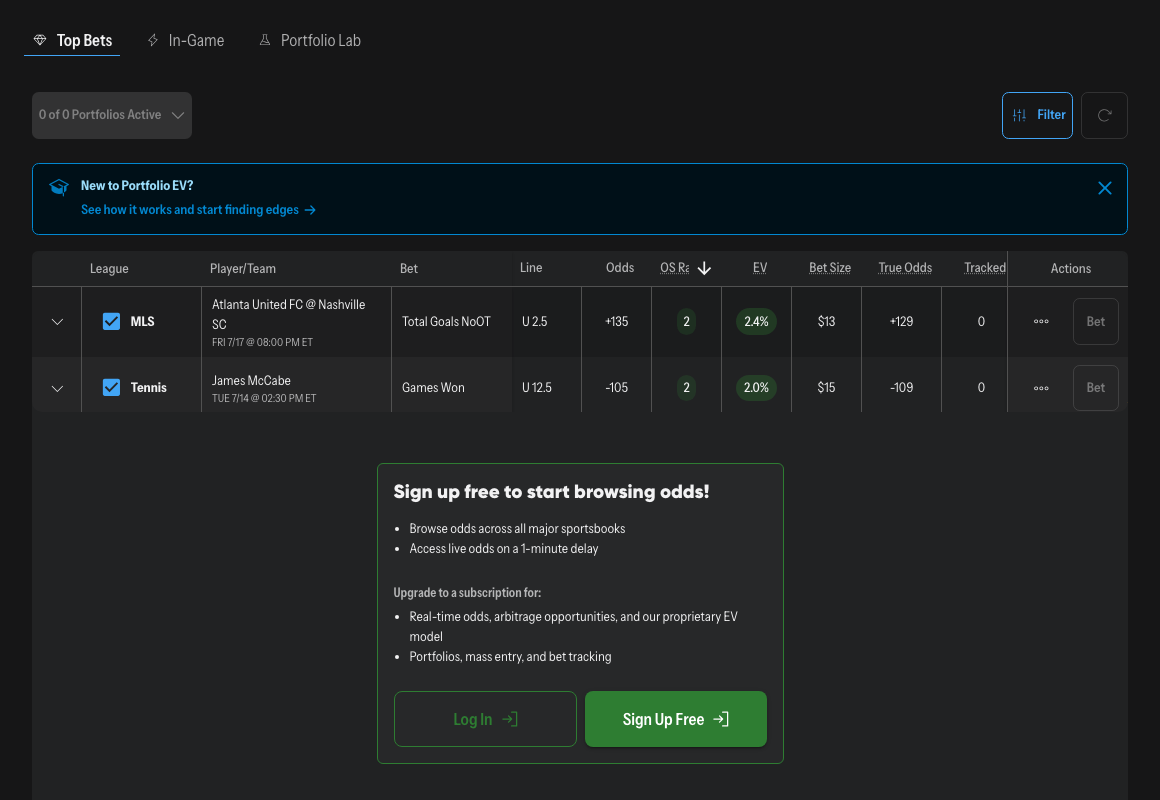
The OddsShopper +EV Screen.
Everything below is a consequence of that one insight, so it is worth being precise about which legs qualify and why the boundaries are where they are.
The Rule: Cross Both 3 And 7
A teaser only earns the Wong name when its six points sweep through both key numbers on every leg. Two spread windows do that cleanly:
| Leg Type | Base spread | Teased to | Key numbers crossed |
|---|---|---|---|
| Favorite | -7.5 to -8.5 | -1.5 to -2.5 | 7 and 3 |
| Underdog | +1.5 to +2.5 | +7.5 to +8.5 | 3 and 7 |
Take the favorite window. A team laid at -8.5 becomes -2.5 after the tease, so it now covers even if it wins by a field goal, and it survives a game decided by exactly 3 or by a touchdown-and-two-point margin. The dog window is the mirror image: a +1.5 underdog teased to +7.5 now survives a 3-point loss and a 7-point loss, the two most common ways to lose a close NFL game.
The boundaries are not arbitrary, and this is where lookalike teasers leak value:
- A -9 Favorite Teased To -3 Stops On The Key Number, Not Past It. A 3-point win now pushes instead of covers. You paid for six points and one of them landed on top of the most valuable number rather than beyond it. Start at -8.5 or lower, so -2.5 clears 3 outright.
- A +3 Dog Teased To +9 Has Already Paid For The 3 It Needed. The plus-3 side was sitting on the key number before you spent a cent, so the tease drags it through comparatively dead space above 7. The value lives specifically in starting at +1.5 to +2.5, where both crossings are still ahead of you.
That is the mechanical test for a Wong leg: not "did I get six points," but "did those six points move me from one side of both 3 and 7 to the other." Miss either crossing and you are teasing at a Wong price without the Wong payoff.
Why Crossing Both Keys Was Worth SO Much
NFL scoring is built out of field goals worth 3 and touchdowns worth 7, so final margins pile up on those exact numbers far more than random chance would produce. A single point that carries your spread across one of those clusters flips a whole band of likely outcomes onto your side, which is why our key numbers guide treats 3 as the most valuable number on the board and 7 as the second. Crossing both in one move is the most efficient six points you can buy in football.
That efficiency is what produced the number every teaser conversation still cites: legs meeting the Wong criteria are widely reported to have won in the mid-70s. Treat that as betting lore rather than a measured guarantee, because the exact figure shifts with the dataset, the seasons sampled, and how each book grades pushes, and no rigorous public sample locks it down. But the direction is clear. Standard spreads cover around 50%, nowhere near enough to overcome a parlay-style payout, while the crossings on a Wong leg do real work on that number.
Why The Classic Edge Compressed
Here is the part that turns a piece of gambling folklore into a bet you actually have to think about. The old math worked because the price was cheap. A two-team, 6-point teaser once paid even money or -110, which means the whole ticket had to cash about 52.4% of the time to break even, and because both legs must hit, each leg needed to win only about 72.4% on its own. Set that against the mid-70s hit rate those legs were credited with, and there was room to profit, at least for as long as the pricing stayed that soft.
The books noticed the same public data Wong did. Over the years they re-priced the standard two-team teaser upward, so today it commonly costs somewhere between -120 and -135 rather than -110. Some books also shade the lines around the qualifier windows, making the ideal -8.5 favorite or +2.5 dog scarcer than it used to be, and market pricing overall is sharper than the samples that produced those old hit rates. None of that kills the concept. It moves the edge out of the leg selection, which is now well understood, and into the price you pay, which still varies from book to book.
Which is where the current number takes over. Here is how to read a single leg.
Is This Leg A Value Or A Trap?
Because both legs have to hit, you can back the required per-leg win rate straight out of the teaser price. Assuming two independent legs with roughly equal win rates and standard push grading, the higher the juice, the higher the bar each leg has to clear:
| Two-Team, 6-Point Teaser Price | Ticket break-even | Required win rate PER leg |
|---|---|---|
| -110 | 52.4% | ~72.4% |
| -120 | 54.5% | ~73.9% |
| -130 | 56.5% | ~75.2% |
| -135 | 57.4% | ~75.8% |
Line that up against a mid-70s historical hit rate and the trap becomes obvious. At -120, a genuine pair of Wong legs is plausibly a slim value. At -135, the same two legs need close to a 76% per-leg win rate just to break even, which sits on top of or above the best figures the strategy ever produced, before you account for today's sharper markets. Same legs, different price, and one is a bet worth making while the other only feels like one.
So the decision on any single Wong leg comes down to three checks. First, does the tease actually cross both 3 and 7 from inside the qualifier windows. Second, is the teaser priced cheaply enough that your realistic per-leg win rate clears the required rate in the table. Third, is the game environment normal, because a heavy favorite on a short week or a total in the low 30s in a gale can distort how margins land and quietly undercut the scoring math the whole strategy assumes. Clear all three and you have a defensible bet. Miss the price check, and you have a good-looking loser.
The number is the bet.A Wong leg at -120 and the identical leg at -135 are two different wagers with two different expected values. That is why line shopping stops being optional here. Before we tease, we line-shop the best base spread across every major sportsbook, DraftKings, FanDuel, BetMGM and Caesars among them, and read the no-vig fair odds on each side, so we cross 3 and 7 from the best possible number and can see when the teaser price still clears the math. The OddsShopper odds screen and its no-vig fair-odds pricing run that scan for you. Start a 7-day free trial, and code WONGTEASER20 takes 20% off OS Pro or OS Core.
A Worked Example: The Same Two Legs At Two Prices
Say we are eyeing a classic two-team build. In one game a home favorite is laid at -8, which teases down to -2 and clears both 7 and 3. In another, a road underdog sits at +2, which teases up to +8 and clears 3 and 7 the other way. Both legs are textbook: inside the windows, both crossings still ahead of them. From here the price does all the remaining work.
| Book A | Book B | |
|---|---|---|
| Two-Team, 6-Pt Teaser Price | -120 | -135 |
| Required Win Rate Per Leg | ~73.9% | ~75.8% |
| Verdict On A Mid-70S Pair | slim but real value | a trap that feels safe |
Read the second row of that table and the whole point lands. Nothing about the football changed between the two books, and the legs are identical. At Book B we are simply paying for a per-leg win rate that sits at or above the best figure the strategy ever produced, which is exactly how a "safe" teaser turns into a slow leak. That is the same discipline we come back to every week: shop the teaser price itself, not just the base spread, because on a bet this tight a 15-cent gap in juice is most of the edge. (These spreads are illustrative, chosen to show how price alone flips a Wong from a value to a loser; always run the current, real number before you bet.)
Wong Teaser Variants, And Which Ones To Skip
Once you understand why the classic works, the variants sort themselves quickly.
- Basketball "Wong" Teasers Do Not Work The Same Way. NBA and college basketball margins spread smoothly across a wide range with no comparable spikes at any single number, so buying points, whether it is the 4 in a basketball teaser or a borrowed 6, does not deliver the outsized jump you get from crossing 3 and 7 in football. That advantage is an NFL phenomenon.
- Three-Team And "Sweetheart" Teasers Raise The Bar, Not Lower It. A 10-point sweetheart teaser looks generous, but it usually carries three legs and inflated juice, which pushes the required per-leg win rate well past the two-team numbers above. Every leg you add is one more result that has to come in. The classic two-team build is where the historical edge lives.
- Sometimes The Alt Spread Is The Better Buy. Teasing is one way to move a number, but you can often buy an alternate spread directly, and occasionally that alt-spread price beats teasing the same line. Comparing the two on the odds screen's alternate-spread pricing before you commit is worth the extra ten seconds, because assuming the teaser is the cheaper path to your number is how you overpay.
- Never Tease Totals. Totals have no 3-and-7 structure, so six points on an over or under mostly passes through meaningless numbers. Wong logic is a spread-only tool.
Notice the through-line: every one of these fails or passes on the same test as the classic leg, whether the points you are buying cross numbers that actually matter, at a price you can beat.
The Bottom Line On The Wong Teaser
The Wong teaser earned its reputation honestly. For years, a two-team, 6-point NFL teaser on favorites of -7.5 to -8.5 and dogs of +1.5 to +2.5 crossed both key numbers and cleared its break-even with room to spare. What changed is the price, not the football. Books moved the standard teaser to -120 and beyond and pushed the required win rate right up against the strategy's own history. That leaves the leg selection exactly where Wong put it and moves the edge onto the number in front of you. Find qualifying legs from inside the windows, shop the base spread and the teaser price, skip totals and long sweethearts, and fire only when the price still clears the math. The play is not dead. It is just no longer free.
Frequently Asked Questions
What is a Wong teaser? A Wong teaser is a two-team, 6-point NFL teaser built only on legs where the six points cross both key numbers, 3 and 7: favorites of -7.5 to -8.5 teased down to -1.5 to -2.5, and underdogs of +1.5 to +2.5 teased up to +7.5 to +8.5. It is named after gambling author Stanford Wong, who documented the approach in Sharp Sports Betting.
Is the Wong teaser still profitable? Sometimes, but not automatically. The classic version could be +EV at -110, where each leg needed only about a 72% win rate, provided the true hit rate on qualifying legs actually cleared that bar. Many books now price the standard two-team teaser at -120 to -135, which raises the required rate to roughly 74% to 76% per leg and sits on top of the strategy's historical hit rate. Whether a given ticket is +EV depends on getting the best base spread and the cheapest teaser price.
Why do the spreads have to be -7.5 to -8.5 and +1.5 to +2.5? Those are the windows where six points cross both 3 and 7. A -9 favorite teased to -3 stops on the key number instead of clearing it, and a +3 dog has already paid for the 3 before you tease. Starting inside the windows is what keeps both crossings ahead of you.
Can you Wong teaser NBA games? The logic does not transfer. NBA and college basketball margins are spread smoothly with no spikes on specific numbers, so buying points does not deliver the outsized jump that crossing 3 and 7 provides in the NFL. The Wong teaser is an NFL-only concept.
Should a Wong teaser ever have more than two legs? Two clean qualifying legs is the classic build and the easiest to keep +EV. Every extra leg raises the combined win rate you need and usually comes with a worse price, so only add a third leg if it also cleanly crosses both key numbers at a number you can beat.
Where do I find the best teaser pricing? Because the edge is now just a point or two of spread and a few cents of juice, compare both the base spread and the teaser price across books. OddsShopper scans every major sportsbook so you can start from the best number and place the teaser at the best available price.
New to OddsShopper? It does automatically what a disciplined Wong teaser requires by hand: it scans every major sportsbook, flags the best NFL spread on each leg, and shows fair no-vig odds so you can see when a teaser is actually priced in your favor. You can try it free for 7 days, and code WONGTEASER20 takes 20% off OS Pro or OS Core if you subscribe.
More on this: NFL Teaser Betting Strategy: Wong Teasers & Key Numbers · Positive EV Betting Strategy: Top-Down Vs. Bottom-Up Edges · Underdog Playoff Best Ball Strategy: Draft To Survive · PrizePicks MLB Strategy: Price Every Line Before You Play · Same Game Parlay Strategy: Is SGP Worth It?