Point Spread Betting Explained: How To Read The Spread, Cover & Bet ATS
The first time I looked at an NFL betting screen, the moneyline made sense and the point spread did not. Why would I lay 6.5 points? What does a little minus sign next to a number mean, and why is there a second number, like -110, hanging off it? Once it clicked, the spread became the bet I make most, because it turns a lopsided game into a near coin flip you can actually handicap. Below is the whole thing in plain English, with real dollar examples.
In Summary
A point spread is a handicap the sportsbook attaches to the favorite to level an uneven matchup. The favorite has to win by more than the spread; the underdog can lose by less than the spread (or win outright) and still cash. You will see it written as -6.5 (the favorite, the minus side) and +6.5 (the underdog, the plus side). Most spread bets are priced at -110, which is the book's cut, often called the juice or vig: you risk $110 to win $100. When your side beats the spread, you cover; when the favorite wins by exactly the spread on a whole number, the bet is a push and your stake is refunded. Betting the spread over and over is called betting against the spread (ATS), and a team's ATS record tells you how it has done versus expectations, not just its win-loss. Below I break down how to read the favorite and underdog, what the -110 juice actually costs you, why half-points and the key numbers 3 and 7 matter in the NFL, and when the spread is the right bet versus the moneyline or the total.
Watch: How To Bet Point Spreads For Beginners
If you'd rather see the spread walked through out loud, we covered the exact fundamentals below in this OddsShopper NFL Betting 101 breakdown. It pairs well with the worked examples further down.
What Is A Point Spread, And Why It Exists
Take a typical matchup. Say the Kansas City Chiefs host the Denver Broncos, and everyone expects the Chiefs to win. If the only bet available were "who wins," almost all the money would pile on Kansas City and the book would have to pay out a tiny return on the obvious side. The point spread fixes that. Instead of betting on who wins, you bet on the margin of victory.
A real-format example looks like this:
Kansas City Chiefs -6.5 (-110)Denver Broncos +6.5 (-110)
That -6.5 is the spread. It means Kansas City is favored by six and a half points. For a Chiefs bet to win, they have to win the actual game by 7 or more. For a Broncos bet to win, Denver has to either win outright or lose by 6 or fewer. The book has effectively spotted the underdog 6.5 points before kickoff, which pulls a blowout-looking game back toward a 50/50 proposition. That balance is the entire reason the spread exists: it gets roughly equal money on both sides so the book profits from the juice instead of sweating the result.
How To Read The Spread: Favorite (Minus) Vs Underdog (Plus)
The sign in front of the spread number tells you which team you are backing and what they have to do.
- Minus (-6.5) = The Favorite. The number is how many points get subtracted from their final score for grading. The favorite must win by more than that number to cover.
- Plus (+6.5) = The Underdog. The number is how many points get added to their final score. The underdog covers if they keep it closer than that number, or win straight up.
So "what does -3.5 mean?" The team is favored by three and a half and must win by 4 or more. "What does +7 mean?" The team is a seven-point underdog and covers as long as they don't lose by 8 or more (lose by exactly 7 and it's a push, more on that below). The half-point in -3.5 is there on purpose, so there is no possibility of landing exactly on the number.
What The -110 Juice On A Spread Means
That second number, the -110, is the price, not the spread. It is the sportsbook's commission, called the juice, vig, or hold. A standard spread is priced -110 on both sides, which reads in American odds as "risk $110 to win $100."
The reason both sides aren't an even +100 is the hold. The book is taking a cut for setting the line and holding the bet. Add up the implied probability of both -110 sides and you get about 105%, and that extra ~5% is the vig. Over a season of -110 bets, that built-in tax is the single biggest thing standing between you and profit, which is exactly why getting the best available price matters so much.
A Worked Example: Betting A Spread At -110
Let me run real dollars through it. Say you like the Broncos +6.5 (-110) and you bet $110.
| Outcome | Final score | Did +6.5 cover? | Your result |
|---|---|---|---|
| Denver Loses By 6 Or Fewer | Chiefs 24, Broncos 20 | Yes (lost by 4) | Win $100 (get back $210) |
| Denver Wins Outright | Broncos 27, Chiefs 24 | Yes | Win $100 (get back $210) |
| Denver Loses By 7+ | Chiefs 31, Broncos 20 | No (lost by 11) | Lose $110 |
Notice the Broncos can flat-out lose the game and you still win the bet, as long as they lose by 6 or fewer. That is the appeal of the spread: you are not married to picking the winner, just the margin. And notice the math of -110, you risk $110 to win $100, so you need to win more than about 52.4% of your spread bets just to break even. Getting -105 instead of -110 on the same side, or +7 instead of +6.5, chips directly at that break-even number. That is free value, and it's why I never bet a spread without checking a few books first.
Covering The Spread And Pushes
Two terms you'll hear constantly:
- Covering The Spread means your side beat the number. The Chiefs "covered" -6.5 by winning by 7+. The Broncos "covered" +6.5 by keeping it within 6 (or winning).
- A Push happens when the result lands exactly on a whole-number spread. If the line is Cowboys -7 and Dallas wins by exactly 7, neither side covered. It is a tie with the book, and your full stake is refunded, no win, no loss. Pushes are only possible on whole numbers, which is why books so often hang a half-point (-6.5, -7.5) to take the tie off the table.
If you ever see "-7" instead of "-7.5," know that the push is in play, and that whole number is usually there because it sits on a meaningful margin (we'll get to key numbers).
Against The Spread (ATS): The Basics
When people say a team is "7-3 against the spread" or quote an ATS record, they mean how that team has done relative to the spread, not its straight-up wins and losses. A great team that everyone bets can go 12-4 on the field but only 7-9 ATS if it keeps winning by less than it was favored. A bad team can have a losing record but a winning ATS mark by routinely keeping games closer than expected.
ATS is the lens spread bettors actually care about, because the spread is designed to make every game a coin flip. Beating it consistently is hard. The historical break-even for -110 bets is about 52.4%, so a bettor hitting 55% ATS over a real sample is comfortably ahead of the break-even bar. Be skeptical of any "record" quoted without how many bets and over what timeframe, a hot 8-2 stretch over two weeks tells you almost nothing.
The number that matters: 52.4%.At standard -110 juice, you have to win nearly 53% of your spread bets just to break even. That's the bar every ATS edge has to clear, and it's why shaving the price (or grabbing a better number) is worth real money over a season.
Spread Vs Moneyline Vs Totals: When To Pick Each
The spread is one of three core bets on most games. They differ in what you're actually picking, and each one fits a different read:
| Bet Type | What you're picking | Best when |
|---|---|---|
| Point Spread | The margin (favorite by more than X, or dog within X) | You think the game is closer (or more lopsided) than the line says |
| Moneyline | Who wins straight up, any margin | You like an underdog to win outright, or want to avoid a backdoor cover |
| Total (Over/Under) | Combined points by both teams | You have a read on pace/scoring, not on a side |
A quick rule of thumb I use: if I love a favorite but think it's a tight game, the moneyline can be safer than laying a big spread. If I think a heavy favorite wins comfortably, the spread pays better than a steep moneyline price. And if I have no opinion on who wins but a strong read on whether it'll be a shootout or a grind, the total is the cleaner bet. For the full breakdown of how those prices work, see our guide on how to read betting odds.
Half-Points And Key Numbers (3 And 7 In The NFL)
Football margins are not random, and that is where half-points earn their keep. In the NFL, the two most common margins of victory by far are 3 points (a field goal) and 7 points (a touchdown and extra point). Those are the key numbers.
This is why the difference between -2.5 and -3.5 is huge, even though it's only one point. A -2.5 favorite covers on a field-goal win; a -3.5 favorite does not. So books charge you for crossing a key number, a practice called buying points. Moving a line from -3 to -2.5, for example, might cost you extra juice (say -110 up to -130) precisely because you're buying your way to the safe side of the most common margin.
| Margin | Why it matters | Practical takeaway |
|---|---|---|
| 3 Points | Most common NFL final margin (the field goal) | +3.5 and -2.5 are premium numbers; +2.5 and -3.5 are exposed |
| 7 Points | Second most common (TD + extra point) | Crossing the 7 with a half-point has real value |
| Half-Point (The "Hook") | Removes the push and can clear a key number | Often worth shopping for, sometimes worth buying |
You don't need to memorize a key-number chart to start. Just know that not all points are equal, and the spots around 3 and 7 are where line shopping pays off the most. If you want the full breakdown of which margins matter and by how much, our NFL key numbers guide goes deeper — and it's the same logic behind NFL teasers, which move a spread through those key numbers on purpose.
Point Spreads By Sport: NFL, NBA & College Basketball
Spreads work the same way everywhere, but the texture changes by sport, and that changes where the half-point is actually worth buying:
- NFL: This is the sport those 3 and 7 key numbers were built on. Because so many games land on a field goal or a touchdown, the half-point around -2.5/-3.5 and 6.5/7.5 carries real weight, and spreads mostly live in single digits. It's the one sport where buying a point across a key number is routinely defensible.
- NBA: Margins are spread far more evenly, so there's no dominant key number the way the NFL has 3. That means the half-point "hook" matters much less, and buying points is rarely worth the juice. What moves NBA spreads instead is pace and rest, a team on the back end of a back-to-back is a different bet than a rested one.
- College Basketball: Home court is historically worth roughly three to four points, and rotations are short, so one injury or a star in foul trouble swings a line harder than it would in the pros. Mismatched teams can push spreads into the 20s.
Baseball and hockey use a fixed 1.5-run or 1.5-goal version of the spread (the run line and puck line), where the price moves instead of the number. The concept is identical, a handicap to level the favorite, just locked at 1.5. The practical upshot across all of them: the same odds screen that shops your NFL spread shops these too, so you never have to eyeball which book has the number.
How To Find The Best Spread (And Price)
Here is the part most beginners skip and shouldn't. The same game is not priced the same at every sportsbook. FanDuel might post Chiefs -6.5 (-110), DraftKings the same game at -6 (-105), and BetMGM sit at +6.5 (-105) on the Broncos — three different bets on one matchup. Grabbing the extra half-point, or the cheaper juice, is free expected value, the betting equivalent of buying the identical item for less. Over a season, that's the difference between break-even and profit.
Doing it by hand across a dozen books is a pain, especially since spreads shift with line movement all week (books nudge the number as money comes in). This is the free part of the job, and where a tool earns its keep: on OddsShopper's live odds screen, the tool surfaces the best spread and the cheapest juice for the same game across every book it tracks, so you can see at a glance who's offering the best number before you bet. That comparison is free, and it's the habit that matters most for a beginner.
Once you're comfortable getting the best number, the next step is learning which prices are actually mispriced in your favor, that's positive expected value (+EV), and it's what separates bettors who win long-term from everyone else. A simple gut-check that you're on the right side of the market is closing line value: if you keep beating the spread the game eventually closes at, the profit tends to follow. The spread is where the volume is; +EV is how you beat it.
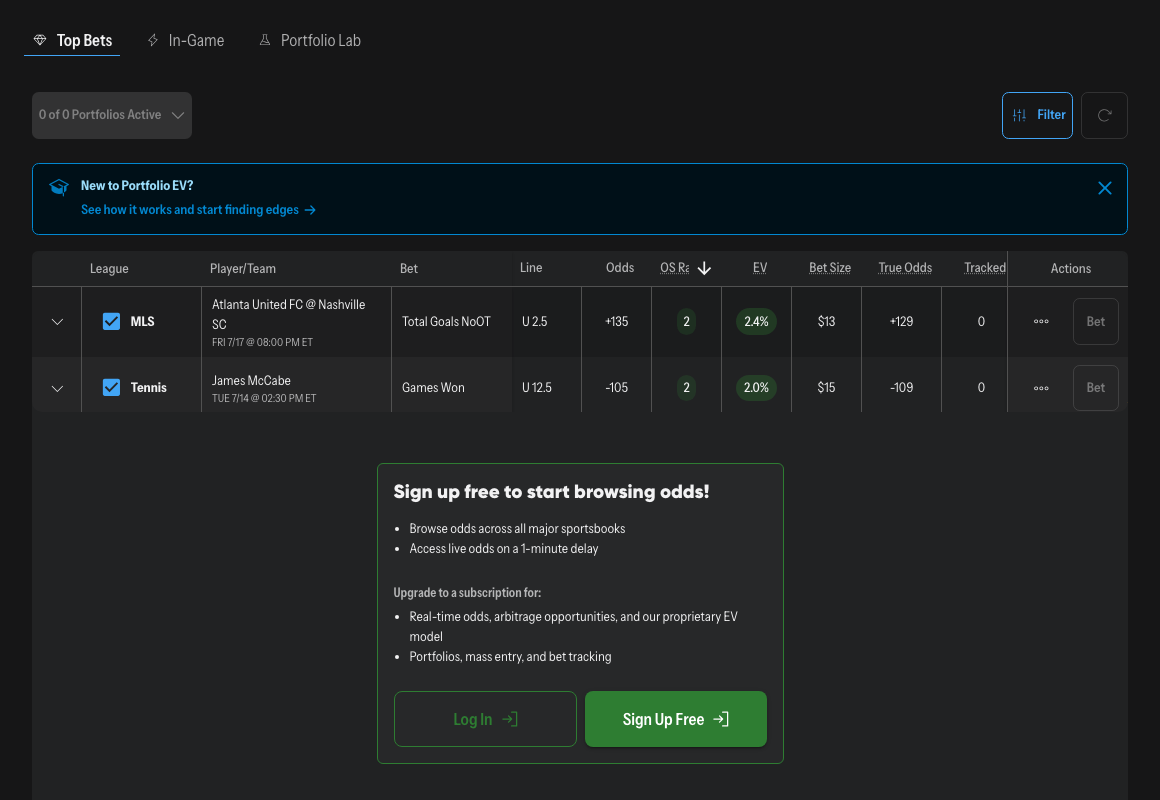
The OddsShopper +EV screen grades each book's price against the true line and flags the ones worth betting — the paid step beyond free line-shopping.
New to OddsShopper?Line-shopping the best spread and cheapest juice is free, and it's where you should start. When you're ready to go further, OS Pro's +EV screen grades every book's price against the true line and surfaces the spots that are actually in your favor. You can try it free for 7 days, and code SPREADEDGE20 takes 20% off your first payment.
More on this: What Kalshi's Bid-Ask Spread Actually Costs · NFL Preseason Event Contracts, Explained In 60 Seconds · Prediction Market Spread Cost: The Spread Is The Vig · Golf Betting Odds Explained: Outrights, Top-10S And Matchups · Soccer Spread Betting & Asian Handicap Explained
Frequently Asked Questions
What is a point spread in betting? A point spread is a handicap the sportsbook puts on the favorite to even out an uneven matchup. Instead of betting who wins, you bet the margin: the favorite (the minus side) must win by more than the spread, and the underdog (the plus side) covers by losing by less than the spread or winning outright.
What does -3.5 mean on a spread? The team is a 3.5-point favorite. They must win the game by 4 or more points for a bet on them to cover. The half-point means there's no chance of a push, the bet either wins or loses.
What does it mean to cover the spread? Covering means your side beat the spread. A -7 favorite covers by winning by 8 or more; a +7 underdog covers by losing by 6 or fewer (or winning). If the favorite wins by exactly 7 on a whole-number line, it's a push and stakes are refunded.
Why is the spread priced at -110? The -110 is the juice, the sportsbook's built-in commission. It means you risk $110 to win $100. That cut is why you need to win about 52.4% of your spread bets just to break even, and why getting the best price matters.
What is a push in spread betting? A push is a tie with the book. It happens only on whole-number spreads when the result lands exactly on the number (a -7 favorite winning by exactly 7). No one covers, and your full stake is returned.
What is against the spread (ATS)? Against the spread, or ATS, refers to betting and grading by the point spread rather than straight-up wins. A team's ATS record shows how it has performed relative to expectations, which is different from its actual win-loss record.
Should I bet the spread or the moneyline? Bet the spread when you think the game will be closer or more lopsided than the line suggests. Bet the moneyline when you simply like an underdog to win outright, or when you want to avoid losing on a late, meaningless score that flips the cover.
The spread is the most popular bet in football and basketball, and the single easiest way to gain an edge on it is to never accept a worse number than you have to. OddsShopper lines up the spread and price for your game across every book in real time for free, so you grab the best half-point and the cheapest juice before the line moves. When you want to know which of those numbers is actually mispriced in your favor, OS Pro's +EV screen is the step up. Try it free for 7 days, and use code SPREADEDGE20 for 20% off your first payment. Stop leaving the better number on the table. Bet responsibly: 21+ where legal.