If you bet NFL point spreads, half a point can be the difference between a profitable season and a frustrating one. Football rarely produces winning margins of 1 or 2, so final margins pile up on a few specific numbers, and 3 and 7 tower over the rest. Learn where those numbers sit and you stop treating a spread like a random line and start treating it like the pricing of a field goal.
What NFL Key Numbers Are, And Why The Scoreboard Creates Them
A key number is simply a common margin of victory, the final gap the two teams are most likely to land on. In the NFL that list is short and predictable because points come in chunks: a field goal is 3, a touchdown with the extra point is 7, and almost every final score is built by adding those two blocks together. A margin of 1 or 2 takes something unusual, a safety or a missed extra point, so those results stay rare. Win by a field goal or a touchdown, and you have landed on the two most crowded numbers on the board.
A spread of 3, then, is not the same kind of line as a spread of 5. When a number matches a common margin, which side of it you bet decides a huge share of your bets outright. Already comfortable with how a spread works? This is the layer that sits on top of it. If you want the foundation first, start with point spread betting explained and come back.
| Winning Margin | How often NFL games land there (historically) | Why it clusters here |
|---|---|---|
| 3 | The single most common margin, about 1 in 7 games | A single field goal |
| 7 | The next most common, roughly 1 in 11 games | A touchdown plus the extra point |
| 10, 6, 14, 4 | A second tier, each in low single-digit percentages | Other common scoring combinations |
| Everything Else | The long tail | No scoring pattern favors those gaps |
Why 3 And 7 Sit Above Every Other Number
No two margins carry the weight these do. A game landing on exactly 3 is historically the single most common result in the NFL, and 7 is next in line. Between them, those two margins decide a large share of games every season. When a game lands on 3 and you are sitting on the wrong side of it, that is a bet you lose for the sake of a single point you could have had.
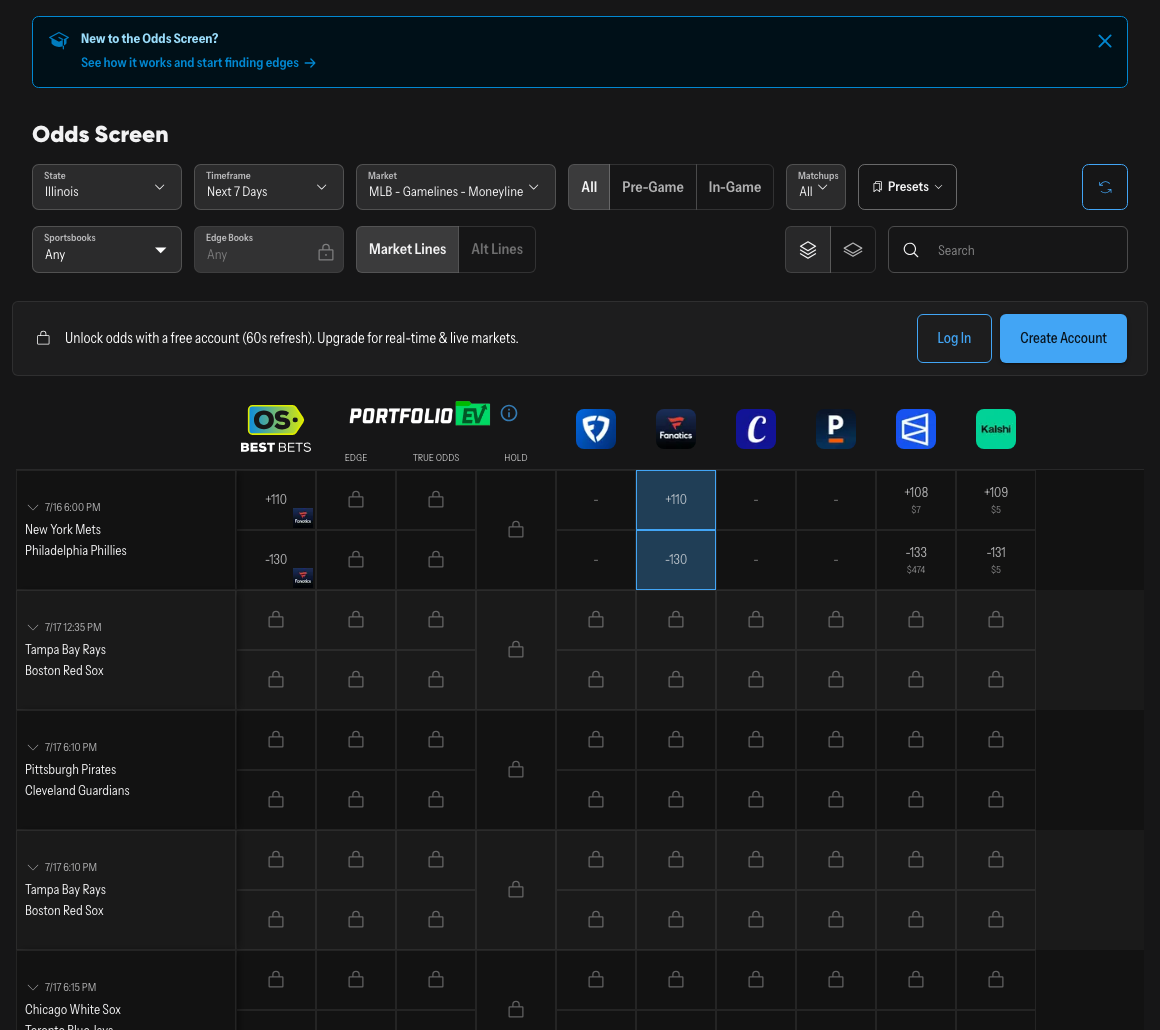
The OddsShopper Odds Screen.
After 3 and 7 comes a second tier that still matters: 10, 6, 14, and 4 all show up often enough to respect. Most of them are combinations of field goals and touchdowns, so they cluster for the same reason the top two do. They are not in the same class as 3 and 7, but a spread parked on 6 or 10 deserves more care than one on 5 or 9. The takeaway is the same either way: before you place a spread bet, ask whether the number is a key one, because that single question changes how much a half-point is worth.
Line Shopping Around A Key Number Is The First Move
Here is the part most bettors skip: you do not always have to pay to get the number you want, because sportsbooks do not all hang the same line. One book might post a home dog at +2.5 while another already has it at +3. Take the +3, and a 3-point loss becomes a push instead of a loss, at no extra cost. Over a full season, that free value dwarfs almost every "system" a new bettor chases.
Checking five or six books by hand for every game is not realistic, though, and that is exactly the gap OddsShopper's odds comparison closes: it pulls the same spread across 100+ sportsbooks at once, so we can see at a glance which book has us on the safe side of 3 or 7. When DraftKings 🎁 has a team at -3.5 but BetMGM 🎁 still shows -3, that half-point is the whole edge, and we want the book already handing it to us for free.
New to OddsShopper?It scans 100+ sportsbooks in real time and flags the exact bet priced in your favor, including which book already has you on the right side of a key number without buying it. You can try it free for 7 days, and code KEYNUMBERS20 takes 20% off OS Pro or OS Core if you subscribe. See today's edges free
Buying The Hook: When A Half-Point Is Worth The Juice
If no book has the number you want, most sportsbooks will sell it to you. Moving the line in your favor is called buying points, and buying the half-point that gets you onto a key number is buying the hook. It is not free: a standard off-key half-point costs about 10 cents of juice, moving a price from -110 to -120, and buying onto or through 3 and 7 costs more because the book knows exactly what that half-point is worth.
A Worked Example: Buying -3.5 Down To -3
Say we like a 3.5-point favorite, but we want to sit on the right side of that field goal. At -110, we need to win about 52.4% of the time to break even. Buy the favorite from -3.5 down to -3 at a price of -130, and our break-even climbs to about 56.5%.
The mistake most people make here is overstating what they are buying. Only one outcome actually changes: our favorite winning by exactly 3 stops being a loss and becomes a push. That is not the same as the roughly one-in-seven rate for a 3-point margin, which counts either team winning by 3; we only get the half of it where our side is the one winning by three, so the real gain is a few percent, not 15. The fair price for that half-point usually lands somewhere around 15 to 20 cents, which makes -130 close to fair rather than a steal. The buy is worth it when we can get it cheaper than fair, or when the matchup projects to land right on a field goal. Pay 25 or 30 cents for it and we are overpaying for a low-frequency result.
| The Move | Typical price change | Is it worth it? |
|---|---|---|
| Off-Key Half-Point (E.g. -5.5 To -5) | About 10 cents (-110 to -120) | Usually not. You are paying for a rarely decisive margin. |
| Onto 3 (E.g. -3.5 To -3) | Often 15 to 25 cents, sometimes more | Only at or below fair value (around 15 to 20 cents). An overpay above that. |
| Onto 7 (E.g. -7.5 To -7) | Often 15 to 25 cents, sometimes more | Same test: worth it near fair value, an overpay if the book gouges the price. |
| Through A Key (E.g. -3.5 To -2.5) | Steep, the book protects it | Rarely. You pay double juice to cross the most valuable number. |
Boil it down to three rules, and buying points stops quietly draining your edge:
- Buy Only Onto 3 Or 7. Those are the margins worth capturing. A half-point that never touches a key number is almost never worth the juice.
- Only At Or Below Fair Value. Onto 3 or 7 usually runs 15 to 25 cents, and the low end of that is fair; paying to cross a key, or paying well above fair, gives the edge right back.
- Shop Before You Buy. If another book already hangs the number, take it there for free instead of paying for it.
For a second read on whether a number is actually priced in our favor before we pay for it, OddsShopper's Portfolio EV tool grades the bet against the fair, de-vigged price, so the call is not a guess.
Teasers: Moving Through Two Key Numbers At Once
Teasers are where key numbers turn into a strategy of their own. A teaser lets you move the spread in your favor across multiple games in exchange for a lower payout, and the standard NFL teaser is 6 points. The whole point is to drag your line through both 3 and 7 at the same time.
The classic version moves a favorite down through the keys or a dog up through them. Take a favorite from -8.5 to -2.5 and the line now sits on the safe side of both 7 and 3; bump a dog from +1.5 to +7.5 and it clears both 3 and 7 the other way, so the dog can lose by up to 7 and still cover. Because each leg now sits past two key numbers, it wins far more often, which is why a two-team 6-point teaser needs each leg to hit roughly the low-to-mid 70s percent to break even, depending on the teaser price. The discipline is simple: tease NFL point spreads, not totals. Scoring totals do not cluster on a couple of numbers the way winning margins do, so the key-number edge that makes a teaser work is not there. For the full breakdown of when a 6-point teaser is actually value versus a trap, see teaser bets explained.
Timing And The Rest Of The Spread Playbook
Key numbers set the frame, but a few habits sharpen the rest of the spread read. Lines drift over the week, and a common pattern is to bet a favorite early, before public money pushes the number up, and to shop an underdog closer to kickoff, when late money on the chalk can leave a better number on the dog. It is a tendency, not a rule, and injury or lineup news can override it either way. On totals, public money often leans toward overs, so some bettors hunt for under value, but every total still has to be priced game by game rather than bet on the lean alone.
And the most underrated move of all is no move. Not every game has a side worth betting. A spread parked on a key number at a fair price, with no better number available anywhere, is a perfectly good pass.
The sharpest move is often no move.A bet you skip because the number is against you is money you keep.
The Bottom Line
NFL scoring is built from 3s and 7s, so the margins cluster there, and that is why the point spread lives and dies on those two numbers. Respect them in this order: shop for the best number first, buy the hook onto 3 or 7 only when the price is at or below fair, lean on teasers to cross both keys at once, and skip the bet when the number is against you. Do that consistently and you are making the number part of the bet instead of treating every spread the same, one half-point at a time.
Frequently Asked Questions
What are the key numbers in NFL betting? The most important are 3 and 7, the two most common margins of victory because points come in field goals and touchdowns. A second tier of 10, 6, 14, and 4 also matters, since most of those are other common combinations of field goals and touchdowns.
Why are 3 and 7 the most important key numbers? A field goal is 3 points and a touchdown with the extra point is 7, so NFL games land on those margins far more than any others. Between them they decide a large share of games every season, which is why which side of those numbers you bet is so valuable.
Is it worth buying a half-point onto 3? Often, if the price is fair. Moving a favorite from -3.5 to -3 turns every 3-point loss into a push, and 3-point margins are the single most common result. It stops being worth it when a book charges steep juice to cross the number, or when you are buying a half-point that does not touch 3 or 7.
What are the secondary NFL key numbers? After 3 and 7, the numbers 10, 6, 14, and 4 come up often enough to respect. Most are totals you reach by combining field goals and touchdowns, so a spread sitting on one of them deserves more care than a spread on 5 or 9.
Do key numbers matter for NFL totals? Far less than for spreads. Totals do not cluster on a small set of margins the way winning margins do, which is why the standard advice is to tease only point spreads and never totals. Key-number strategy is a spread tool first.
More on this: NFL Betting Strategy: Key Numbers, Timing & Line Shopping · Kalshi NFL Total Key Numbers: 51 Is The Real One, Not 3s And 7s · NFL Preseason Event Contracts, Explained In 60 Seconds · Don't Bet NFL Preseason Totals Before Reading This · How To Bet NFL Rushing Yards Props: A Strategy Guide