How To Bet NFL On FanDuel (Beginner's Guide)
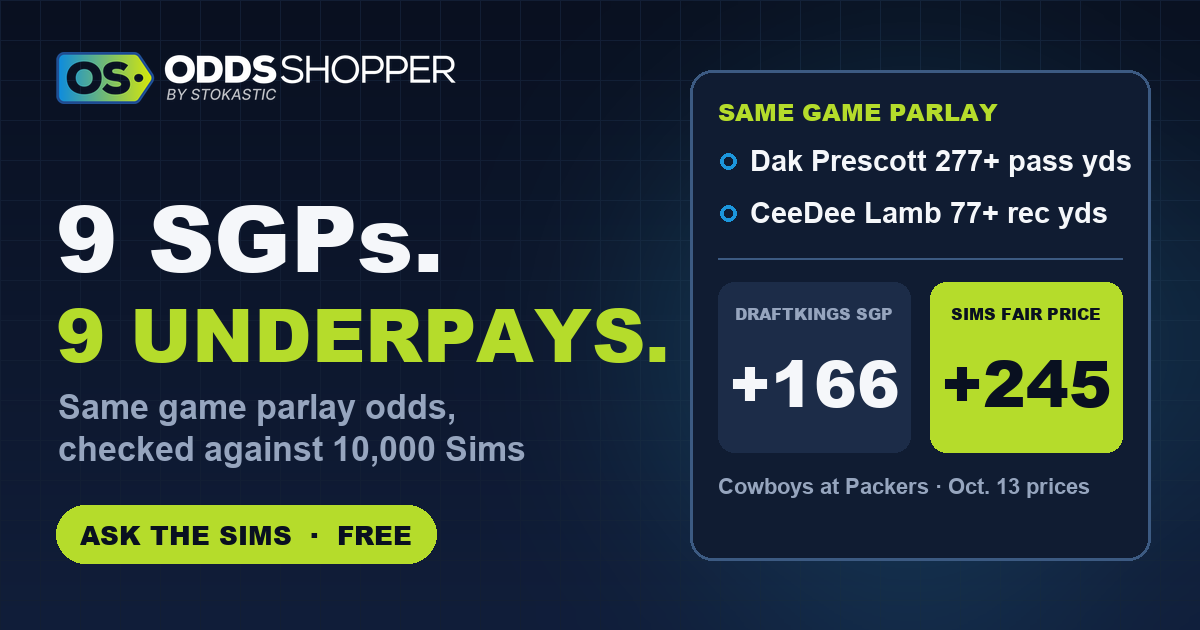
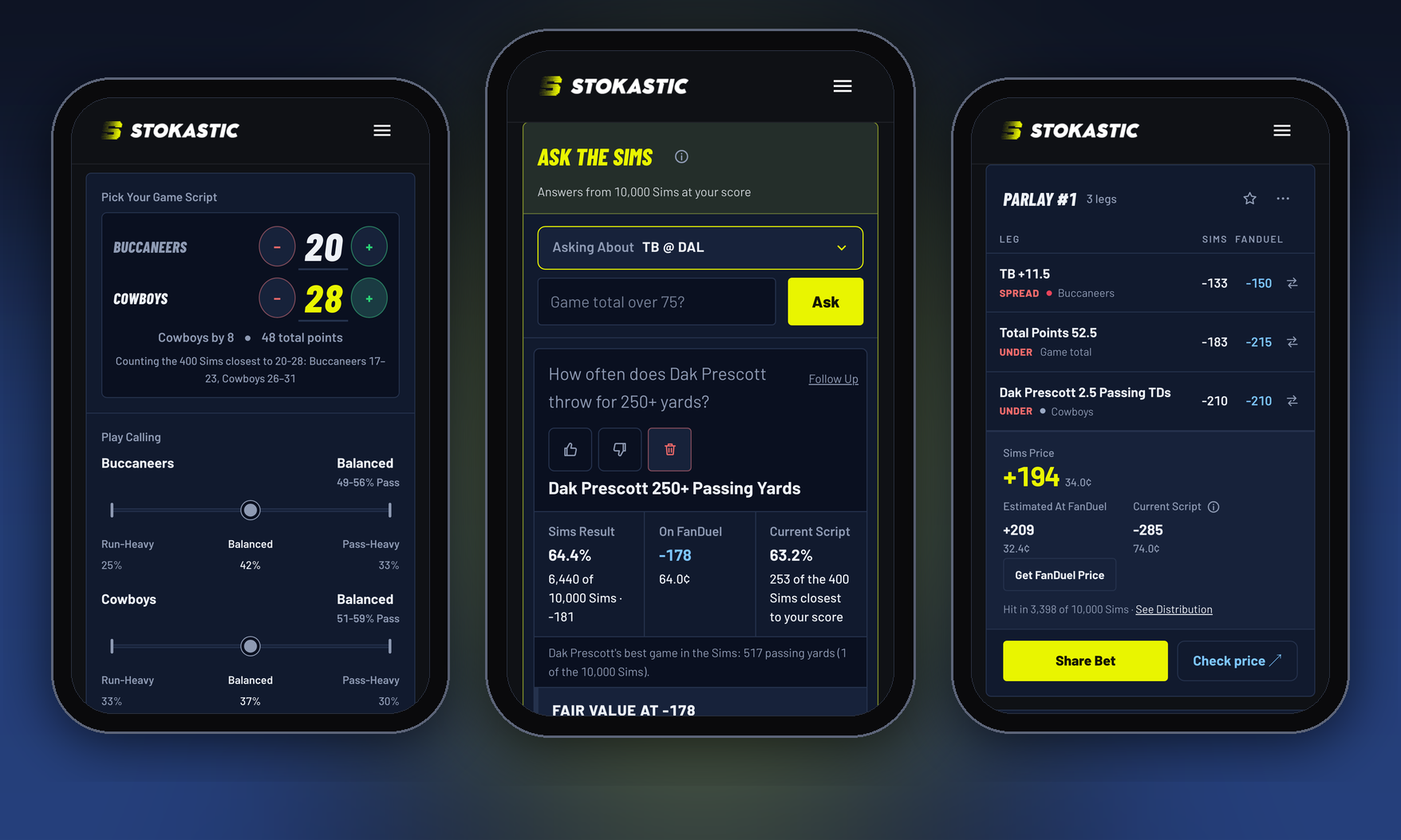 See what the parlay is worth before you place it. The FanDuel Parlay Simulator plays the game 10,000 times and prices any parlay you build next to the FanDuel odds, on your phone, free, no login.
In Summary
Firing your first NFL bet on FanDuel 🎁 takes about two taps, and that is the whole point: the app is engineered to make betting football effortless, and effortless is the house's advantage. Every tap FanDuel makes frictionless is a tap toward a number you never checked. This guide covers the part that actually matters for a beginner: the three core NFL markets (the point spread, the moneyline, and the total), how to read the prices attached to them, how the Same Game Parlay and teaser that FanDuel pushes so hard really work, where touchdown props and live betting fit, and which promos carry real value. There is one number that quietly decides whether you finish the season up or down, and it is not a final score. That number is the price you take. Getting the best available price on every bet is what OddsShopper does for you, and it is where this guide ends up.
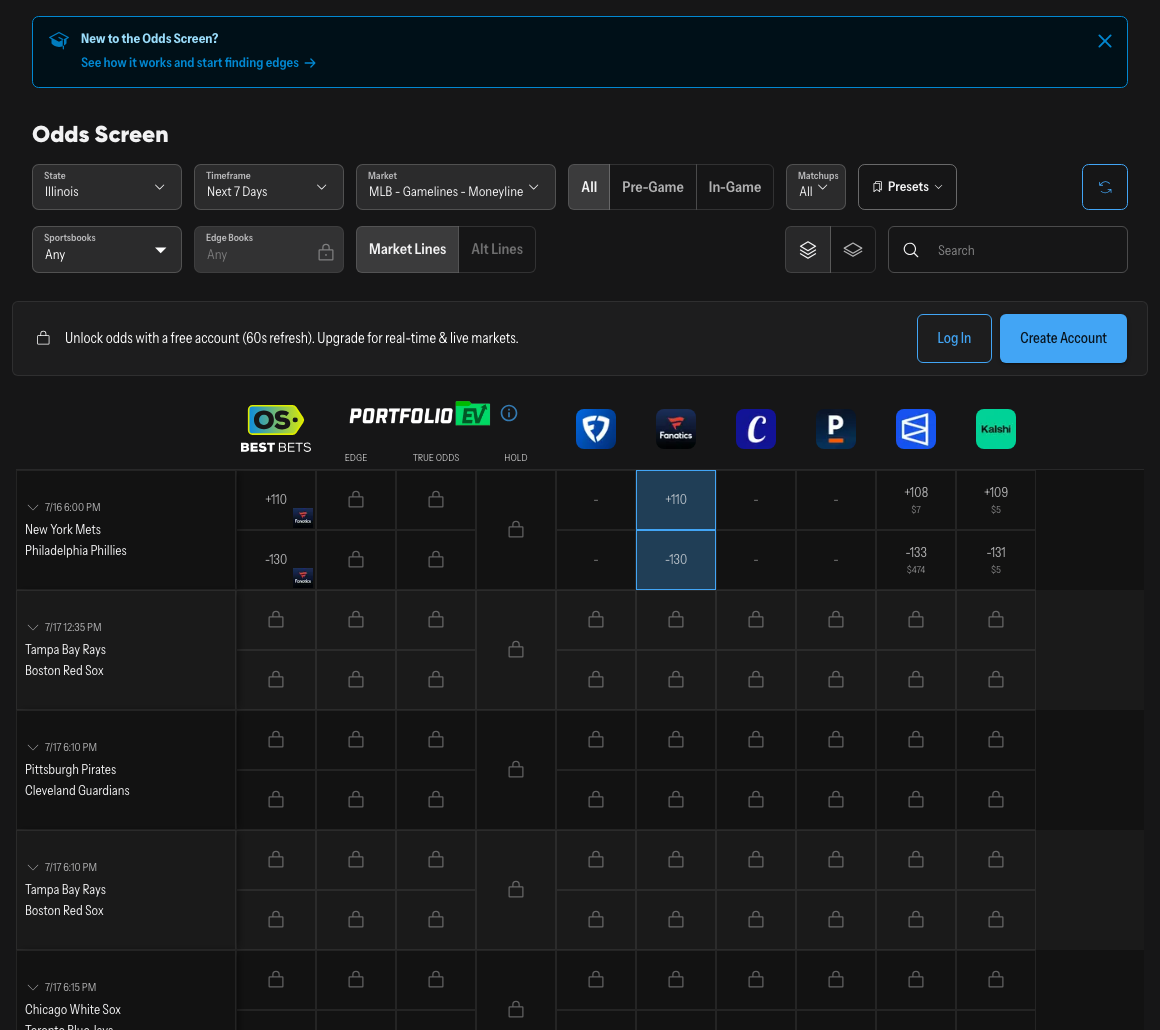 The OddsShopper live odds screen — every book's price on one board, refreshed in real time. Open the live board.
Betting a Kalshi combo on this game?run the combo through 10,000 sims before you buy it: 10,000 simulated games price every combo next to the price on Kalshi.
Getting Started On FanDuel: The Sign-Up, The Geo-Check, And The Layout
Signing up and depositing takes a couple of minutes. Tap Join Now, enter the routine account details, and fund the account. If you already have a FanDuel Fantasy or FanDuel Casino login, in most states it carries straight over to the sportsbook on the same account, so plenty of NFL bettors are already halfway signed up without realizing it. The one step that surprises new bettors is the location check: FanDuel asks you to allow a geo-tracker before your first wager. Do not let it spook you. Every legal U.S. sportsbook requires one, and it is not watching your life. It only confirms you are physically in a state where betting is legal, because the regulator requires the book to verify that.
FanDuel may offer eligible new accounts a welcome bonus after a qualifying deposit and first bet, but the exact amount and structure change by state and by the time of year, so read the current terms on FanDuel's own site rather than trusting a figure you saw quoted somewhere. A welcome offer is a small head start on your bankroll, not a reason to bet markets you do not understand.
Before you bet a dollar, learn the layout. A handful of tabs do almost all the work:
- Home is your hub for every sport, the day's promos, and the featured NFL games.
- Live is where you bet a game already underway, in-play.
- My Bets holds every wager you have placed: open, upcoming, and settled.
- Promos is the tab most beginners skip, and it is worth a look every day. FanDuel posts new profit boosts, bonus-bet offers, and No Sweat promotions constantly, and some days there is good value sitting there.
One FanDuel-specific thing to know before you tap into a game: its Same Game Parlay builder sits right inside every NFL game page, not in a separate menu, which is half the reason it is so easy to talk yourself into one. We will come back to that. Checking the promos daily also matters more than it looks, and why becomes clear once you can tell a good boost from a bad one.
The Three Core NFL Markets: Spread, Moneyline, And Total
Open the NFL tab and you will see every game line for the upcoming week, often the week after too. Tap into a single game, say a Sunday matchup between the Kansas City Chiefs and the Buffalo Bills, and a wall of numbers appears. Almost all of it reduces to three markets.
| Market | What you are betting | How it works on an NFL game |
|---|---|---|
| Point Spread | A team to cover a margin | The favorite must win by more than the spread; the underdog can lose by less than it or win outright. |
| Moneyline | A team to win, straight up | Just pick the winner. The price sets the payout. |
| Total | Combined points, over or under | Bet whether both teams' points land over or under a posted number. |
The point spread is the one to understand first, because it is where most NFL money goes. The book sets a margin to level an uneven matchup so you can bet either side without picking the outright winner. Say the Chiefs are -2.5 and the Bills are +2.5. Laying the Chiefs at -2.5 means they must win by 3 or more to cover. Taking the Bills at +2.5 means they cover by losing by 2 or fewer, or winning outright.
That half-point on the end of the number is the hook, and it does one useful job: it makes a tie impossible. A spread on a whole number can push. Picture the Chiefs at -3 instead. Win by 4 and you cash. Win by exactly 3 and the bet pushes: it is voided and your stake comes straight back. That whole-number push is not a rounding detail in football; it sits right on top of the sport's most common margin, which is the next thing worth knowing.
The total is the most straightforward market. You are betting the combined score to go over or under a posted number. With a Chiefs-Bills total of 48.5, the over needs 49 or more, the under wins on 48 or fewer, and a 30-20 final (50 points) is an over no matter how it was scored. The moneyline is just the winner with no margin attached, but the price is where beginners trip, so it earns its own example.
A Worked Example: Reading A FanDuel NFL Price
Numbers are easier with a real one in front of you. Say FanDuel lists the Chiefs at -140 on the moneyline and the Bills at +118.
- Chiefs -140. The minus sign marks the favorite. The number is what you stake to win $100, so -140 means betting $140 to win $100. Push a favorite to -300 and you would risk $300 to win $100; the more negative the number, the more you lay for the same return.
- Bills +118. The plus sign marks the underdog. The number is what a $100 stake wins, so $100 returns $118 in profit if they pull the upset.
That is the entire language of American odds. You never have to bet exactly $100; the price just expresses the rate. Spreads and totals carry a price too, usually near -110 a side. That extra dime is the book's cut, the vig: price both sides of a market at -110 and the two together carry roughly a 5% hold, which is why you have to win a bit more than half your spread bets just to break even. The same margin hides inside a moneyline. A -140 favorite implies about a 58% chance and a +118 underdog about 46%, and adding those two clears 100%. That overage is the hold again, the book's built-in margin, and stripping it back out (de-vigging the market to its no-vig price) is how you find what a bet is truly worth. If turning odds into probability still feels fuzzy, our how to read betting odds guide walks the math step by step. Remember the Bills at +118; that exact price comes back at the end for a reason.
Key Numbers: Why 3 And 7 Rule NFL Spreads
Football is not scored in ones. Points come in 3s (field goals) and 7s (touchdowns), so final margins pile up on those numbers far more than any others. 3 is the single most common margin, 7 is next, with 6, 10, and 14 close behind. This is the one NFL-specific idea a spread bettor cannot skip, because it changes which half-points are worth chasing.
The practical rule: a half-point only matters when it moves you across a key number. Going from +2.5 to +3 is enormous, because it takes you across the most common margin in the sport. Going from +4.5 to +5 barely moves the needle, since almost no games land on 5. FanDuel will happily sell you the extra half-point as an alternate line, but paying up for one that does not cross 3 or 7 is money handed back.
The half-point rulebuy a point only when it crosses 3 or 7, and only when the juice is cheap (a 10-cent move, say from -110 to -120). A half-point that does not cross a key number is the alt line the book most wants you to buy.
The NFL key numbers guide breaks down exactly which points to buy and which to leave alone. Hold onto the key numbers, because they are the engine behind the smartest thing FanDuel lets a beginner do: the teaser.
Same Game Parlays, Parlays, And Teasers
FanDuel is the book that popularized the Same Game Parlay, and its NFL menu is built around it. All three of these combine bets, and they reward you very differently.
A parlay ties two or more separate bets into one wager for a bigger payout. Each pick is a leg, and every leg has to hit or the whole ticket loses. Miss one leg of a five-leg parlay and the other four are worthless. The math is not a mystery: a parlay multiplies the odds of its legs together, so chaining bets that are each priced against you compounds the disadvantage. Use one only when every leg is a bet you would happily place on its own.
A Same Game Parlay (SGP) combines multiple bets from a single game, say the Chiefs moneyline plus their quarterback's passing-yards prop plus a receiver's reception total, into one ticket at longer odds. FanDuel promotes it the hardest, which tells you something: the legs are correlated, that correlation is priced into the payout in the book's favor, and the extra hold stacks up. There is even a Same Game Parlay+, which parlays several SGPs across games together, and that is murky water for a beginner. SGPs are fun; treat them as entertainment money, not the core of your card. The same game parlay strategy guide covers the rare spots where one is actually worth it.
Of those three combined-bet types, the teaser is the tool that turns key numbers into an edge, and it is the one I keep coming back to for a new bettor. A teaser lets you move the spread or total in your favor across each leg in exchange for a smaller payout. NFL teasers usually shift the line 6, 6.5, or 7 points. Two rules keep you out of trouble.
| If You Tease... | The move that helps | Why it works |
|---|---|---|
| A Small Underdog | +1.5 up through +3 and +7 | Clears the two most common NFL margins |
| A Modest Favorite | -8.5 down through -7 and -3 | Buys back off the same key numbers |
| Anything Across 0 | Avoid teasing through zero | You surrender most of the points' value |
Read that middle row again, because it is the whole idea in one line: a 7-point teaser that drops a -8.5 favorite to -1.5 crosses both 7 and 3, which are the two numbers you just learned NFL games land on most. That is not a coincidence you stumbled into; it is the reason experienced bettors tease NFL spreads through the keys and never touch totals. One honest caveat: FanDuel and the other books long ago raised the juice on 6-point teasers, often to -120 or worse, so a key-number teaser only pays when the price has not already swallowed the edge. It faces the same +EV test as every other bet in this guide. For the full playbook, see NFL teaser betting.
Start small.If you are new, skip the alternate lines, the long parlays, and the Same Game Parlays until the standard spread, total, and moneyline feel automatic. The fancy stuff is more fun to lose on than to learn on.
Touchdown Scorers And Player Props
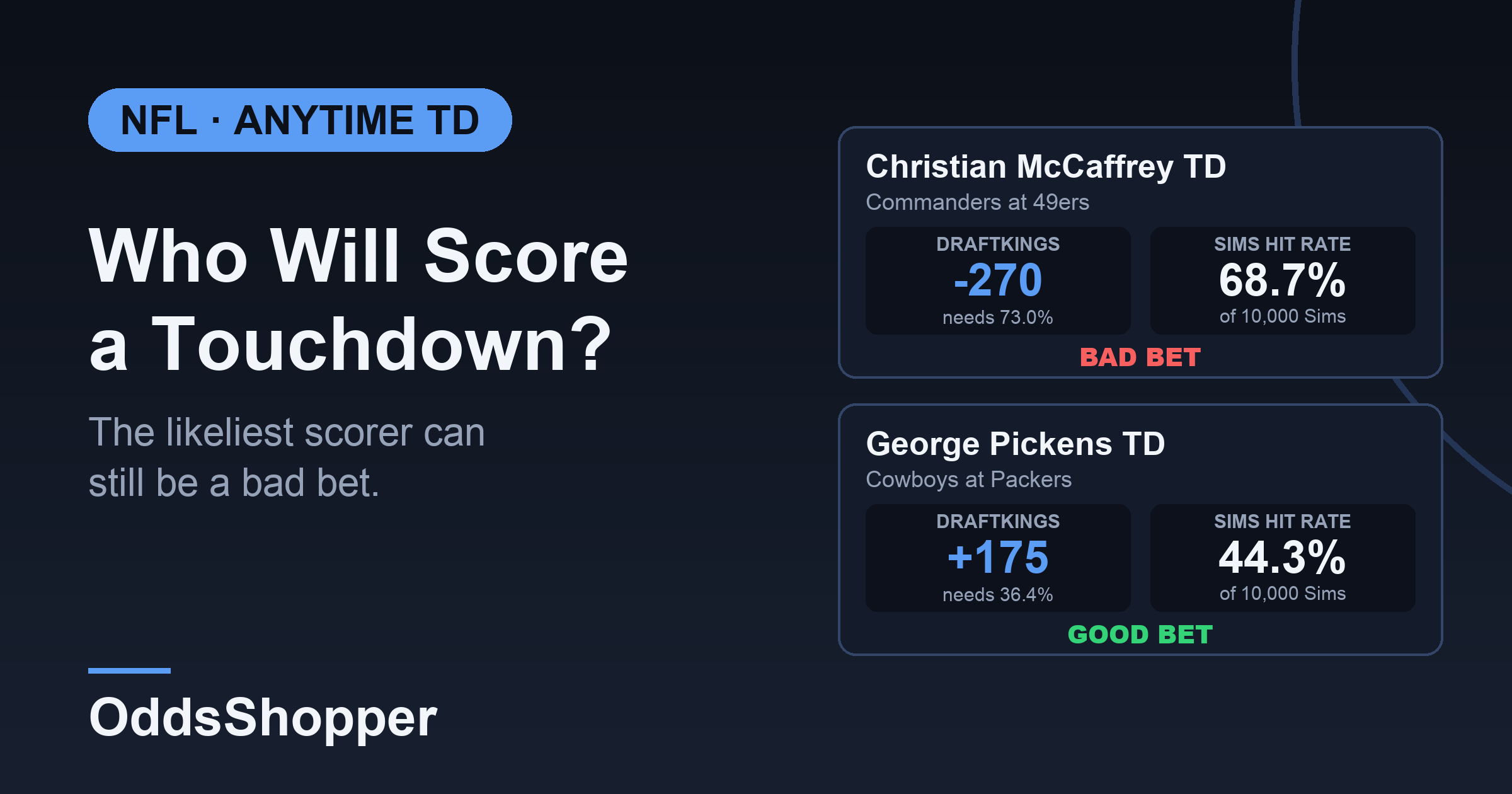
Tap the game itself and FanDuel opens a much deeper menu, and football has its own signature market: who reaches the end zone. You can bet a player to score the first, the last, or anytime touchdown. The anytime line is the friendliest starting point; first and last prices run far longer because they are much harder to hit. Just know what settles it: an anytime touchdown counts a rushing or receiving score only, so a quarterback's passing touchdowns do not credit him, they credit the receiver. See NFL anytime touchdown props for the settlement quirks.
Beyond touchdowns, FanDuel's NFL props run deep: passing yards, rushing and receiving lines, receptions, and defensive markets. Props behave like small totals, but the odds swing hard from bet to bet, so price discipline matters even more here than on the game lines. One angle a lot of sharp bettors like: a dual-threat quarterback's rushing-yards prop is a market casual bettors tend to ignore, and the line is often posted low relative to how often those quarterbacks actually run. The NFL player props guide maps every market and how to read it.
Live (In-Play) NFL Betting
The Live tab lets you bet a game already in progress, and football suits it well. FanDuel runs its live NFL markets alongside a play-by-play game tracker and even lets you build a live Same Game Parlay as the game unfolds. One gotcha to know first: between plays the book briefly suspends a market and can re-price it, so a live number you tapped can come back a beat later at a slightly different price to accept. Prices update constantly as the score, field position, and time remaining shift. Two natural spots: a favorite falls behind early and you think it bounces back, so you grab it live at a longer price than it opened; or a game is racing past its total in the first half and you doubt the pace holds, so you take the live under. The rule does not change in-game. A live price is only good if it beats the true odds of what is left to happen, which is the same test every other bet in this guide has to pass.
FanDuel Promos: No Sweat Bets, Bonus Bets, And Boosts
FanDuel runs a heavy promo calendar, and some of it carries genuine value:
- No Sweat Bets. A No Sweat offer refunds your stake as bonus bets if the wager loses, on a bet you were placing anyway. That refund tilts the real return in your favor, so these are among the better promos to use, provided you read how the bonus bets pay back.
- Profit Boosts And Odds Boosts. A profit boost raises how much you win on a specific bet; an odds boost sweetens the price on a game, player, or sport. Both add value, but neither makes a bad bet good. The only question that matters is whether the boosted price beats the true odds. A big boost can flip a marginal play into a real one; a small one will not rescue a bad number. Run the math first. Our odds boosts strategy guide shows how to tell the difference.
- Bonus Bets. These stretch furthest on longer-priced or +EV plays, not when they are burned on a heavy chalk favorite.
Worth rememberinga promo or boost is added value, not a sure thing. The bettors who get the most out of FanDuel's promo tab are the ones who apply each offer to a bet that already clears a fair price.
Shop The Number: The One Habit That Decides Your Season
Here is the number promised up top, the one that quietly decides whether you finish ahead. It is not a score; it is the price. Every NFL bet on FanDuel has a true price, the fair number a sharp market would set. FanDuel posts its line around that, and so does every other book, and they rarely agree to the penny. When FanDuel is offering a worse price than the rest of the market, you are handing back money on a bet you would make anyway. I do not place an NFL bet until I have seen its price across books, because it is the cheapest edge in betting and the one most people skip.
Remember the Bills at +118 from the worked example. Picture that same Bills moneyline sitting at +126 at another regulated book at the same moment. Identical wager, better payout: a $100 bet wins $126 in profit instead of $118. Take the worse one and you have donated the difference for nothing. Across a full NFL season, with a card every week, that quietly compounds into real money left on the table. Shopping for the best number is also how you build closing line value (CLV), which is getting a price better than where the line settles at kickoff, not just better than the book next door. CLV is the closest thing betting has to a scoreboard: beat the closing number consistently and you are betting well, whatever any single Sunday says. The bettor who wins the same game on the worse number is the bettor you never want to be.
This is exactly what OddsShopper does for you. Its line shopping feed scans 100-plus regulated sportsbooks and, for any NFL bet, the tool surfaces which book has the best number and how that price stacks up against the true, market-implied odds. The Portfolio EV view estimates whether a bet is +EV, priced in your favor, before you ever place it, and the Odds Boost Evaluator tells you whether a FanDuel boost actually clears +EV or just looks like it does. Pull up the NFL live odds screen and you can see the spread, moneyline, and total for every game lined up book by book, or start from our real-time NFL odds hub.
New to OddsShopper?It scans 100-plus sportsbooks in seconds and flags the NFL bets priced in your favor, so you can confirm FanDuel is giving you a fair number before you bet, and find a better one when it is not. Try it free for 7 days, and code NFLFD20 takes 20% off OS Pro or OS Core if you subscribe.
The One Thing To Remember
FanDuel makes betting the NFL easy, and easy is exactly what should make you slow down. The app is built to move you from an idea to a placed bet in seconds, and the faster that happens, the less likely you checked whether the price was any good. So read the spread and the total, not just the moneyline. Respect 3 and 7 when you buy a point or build a teaser. Treat Same Game Parlays as entertainment, mind the price on every prop, and use the No Sweat and boost offers on bets you already like rather than as a reason to fire. Then size to your bankroll instead of your confidence, which is its own skill worth learning from our bankroll management guide. Above all, shop every number against the market so you know whether a bet is +EV before you place it. For the broader football fundamentals, start with our how to bet on NFL guide, and if you also bet the other big app, our how to bet NFL on DraftKings walkthrough covers the same ground there. It is 21+ and legal only where regulated, so bet responsibly; if gambling stops being fun, call or text 1-800-GAMBLER.
Frequently Asked Questions
How do I bet NFL on FanDuel as a beginner? Open the app, tap an NFL game, and read the three core markets: the point spread (the favorite must win by more than the number, the underdog covers by losing by less or winning), the moneyline (just pick the winner, the price sets the payout), and the total (over or under the combined points). Add a side to your bet slip, check the price and shop the number against other books, then set your stake and place it. Mind the odds on every bet before you confirm.
What does the point spread mean in NFL betting on FanDuel? The spread is a margin the book sets to even out a mismatch. If a team is -2.5, they must win by 3 or more to cover; their opponent at +2.5 covers by losing by 2 or fewer or winning outright. On a whole-number spread, if the favorite wins by exactly that number it is a push and your stake is returned, which is why the half-point hook matters so much in football.
How do I read FanDuel NFL odds? A minus number is what you stake to win $100 (a -140 favorite means $140 to win $100). A plus number is what a $100 stake wins you (a +118 underdog means $100 wins $118). Totals and spreads use the same scale and usually sit near -110, while props swing more, so always check the price, not just the side.
What is a Same Game Parlay on FanDuel, and is it worth it? A Same Game Parlay combines multiple bets from one game into a single ticket at longer odds. FanDuel popularized the market and promotes it heavily, but the correlation between the legs is priced into the payout in the book's favor, so most SGPs are negative expected value by design. They are entertainment money, not the core of a smart card.
Are FanDuel odds boosts worth it for the NFL? Sometimes. A boost adds value, but it does not automatically make a bet good, and the bet does not have to be good already. What matters is whether the boosted price beats the true odds. A large boost can turn a marginal bet into a play, while a small one will not save a bad number, so run any boost through an odds boost evaluator before you take it.
*Betting the NFL well comes down to the prices you take, and that is the easy part to outsource. OddsShopper compares the major regulated books, surfaces the best number on any football bet, and rates whether it grades as +EV against an estimated fair price, with an Odds Boost Evaluator to judge whether a FanDuel boost is worth taking. Try it free for 7 days; code NFLFD20 is 20% off OS Pro or OS Core after that.
More on this: Kalshi Vs FanDuel NFL: Who Pays More On $100, Every Game · NFL Win Totals 2026: Kalshi Vs DraftKings Vs FanDuel · NFL MVP Odds: Who The Market Backs In Week 1 · NFL Preseason Event Contracts, Explained In 60 Seconds · Don't Bet NFL Preseason Totals Before Reading This